Eternal Twilight at the New Museum

July 21st, 2008

_alloracalzadilla_.jpg

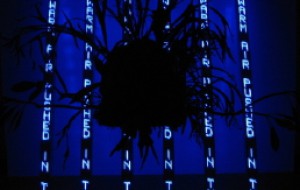
Several Art21 artists temporarily engage in a moment of symbiosis in the New Museum’s new group exhibition, After Nature, curated by Massimiliano Gioni with the assistance of Jarrett Gregory and Chris Wiley. The work of the Puerto Rico-based collaborative team Allora & Calzadilla (Jennifer Allora and Guillermo Calzadilla) (Season 4) often explores hybrid relationships and global politics. Their installation, Growth (Survival), 2006, presented in After Nature, pairs an existing work by Jenny Holzer (Season 4), Yellow Corner, 2002 with a Staghorn Fern (a plant native to such places as Southeast Asia and Australia, among other tropical locales). The work actually exists in two forms using the aforementioned work or with Holzer’s Blue Wall Tilt, 2004. The installation at the New Museum is placed in a darkly lit corner so the plant is exposed to virtually no other light besides the somber glow of the yellow LED screens of Holzer’s sculpture.

In his catalogue essay, Gioni describes the exhibition as “a land of wilderness and ruins that exists in an imaginary time zone suspended between a remote past and a not-so-distant future.” It’s impossible to hear this statement without recalling Rod Sterling’s hauntingly apocalyptic introduction to the 1960s television show The Twilight Zone: “There is a fifth dimension, beyond that which is known to man. It is a dimension as vast as space and as timeless as infinity. It is the middle ground between light and shadow, between science and superstition, and it lies between the pit of man’s fears and the summit of his knowledge. This is the dimension of imagination. It is an area which we call the Twilight Zone.” Gioni’s curatorial premise, not to mention Allora & Calzadilla’s installation, seems to take this notion to heart, reminding humankind that new systems of sustainability are inevitable on a planet that has been irrevocably altered by the careless endeavors of its inhabitants and also suggests that earth’s only hope for survival may be found within the unpredictable landscape of the mind.

SIDE X SIDE

July 17th, 2008

sweet_oblivion.jpg

Art and activism have been intimately engaged throughout contemporary art history, reiterating the notion that the personal is political. In 2007, Art:21’s Season 4 addressed activist strategies (in particular, the politics of war) in “Protest,” which included Jenny Holzer, Alfredo Jaar, An-My Lê, and Nancy Spero. A new investigation of art and activism (in this case, the AIDS crisis) can currently be seen in SIDE X SIDE, an exhibition curated by Dean Daderko for Visual AIDS on view through August 3, 2008 at La MaMa La Galleria in the East Village.

With works from the 1980s to the present by Scott Burton, Kate Huh, Nicholas Moufarrege, Martin Wong, and Carrie Yamaoka, Daderko’s project is rooted in the history of the 1980s in New York City where more than 10,000 people were diagnosed with AIDS in 1986. Between 1986 and 1991 there were numerous exhibitions, conferences, and artworks about AIDS in New York, while activist groups such as ACT UP (AIDS Coalition to Unleash Power) and Visual AIDS worked to educate the public and insist on medical research and treatment. Art21 artist Oliver Herring (Season 3) has also made works related to AIDS, in particular A Flower for Ethyl Eichelberger (1991) a tribute to the performance artist who committed suicide in 1990 after discovering that he had AIDS.

One of the most noted exhibitions about the politics of AIDS was Witnesses: Against Our Vanishing (a 1989 review of the show can be found in the New York Times on-line) organized by artist Nan Goldin at Artists Space in 1989. The show highlighted a group of artists living in the lower east side of Manhattan who were directly affected by AIDS. Daderko’s project is a sobering reminder of this history as well as a tribute to those who have been lost to this vicious disease. Further details and upcoming events related to SIDE X SIDE can be found on the Visual AIDS website.

Socially Acceptable

July 15th, 2008

salivesalve.jpg

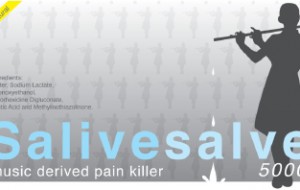
My biggest pet peeve in New York City is watching men (and women) of all walks of life, hack and cough, then swiftly discharge a slimy wad of saliva on the sidewalk as passersby narrowly attempt to avoid its path. Despite my repulsion for this most sordid act, saliva is the product of Ana Prvacki’s innovative performance at the Sydney Biennale this year in which she produced gallons of saliva through a solemn flute solo. The bodily fluid—known for its medicinal properties—is then used as a healing salve. Though her actual saliva cannot legally be used, Prvacki has worked with a chemist to create wet wipes infused with her music-derived painkiller that were distributed at her performance at Sydney’s Museum of Contemporary Art in June. The event was reviewed in the The Sydney Morning Herald and images of her performance can be seen on the 2008 Sydney Biennale website.

I’ve been thinking a lot about Prvacki’s performance in view of the upcoming exhibition, theanyspacewhatever, at the Guggenheim Museum, New York, organized by Chief Curator Nancy Spector, which will open this fall. The show addresses artists whose conceptual and social practices in the 1990s are frequently defined by the term “relational aesthetics,” a phrase coined by Nicolas Bourriaud in his collection of essays by the same name (originally published in France in 1998). Art: 21 artist Pierre Huyghe (Season 4) as well as Angela Bulloch, Maurizio Cattelan, Liam Gillick, Dominique Gonzalez-Forester, Douglas Gordon, Carsten Höller, Jorge Pardo, Philippe Parreno, and Rirkrit Tiravanija are included in the forthcoming exhibition. Though I am eager to see how this ambitious project is executed, I can’t help but question the institutionalization of such practices. Aren’t they inherently in opposition to such institutions? And where do artists like Lygia Clark, Jeremy Deller, William Pope L., and Ana Prvacki fit into this dialogue?