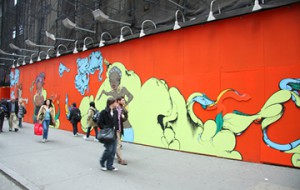
“That’s Not Us”
Do artists from underrepresented demographic groups have a responsibility to represent their ethnicity in a positive light? This is not a new question, in fact, it seems to re-enter the national conversation every time a minority artist ventures to create a provocative image. This question has recently reemerged in response to Sofia Maldonado’s mural installed near Times Square. As reported on CNN, the local Fox affiliate, the New York Times and several popular blogs, Maldonado’s work has come under fire because some viewers find her representation of the women of color in her mural—scantily clad with long acrylic fingernails—inappropriate. Furthermore, as reported by Jezebel, a feminist blog, at least one minority group, New York City Black Professionals, condemns the mural noting that, “this is not even about the Latina artist [Maldonado is of Puerto-Rican and Cuban descent] or her expression of how she sees NY; she was only painting what they [the Times Square Alliance] commissioned her to do in order to get her paycheck…and the end result was a slap in the face of every woman of black and brown descent.”
This question of “responsible” representation is not unique to the visual arts. Over the years, African-American rappers, such as Ice-T and DMX, have been lambasted for their hyper-masculine, misogynistic lyrics. Stephenie Meyer, the author of the wildly successful Twilight series, has been roundly criticized by feminist scholars for creating a heroine, Bella, who is devoid of all personality and lives only for her boyfriend.
The problem with this question is that it aims to reduce artistic expression into a Manichean dichotomy of good and bad, acceptable and offensive. The very supposition of responsibility removes the essential subjectivity from the creation and viewing of art. An African-American woman in the Fox 5 News piece on Maldonado’s mural condemns the work because, “that’s not who we are.” Maldonado would agree. In all of the statements she has given about her mural, she has never presented her work as representative of all women of color. Her most widely quoted statement makes this clear; Maldonado wrote on her blog that her mural “illustrates strong New York City women as a tribute to the Caribbean experience in America. Inspired by my heritage, it illustrates a female aesthetic that is not usually represented in media or fashion advertising in Times Square.” Maldonado’s mural depicts a segment of the Caribbean-American population. It may be a segment that some viewers would consider “ghetto,” as another person interviewed by Fox put it, but it is not a segment ever intended to represent the entire ethnic group.
So why this confusion? Why do some viewers of subjective, specific pieces like Maldonado’s have this immediate, offended reaction? As African-American blogger Keysha Whitacker explained, people of color are concerned that “good white folks” will see “our shame.” She further admonishes people of color to stop trying to “manage” how they are viewed by other racial groups.