Spaceship Earth

June 27th, 2008

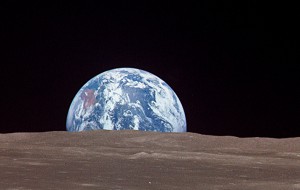
NASA Earthrise

Buckminster Fuller was one of the most inventive and prolific visionaries of 20th century who was keenly intuitive. Much of the work in the new Whitney exhibition, Buckminster Fuller: Starting with Universe, is on display for the first time. “We are not going to be able to operate our Spaceship Earth successfully for much longer unless we see it as a whole spaceship and our fate as common. It has to be everybody or nobody.”

2001: A Space Odyssey (1968), the science fiction classic, was created at the pinnacle of the Apollo space exploration project beginning with manned Earth orbiting missions and reaching its plateau with landing on the moon on July 20, 1969. The Hal 9000 computer gave us a preview into how computers would one day dominate our lives.

In Is Google Making Us Stupid? Nicolas Carr makes several references to Hal: “… the implacable astronaut Dave Bowman, in a famous and weirdly poignant scene toward the end of Stanley Kubrick’s 2001, is calmly and coldly disconnecting the memory circuits that control its artificial brain. ‘Dave, my mind is going,’ HAL says forlornly. ‘I can feel it. I can feel it.’” Reading about Carr’s experience and how Internet searching and surfing has affected his thinking process and focus level, I realize that I am not the only one.

Are we becoming more aware of the hybridization of human and machine even though our minds are numbing by the plethora of information? As Internet has shifted our reading habits, how is it influencing the way we perceive art? Do we spend as much time contemplating works of art as we did in the past?

Depth and form are perceived in the visionary light creations of James Turrell (Season 1). His Roden Crater Project acts as a giant naked eye enabling viewers to see the sky as a dome and to feel the roundness of Earth. This is an experience similar to what Fuller experiences, “The earth is revolving to obscure the sun. The sun is not going down. I want you to really feel this with me. We’re rolling around to obscure the sun. We’re about to have a sunclipse: the earth is revolving around rapidly to obscure the sun. It’s perfectly easy to feel it, particularly if you face north and look over your left shoulder. Just watch! and you suddenly begin to feel this enormous earth revolving on its axis.”

Another visionary artist who is acutely aware of the environment is Roni Horn (Season 3). Her Vatnasafn/Library of Water replaces the solid with liquid as it engages the community to participate and to interact through a variety of activities. It is the epitome of relational art. An extensive collection of books on Fuller, Horn and Turrell are available for on site and take home use at the Art Collection of Mid-Manhattan Library.

At the 2005 Art Basel Miami Conversation, Hans Ulrich Obrist asked Robert Rauschenberg what advice he had for young artists and he replied, “Just nurture your curiosity and have respect for change. And I think the curiosity part will make life very exciting. It will also fight back habits like repeating oneself.”

Earthrise. NASA AS11-44-6548

Sound & Language

June 26th, 2008

Chess Set. Photo by Alan Light

The human voice is the most specific expression of an individual. With its infinite potential for sound effects and imitation along with its prime role in communication, it is clearly the most versatile and valuable instrument.

In 1939, Marian Anderson captivated an audience of 75,000 and millions of radio listeners during her Lincoln Memorial recital. Her response to weeks of debate fueled by the refusal of the Daughters of American Revolution to grant her a permit to perform at Constitution Hall was, “Music to me means so much, such beautiful things, and it seemed impossible that you could find people who would curb you, stop you, from doing a thing which is beautiful. I wasn’t trying to sway anybody into any movements… I just wanted to sing and share.”

Four years earlier in 1935, Melvin Tolson an English professor and poet inspired his students to organize Wiley College’s first debate team that moved on to face off Harvard University’s national champions. The Great Debaters is a dramatic depiction of the true story of Tolson, his life at Wiley, the people of Marshall and the four brilliant aspiring team members. The debate scenes are a testament to their consuming passion for language, education, and freedom.

The acclaimed writer, painter, and educator N. Scott Momaday said, “If I do not speak with care, my words are wasted. If I do not listen with care, words are lost.” Care for language, its look, meaning and sound is what we experience in the work of Jenny Holzer (Season 4). Also Laurie Anderson (Season 1) gives a multimedia spin to the use of language in her spectacular storytelling performances. In Writing on the Wall: Word and Image in Modern Art, Simon Morley has compiled the first comprehensive survey of the use of word in art from the past 140 years.

A completely different approach to sound is encountered in the sculptures of Martin Puryear (Season 2). We imagine and hear silent sound, especially in his Ladder for Booker T. Washington as it reaches the sky. On the other hand as Barack Obama is reaching closer to becoming the next president, we look forward to hearing his upcoming debates.

Chess Pieces. Photo by Alan Light

1968 | 2008

June 24th, 2008

China Haze. Provided by the SeaWiFS Project, NASA/Goddard Space Flight Center, and ORBIMAGE

This is not the first time that Summer Olympics Games are embroiled in environmental and political controversies. In 1968, Mexico City, with its high altitude containing 30% less oxygen than at sea level, proved to be a controversial choice. The lack of air led to terrible results for some, while others were able to achieve world records. Forty years later Beijing is faced with massive air pollution as it completes the preparations for the Olympics. The world renowned Ethiopian runner Haile Gebrselassie has opted out of running in the marathon noting “the pollution in China” as a threat to his health. It remains to be seen how the environmental pollution in China will affect the athletes and the Games’ results.China is also plagued with its outrageous treatment of Tibet, resulting in massive protests around the world. Protest was also seen in Mexico City during the medal ceremonies when the two Americans Tommie Smith and John Carlos “performed their Power to the People” salute. Peter Norman, the Australian silver medalist, wore an Olympic Project for Human Rights badge showing his support for Smith and Carlos.

Another athlete to cancel an Olympic Games participation was Bobby Fischer, one of the greatest chess players of all time, who passed away earlier this year. He had plans to play for the United States at the 1968 Chess Olympiad in Lugano, Switzerland and backed out when he saw the playing hall with its bad lighting.

As athletes were breaking records in 1968, artists were busy reshaping culture. Nancy Spero(Season 4) was working on her War Series (1966-70). Bruce Nauman (Season 1) produced his first video titled Pinch Neck. Romare Bearden, in addition to being involved in founding The Studio Museum in Harlem, also established Cinque Gallery with the help of Norman Lewis and Ernest Crichlow. Cinque provided support for younger minority artists.

1968 marked the passing of Marcel Duchamp and the coinage of “15 minutes of fame” when Andy Warhol stated “In the future, everyone will be world-famous for 15 minutes.” Frank Zappa released his first solo album Lumpy Gravy and performed King Kong with the Mothers of Invention at BBC Studio in London. Chou Wen-chung, who had studied with Edgard Varese, completed Nocturnal (1961-1968), an unfinished piece by Varese.

In his 1968 Nobel Lecture, Yasunari Kawabata explained, “The excitement of beauty calls forth strong fellow feelings, yearnings for companionship, and the word ‘comrade’ can be taken to mean ‘human being.’ The snow, the moon, the blossoms, words expressive of the seasons as they move one into another, include in the Japanese tradition the beauty of mountains and rivers and grasses and trees, of all the myriad manifestations of nature, of human feelings as well.”

How will 2008 be reminisced forty years from now? What will be the low and high points in our cultural and social achievements? Will 2008 be a critical year marking a pivotal change in the way we treat the environment and each other?

China Haze. Credit. Provided by the SeaWiFS Project, NASA/Goddard Space Flight Center, and ORBIMAGE

Museum

June 20th, 2008

Boys’ dormitory, Bennett Colle... Digital ID: 1218280. New York Public Library

The Negro Leagues Baseball Museum was established eighteen years ago in Kansas City, Missouri on 18th and Vine Streets, just around the corner from the Paseo YMCA building where the Negro National League was founded in 1920 by Andrew “Rube” Foster. The founding of the eight-team league was the direct result of a silent agreement to segregate African-American players from baseball. Jonathan Earle, Associate Professor of History at the University of Kansas, presents an extensive review of NLBM in a feature article titled In a League of Its Own: The Negro Leagues Baseball Museum in May/June 2008 issue of Museum. Several pictures and illustrations accompanying the article make the hard copy more informative and visually appealing than the electronic version. The expansion plans for NLBM will create a five-level structure complete with a gymnasium and an addition of 40,000 square feet, making the museum emerge as one of the most remarkable sport museums in the world.

The other interesting article in the same issue, titled Meet the New Boss: Opening the Door for Emerging Professionals, is a brief survey of the formation of new leadership in the museum field, and it introduces five new leaders who speak about their careers. Given the freedom and team support, this is an enormously fertile time for new leaders to grow and to make dramatic changes and improvements. Kathy Halbreich, Associate Director of MoMA, is a great advocate for open thinking and a huge source of inspiration to new museum professionals and artists. In her Museum interview, Making the Modern More Contemporary, by Robert Ayers, she reflects back on her experience as the director of the Walker Art Center and mentions the positive ripple effects of the close camaraderie and teamwork between the staff. During the April 14th “Artforum at The New School - Art and Money” panel discussion she expressed some of her thoughts on institutional traditions and the necessity for in-depth research to discover new approaches in art.

Another seasoned leader who also took up her new position in February 2008 is Sabine Folie, the Artistic and Managing Director of the Generali Foundation in Vienna, Austria. In her statement she also makes a reference to teamwork: “The time has now come for me and a highly committed team to resume work under the new premises and to continue to build a collection that constitutes a commitment to collecting far away from all criteria oriented by speculation or conforming to the market.”

Exemplary teamwork and nurturing leadership is what I also encountered during my recent collaboration with the staff of Art21. Witnessing the tremendous dedication and knowledge of contemporary art among the Art21 staff was an unprecedented experience for me. The extraordinary results of harmonious teamwork can also be seen in the work of the Art:21 Season 4 artists Mark Dion, Judy Pfaff, Catherine Sullivan and Ursula von Rydingsvard. It is apropos to conclude with an interview, featuring Art:21 Season 2 artist Raymond Pettibon, titled Gumby, Vavoom, & Baseball Players.

Jörg Heiser at Austrian Cultural Forum

June 16th, 2008

schorr-photo2-002.jpg

On Wednesday June 25th at 7:00 p.m., the Goethe-Institut New York and the Austrian Cultural Forum will co-host a conversation between Jörg Heiser and Brian Sholis, editor at Artforum.com. The event will begin with the presentation of Heiser’s new publication titled All of a Sudden Things that Matter in Contemporary Art. Earlier this year Heiser’s writing also appeared in another book, Romantic Conceptualism, featuring the work of Collier Schorr (Art:21 Season 2, Loss & Desire). The photographs of Schorr are also included in the exhibition, History Will Repeat Itself Strategies of Re-enactment in Contemporary Art, originally opening at KW Institute for Contemporary Art in Berlin and now traveling to Goethe-Institut Hong Kong. For those who might not have visited the ACF building on 11 East 52nd Street, take the virtual tour on the menu to see the intriguing double-height theater located on the 2nd and 3rd floors. This narrow and dynamic building, designed by the Austrian born architect Raimund Abraham, is a poignant reflection of romantic conceptualism. The seating is limited to 80 and reservations for this free event can be made at 212-439-8691.