Notes on a workshop (Part 2)

(continued from Part 1…)
My students and I had knocked on the door of the Éloignement office of the Préfecture in Nantes. The woman who answered asked us what we wanted and why we were there. My students said, “We came to learn about the Préfecture and to ask you what éloignement means.” After we established the understanding that it was indeed a strange situation for us to be asking her this question, she remarked that it was ironic that of all the offices in the Préfecture, we would be knocking on hers. She explained to us that she oversaw the deportation of migrants sans-papiers (undocumented immigrants). She was apprehensive when she opened the door because the people who come to her office are in the situation of imminent deportation or they are activists who come to protest on the immigrants’ behalf. She said that as a victim of aggression, she found her job sometimes stressful. However, she had worked in the same office for fifteen years and would stay on.
After leaving, the students and I talked about the exchange that took place. What was necessary for the conversation to have even happened was the establishment of rapport or mutual trust. However, one student noted that she didn’t feel comfortable identifying herself as an artist when talking with the woman. As artists are often associated with liberal political views, the woman might have questioned our motives for talking with her and been less forthcoming about what is admittedly a sensitive subject in France. However, this raised an ethical dilemma. Did it count as lying or withholding the truth for us not to tell her that we were artists? But we were not there to judge or condemn her. We arrived at her door due to our curiosity, and she had respected it by speaking with us.
The next week, we considered the question of documentation. Specifically, how does the presence of a camera affect an exchange between individuals? These days, people are often nervous in the presence of a camcorder because they are afraid of appearing on YouTube. Perhaps some exchanges can only take place off camera. In an earlier conversation, we had talked about the use of video by activists during protests to document instances of police brutality. One student expressed doubt about this kind of “speaking truth to power.” She explained that she had participated in a protest in which she and others were standing with linked arms with scarves tied under their eyes to hide their identities. In response, policemen pulled their scarves down and took photographs of each of their faces. Given the ubiquity of surveillance cameras mounted in public spaces, it is in some ways surprising that people are more nervous about cameras wielded by other ordinary citizens.
Documentation can take a number of forms, including photography, video, writing, and oral histories (recorded or told in passing conversations). We talked about what is gained and lost by allowing an experience to maintain its own integrity or by committing it to documentation. In both cases, the live moment of interaction can never be replaced (this can also be said of performance) but it is in the retelling or mediation of an experience that makes it possible to share it with others, and hopefully generate dialogue and other meanings.


We decided to test out these ideas by returning to the nearby university campus, this time with a video camcorder in hand. At the campus entrance gate, we saw a poster announcing an open debate between faculty and students regarding the government’s proposed reforms to higher education policy (which includes eliminating a financial program) and the decision of the majority of students and faculty to go on strike. Some of the students shot video footage and did some informal interviews with students and professors. Another student had a long conversation with a lab technician about his job and the relationship between art and science.
We were interested in pursuing the question of this relationship further. Last week, a friend of one of the students, who is currently studying physics at the university, gave us an introductory lesson on Einstein’s theory of relativity. We spoke about the relationship between conceptual art and physics in terms of using abstract models to represent invisible forces. And how perhaps Marcel Duchamp is the art historical equivalent of Albert Einstein.
In the workshop, we often start with identifying our common questions and concerns (artistic and social), and looking for ways to address them outside of the classroom, often with other people. Sometimes it’s a matter of being in the right place at the right time, and at other times, it’s a matter of responding spontaneously to the circumstances at hand. Now we’re trying to figure out together how to translate these experiences and observations into the gallery to share with an audience. We already know something will be lost in the white cube, but hopefully something will be gained as well.
Notes on a workshop (Part 1)

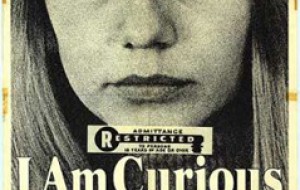
Vilgot Sjöman's "I Am Curious (Yellow)," (1967)
I’m also teaching a course at the École Régionale des Beaux-arts de Nantes called, “Workshop: I am curious… (The Artist as Ethnographer).” Each Friday morning, my students and I have made a regular practice of going to a place, talking with strangers, and asking questions. I’ve gathered a few notes on my research for the course, what we’ve done, and what we’ve discussed.
The title of the workshop is based on the films of Swedish director, Vilgot Sjöman, I Am Curious (Yellow) (1967) and I Am Curious (Blue) (1968), both documentaries-within-films. In the opening scenes of I Am Curious (Yellow), Lena surveys passersby, microphone in hand, asking the question, “Do you believe Sweden has a class system?” Later, we see the director and his camera crew filming the documentary, but it is Lena’s intense curious energy that drives the film.
Another source of inspiration for the course was Hal Foster’s essay, “The Artist as Ethnographer” [in The Return of the Real: Art and Theory at the End of the Century (October Books, 1996)]. I have the vague suspicion that we may actually be performing the faux alterity or “outsideness” that he criticizes in applications of pseudo-ethnographic models in contemporary art practice. But sometimes you have to do wrong before you learn how to do right.
Artist Harrell Fletcher wrote a text called “Some Thoughts About Art and Education” (2007) based on his artistic practice and experience as a teacher. His observations about experiential education, the classroom environment, project research, and going on field trips, have influenced the way I approach teaching. For example, he writes:
Collective Learning
I teach at Portland State University in Portland, Oregon, and I have a class currently where we started by having all of the students tell their life stories to everyone else. It took three classes to get through them all, but they revealed many interesting things that wouldn’t come out in more cursory introductions. Based on connections the students had we organized a series of field trips to places like a Veterans hospital, an alternative kindergarten, a campus fraternity, a high school geometry class, a Native American community center, a radio station, etc. From those experiences the students broke off into groups to develop projects like a radio show about grandmothers, and a lecture series in the frat house living room. Some of the field trips didn’t develop into projects, but were still valued as experiences. I like to think of this method as a way to lessen my role as the authority in the classroom and instead we share that role and all become collective learners.
On the first day of the workshop, I asked the students to tell me about their experience of the city of Nantes and the art school. They said that despite the school’s location in the heart of the town center, they felt isolated both from the public of Nantes as well as students from other universities. In France, college students typically focus on their area of study exclusively (e.g. law, biology, history) and that often determines their social circle.
Motivated by our conversation, we took a fieldtrip to the campus of the nearby Université de Nantes Faculté de Sciences et Techniques, the science and technical campus of the University of Nantes. One of the students said that they felt like tourists. By making the place “strange,” we were self-conscious of our role as outside observers. We noted that most of the students and faculty were walking briskly in the opposite direction as us, heading to the tramway for their lunch break.
One of the students became the de facto interviewer based on her outgoing personality and ease with approaching strangers. We approached a few young men hanging out by the entrance of the Resto Universitaire (cafeteria), who turned out to be students from the local lycée (high school) who come to the college campus to eat because they have trouble finding seats in their own cafeteria. We learned more about the university culture from a biology student and a mathematics student who were also waiting for the cafeteria to open. It was a modest exchange, but a step in the right direction.
On representations of the artist at work (Part 2)

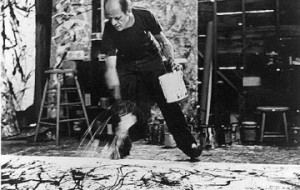
Jackson Pollock at work in his studio, photographed by Hans Namuth, 1950.
Following up our discussion about documentation of the creative process in the cases of Mark Bradford and Jackson Pollock, my students and I talked about what we might include in an Art21-style documentary about the artist at work* based upon our own experiences and observations. In the interest of presenting a more representative picture of the artist at work in the 21st century, we brainstormed a list of scenes and topics that included:
Working at a day job
Many (if not most) artists need to find day jobs to support their art practice. This goes for both young artists who are just starting out as well as artists who are actively showing their work. Unlike in most professions, artists do not receive a regular salary or wage for their creative labor. An artist’s day job may or may not relate specifically to his or her artistic interests. These jobs may include: working as a studio assistant to a more established artist, museum administrator, teacher/professor/educational staff, gallery receptionist, retail associate, bartender, and freelance gigs (to name a few).
Art school
We talked about some of the (sometimes intangible) lessons and skills that we learn in art school. One is the importance of being part of an artistic community of peers, collaborators, and mentors. Another is discourse, or learning how to talk about art. This is a skill developed in both group critique settings and faculty reviews. Group critique is a process by which an artwork’s meaning is generated through collective conversation and debate. It is also a process of judgment and consensus. It is difficult to say whether art school prepares students for a career, a way of life, and/or a way of thinking. But upon graduating from art school, a common concern among young (American) artists is the need to pay off their student loans for tuition debt incurred during their artistic training.
Career trajectories
Artists are usually chosen to be featured in a documentary when they have achieved a measure of success and recognition in their careers. They have been included in major exhibitions, collections, and commissions. Their work has been written about in influential publications, and it has attained a level of maturity and context. However, besides focusing on this select group of artists, a documentary series could also represent artists at different points in their careers to show the highs, lows, and plateaus in the life of a working artist. This would include artists who are just starting out, artists who have had long careers without wide recognition, as well as individuals who have stopped pursuing careers in art for various reasons, or are doing interesting things that may not be called art.
On representations of the artist at work
In the Art:21 Season 4 episode Paradox, artist Mark Bradford cites the legacy of Abstract Expressionism as an influence on his process-oriented paintings and collages. On a formal level, Bradford’s paintings share AbEx’s treatment of surface as an anti-illusionistic field of play and action. But in watching the video segments of Bradford at work in his studio, especially when working on pieces on the floor, I was struck by similarities to Hans Namuth’s documentary, Jackson Pollock 51 (1951), which is perhaps the most famous documentary of an artist at work. Namuth’s photographs of Pollock painting in his studio appeared in LIFE magazine in 1950, after which the artist became an instant sensation and celebrity. In his oft-repeated mythology, Pollock was traumatized by the public exposure of his working process and became paranoid that his celebrity persona overshadowed his actual paintings. His alcoholism deepened and he died in a drunk driving accident at the peak of his career.
In April 2007, the Chelsea College of Art and Design in London held a symposium entitled, “Did Hans Namuth Kill Jackson Pollock? The Problem of Documenting the Creative Process.” The following is from their press release:
When Hans Namuth and Jackson Pollock finished filming on the Saturday before Thanksgiving in 1950, they walked inside from the barn, out of the cold. Pollock walked over to the sink, reached down, pulled out a bottle of whiskey and said to Namuth, “This is the first drink I’ve had in two years. Dammit, we need it!” The rest, as they say, is history.
— Jeffrey Potter, To a Violent Grave, 1985Embedded in this brief account is the very real problem of how the creative process can be documented. Does documenting art ‘kill’ it? Arguably, the film assured Pollock his place in history, but can the archive deal with living process? If it is not possible to make a document that doesn’t impinge in some way on the creative process, can it tell us much about how creativity happens? How do we interpret and understand such documents? Does knowing about an artwork’s evolution spoil our relationship with that work?
More recently, artists have collaborated to make documents of their thinking and making, so is the Pollock anecdote simply not relevant today? Can contemporary artists use documentation creatively, as an integral part of their process? How have new technologies impacted on this documentation of process? And what role do conservators and archivists play in documenting the creative processes?
While I don’t believe that documenting a work of art ‘kills’ it, I do question whether a behind-the-scenes documentary demystifies the artistic process or in fact adds another layer to the mythology of artistic genius.
My students and I discussed the Mark Bradford Paradox episode and the excerpt of Jackson Pollock 51. We observed the similarities in the documentaries and the manner in which they construct a representation of the artist at work:
- We see the artist’s studio and working environment.
- The artist narrates his biographical origins of family and place. He also recounts his experience and influences as a student of art, which establishes his place within an art historical and pedagogical lineage.
- The artist is the primary narrator of his own practice; the director and interviewer are off camera.
- We witness the physical process of making an artwork. For example, we see the artists’ hands manipulating materials and close-up shots of the artworks’ surfaces.
The questions I posed to the students were: “Is there anything missing from this portrait of the artist at work?” and “If you were to make an Art:21 segment, what would it include?”
What transpired was a conversation about the realities of working as (young) contemporary artists—the mundane matters that both support and undermine the creative process.
(to be continued in my next post…)
Authenticity 2.0

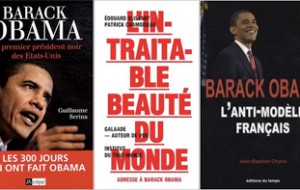
A few recently-published French titles about the rise of Barack Obama (from left to right): "Barack Obama: Le premier president noir des Etats-Unis" by Guillaume Serina; "L’intraitable beauté du monde. Adresse à Barack Obama" by Édouard Glissant and Patrick Chamoiseau; and "Barack Obama: L’anti-modele français" by Jean-Baptiste Onana.
At the École des Beaux-Arts de Nantes (Nantes School of Art), I am teaching a course called “Contemporary Art in the United States, 2000-Today.” The premise of the course is to give students an introduction to recent American contemporary art while also giving them an opportunity to practice their English. While we will consider art made during “the Bush years” (2000-2008), I am also interested in the notion of “today” as a moving target.
The first week of the course coincided with l’investiture (inauguration) de Barack Obama. If there was Obama fever in Nantes during the week of the Inauguration, it was subdued. My French friends and colleagues shared their impressions with me, which ranged from joy…to envy…to apathy…to skepticism about the hype…and finally, to doubt as to whether France would ever elect a black president. In France under President Nicolas Sarkozy, like in the U.S. under Bush, citizens have become deflated, prone to anger, and weary of the government’s lack of response to public complaint.
In class, we watched the first several minutes of Barack Obama’s inaugural address. I invited the class to consider Obama’s address as a work of performance and spectacle. Our conversation centered on the symbolic trappings of the inaugural ceremony. First, there was the issue of the canon firing, which the students found inexplicably silly. They questioned why the inauguration would employ such an anachronistic weapon. For example, why don’t the aesthetics of the inauguration change to reflect contemporary sensibilities? The canons alluded to military salutes from the time of the nation’s founding in the late 18th century. Perhaps it was the sheer anachronism of these symbols that situated Obama in the lineage of American history on Inauguration Day (and was a reminder that some of our first Presidents were slave owners).
The students also took note of the many American flags on display, both on the National Mall and waved by the cheering audience. They explained that in today’s France, to prominently display the French flag is a gesture towards nationalism and the FN (National Front) political party. The FN, led by Jean-Marie Le Pen, promotes an anti-immigrant and racist nationalist agenda and opposes France’s participation in the European Union. The younger generation doesn’t associate with the flag as a symbol of French identity.
Also, unlike the American flag, the French flag’s origins are not explicitly linked to the nation’s independence and founding. In fact, how could a single modern flag represent a history that accounts for Gaulic tribal occupation, Roman rule, monarchical succession and overthrow, and numerous revolutionary governments? The notion of historical “change” in France could be said to be more cyclical than linear in nature. As the saying goes, the more things change, the more they stay the same.