Letter From London: Protest Too Much

September 29th, 2008

hooters-protest2.jpg

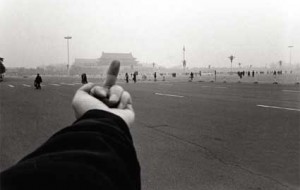
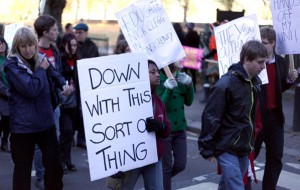
Whichever candidate succeeds this November, there will be a discernible effect in art. The last eight years have seen a resurgence of politically motivated art comparable to that produced during and after the Vietnam War. Characterizing the nature of art made now is, of course, a quixotic and thankless task. Contemporary art is far too multifarious and globally produced, experienced, and consumed to be bracketed into an “ism.” However, an art born of outrage revitalizing art’s shock tactics has emerged within the last few years, and may be seeing its twilight in the run up to a new administration.

Political outrage can blast the subtlety out of artmaking, and not all attempts to articulate it have been successful. Too often, real events throw artists’ discontent into stark relief. Thomas Hirschhorn’s Superficial Engagement at Barbara Gladstone in 2005, nail-studded, gnarly, and startling, looked mute and minor in relation to the Abu Ghraib revelations.  A new show of work by veteran minimalist and performance artist Robert Morris at Spruth Magers in London has a pre-emptively archaic look to it: all inverted American flags, big black eagles, and screaming skulls in relief: theatrical, even camp in its outrage.

However, some works have addressed contemporary history with a lucidity and thoughtfulness that has asserted the importance of art as a forum for non-mainstream discussion. Mark Wallinger’s State Britain installation at Tate Britain was a rare example of a poised and poetic response to the curtailing of civil liberties that have taken place during the Iraq war, and is one of a number of more oblique responses to contemporary events that drag the discussion into the realm of art without compromising their efficacy as works of art (Alfredo Jaar’s and An-My Lê’s works operate on similar levels). And Maypole (Take No Prisoners) (2007), by fellow Protest artist Nancy Spero, might be this generation’s Guernica: a howl of pain and anger distilled into a direct visual language that feeds into a historical continuum of the human cost of war—the visual articulation of horrified disbelief. Graphically simple paintings on paper of human heads–screeching, wailing, vomiting–radiate suspended from blood-red threads around a maypole, conflating historical circularity (the pole itself recalls the grotesque folk ritual dramatised in The Wicker Man), the theatrics of warfare, and raw human emotion.

The example of Spero is, in fact, instructive; the best political art has always been able to be comprehended in mass-media contexts. It’s significant that Goya’s Third of May and Gericault’s Raft of the Medusa–both produced on the cusp of the mass-distribution period that produced Guernica, a painting that replicates the striations of newsprint–retain their visual currency in political cartoons. Conversely, successful photographic icons of wartime have a pictorial quality that links them to the heritage of painted protest. Staged propaganda photographs from the American Civil War and photographs of atrocities from Abu Ghraib share a compositional quality that taps into a subconscious compositional sympathy (Art21 guest blogger Emily Liebert has written succinctly and fascinatingly on the role of photography in wartime here).

The revival of protest in painting has re-engaged the connection between painted mark and emotional intensity muffled by the generation of post-Richter distanced photorealists. Increasing mistrust of mainstream media coverage and the euphemistic language of contemporary conflict may turn out to be art’s gain; we may return to it as the basic language of human understanding and communication. Whether or not that continues to be the case will, in part, depend upon what takes place in six weeks’ time.

Letter from London: Art During Wartime

September 23rd, 2008

noli-titian1.jpg

All the talk around the potential sale of two of the most important paintings in British collections (Titian’s Diana and Actaeon and Diana and Callisto) has generated more interest than usual in the public value of works of art, or the distinction, at least, between value and worth. That this debate is happening against the backdrop of crumbling financial institutions on the one hand and astronomical flashing of cash on the other makes the discussion all the more important now, underscoring the need for patient re-evaluation of art and its importance to the wider world.

With that in mind, a smaller Titian painting in the National Gallery, Noli me Tangere, has been drawing me back more and more in recent months. Titian was about 19 when he painted this; it’s small enough to be intended for private worship, and to be drowned out in proximity to larger and more celebrated Titians in its room (like this one). Against a backdrop of tumbling hills, farm buildings, scattered sheep and a rich melancholy Venetian sunset, Mary Magdalene reaches towards the recently-resurrected Christ. She’s just realized who he is and what’s happened, and tries to touch him; he bends away (his bent body, like an open parenthesis, imitated by the bend of the tree above), to demonstrate the need to focus on the spiritual rather than earthly, the soul and not the body. What seems to happen is that shape–a curve leaning away from a vertical, like a sprung bow–echoes across the shapes of the painting, like a chorus.

As a meditation on the nature of mortality, the painting is exemplary and that poignancy opened up its second life, during World War II, when the Blitz was ravaging the city (there are still ragged craters—bomb damage—on the sides of Tate Britain and the Victoria and Albert Museum). The National Gallery’s emergency plan was to ship its paintings to the Welsh countryside (contingency plans like this had been actioned by all the major institutions: the Parthenon Frieze spent most of the forties in the dank gloom of a disused tunnel in Aldwych tube station), where they sat in slate mines, gradually brought back one by one to the gallery. The first to return was Noli me Tangere, due to vociferous pressure from the public documented in newspapers of the time. A letter written to the London Times in January 1942 explained, “Because London’s face is scarred and bruised these days, we need more than ever to see beautiful things.”

So for the first month–with the exception of a small display of contemporary paintings–Noli me Tangere was the only painting in the National Gallery. For Londoners under constant threat of extinction from above, this small High Renaissance painting, produced as a display of virtuosity and ingenuity by a young artist on the make in the aristocratic circles of early 16th century Venice, contained an idea of transcendence that collapsed historical time and lived again at that moment. It might be worth reminding ourselves, especially now, that that’s what art is supposed to do.

Letter from London: Hirst Among Equals

September 15th, 2008

golden-calf-21.jpg

Art gets into the national news in the UK in four ways. One: a publically funded institution decides to purchase something of apparent worthlessness (a ‘pile of bricks,’ a can of poo) with taxpayers’ money. Two: privately owned works of art on public display are put up for sale and the public is asked to help ‘save’ them through a national appeal. Three: the international auction price for a work of art reaches unprecedentedly astronomical heights. And now there’s a fourth: an artist decides to sidestep the gallery system altogether and sell new works directly at an auction house, leaving the dealers by the wayside.

Damien Hirst’s sale (titled ‘Beautiful Inside My Head Forever,’ like an exhibition), which takes place at Sotheby’s in London on Monday and Tuesday evening, is either the death-knell for the gallery system or a predictably unorthodox approach from an artist whose work is so unrepresentative of most contemporary art that it demands its own particular form of critical language. Hirst’s supporters reach for the Old Testament when defending his work, which is appropriate for an artist whose work makes apparently unironic reference to biblical parable (imagine discussing Tomma Abts or Kara Walker or even Matthew Barney in a similar way and you can see the point). The Golden Calf, the centerpiece of his Sotheby’s display, is practically an illustration of Aaron’s sacrilegious statue cast from the molten jewelery of the Israelites. Hirst’s work is more or less what it sounds like: a whole calf pickled in formaldehyde with golden hooves, horns, and a gold disc lodged in its forehead in a gold-plated vitrine atop a Carrara marble plinth. If that sounds like a prop from a Queen backstage party in the late 70s, it’s appropriate: ever since his diamond-studded skull (For The Love of God) and its accompanying security frenzy, Hirst has embraced the grandiloquent pretensions of his loyal supporters, the oligarchs and hedge-funders who are the only people not squeezed out of the bidding by his extraordinary price-tags (the relative paucity of significant Hirsts in public collections is testament to that). The appeal is obvious: you get what you pay for. Gold and diamonds equal expensive, death and mortality equal important themes, big art equals good art. Hirst’s prices have a perverse logic that would appeal to the dulled wits of the 19th century French salon who held that paintings of classical heroism and tragedy must be more important than still-lifes because they’re, like, big pictures about big stuff.

Hirst is still the (British) public’s go-to guy for the definition of modern art: a bit shocking, a bit gruesome, easy to describe in a few words (‘shark in a tank’ – try doing that with Martin Puryear), high-concept and high-gloss. For good or bad, he makes art of our time: iconic works that withstand the buffetings of international communication, able to retain their power across all information streams. Hirst’s art lives in the head as much as in the gallery, and for art to do that, at this moment in history, is an achievement in itself. And while his inverse snobbery is absurd and ill-founded (selling works at prices inaccessible to any museum’s acquisitions budget isn’t exactly sticking it to the man, however radical the implications of the sale), it’s true that Hirst is a genuinely popular and (in the best possible way) populist artist whose works are comprehensible to a far wider public than that of most of his contemporaries. Don’t get what the shark is about? Read the title: The Physical Impossibility of Death in the Mind of Someone Living. (This is not Untitled Number 243).  The hope is that Hirst will become a gateway drug for viewers hankering after something more reflective and substantial (Paul ThekSol LeWittJoseph Beuys, or any number of other artists to whom Hirst owes a substantial debt). The fear is that most of his best work (and there is more than a handful) will be invisible to the public and turn into a series of one-liners from a bygone past, signifiers of mad wealth without a life beyond the funny pages.

Letter from London: Lackluster Blockbuster

September 8th, 2008

yinka-shonibare1.jpg

Assuming they couldn’t speak our language, read our minds, develop a communicable form of sign language, or were made out of gas, a good way for aliens to gauge the cultural habits of human beings would be to observe seasonal cinematic behavior. In summer, when the sun beats down, eggs fry on the pavement, etc, many of us sit inside large air-conditioned rooms to watch robots stomp around crushing things. In winter, when the snow falls down the back of your shirt, making a reservoir at the base of your spine, many human beings sit inside small air-conditioned rooms to watch European people have affairs with each other.

In the art world, the opposite happens. After a summer of somewhat low-key gallery and museum shows, the two Tates are going for a Dark Knight/Hellboy 2 -style double-header in the form of Francis Bacon and Mark Rothko retrospectives (at Tate Britain and Tate Modern respectively).  The Hayward Gallery is showing a huge exhibition of Andy Warhol’s video and television work (Sex and the City, perhaps), whereas the Serpentine has Gerhard Richter’s new grids of monochrome squares (Hancock, definitely). Museums obviously rely on the blockbuster format to cover less populist exhibition programming and to keep themselves in the cultural spotlight, but recently there has been an interesting move away from the bums-on-seats approach of some institutions that may usher in a new period of museum identity.

The National Gallery’s new director Nicholas Penny has made it clear that his tenure will be marked by an avoidance of blockbuster exhibitions in favour of an emphasis on the permanent collection and a more connoisseurial and risk-taking exhibitions program. Those who elbowed their way through the recent Velazquez and Titian exhibitions with the insecty whisper of audio-guides ringing in their ears will be glad to hear it. Any attempt to encourage the one-time visitor to appreciate the permanent collection (something many museums fail to emphasize) and to remind infrequent gallery-goers that the experience of art can be an enjoyably relaxed and meditative one, not time-bound by staggered entry or a box to tick on the social calendar, is to be applauded. The gallery’s current exhibition is a case in point: the Italian Divisionists, an Italian translation of Georges Seurat’s Neo-Impressionism, and a jumping-off point for the better-known Futurists (few of the artists are well-known outside of Italy, and when Boccioni appears in the final room it’s as startling as seeing your elderly aunt in the Big Brother house).

Whether or not Penny’s move will prove influential remains to be seen; what is important is the shift of value his ideas suggest, proposing a resolution to the identity crisis that seems to have dogged museums in recent years, going all Hulk when Bruce Banner will do.

Pop (and) Art

May 30th, 2008

Salvador Dali and Alice Cooper

The relationship between fine art and pop music is characterised most often by a specific historical period in Europe and America, the mid-sixties, which is probably the closest point there has been or will be between the two disciplines. Like its relationship with cinema, art was never completely comfortable with pop music, all smiles in public but laughing behind its back when the coast was clear. In reality, Warhol’s peelable banana on the first Velvet Underground record had little or no relation, aesthetically, to the music it contained. Double Elvis has more to do with Barnett Newman than The King. Maybe that’s partly to do with the unbridgeable gap between them: a still point of time versus three unfolding minutes; in market terms, coy flirtation (at most) versus out-and-out capitulation. In pop music, the commercial imperative has produced some of the greatest masterpieces of twentieth-century culture; in art, selling out retains its weird taboo. I imagine Rirkrit Tiravanija lost a few fans by designing a Gap t-shirt; pop music is so bound into commercialism that no-one bats an eye when Keith Richards poses for Louis Vuitton.

It’s usually implied, as befits Western cultural hierarchy, that art borrows from popular culture — that it redeems it, even — as part of a post-Duchampian mindset that lends the artist a kind of alchemical magic touch. Base matter becomes gold. But it’s when pop music returns the favour, taking art as its inspiration, that stranger and more interesting things happen. The Modern Lovers’ Pablo Picasso, David Bowie’s Andy Warhol, Lou Reed and John Cale’s Songs for Drella album — it’s often when art is transmitted by other means that you end up returning to it, refreshed. Who wouldn’t love Van Gogh after hearing Jonathan Richman’s Vincent Van Gogh: “He loved, he loved life so bad/His paintings had twice the colour other paintings had”?

Picture: Salvador Dali (standing) and Alice Cooper (sitting)

Pre-Teen Wolf

May 28th, 2008

Gallery Education at its very best.

I spent last Sunday morning at the National Gallery with a large group of very small children in front of Sassetta’s early Renaissance painting of St Francis and the Wolf of Gubbio. Magic Carpet storytelling at the National Gallery is an enormously popular weekend activity; as the name implies, a large and magical carpet is rolled out in front of a chosen painting and an educator tells a story directly or indirectly related to the subject of the painting.

While inciting the group into a collective fist-thumping on the carpet (to simulate the wolf’s nocturnal scampering around the walls of the city), it occurred to me to consider the differences in using representational and abstract art within a gallery education context. Working with the modern and contemporary art collection at the Museum of Modern Art, New York, it became clear to me that the freedom with which children were able to engage with works of art was appropriate to the openness of the works themselves. Very young children, in particular, responded with ease and enthusiasm to many works that teenagers found more challenging. Art made out of splashes and drips to them was the very definition of art in any case. Interpreting its relation to the real world was occasionally a matter of somewhat impatient explanation (”that’s a fox, obviously“).

The National Gallery collection, however, which spans about 700 years of Western European painting, is entirely concerned with representational narrative work, to which children respond in very different ways. As an educator, it can be challenging to encourage children to think creatively about evidently devotional or didactic works of art, especially those of the early Renaissance. There remains in both cases a desire on the educator’s part to facilitate a measured response to a work that respects an object’s historical context and apparent intention.

As difficult as these things are to assess, I suspect that most educators would see their role as enabling children and teenagers to gain both comfort and confidence in approaching art from any period, which necessarily involves directing them towards appropriate responses via observation and conversation. To what extent, though, are interpretations ‘guided’ by educators - and is this their role? I’d love to hear other educators’ experiences of working with art of all periods and the challenges involved.

Best Supporting Artists

May 23rd, 2008

Kirk Douglas as Vincent Van Gogh in “Lust for Life” (1956)

Artists in films tend to act as shorthand for oversensitive loners, just as lawyers in films are shorthand for unscrupulous money-grubbers and people with British accents are shorthand for oleaginous bad guys. Jeffrey Wright as Basquiat, Ed Harris as Pollock, Salma Hayek as Kahlo, Kirk Douglas as Van Gogh: each presents the artist’s work as an inevitable byproduct of a life lived at maximum intensity.

Actors seem to enjoy playing artists because it’s the stuff of Oscars: lots of shouty scenes, gruff sex, and jittery tics. (It may also be because of an insecurity about the validity of their own status as artists: making artists behave like actors has, in its own way, a kind of symbiotic effect). “Vincent!” bellows Anthony Quinn. “Paul!” yelps Kirk Douglas, embracing him like it’s 1888. The best is Anthony Hopkins’ Picasso (Surviving Picasso), who capers around like a high camp sex dwarf.

Is it that the idea of being an artist is so alien to everyday experience that it can only be expressed through an actorly language reserved for reclusive mathematicians, effete eccentrics and serial killers? Perhaps this is too harsh. The truth is that the process of making art is often not very exciting to watch. Even Pollock, whose hoary myth would suggest some sort of high-kicking John Wayne, comes across like your boring uncle at Christmas in Hans Namuth’s 1950 film, painstakingly describing his technique with all the panache of Ben Affleck reading the ingredients on a packet of dried plums. Maybe what’s needed is a greater willingness to go completely off-script, acknowledge that the artistic process of necessity involves lots of sitting around, and go hog wild. Better yet, go Wild Hogs: how about John Travolta as Cy Twombly? Martin Lawrence as Martin Puryear? Tim Allen as Jasper Johns? Suggestions welcome.

Bacon: Whoopee

May 21st, 2008

Lucian Freud, “Benefits Supervisor Sleeping”, 1995. Courtesy Getty Images.

Roman Abramovich, the partially-bearded Russian owner of Chelsea Football Club (AKA ‘Chelski’), and 16th-richest person in the world (according to Forbes), was this week reportedly the purchaser of two paintings by significant British painters. Lucian Freud’s Benefits Supervisor Sleeping and Francis Bacon’s Triptych (1976) sold at auction in New York for a collective total of around $120 million.

Meanwhile, it emerged that the model for Freud’s vast canvas of a overweight woman reclining on a bulging couch, Sue Tilley, was paid about £20 ($38) a day to pose. While it’s tempting (and very high school maths exam) to work out how long she’d have to pose to be able to afford the painting she was posing for, it’s perhaps more interesting to consider the always-baffling disparity between an object and its value.

Freud’s painterly insistence on the quiddity of his subject - the lunar impasto of paint on the bulge of Tilley’s stomach, the layers of tone gradually ‘becoming’ flesh - is predicated on the idea that paintings are in their essence traces of elapsing time, time that (here) directly corresponds to a financial transaction. The thought that each brushstroke translates into a before-and-after set of specific values is weirdly giddying, like comparing the price on the menu and the price on the bill.

(Artist) Frays Book

May 20th, 2008

Cai Guo-Qiang, “Danger Book: Suicide Fireworks”, flammable and adhesive substances and gunpowder, 2008. Courtesy Ivory Press.

The Victoria and Albert Museum’s latest exhibition, Blood on Paper: The Art of The Book, showcases book-based work by a wealth of modern and contemporary artists, including Cai Guo-Qiang and Richard Tuttle (Season 3) and Louise Bourgeois (Season 1).

Since the book form implies a beginning, middle and end, it’s always been a popular form for artists looking to meddle with heads, from Max Ernst’s superlative The Hundred Headless Woman onwards. The exhibition traces a significant transformation in the definition of the artist’s book: from a kind of freeform improvisation on textual illustration (Matisse’s Jazz, Sol LeWitt’s take on Borges’ Ficciones) to an artwork taking the form of a book as its conceptual jumping-off point (Dieter Roth and Richard Hamilton’s Inter Faces and Richard Tuttle’s NotThePoint). The connotations of books as cornerstones of religious doctrine are underscored by Damien Hirst’s New Religion, a huge, plinth-mounted mixed-media sculpture in the form of a shelved Bible, set off by a display of Francis Bacon’s much-pored-over ephemera, battered Muybridge photos and snaggly Polaroids, displayed in glass like the fingerbones of a saint.

The most fun is to be had in the illumination artists’ work can cast on a canonical text; Balthus replays Wuthering Heights as a pas de deux of feral adolesence; Paula Rego turns Jane Eyre into a mad psychodrama of Gothic puppetry. Serialism found an easy home in the book form, with Ed Ruscha’s deadpan series of swimming pools and gas stations repeated on every page of a pocketsize book, insouciance itself. Meanwhile, the pages of Cai Guo-Qiang’s Danger Books, charred with the spidery remainders of fireworks, indicate the book as a site of explosive excitement, and anyone who’s ever been 7 will probably agree.

Turner: New Leaf?

May 20th, 2008

cartoon_homeless.jpg

The announcement of the shortlist for this year’s Turner Prize has coincided neatly with a short-lived heatwave in the UK that sent Londoners leaping out of their winter clothes to bask grimly on any available patches of unshaded ground. Notwithstanding the capricious British weather, these two incidents tend to run together; the Turner Prize has long entered the national consciousness as a summer season space-filler, dependably absurd and apparently easy to describe in a breezy article next to some breasts. The fact that the YBAs made (some still do) art of a graphic bluntness that made their work translatable in the punchy prose of the tabloids (Shark in a Tank! Unmade Bed! Cow in a Tank! Lights Going On And Off! etc) is of a piece with the now sometimes embarrassing ballsy nationalism of the late 1990s, which reached its nadir, in a classic example of her inverse Midas touch, with Madonna stepping in and swearing live on TV, British art’s very own ‘Mission Accomplished’ moment.

The media exposure, though, did at least mean that contemporary art was, for perhaps the first time, a regular staple on letters pages, editorials and gossip pages, a position which has arguably had an effect on artistic practice itself (see the gradual domination of Banksy). The latest Turner Prize line-up, though, is largely in line with current vogues in contemporary art: cautious, careful arrangements of found objects with a fairly disturbing suggestiveness; quiet, contemplative, somewhat minimalist video; tongue-in-cheek allusions to modernist art history and popular culture; post-Hans Haacke blurring of curatorial and artistic boundaries. None of which has resulted in much of a fuss. Even the usually dependable Daily Mirror has struggled to find much to get upset about, not generally being known as Haacke purists.

Is this a sign of the growing acceptance of contemporary art by the broader public? Or are artists retreating from engaging with the language of popular taste?