Urban Homestead

October 9th, 2009
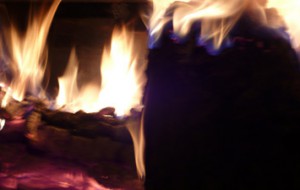
Wood on the stove at Urban Homestead, 2009. Courtesy Nance Klehm.

Wood on the stove at Urban Homestead, 2009. Courtesy Nance Klehm.

Urban Homestead is a residency run out of Chicago-based ecologist Nance Klehm’s home. Residents stay with Nance for various periods of time and help keep the home running. This includes working in its huge yard garden, herding quail, and helping compost among other things. According to the website, Urban Homestead “is a residence that is open to working travelers and out-of-towners for stays of a few days to a few weeks and sometimes a few months. It fills the niche of people who find themselves in Chicago perhaps working on art or research or cultural connections who want to live in an urban immigrant neighborhood in a house that has an ecological emphasis.”

Nance invited two past residents to answer my questions with her. The first is Peter Olsen, enrolled at the Jutland Art Academy in Arhus, Denmark and currently on a self-study course in Chicago. He was resident for three weeks in September 2009. The second is Sarah Kavage of Seattle, WA, resident for one week in May 2009.

Bryce Dwyer: Do you see a connection between the practice of homesteading and artistic practice in general?

Nance Klehm: Homesteading is part of my artistic practice. Homesteading inherently involves constant creative problem solving.

Sarah Kavage: I would say that connection is through physical labor, learning by doing, and creating something that exists in physical space.

BD: Would you describe a past resident’s project and speak about how the ecology of the residency influenced it?

SK: I was at the Urban Homestead to do preliminary research on an art project about agricultural production, exchange and distribution, which will begin with the purchase of 1000 bushels of wheat on the Chicago Mercantile Exchange.

Being immersed in the Urban Homestead prodded me to think more deeply about what I was doing, and how to use this project to create real nourishment and abundance. There was a grounding and a clarity that came from being in a space that was a whole system – where I wasn’t just a consumer, but a part of a cycle. I weeded the garden and these weeds became dinner for me and Nance, two chickens and a bunny. The chickens made eggs for breakfast. Our dishwater watered the plants. Our poop (eventually) became manure. It was glorious to think about all that was happening on this little tiny speck of land in the middle of one of the largest urban areas in the country. If you asked me, I’d say, “Of course you get out of life what you put into it,” but the Urban Homestead was a physical lesson in actually doing that.

Peter Olsen: The projects I normally do take place in the area that surrounds me and in public space, so I was very influenced by staying here. First, the location of the residence: an interesting Mexican neighborhood [Chicago's Little Village -BD]. An area you have to face and forces you to think about a Mexican society placed in Chicago. Gangs, Mexican families, Spanish and tortillas everywhere. No white people but me (and Nance). While living in this area I got a very different view of Chicago than if I had lived anywhere else.

Continue reading »

Interview with the Department of Safety

October 7th, 2009
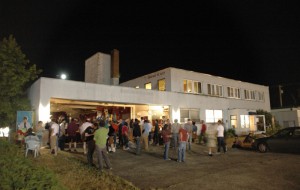
Outside the Department of Safety, 2005. Courtesy the Department of Safety.

Outside the Department of Safety, 2005. Courtesy the Department of Safety.

The Department of Safety is an artist run center in Anacortes, Washington, a small town on an island midway between Seattle and Vancouver. Housed in the town’s former police and fire station, DoS maintains a music venue, art gallery, recording studio, and residency program. I corresponded with Azure Akamay who, with Laura Wing and Matthew Spencer, answered my questions about life at the DoS.

Bryce Dwyer: Can you describe the relationship between residents and administrators at the Department of Safety?

Department of Safety: The Department of Safety is run by the volunteer resident workers who live in the building. At any time, there are between 4 and 8 workers administering the programming and generally taking care of business. The DoS was founded as an artist-run organization in 2002 and continues to operate in this way. There is no paid staff. The workers subsidize the Artist in Residence (AIR) program with their own rent and volunteer efforts. The selected resident artist lives and works alongside the other people who live and run the DoS. Some residents have chosen to become very involved in other aspects of DoS. Some have been more focused only on their specific creative project. Participation in the community is inevitable and delightful, especially since Anacortes is a small town and there aren’t many people in town who are interested in weird and contemporary creative projects. The artists-in-residence definitely become integrated into the overall project that is the Department of Safety and some artists, after their residencies, have continued to be involved in the DoS (though, this is not an all an expectation).

BD: What is the physical facility like?

DoS: The Department of Safety is housed in Anacortes’ old police and fire station. It is a big concrete building that was built in 1952 and the architecture is very much of that era. The plumbing is temperamental. The venue is cold in the winter. The building is powerful in both magical and harsh, always. We are always fixing it. There are mysterious artifacts left over from the years when it was inhabited by police officers and firefighters. We love the building. The hallway’s acoustics are incredible and some important albums have been recorded in them.

The downstairs of the building is where most of the public activities take place—it includes an all-ages music venue, an art gallery, a recording studio, a zine and small press library, screen printing facilities, a media screening room, and personal studio spaces. The upstairs is the more domestic/private part of the building—it includes the bedrooms of the resident-workers who run the DoS, a living room and dining area, as well as a shared kitchen and bathroom facilities. Artists-in-residence are provided a furnished bedroom as well as a private studio space.

The building is located on the only main intersection of downtown Anacortes and is in walking distance to basically the entire town, including grocery stores, hardware stores, thrift stores, restaurants, and the Pacific Ocean.

BD: In general, what kinds of work do residents make?

DoS: Emerging artists practicing in all media are encouraged to apply. We are interested in installation and performance and tangible art objects and documentation and ideas. Artists who are chosen as residents at the Department of Safety, at the end of their 3-month residency will exhibit their work in some way. AIRs are encouraged to create work within the confines of the gallery in a site-specific installation and/or work in the adjacent spaces. Any thoughtful use of space will be considered and it is important for applicants to understand the context for which they are creating. This is not to discourage traditional art practitioners from applying, but we want individuals to think about context.

Continue reading »

Public Collectors

October 5th, 2009
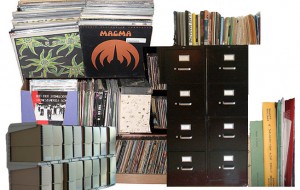
Some of Public Collectors' collections, 2009. Courtesy Marc Fischer.

Some of Public Collectors' collections, 2009. Courtesy Marc Fischer.

Public Collectors is a project run by Marc Fischer in Chicago. It began with the notion that there are all sorts of things that libraries, museums, and other institutions that store cultural objects don’t incorporate into their own collections. Alongside the public collecting of these institutions, there are a host of people out in the world who collect just these sorts of “miscellaneous” objects themselves, maintaining them at their home in private collections. Fischer asks these sorts of collectors to organize their collections and make them available publicly. Public Collectors identifies a deficiency in a system and attempts to remedy it with another system. This remedy is less formal, rooted in mutual enthusiasm, and played out in a private space made public.

On the Public Collectors website, one can peruse the inventories of these collections and arrange to visit them. Most of them are in Chicago, but there are also collections in London, Iowa City, Baltimore, and De Pere, Wisconsin.

Last month Public Collectors launched a new blog that spotlights various objects in the collections. So far, they’ve ranged from a twenty-five year old issue of High Performance to a 1960 book of typography, thrown out by a Chicago public library, that instructs the reader in the art of making hand-painted signs. More variously assimilable examples are posted on the blog every few days or so.

Unconventional Residencies

September 28th, 2009
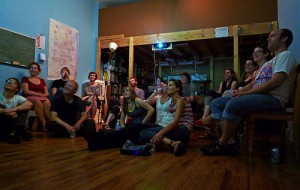
Artist duo Hideous Beast hosts a Mini Movie Fest during their InCUBATE residency

Hideous Beast, "Mini Movie Fest hosted during their InCUBATE residency," 2008. Courtesy Charlie Roderick.

Last November, the National Endowment for the Arts established a new funding category explicitly for artist communities. The NEA defines an artist community as “an organization, whether focused on a single discipline or multidisciplinary, whose sole mission is to provide artist residencies.” This unprecedented recognition of the importance residencies play in the contemporary art ecology also serves as a way for the NEA to support the activities of individual artists without the political liability of direct grants to them. The recent dust-up over an NEA conference call encouraging artists to support certain domestic policy agendas is only the most recent example of how the agency continues to be a political flashpoint.

Residencies are an important step in one path to professionalization taken by artists today. Many artists’ CVs have subheadings devoted to residencies they’ve been on, in addition to documenting their education, exhibitions they’ve shown in, and collections to which their work belongs. Residencies serve artists from every discipline, who benefit from them in a variety of ways. They provide devoted studio space and time to complete work and allow artists to operate in new contexts. They serve as postgraduate institutions where artists can continue working out ideas in a social setting. They offer facilities that an artist might not normally have access to and potential collaborators they might not ever have met. Some residencies are invite-only, and others have competitive application processes. This diversity of organizational models is what allows residencies to serve so many artists — the precise reason that funding them makes sense for the National Endowment for the Arts.

But in addition to the residency organizations currently eligible for funding by the NEA, those that run as non-profit 501(c)(3)’s, there exists a great number of unconventional residencies operating under independent organizational models and at radically different scales. They don’t have traditional boards and tend not to be eligible for public funding. Sometimes they operate out of a spare bedroom at the home of the artist or administrator in charge. Others are nomadic, and never work out of a fixed place. Some are hosted in a string of places that open and close as spaces become available. All of them nurture especially strong connections between the artist on the residency and person or persons who administrate it. With administrative duties minimized, the administrators of these residencies take especially active roles in shaping the artist’s work. What they may lack in artist’s facilities, they compensate for with an intense investment in the artist’s residency experience.

For the past two years, I’ve co-run just such a residency as a member of The Institute for Community Understanding Between Art and the Everyday (InCUBATE). In that time, we’ve hosted fourteen residents (including four collectives) out of a storefront in Chicago. InCUBATE is a research group dedicated to exploring and documenting experimental approaches to arts administration and arts funding. In addition to running the residency, we produce and participate in exhibitions, organize public programs, and co-manage the storefront with three other organizations. We accept applications from people working in any discipline to come stay in a bedroom at our storefront from one to three months and work with us on their projects.  These projects are generally interdisciplinary, and produce some sort of resource available for public use. The InCUBATE residency is an opportunity for us, as young arts administrators, to both test out ideas and to collaborate with a wide variety of people whose work we’re interested in.

My own personal investment in unconventional residencies led me to the Alliance of Artists Communities in Providence, Rhode Island. I spent six weeks there this past summer researching other groups and spaces operating residencies at scales and with values similar to InCUBATE’s. Over the course of the next two weeks, I’ll be conducting interviews with some of these residencies and posting them here. I hope to show that they make up an important informal system for a host of people working in modes outside or parallel to traditional art infrastructures.