The shock of the unseen.

January 16th, 2009

Looking eternity in the eye
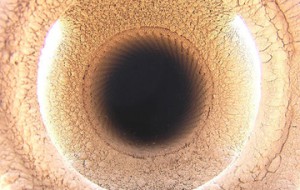
“Looking eternity in the eye.” (All photos by Luodanli.)

Almost four years ago, in the course of my web wanderings, I stumbled on the photographs of an Army serviceman  who had been deployed to Iraq. To this day, I know little about him — only that his online handle was Luodanli, he was stationed in Taji, and he had a family waiting for him back in the States. Somewhat sporadically, Luodanli would post a batch of photos to Flickr. The images rarely revealed much about his personal life, but they were beautiful, often bordering on abstract — such as the sand-clogged interior of a piece of artillery, above

What does any of this have to do with the idea of shock in art? On the surface, not much. Initially, I’d contemplated all sorts of “shocking” subjects for my final post here on Art21: nudity, racism, excrement, violence — even farm animals in formaldehyde. But given the state of our planet, it all seemed rather frivolous. Gaza is burning. Yesterday, the AP reported that more than 4,200 U.S. servicemen have died in Iraq. (Not to mention the tens of thousands Iraqi dead.) And then, of course, there’s our economy. Or lack thereof. In keeping with the times, I considered writing about the work of war photographers such as Matthew Brady, Robert Capa and James Nachtwey. (I have an abiding admiration for people who have the capacity to click a shutter at a time when I’d be running for cover.) I also considered doing something on works related to war, perhaps pieces by Goya and Picasso and Omer Fast. But then I thought that these images, collectively, might seem too familiar, or bear too much resemblance to what we take in on a daily basis.

That’s when I thought of Luodanli’s pictures — and their pithy captions (which I’ve appropriated for the purpose of this post). They bear none of the obvious markers of war. Yet we know that it’s happening somewhere beyond the edge of the frame. The images are artfully composed and find beauty in objects that, to soldiers, must be mundane. But what did Luodanli witness that went unrecorded? Who knows. Each of us could probably hazard a guess. Sometimes, what remains unseen is the most shocking thing of all.

Many more images after the jump.

Continue reading »

Found Art: 10 Ways to Die of Electric Shock

December 31st, 2008

30 Ways to Die of Electrocution

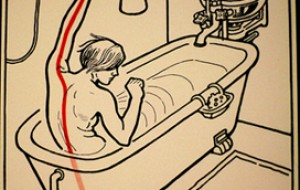
Disaffected hipster meets his maker. All images courtesy of Bre Pettis.

Since we’re talking “shock” here at Art21, I decided to plug the word into Flickr to see what it’d turn up. It was a jackpot. I discovered a set of graphic designs from a 1932 German book that featured dozens of renderings of ways in which you can die (or get seriously hurt) by electric shock. It’s freaky.

The set of images, dutifully photographed by mechanical wiz Bre Pettis during a trip to the Technisches Museum in Vienna, are irresistible. They come from Electroschutz in 132 Bildern, a pre-War tome about which I know next to nothing, and whose exact purpose eludes me. But the drawings rock (or is it shock?)—stark Raymond Pettibon-meets-Los. Bros.-Hernandez-meets Alfred Kubin-style imagery that just drips with the anticipation of something big. The red arrows over the black-and-white figures beckon clinically, like instructions: Grab lamp with frayed wiring. Put foot in tub. Electrocute. Simple, yet absurd. And totally macabre and grody.

Here’s a round-up of my 10 favorite shocking images from the set. Do not try this at home.

Continue reading »

I wanna shock.

December 18th, 2008

c-monster.jpg

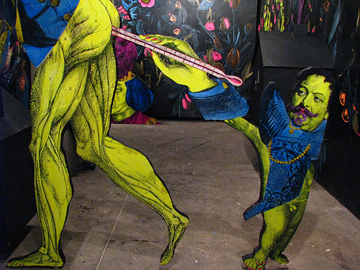
Dirt Mansion, an installation by Judith Supine at English Kills Gallery in Brooklyn, April, 2008. (Photo by C-M.)

In a move that undoubtedly goes against somebody’s better judgment, the respectable folks here at Art21 have asked me, C-Monster, puny art blogger and avid burrito eater, to do a few links round-ups (as I do on my own blog) in honor of this month’s Flash Points series: “What’s so shocking about contemporary art?“For the purpose of my first assignment, I thought I might take things literally. I’ve spent the better part of an afternoon trolling online museum collections for the word “shock”—either in the title or the describing text. This is hardly a scientific way to produce a list (a lot of museums don’t have searchable databases of their collections online). But it’s deliriously random (kinda like the web), and a good way of discovering how various artists have treated the idea of shock without being all self-conscious about it.

It’s also a good way of avoiding all the obvious names. (Because, really, how many times in one lifetime should a girl have to look at Piss Christ?) But it means that most of the links do not connect to images by contemporary artists. Not that this really matters. If there’s one thing I’ve learned in this exercise, it’s that shock in art is hardly anything new.

The shock of sex:

The shock of color:

  • “It shocks you every time.” William Eggleston, on his hyper-saturated (and ironically titled) blood-red photograph, Greenwood, Mississippi, at the Getty.

The shock of violence:

The shock of a prank:

  • Waaaay before Banksy: L.H.O.O.Q., Marcel Duchamp’s vandalized Mona Lisa replica from 1919, at D.C.’s National Gallery.

The shock of shock:

  • Looking shocked: A Man’s Face, c. 18th century, by Sir Nathaniel Dance-Holland, at the Tate, and Clandestine Marriage, an 1819 etching by Henry Hoppner Meyer, at the British Museum, .
  • More surprise than shock, but wryly funny nonetheless: A Man Who Suddenly Fell Over, 1952 by British painter Michael Andrews, at the Tate.
  • The gestures of shock: William Blake’s early 19th-century watercolor Judas Betrays Him, at the Tate.
  • At England’s National Gallery, Queen Charlotte, 1789, by Sir Thomas Lawrence, captures the monarch after “having recently undergone the shock of George III’s first attack of apparent insanity.” Quite incredible. You can see the wear on her face.

C-Monster is a Brooklyn writer and blogger who is shocked by very little.