A Willing Girl

January 13th, 2012

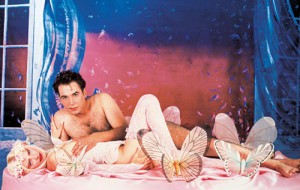
Jeff Koons. "Hand on Breast," 1990. Photo courtesy of Luxembourg & Dayan, New York.

For years, Jeff Koons (Season 5 Episode “Fantasy”) has been controversially appropriating dime store trinkets — kitschy souvenirs and ad campaigns. If it wasn’t for Koons, these once popular items would clog beaches and landfills as forgotten castaways of passing fancy. Koons “rescues” them, plucking them from the lowly world of dollar store giveaway bins and subway billboards, in order to reproduce them on a larger-than-life scale. With a new pedigree, the artifacts are worth thousands, if not millions of dollars. They ooze with a disposable, American decadence — a “Nouveau Versailles” aesthetic — critiquing the culture in which they were conceived almost as if by accident. “Balloon Dog is full of everything except gods, a de-deified sculpture that radiates irony and Eros. It’s an updated version of Duchamp’s urinal,” wrote Jerry Saltz in New York Magazine in July 2008. His work Made in Heaven represents the final fruit of Koon’s ongoing ironical exploration.

Where Warhol employed the soup can, Koons took the toaster, the vacuum cleaner, and the basketball. Rather than silk screen these objects (a medium with its own associative history of democratic dissemination), Koons set the objects in custom vitrines, enhancing the already emanating auras of convenience, luxury, and free time – conquests of an American life that indicate success. He aestheticized the design of everyday objects, and like a knight in shining armor, (think of Richard Gere pulling down the street in a limousine to fetch Julia Roberts in Pretty Woman), redressed the debauch of everyday in expensive clothes, toured it around the country, and made a fortune. He mirrors the exploitation of entrepreneurial practice in his own artistic endeavors, highlighting the erotic potential of inanimate objects so that we, the audience, begin to salivate. Shortly after his first exhibit, Koons began recreating tchotchkes. He made towering reproductions in factories with a team of employees. Videos of the artist at work feature Koons with a hard hat and a clipboard, pointing directions to a team of laborers. His art became a comment on the manufacturing business and has continued since.

There has always been a sardonic, if not nihilistic flair to his work. For all we know he is making fun of us, mocking our feeble efforts to maintain a cool distance from the uglier parts of consumer culture, pointing out the terrible truth behind exploitative ad campaigns and commercial structures. By reproducing and marketing lowbrow detritus to the cultural elite, Koons demonstrates the undeniable appeal in trashy, hedonistic totems. Cuddly kittens, balloon animals and Popples are irresistible. Still, Koons manages to remain ironically distant. It is unclear whether he believes in his homage to bubblegum, or if he makes his work out of critical spite. The taboos he picks up on – the more than dubious representation of women in his work, for instance (think of the Pink Panther hugging the busty blonde, which sold for 16.8 million dollars in 2011) – are not originated by Koons, but by us and our culture. Koons implicates everyone while profiting himself. Which is why Made in Heaven seems like such an excellent conceptual climax: he illustrates a cultural fantasy, propagating the power structures therein, indulging in a non-literal, plastic, commercial body. In this case, however, his hands are dirty. He offers his own body for public consumption.

The blatant point made in this work still elicits disgust. When exhibited in museums, the work is sequestered in smaller, partitioned rooms with signage that warns against their content. We are, after all, squeamish about sex. Made in Heaven taps into an almost ancient battle: how to define the distinction between pornography and art? In this particular case, that distinction is deliberately conflated. One might supposed the series is art because it is pornography: a specifically staged, anesthetized project about copulation. A reproduction of porn that nevertheless fulfills its pornographic function: penetration is visible. Body fluids are exchanged. Yet, like the rest of Koons’s work, Made in Heaven neither celebrates nor condemns pornography. Instead it reflects the cultural feelings around it, the artifice and industry of porn. The bodies in this work, like the bodies in pornography, are highly anesthetized, no different from his Michael Jackson sculpture and probably as misleading as one of his balloon rabbits. Ultimately this display of intentional and highly controlled sexuality troubles the function of a museum, highlighting also Cicciolina’s troubling insistence on participating in other echelons of society, namely politics.

Continue reading »

Centerfield | Ideas as Medium: An Interview with Laurie Palmer

January 10th, 2012

Coming to Chicago marked my first awakening into the world of contemporary art; for the first time, I discovered a whole working community of people engaged in a dialogue. These singular voices nevertheless resound in congress, creating a multi-focused, multifaceted din. Recognizing Laurie Palmer’s work was coincident with my sense of this new world; like the macrocosm I just described, her individual practice is its own tapestry comprised by various threads. Her work with Haha — a group she has been working with for almost 20 years now — was included in lectures about collaborative, political practice at school. She has an impressive solo sculptural career as well, and I came across her critical writing in magazines like Art Forum. Hers is a rich and diving kind of work, one that reaches into and underneath the material she uses. The fruit of this process manifests in an experience somehow aesthetic, educational, and (often) political. In the following interview we focus almost entirely on materiality, examining in part the self within that — where and how it might be singular or multiple.

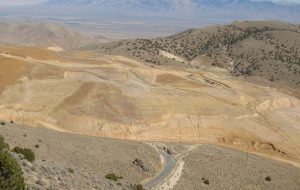
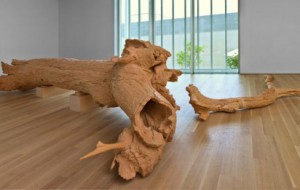
Laurie Palmer. "Hole," 2010. Work in progress. 17 x 17 x 7 feet.

Caroline Picard: I know that you’re working on a book about mineral extraction that’s on review for publication. Can you talk a little bit about that book? 

Laurie Palmer: It seems like (and it is!) many years that I have been working on this book project. It started as a way to learn about materials and where they come from and it became a rationale to read voluminously and to teach myself about chemistry, geology, astrophysics, and philosophies of matter as well as histories of mining, U.S. land surveys, and environmental policy. It is organized around 18 chemical elements, and the places that I visited where these elements are extracted.

Continue reading »

Center Field | Embodying Echoes: An Interview with Matthew Goulish

July 26th, 2011

Every house a door, "They're Mending the Great Forest Highway," 2011. Photo: John W. Sisson, Jr.

“WE MAY AGREE on the premise that each work of art is at least in part perfect, while each critic is at least in part imperfect. We may then look to each work of art not for its faults and shortcomings, but for its moments of exhilaration, in an effort to bring our own imperfections into sympathetic vibration with these moments, and thus effect a creative change in ourselves” (Goulish, “Thoughts on Criticism,” 39 Microlectures, Routledge, 2000).

This June, I saw a performance by Every house has a door, a collaborative group founded by Lin Hixson and Matthew Goulish in 2008 to “create project-specific collaborative performances with invited guests.” Having seen the piece in its intended context I want to ask questions outside its bounds. I appear like a kind of critic—a person asking the artist for something outside the presentation of a complete work. They’re Mending the Great Forest Highway is a dance for three men (Matthew Goulish, Jeff Harms, John Rich), with a DJ (Charissa Tolentino) and a narrator (Hannah Geil-Neufeld). It took place in the second floor gymnasium at Holstein Park in Chicago. Participants enacted a score of movement and sound presenting thematic elements from Hungarian folksongs, the tritone, and Benny Goodman. I wanted to ask about crisis, the framework of the theater, and the vocabulary of gestures—oblique responses to dance. Perhaps by asking them, perhaps through Goulish’s response, you might catch a ghost of the dance, left behind and buzzing in those summer-hot gymnasium walls.

Caroline Picard: How do you conceptualize the context for performance—do you frame it within traditional theater? How does time function within that context?

Matthew Goulish: Yes, theater as the container – less a set of conventions than of structures. Into it we place, let’s say, dance, writing, and music. We keep those elements distinct for clarity. Theater allows their coherent composition in time, the way the parts fit together. What happens first, second, last? What happens where? What echoes, and when? We have a sense of the parts in themselves (dance, music, writing), and another sense of the parts in relation as a cumulative experience (theater).

Can we call any room a theater if it contains theatrical events? What if we set up chairs in the afternoon at one end of a gymnasium that has windows and skylights? A little room noise might help the performance in unexpected ways. If we begin a 60-minute performance on June 18th at 2:00 PM, where will the sun be in the skylight when we end?

Continue reading »

Center Field | Threading Infrastructure: An Interview with Anne Wilson

May 31st, 2011

Anne Wilson installing “Topologies”

When I asked Anne Wilson if I could interview her for Art21, she sent me a preview copy of her book, Anne Wilson: Wind/Rewind/Weave—a catalogue published collaboratively by White Walls and The Knoxville Museum of Art. It was a good place to start. In the second essay, curator Chris Molinski writes, “Anne Wilson: Wind/Rewind/Weave consists of three distinct projects: Wind Up: Walking the Warp (2008), Rewinds (2010), and Local Industry (2010). These projects represent the work of 2,100 community volunteers, seventy-nine weavers, and dozens of studio assistants working in glass, thread, video, sound and live performance.” While Wilson’s work is significant for its individual, sculptural, and material aesthetic, it is also reliant on the energy of others. not simply because those others are invested in her practice for its own sake, but because her practice speaks to larger questions embedded in textiles.

Quilting and weaving are inherited skills that have been part of the human experience for eons. The textile industry employs massive numbers of people and is now located primarily overseas. These aspects are simultaneously present in all three projects. In Sites of Production, another essay in the catalogue, Julia Bryan-Wilson asks, “Stop reading for one second and look down. What are you wearing?” Because everybody wears clothes, and those clothes come from somewhere. People make them. Wilson’s work touches on the migration of industry, locating the exhibition in Knoxville, Tennessee, within the southeastern U.S. most identified with histories of industrial textile production as well as hand weaving traditions. A history of settlement schools in the Appalachian mountains allowed women to raise extra income through hand weaving. According to Philis Alvic in her catalogue contribution, those women were in charge of how they spent that money. Here, too, we see how Wilson highlights issues of power and gender and history: the tradition of knowledge, the empowerment of skill-sharing and making. In Walking the Warp, she also addresses labor conditions, engaging the repetitive work of weaving: what it takes to walk a warp as a performance: how often the performers take breaks, what they do, how their bodies are on the one hand restricted by the demands of their task, and how those restrictions create opportunities for freedom at such times when breaks are had.

Everything Wilson does is precise and deliberate; she creates an aesthetic experience autonomous to the conceptual framework she is working within. For that reason, there is light and air in the space her practice occupies; it is evident in the catalogue, already rich with various interacting themes and interpretations as well as textual excerpts from the artist herself, photographs of the work, and visual excerpts from a gathered archive of weaving samples from all over the world. The book reinforced what has always been an intuitive impression of mine, namely that while Wilson establishes a formal connection with the viewer, her work is supported by a meaty conceptual framework both critical and optimistic. My knowledge of Wilson’s work was concentrated on her more recent projects, beginning in 2008 when I saw her show at Rhona Hoffman Gallery. I wanted to find out more about what led up to this point, and how she locates her practice within contemporary and material culture.

Anne Wilson, “Feast,” 2000. Collection of the MCA Chicago

Caroline Picard: How do you think about scale?

Anne Wilson: In terms of scale, and the implication of larger worlds suggested my work, I’d like to first talk about how I came to work this way in the first place, with horizontal fields.

In the Fall of 2000, I had a solo exhibition at the Museum of Contemporary Art Chicago.  In addition to a range of other works utilizing found cloth and hair, I made a large sculpture called Feast that occupied its own exhibition space. Feast was a huge table, 22′ in length, and the stitched holes and tears from table linen — a vocabulary of parts stitched over 10 years — were placed back onto the horizontal table surface creating a kind of abstract topography.  In developing Feast, I wanted to investigate aspects of perception, the optical imagination and relational ideas extending from the body and social space. I became interested in new ideas suggested by the horizontal format; ideas to do with mapping, navigation, architecture, and landscape.  Also the power of a raking view—looking both down and across at a field of complex activity.  This was the first piece that proposed this dual scale, suggesting both micro and macro worlds.

Continue reading »

How To Stretch an Arm Through a Gap : An Interview with Ellen Rothenberg

January 17th, 2011

While Ellen Rothenberg works in a range of scale and material, there is a tactile quality to her work–a directness that calls attention to the body. I always think of organic bodies, bodies that don’t recognize an essential authority in our human structures. Like a climbing vine or water, her work seems to stretch through and around expectations. There are cracks in the street where weeds grow. The roof boasts an almost mystical, wandering leak. Ellen investigates literal and psychological structures, delving into the tension between what we take for granted and what has been overlooked. She activates the porousness of an assumption, nestling into its marginalized areas in order to produce new, self-reflexive spaces.

Caroline Picard: I was wondering if you could talk a little bit about your background.

Ellen Rothenberg: I was born in NYC and grew up in and around the NY metropolitan area. My parents were both engaged in progressive politics and the arts. My mother was a painter and my father a director of television commercials, industrial films, and documentaries. They were involved with leftist politics, the civil rights and the anti-war movement.  I guess you could say I’m a classic red-diaper baby. My father helped to integrate the film production unions in NY and during the McCarthy era, he employed many blacklisted actors who were under investigation by the House Un-American Activities Committee.  It was this mix of urbanism, politics, and the arts that was influential on my own development as an artist.

As a teenager, I took drawing classes at the Art Students League and went on to Cornell University’s College of Art and Architecture and later studied Massachusetts College of Art in Boston, the only state supported art school in the country.  I lived and worked in Boston before moving to Chicago.

CP: How does a new project occur to you? Is it a consistent process? Is it easy? Do you always work in the same way?

ER: Projects occur in different ways; I’m not sure about consistency. Sometimes, like in Stealth, ideas occur in relation to events — in this case the wars in Afghanistan and Iraq.  It was the discrepancy between the abstracted satellite and smart bomb images of landscapes and “facilities” transmitted on the news, against the images from the ground of refugees and the violence, which triggered the project.  Stealth was also my attempt to acknowledge and address the distance between these events and daily life in the US.

As the wars progressed, I also began to notice the infiltration of militarization into life in the States. This produced some strange material anomalies like pink camouflage baby pajamas or camouflage patterned bikinis! For more formal research into camouflage, I arranged to visit the Natick Soldier Systems Center, a Department of Defense installation responsible for technology development and engineering of US military food, clothing, shelters, airdrop systems, and soldier support. I met with a member of the Materials and Systems Integration Team, the group that develops and tests camouflage for the US military.  The visit ended with a strange doubling back to artmaking, when a product engineer asked about Mondrian and Seurat and what they had to do with camouflage.  Later we had an exchange. I sent him books on the artists and he forwarded samples of ‘failed’ camouflage patterns, which I later incorporated into Stealth.

Continue reading »

Fostering Pragmatism: An Interview with Nadine Nakanishi

January 16th, 2011

Nadine Nakanishi has been working with Nick Butcher in their collaborative independent print shop since 2005. Under the shared moniker, Sonnenzimmer, they’ve made posters for such notables as Beach House, The Books, and Broken Social Scene. They also make posters for comedians, design shows, and the like. While I’ve been consistently astonished by Sonnenzimer’s dedicated success, Nadine and Nick  mustered additional energy to kickstart a Creative Printer’s Guild. Through that network, screen printers are able to troubleshoot, share resources, and develop a community around their interest. All of that is of itself worth note: starting a business is not easy; neither is facilitating community. Nevertheless, Nadine manages a personal practice in addition. She is a painter, a sculptor, and (of course) a screenprinter. Here, too, she has a distinct voice. Everything she makes is perfectly placed, perfectly balanced, and often with a distilled or sun-bleached pallet. Embedded in her highly aesthetic objects is a research-based practice. Like poetry, each element in the work is purposeful, abstract, and pregnant with meaning. Consistent throughout those facets of her work lies a buoyant optimism–what I think she’d call pragmatic; and although her work manifests itself differently, there is an underlying foundation of careful, political thought. Last year, I remember there was all this buzz around the artist being the “new entrepreneur.” While I don’t know what to make of that contraction, I do think Nadine epitomizes a self-made, conscientious spirit.

Nadine Nakanishi, "Archive," 2010. Found materials, 46" x 32" x 4".

Caroline Picard: How did you start Sonnenzimmer?

Nadine Nakanishi: Sonnenzimmer started as a consequence of Nick, my partner, and me getting together to share art space. We both had separate painting studios and we thought that, through sharing resources, we could get more and finally print out of our own space. At that time, we both were printing out of Jay Ryan’s shop, The Bird Machine, and we were starting to overextend the invitation to use the shop. When we set up our studio, we worked part-time jobs not thinking of anything else, but eventually here and there a poster job helped pay the rent. Those jobs increased a bit, which lead to the next uncertainty, could we even work together? Would there even be a space for our visuals to make it commercially? And as those two things intensified, we slowly started formulating the idea of Sonnenzimmer. This will be our fifth year in business and it’s still much of an experiment, honestly.

Continue reading »

Occupying Multiple Scales at Once: An Interview with Hiro Sakaguchi

January 14th, 2011

I am fascinated by varying scales of reference, especially when one has to negotiate multiple scales over the course of a single day. Hiro Sakaguchi works as an art handler, a professor, and an artist. As an art handler in the Philadelphia Museum of Art, he negotiates the canon of art history within a massive, authoritative building. He spends most of his time in the basement. He also teaches where, respective to his students, he necessarily affords greater authority. He is at the front of the class, creating assignments and offering knowledge. He is also an active member of the Philadelphia art community, where (I would argue) he is among peers. If this were a movie, the camera angle would begin over his head during a working day. The camera (the eye of the museum) looks down on him. Perhaps, to make it feel less creepy, you could imagine a smiling, benevolent lens. The camera follows Hiro from the museum (passing by the Rocky statue) to his class. Over the course of that journey, the camera angle shifts and by the time he begins to teach, the camera is seated, below his eye level. At the end of the class, the camera follows him to dinner, or an opening. There it is at everyone’s eye level. Yes. Imagine everyone in the room is exactly the same height. Everyone is laughing, chatting, and it’s difficult to parse any one conversation from the din. Overall there is an impression of camaraderie. Lastly, we follow Hiro to his studio. Maybe it is just beginning to snow.

I have seen his studio: located in the heart of Philadelphia’s Chinatown, I hiked several flights of stairs before arriving on a dusty, dark landing. Temporary walls divided the space into smaller, padlocked studios belonging to others. There was a lasting after-smell of incense. Many things were wrapped in plastic, and I remember feeling as if I had entered a labyrinth. No one else was there, except Hiro, of course. Behind Hiro’s door, there lies a ping pong table, a cot, and several canvases. There are other materials as well, but I don’t remember those precisely, only that they were there. Some paintings are in progress, others are complete. I’m still not sure where the camera is, but I notice variant scales in his paintings also. Bears eat airplanes like trout while people watch on the side like plastic figurines. Hiro is playful in his work. The ranging scales seem pleasant rather than confounding. Why would they be confounding? you might ask. Because one’s sense of one’s own size would constantly shift relative to that variant context. I asked Hiro what he considered home. He answered, “I do not consider myself a Japanese artist.  I am an artist based in Philadelphia but I think I may be somewhat more global at the same time.” Hearing him say this, I recognized his frame of reference was even greater than I’d given him credit. His variant scale is not simply about his life in this old American city, but also about his relationship to a cultural past. In everything, he is his own center.

Hiro Sakaguchi, "Chrysanthemum Delivery," 2009. Graphite, ink, and gesso on panel, 18" x 24".

Caroline Picard: Would you say there was a turning point in your career, a moment when you felt especially validated as an artist?

Hiro Sakaguchi: Turning point….It is hard to say when or what changed my artist’s career, but one memorable one was when I was chosen for 2004 Fleisher Challenge exhibition at Fleisher Art Memorial in Philadelphia after I applied 9 times.

I wanted to be a painter since I was 11 years old when I saw Japanese painter Yuzo Saeki’s retrospective at the Tokyo National Modern Museum. I called myself an artist after graduating art school, even though I did not have any exhibition records. No one bought my work yet. I guess by calling myself an artist, I was encouraging myself to be one.

Continue reading »

Caution, You Are Being Watched: Deb Sokolow and You

January 13th, 2011

Deb Sokolow invokes You, the audience. When engaging her work–wall drawings rife with text-narratives that revel in heist, hijinks and mystery, You are not a passive bystander. You are implicated as a character in her web, because she always writes in the second person. I spent some time talking to Deb about that second person device. It strikes me as particularly interesting because of its self-reflexiveness. Rather than sharing the artist’s gaze, looking through the lens of a camera say, the audience suddenly identifies with the model. You/We are in the drawing. You/We are being watched. Deb Sokolow is looking at us. Like an unnerving Welcome mat, Sokolow gives you a platform on which to stand.

Caroline Picard: How would you describe your development as an artist? Do you feel like there are different stages of Deb Sokolow work?

Deb Sokolow: Good question, maybe it’s a question I’d be able to answer better 10 or 20 years down the road. I’ve only been working in this current vein since 2003. That year, I was smack-dab in the middle of grad school, and it was the year that I had an art crisis; I realized I didn’t know what the heck I was doing or wanted to do as an artist. I had no personal investment in anything going on in the studio, so I stopped making work. I went home. I watched movies and ate Chinese take-out. “This is so much better than making art,” I told myself. But then when I started asking myself what was so compelling about watching movies, I realized that it was the stories, the narrative form that I loved, that I could get lost in. This was an A-ha! moment for me, because prior to this, I was making these blobby shapes out of glue and arranging them on table tops. It was boring. So boring! So I moved into working with the narrative form, making large, diagrammatic drawings on paper or multiple papers, always narrated by an anonymous, unreliable protagonist who’s only ever referred to as “you” and that’s what I’ve been doing for the last couple of years up until a couple of months ago where I decided to make a break with this, keep using the “you” but develop a new framework for the narrative and a new way of presenting it. So, in answer to your question, I guess I could say that I’ve recently entered dynasty #2, which is actually a pretty exciting place to be.

Deb Sokolow, "Dear Trusted Associate" (detail), 2008-2009. Graphite, charcoal, ink, acrylic on paper and on wall, approx. 40 feet long. Installed at the Van Abbemuseum in 2008 and at the Smart Museum of Art, University of Chicago, 2009-2010.

CP: How do you think about a single piece of paper?

DS: If it’s a small piece of paper and I’m just doing a small drawing on it, I tend to think a lot about formal concerns first. Usually, the first thought entering in my mind is, “Are you going to make a drawing smack-dab in the middle AGAIN?” Once I get over whatever frustrations I have with composition, though, and actually start drawing, I almost always erase or white-out whatever first pops up on the page, mostly because I’m never happy with it. I’m constantly erasing and whiting-out the whole way through.

Continue reading »

Active Blur: An Interview with Tsherin Sherpa

January 12th, 2011

Tsherin Sherpa has a unique background. Trained as a Tibetan thangka painter in Nepal, he was raised within a specific regime of mark-making, proportion, and subject. Embedded in that tradition is the need to preserve and pass on an exiled cultural heritage. As such (and having relocated to California), Sherpa has carved out a practice painting traditional Bhuddist thangka paintings. In the last five ten years, however, he started working outside the traditional confines he’d inherited, embarking on a course of personally expressive work. Transferring the aesthetic of his background into the relative freedom of the contemporary art context, Sherpa currently maintains two styles at once. For that, and in both spheres, he has achieved some real success. He has exhibited internationally in a variety of museums, he is represented by a gallery, and worked on a national ad campaign. Every aspect of his work has begged a delicate balance of reflection and production. In the following interview, we talk at length about the the process of Sherpa’s development and the relationship he has with its course.

Tsherin Sherpa, "Baby Spirit # 1," 2010. Gouache, acrylic and gold leaf on paper.

Caroline Picard: Could you talk a little bit about your background and what your artistic training was like?

Tsherin Sherpa: For a couple of generations, my family had been creating traditional art. My father was originally trained under his uncle.  In turn, my uncles, my dad’s cousin, and I were handed down this craft [thangka painting] by him. At the age of 12, I began studying this art form during my school breaks.  Growing up in Nepal, I was immersed in Buddhist culture and iconography.  Even though I was not a monk, I studied Buddhist scriptures in a nearby monastery.  So, alongside the traditional art, I was seeped in the meaning of it.

As for the process of learning thangka painting, the traditional training begins by creating specific measurement grids for the Buddhist deity. Once that is understood, then we learn paint application and fine brush stroke detailing.  The basics took me about 5 years then I continued perfecting my skills for many years.

Only in the last few years did I begin experimenting in contemporary forms.

Continue reading »

At the Center: An Interview With Brandon Alvendia

January 11th, 2011

Brandon Alvendia, "Headshot Inside a Dan Graham Sculpture," Washington DC

While conversations continue (albeit tiredly) to predict the demise of physical book production, new publishers continue to produce books. There is a wealth of new, bright-eyed small presses all over the country. None so unique as Brandon Alvendia’s Silver Galleon Press. There is a pioneer quality to Alevendia’s style of book making. It’s cheap and fast and easy. It’s also utilitarian. The preciousness of the object he creates comes from it’s easy, DIY production. These books are art objects as a result of their disregard for self-fetishization. Silver Galleon Press is one of many Branches in Alvendia’s art practice. First and foremost, Alvendia creates. The material in which his ideas manifest vary–whether its curatorial, written, published, performed, taught, filmed, or sculpted, the work follows from a verb of action. Alvendia is at the center of that action.

Caroline Picard: Where did the idea for the Silver Galleon Press come from?

Brandon Alvendia: The Silver Galleon Press comes from a desire to read from the infinite repository of texts stored online in a form that can be handled, highlighted, written-in, dog-eared, torn, collected, exhibited, archived, shelved, lost, given as a gift, traded or burned for warmth.

CP: How do you choose your publications?

BA: The continually growing collection of texts represents years of maintaining a folder on my computer named “readme.” Approaching one DVD in size, the library of PDFs is slowly built from a daily practice of hunting and gathering new reading material online. The books are published on an as-needed and on-demand basis to suit a wide range of distribution and exhibition contexts. Titles are also published by request or for personal enrichment.

Brandon Alvendia, "Silver Galleon Press," Mobile Printing Workstation

CP: Can you talk a little bit about how you make your books?

BA: The Silver Galleon Press method of bookmaking is an economical and efficient process that can be learned by all. First, the captured PDF is minimally processed using the budget page-imposition software Cheap Imposter (OS X) to rearrange pages for printing. The PDF is then printed using generic printer ink, found online for as cheap as $1.99 a cartridge ($.01/page B+W). The pages are cut, folded and bound using common office supplies such as heavy-duty staples, two-hole brackets, and a wide variety of glue and tape (as in hot and duct, respectively). Covers are made from salvaged materials of all kinds (file folders, cardboard boxes, canvas, photo-backdrop paper, fabric, mass produced books, etc) manipulated with collage, paint and other mixed media. The whole operation can be reproduced anywhere and will adapt to exploit specific resources at any given venue/institution (ie color copiers, interns, etc…) Finished titles are distributed freely, by barter or on a pay-what-you-wish basis (and often part of a larger sculptural installation.)

Continue reading »