Open Enrollment | Job Hunting and Evaluating on the Heels of Graduation

May 11th, 2011

Open Enrollment

This is not the first time on Open Enrollment that I have discussed my post-graduate school future.

In January, I was already feeling the pressure as demonstrated in my post, “So My Last Semester Lies Ahead, Then What?” My colleagues were feeling this, several of them scoring a job and putting the last moments of finishing school on hold since a career trumps all. But now with my graduation a bit less than a week away, I am evaluating all I have done as I worked on my Masters in New Arts Journalism from The School of the Art Institute of Chicago (SAIC).

On days I do not have class, I revise my resumes and my curriculum vitae. I like to think of the combination of my higher education and job experience as diverse, but in month three of a job hunt, I am considering why the application materials I spend entire days working on and sending fall on those proverbial deaf ears. It is disheartening, yes. But after the initial grief-coated haze of rejection cleared, I started to think objectively and pragmatically about how potential employers may be perceiving me.

Am I overqualified? Under-qualified? Is my education and experience so diverse that potential employers may be thinking that I lack focus? These are just a couple of the thoughts that occupy my mind when I consider my place in an already-difficult career field like the arts, often a tenuous place to be, but more so in an economy that continues to sink like stilettos in dewy lawns.

Continue reading »

Open Enrollment | BFA and MFA Shows: The New Collector’s Market?

March 30th, 2011

Last Friday, I got off the subway and felt the crisp, eight o’clock Chicago evening air and saw something I was not expecting: a line around The School of the Art Institute’s (SAIC) gallery building. The lines snaked along busy State Street, winding down and around the side street. Puffs of cigarette smoke and ringing cellphones surrounded everyone waiting to get into the building to see the 2011 SAIC BFA show.

The cigarette smoke and cell phone jingles were primarily coming from art students, but this year, I saw more people off the street than I would usually see at BFA shows. I asked those around me what brought them there, and what compelled them to stand in a cold Chicago night to get into a show of undergraduate artwork.

A couple who appeared to be in their late fifties to early sixties stood behind me with another couple who also appeared to be about their age. I asked them if they knew an artist in the show, and they replied simply, “No. We come here every year to buy art.” They went on to tell me they desired this venue for collecting because it was affordable, but even more importantly, it was completely refreshing and undigested.

Continue reading »

Open Enrollment | On Hierarchies: Thoughts after Sarah Thornton

March 9th, 2011

Sarah Thornton, the author of Seven Days in the Art World — a book that made me book laugh, giggle, and weep — spoke last night at the Museum of Contemporary Art (MCA) in Chicago. The talk was titled, “Artists at Work,” an intriguing idea to me since I have found that all too often the words “Artists” and “Work” are rarely said in the same sentence with a straight face. This is a sad reality, but one I too often see among my talented art school colleagues and a reality I  live myself after seemingly endless years of higher education.

Thornton’s talk discussed the unmentionables of the art world, which she refers to as a “squabbling subculture.” She spoke about the speed of the sale of art in her book chapter “The Auction” and compared it to the next chapter, “The Crit” (taking place at CalArts, where it would take fifteen hours or more to discuss three works of art). The speed of the auction and the slow considerations in a crit speak to these hierarchies. Digested, respected artworks speed by for millions while the work by art students must be dissected and considered for hours.

Continue reading »

Open Enrollment: So My Last Semester Lies Ahead, Then What?

January 5th, 2011

While I chip away at my thesis and look toward my last semester at The School of the Art Institute of Chicago (SAIC), I have begun to think of my future, a career path in the arts, what that should be, where I should look, and if I will be able to find anything in this murky economy when most of the budget cuts are, sadly, made to the arts.

Many of my colleagues are no doubt considering these things as well — us and another million graduate students soon to be entering the reality of the world around us. I am not cynical, but I would be lying if I said I am not terrified by the prospect of re-entering the world of the working, a world that is sadly at a loss for prospects for many people, especially those of us in the arts.

For a very long time, since my days as an undergraduate, I have worked very hard in a variety of arts-related fields and capacities. My hard work was a labor of love since I was rarely paid for the work I did. This has always been okay with me because of the love of what I am doing. But there comes a time when the real world taps on my shoulder and says, “Carrie, it’s time to have a career.”

Continue reading »

The Masters in New Arts Journalism Thesis Part Two: Thus It Begins

December 1st, 2010

I guess you could say my thesis came to me in the guise of an email from one of my favorite galleries in Chicago, the Catherine Edelman Gallery. There was an invitation to an opening for Chicago photographer, Elizabeth Ernst. After looking at her work on their website, I knew I had to attend with Canon Rebel and notebook in hand. I knew also I would have to manage to speak with her, asking her about the possibility of being the subject of my thesis.

What I found instantly alluring about her work were the subjects of her photographs, figures who appeared to be circus performers. I wanted more than anything to know their stories, to enter their world. The resulting meeting with Elizabeth Ernst at the opening went smoothly, she being an approachable woman who expressed a flattery by my interest in her work. I returned the following day for her artist’s talk, gaining more understanding into the work I had photographed and studied closely the evening before.

Elizabeth Ernst, "Knuckles and Lillian," 2010

The exhibition, titled Smoke and Mirrors, reinforces the notion that her work is more than just photography. On shelves flanked by photos sit sculptures she created, pieces that would eventually be shot by the artist with paint applied to the surface. Her process was immediately fascinating: the notion of blurring the lines between painting, sculpture, and photography. But her process became more fascinating after I heard about why these figures existed and in which world they existed: the world of her own creation, The G.E. Circus.

With a visit to Ernst’s studio in the near future, I have begun the foundations of my own study of the history of the circus. My thought in approaching this thesis as of now is to gain some expertise into this history and its people as a way to understand the G.E. Circus, a place with people of the artist’s own creation.

Continue reading »

The Masters in New Arts Journalism Thesis: Trials, Joys, and Exalted Discoveries

October 20th, 2010

As autumn begins to sigh in Chicago, my second and final year as a Masters candidate in New Arts Journalism (NAJ) at The School of the Art Institute of Chicago (SAIC) begins with the reality of pondering my thesis.

For the NAJ program at SAIC, a thesis may be one of two avenues: a more academic thesis that uses journalistic practices such as research and interviewing to name only two, or it may be a creative project that is accompanied by a paper that outlines the journalistic techniques used to bring the thesis to its fruition.

As a creative artist at heart and in soul, the latter appeals to me. I desire my thesis to be a hands-on foray into a world of documentary journalism, a kind of case study of my chosen subject. This is broad, yes, but I believe theses should, in their infancy, be broad, or as I said to colleagues tonight over some Chicago thin crust, it should begin “loosey-goosey.” It should be a malleable entity that is searching for itself.

Continue reading »

Art Journalism in the Twenty-First Century: Where Is It Headed?

June 23rd, 2010

This fall, I will be beginning my final year as a Masters candidate in New Arts Journalism (NAJ) at The School of the Art Institute of Chicago (SAIC). According to SAIC, this very new arts journalism program is diverse, giving students the skills needed to attain a place as art and design journalists in an array of fields from magazines and newspapers, to radio and television, to new media outlets such as blogs and podcasts. There is a definite breadth here — an overwhelming breadth — to this mission, and this evokes feelings of sheer terror and immeasurable excitement about the future of the field.

Art Journalism's print presence: Catalogues, glossies, and journals

I asked a colleague of mine, Whitney Stoepel, about some of the issues I was thinking about when composing this post. Whitney is also a year away from graduating with a Masters in New Arts Journalism from SAIC, and she and I are both learning from wonderful professors who are successful in the field of arts journalism, albeit predominantly in print mediums. While we learn from them, we also hear about the impending death of print due to the unstoppable draw and cost-effective platform that is the Internet. To my question, Whitney asked a very good one. She said, “How do you find teachers with years of experience in the field when the field itself is undergoing a complete transformation?” She continued, “We are young and we have a chance to make the new way our way. We’re not tethered to newspapers or a top-down editorial structure. We can be our own bosses. We are part of a generation that’s old enough to understand change and young enough to master the new technologies that aren’t going to stop evolving anytime soon.”

Whitney’s answer is confident and hopeful for arts journalism students like ourselves, but in this statement lies a tough road ahead — or so it seems to me. As a publishing poet, published only in print, I am feeling the death of print not only in my future as an arts journalist, but also as an artist. These two perspectives make thinking about this all the murkier, more unknown, and more overwhelming. But these perspectives also make all of this wholly invigorating, giving the passion I already possess for the arts an incentive to make them a constant element in the world through writing, marketing, and cultural enrichment.

Continue reading »

The Radical Workshop: For Students, By Students

April 14th, 2010

by Lily Rossebo and Carrie McGath

Lily and Carrie add their two cents about the significance of radical workshops in art school programs.

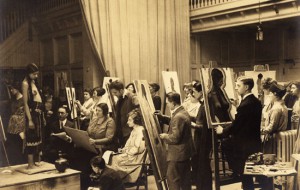
Winold Reiss’s drawing classes at 4 Christopher Street, NYC, c. 1920

Lily Rossebo: Without student protests, what would art school be like today? Would we still be drawing from casts or maybe, with some luck, from a live model? A number of student uprisings and independent schools have helped to dismantle old methods of teaching and reshape art education in the twenty-first century. Present-day programs continue to refer to the Bauhaus (1919-1933) or Black Mountain College (1933-1957) as models for effective and innovative learning. But since the conception of these two prototypical schools, has there been any progress? Are art school programs in touch with contemporary social issues and innovative pedagogical practices?

In recent years, as the DIY spirit has spread across disciplines and subcultures, the current generation of students may be more accustomed to the idea of self-organization. Outside of traditional, degree-granting programs, many art collectives such as Just Seeds and the Radical Art Caucus, offer a wide range of alternative opportunities for artists, emphasizing activism and social change.

In the essay, “There Is No Alternative: The Future Is Self-Organized,” writers Stephan Dillemuth, Anthony Davies, and Jakob Jakobsen propose that artists must take more control and not rely on pre-existing institutional structures. “In our view, self-organization is a by-word for the productive energy of those who have nothing left to lose. It offers up a space for a radical re-politicization of social relations — the first tentative steps towards realizable freedoms … Self-organization is: something, which predates representational institutions. To be more precise: institutions are built on (and often paralyze) the predicates and social forms generated by self-organization” (excerpt from Art and Social Change, 2005).

Interflügs (Interflight)

A few weeks ago, I attended a five-day workshop at Interflügs, an autonomous student-run project at the University of the Arts Berlin (Universität der Künste Berlin, UdK). I applied to the workshop unaware of Interflügs’s amazing history and ongoing mission.

The Interflügs (a German word meaning Interflight) project was founded in 1989/90 in an atmosphere of political change and student protest. Students, unhappy with the hierarchical and ineffective structure of their school, decided to take matters into their own hands. Various groups began to form, crossing traditional department lines to create an independent study alternative to the regular course listings. The initiative proved to be both popular and effective, and it began receiving university funding. Twenty years later, Interflügs is a multi-operational project, offering an extensive and changing list of workshops and lectures. These range from the practical (photo and video editing) to the exploratory, such as creating discussions around current issues and topics.

The particular workshop I attended was called, “Mass – Public Space – Response.” Its aim was to explore the movement of people in public places in order to gain a better understanding of how these areas can be changed, modified, frequented, or avoided. The workshop involved collaborating with participants in groups of four or five; fieldwork in designated public places; a final presentation using photography, video, or projection; and a publication including text and images from each group. Students of all disciplines were invited to attend, including architects, urban planners, artists, and designers.

Continue reading »