A willing participant at EMPAC’s “Uncertain Spectator”

February 11th, 2011

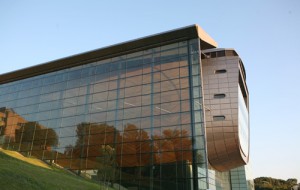
Ship in a bottle: EMPAC. Photo courtesy of Kris Qua.

No matter how many times I fly, there are several minutes while tons of metal lift dozens or hundreds of bodies into the air that I can’t help but think about death. Taxiing down the runway and watching heat pour from turbines of planes ahead of mine, feeling speed increase as we come closer to take-off and the cabin shake while we lift invokes pictures that I can’t deny. During a recent flight to Albany on a 57-seat plane, I sat just behind the wing and watched it vibrate against the force of frigid air through which it sliced, imagining what that wing would look like if it suddenly buckled and snapped off, the way the plane would lurch and twist downward with a deafening roar of violence.

As the thought continued rolling through my head, it attracted the germs of real anxiety and panic. My palms got clammy and my eyes darted around the cabin. The aisle seat one row up and over from me was filled with a man much farther gone, his hands trying to make themselves one with the armrests, jaw muscles wearing down his teeth. His back was rigid and sweat draped his temples. We’ve seen the same disaster movies, share the same shaky-cam perspectives of what a crash would feel and sound and hurt like.

Approaching Albany, and ultimately Troy, New York, to see an exhibition called Uncertain Spectator at the Curtis R. Priem Experimental Media and Performing Arts Center (EMPAC) of Rensselaer Polytechnic Institute, my awareness of anxiety was undoubtedly heightened because the catalog for the show told me there would be more to come. “Uncertain Spectator asks individuals to cross a threshold – to place themselves in situations riddled with tension, confront deeply charged emotional content, and grapple with feelings of apprehension.” Sounds fun, right? “The works presented deal with a general mood of uneasiness arising from recent political and economic events that frames a future rife with imminent threats. Uncertain Spectator not only responds to these unsettling situations, but also creates them by challenging individuals to step outside of a place of comfort both physically and emotionally.” In the interest of accepting that challenge, I spent a few hours with Uncertain Spectator and the night in Troy.

Continue reading »

Connecting – Part 6: Postscript and Postmortem

December 17th, 2010

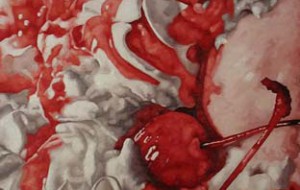
Pamela Johnson, "Ice Cream I," 2009. Oil on canvas, 54 x 34 in. Courtesy the artist.

After exhibiting at The Artist Project in 2008, Pamela Johnson’s American Still Life series began getting attention. Pepperdine University’s Weisman Museum of Art, Adler & Co. Gallery, and the San Francisco Fine Art Fair, all in Johnson’s native California, exhibited the junk food paintings, as well as Manifest Gallery in Cincinnati, the Susquehanna Art Museum in Harrisburg, PA, All Rise Gallery and the Union League Club in Chicago, among others.

Magazines including Juxtapoz, Creative Quarterly, Poets and Artists, and Chicago Home & Garden ran stories, interviews, and images. In November of 2009, Johnson was the recipient of the Alice & Arthur Baer Award as part of the 33rd Annual Beverly Art Competition in Chicago. Her art was being acquired by institutions and traveling the country, and a second wave of the American Still Life series was unveiled which used the same gorgeous technique and compositional strength to focus on the aftermath of consumption as set out in series one. First what we eat, then the garbage amassed when we’re momentarily satiated. Discarded M&M wrappers and crushed Coke cans, Starbucks cups and twisted packaging, half empty bottles of syrup and jars of strawberry jelly, crumpled bags of Doritos and boxes of Frosted Flakes; “empty wrappers forgotten and abandoned in a world of nothingness question the sustainability of our excesses,” in Johnson’s words.

Pamela Johnson, "Coke," 2009. Oil on canvas, 15 x 15 in. Courtesy the artist.

Pamela Johnson, "Cool Ranch," 2009. Oil on canvas, 20 x 20 in. Courtesy the artist.

Disposable plastic and paper that will linger on sidewalks, in gutters and landfills, and swirl in oceans for longer than anyone can guess. Though series two is less confrontational than the big in-your-face junk food canvasses, their poetic quiet sharpens itself against our habits more subtly than the larger pieces; Johnson gets you from both directions. The trash we create and ignore is yet another kind of evidence in the broader argument against mindless indulgence.

I found it somewhat ironic when considering art as evidentiary information against our less noble attributes that, in June of this year, I got an email from Johnson regarding Lyon and Lyon Fine Art, a New Orleans gallery she had sent several paintings to in 2008.

Continue reading »

Connecting – Part 5: Effortless

December 15th, 2010

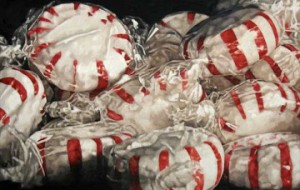
Pamela Johnson, "Starlight Mints," 2008. Oil on canvas, 26 x 40 in. Courtesy the artist.

During the film My Kid Could Paint That (2007, Sony Pictures), New York Times chief art critic Michael Kimmelman said:

I think the beauty of art is that it is in so many ways open-ended, and we should have this in life; there should be cultural things which allow us to add our own thoughts to them, to decide for ourselves whether we like it. But the truth is that a lot of people don’t want to have to bear that burden. We want to be told what we’re supposed to think, we want to be spoon-fed stuff, and the fact is that most of our culture is about that: making things convenient for us, instantaneously obvious, whether it’s fast food or bad television, it doesn’t really take much effort on our part.

I was literally typing the above paragraph moments before I first read about Steve Martin and Deborah Solomon at the 92nd Street Y. How their conversation was interrupted and redirected to suit the audience was a perfect real-time projection of what I had just transcribed, although Steve Martin’s audience at least expended the effort to voice their boredom.

(Artists may internalize this as evidence that art must be made worth the effort, able to capture your eyes, which is when they will undoubtedly aspire toward advertising. Not much else gets our attention for a whole sixty seconds. And when it does, Apple and Urban Outfitters make it hip and suddenly you live in this entire aesthetic built for you by someone you really don’t know so well. By the time art is reduced to advertising, it’s nothing more than an easily appropriated logo, as meaningless as Apple’s for the last 35 years, especially in comparison with their original logo, which referenced Sir Isaac Newton.)

Continue reading »

Connecting – Part 4: All spin of one kind or another

December 13th, 2010

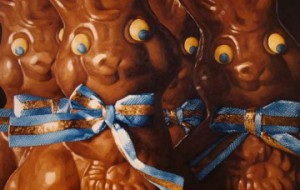
Pamela Johnson, "Bunnies," 2009. Oil on canvss, 46 x 50 in. Courtesy the artist.

Errol Morris said at a Chicago Humanities Festival Q&A in 2006, on the iconography of Abu Ghraib, that human stupidity is one of the only things he really believes in, which introduced me to a flippancy I wasn’t familiar enough with Errol Morris to expect or appreciate at the time. Maybe that stupidity manifests itself in my hope that a book or piece of art could change anything for the better.

After all, it’s not up to the book or the art. Either might be a sign of the times or maybe even a time capsule, but responsibility ultimately falls upon the sleepy shoulders of the audience who must be united and organized in action for any degree of positive social change to occur.  (Half the Sky is a book I would love to see work as a catalyst for such change.)

Morris also introduced me through his First Person series (2000, Bravo/IFC) to Christopher Langan, a bodybuilding former-bouncer who said:

You can’t run a democracy with a citizenry that really doesn’t know how to make valid decisions. Most people don’t even know what decision theory is, they don’t know what maximization of utility is. We live in a highly complex technological world and it’s not entirely obvious what is right and what is wrong in any given situation unless you can parse the situation, deconstruct it. People just don’t have the insight to do that very effectively. We have to have an educated and intelligent citizenry, which I regret to say we don’t necessarily have at the present time.

(Langan’s IQ reportedly hovers around 20 to 30 points above Einstein’s.)

The inability to parse or deconstruct a situation parallels popular support of industries and policies which fail to benefit the citizenry they claim to serve or enrich; auto and oil destroy ecology, fast food destroys the body, advertising destroys focus and attention span, yet we buy into all of it because we’re sold images and ideas of lifestyles we wish to emulate, objects we wish to possess. Nothing new there. Images which more accurately reflect the real terms by which we live don’t have nearly the momentum of Hummer or iPhone, perhaps because those culture-critical images are given to us by artists like Pamela Johnson, who you won’t find on reality television or endorsing shoes, which means you’re less likely to find her at all.

Continue reading »

Connecting – Part 3: Ceci n’est pas une Twinkie

December 10th, 2010

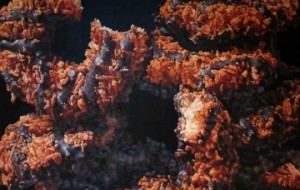
Pamela Johnson, "Girl Scout Cookies," 2008. Oil on canvas, 54 x 68 in. Courtesy of Pamela Johnson.

I asked Pamela Johnson about other people who had encountered the massive Girl Scout cookies or cheese and cracker Handi Snacks™, eager to know how they were received and processed through various memory banks, personal histories and social filters, and curious about what ideas came out the other side.

Some people totally get it and they usually get a bit of an embarrassed laugh out of the junk food. Then there is the large number of people that love the work because they love cupcakes, Pop Tarts™, or P.B.&J’s. At least their interest in the work opens the door to a conversation of why I paint huge piles of junk food. I think most people understand the excess of our culture, even if they are choosing to embrace that excess instead of being disturbed by it. I do get a lot of the ‘I know it is bad but I can’t resist’ sentiment. All of it makes me wonder if I need to push the work a little further.

Pamela Johnson, "PB&J II," 2009. Oil on canvss, 58 x 44 in. Courtesy of Pamela Johnson.

Pamela Johnson, "Burgers I," 2006. Oil on canvas, 72 x 32 in. Courtesy of Pamela Johnson.

The first time I saw the paintings, at The Artist Project in April of 2008 as part of Artropolis, Johnson told me that they even elicited nostalgia, memories of when mom would pack a cupcake or Ding Dong™ in a sack lunch and send you off with an idyllic Americana nudge out the door. Admittedly the sound of cellophane calls my own kidhood to the surface because I too used to get Little Debbie Oatmeal Creme Pies™ in my lunch, or, on special days, Swiss Cake Rolls™ which I would peel the wrapper away from and methodically eat the outer shell of, yes, waxy chocolate, only to unroll the spiral of cake centimeters at a time with my tongue, slowly devouring the whole thing as I went.

Continue reading »

Connecting – Part 2: Useful Junk

December 8th, 2010

Pamela Johnson, "House II," 2006. Oil on canvas, 44 x 36 in. Courtesy the artist.

Sometime in September of 2006, I came across the paintings of Pamela Michelle Johnson, vaguely oppressive canvases dominated by clouds of slate and steel gray, foregrounds indistinguishable from back, and expanses of heavy color upon which occasionally sat detailed tiny houses or which crawled white-knuckled women in a tensed-muscle distress of indeterminate origin, their heads turned down and eyes unseen.

Aside from striking me as beautifully thick with paint in the way of Gerhard Richter’s abstracts, I just didn’t connect with the work, couldn’t wrap my fingers around the images or project my own little world into them. They intrigued me and started me wondering about Johnson’s history, but I found the paintings inaccessible overall. I could stare at length at where colors touched and pressed themselves into other colors, but I couldn’t read their stories. In hindsight, it could be that the averted faces and cloud cover created an impenetrable wall, or that whatever those taut bodies were crawling away from somehow intimidated me or struck a chord I wasn’t ready or able to consider.

Pamela Johnson I connected with, however. She’s self-effacing and quietly eloquent in a way that made me realize she’s a lot smarter than me. Based on the quality of her painting, I was surprised to learn that she not so long ago had an entirely different profession. “I was an engineer until 2003, working on the construction side for Webcor Builders,” a full-service general contractor which has erected many of California’s important and environmentally responsible structures since 1971. She graduated from California Polytechnic with a B.S. in Civil Engineering and a minor with honors in art. While working as an engineer, Johnson was awarded a three-month residency at The Institute of Ceramic Studies in Shigaraki, Japan, which she said was “an amazing experience that came at a crazy hard time in my life.” She credits this period with being instrumental in changing her focus from engineering to art, which ultimately led her from San Francisco to Chicago.

Continue reading »

Connecting – Part 1: Art as Transportation

December 6th, 2010

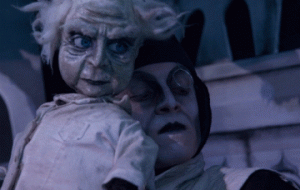
From "The Cabinet," 2010. Courtesy of Ryan Bourque.

There have been times in my short life when I’ve had the good fortune to witness something new and amazing, from births to deaths and the exhausting amount of possibilities in between. Incredibly, though far less frequent, as I bear witness I am momentarily granted insight, and I become aware of how whatever I’m experiencing engrams itself upon me by drawing some hidden, forgotten, or suppressed piece of me into the open air where I can pay it proper attention. In some cases, an image or phrase will act as a Rosetta Stone which makes sense out of my internal chaos and unifies what I once thought were disparate ideas.

Those moments of insight and clarity, fleeting though they may be, are what I enjoy talking about, and the added benefit is that talking about them keeps the moments in mind, which is where I need insight and clarity to be.

For example, I saw Redmoon Theater’s flawless production of The Cabinet, a puppetry-driven performance based on The Cabinet of Dr. Caligari, the 1920 German Expressionist film about a psych ward director who manipulates his somnambulant patient into committing murder, and two things occurred to me while witnessing this performance. First (and for the first time, really), I became acutely aware of how intricately tuned actors must be to each other – moving in unison down to the subatomic level – in order to create art; and second, I was compelled to project my own history into the spectacle. After the show, I couldn’t help but wonder how many people in Redmoon’s sold-out audience saw in The Cabinet, as I did, a snapshot of the feeling of their childhoods?

Continue reading »