A Day at Art Disneyland
As an homage to the recurring 36 Hours feature that frequently appears in the New York Times travel section, I have broken down hour by hour a recent perfect weekend at my new happiest place on earth:

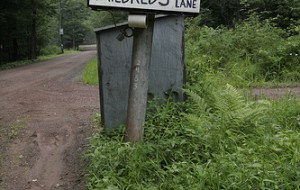
Welcome. Photo courtesy of Rebecca Fuller.
Running late for the four o’clock tour of Mildred’s Lane Historical Society grounds, I quickly made a left onto the red dirt driveway, which wound and curved around the rolling woodlands of the Delaware River Valley in upper Pennsylvania. As cell phone reception became a thing of the past, the drive opened up into a clearing on the 96-acre campus that contained an old barn, a bygone farmhouse dating back to the early 1800’s, and the amazing home of J. Morgan Puett, Mark Dion (Season 4), and their son Grey Rabbit.
As I parked, the car was approached by a woman in suspenders–the first of many pairs in this large-scale “living history” collaboration. Whereas the Skowhegan’s residency in rural Maine receives 1,643 applicants to be whittled down to 65 students for a nine-week summer residency, Mildred’s Lane is highly selective, accepting only 5 to 8 fellows a session, each of which must be recommended by the advisory board over two intensive three-week sessions. The young artists must gravitate towards a like-minded community, as the work-live-research environment experiments in combining all aspects of artistic life: researching, making, cooking, eating… We are so used to stories of the mythical solitary artist toiling away in the studio, that it’s a fascinating experiment to arrange the fellows into a focused, short-term collective, then release them back to different corners of the country. At times during the weekend, Mildred’s Lane was referred to as a museum, but in talking to Morgan she clarified that it is a “form of a new contemporary art complex(ity).”
The Pop-Up Book Academy: An Interview with Sam Gould of Red76

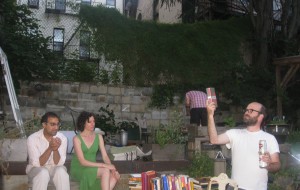
Sam Gould introducing Lize Mogel and Alexis Bhagat
Several weeks ago I found in my email inbox a listing of upcoming events produced by the Portland collective Red76. I regretted that scheduling would prevent me from catching all their activities during their East Coast events, but I would have been remiss if I had neglected to head north for the fourth installment of the Pop-Up Book Academy. Beside an active auto body shop in East Williamsburg, Brooklyn, I joined the audience for a conversation with Lize Mogel and Alexis Bhagat, author/editors of An Atlas of Radical Cartography, a compilation of 10 maps and 10 essays giving visibility to migration, surveillance, and globalization. (Previous Pop-Up Book Academy engagements involved lectures by Steve Lambert and Michael Rakowitz.)
Laid out on makeshift shelves of cinder blocks and plywood was a beautiful collection of well thumbed-through books on race, philosophy, cooking and art…and such assorted pop culture disasters as Confessions of an Heiress: A Tongue-in-Chic Peek Behind the Pose by Paris Hilton.
But, this assembly didn’t just focus on socialites. Since their founding in 2000, Red76 has invited diverse audiences for shared talks about ethical responsibility into non-traditional venues. Recent used spaces have included laundromats, YouTube, institutional settings such as The Drawing Center and Yerba Buena Center for the Arts, and various taverns across Portland. An aspiration for their events is to investigate the possibilities and viability of gray markets, channels for skill sharing to achieve communal self-betterment.

Pop-Up Book Academy #4
All proceeds from the night went towards Red76’s newspaper, The Journal of Radical Shimming, and profits exceeded expectations. The collective redistributed the funds to other liked-minded, free printed matter. Continue reading »
Réquiem, ætérnam dona eis, Dómine; et lux perpétua lúceat eis

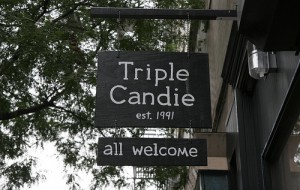
all welcome. Photo courtesy of Rebecca Fuller.
Immediately upon entering Triple Candie’s Harlem gallery you are greeted by a flamboyantly painted coffin lying on a bier, a memorial to an artist who, in many ways, defined the past decade’s guiltiest pleasures. For 49 years, Maurizio Cattelan’s endearing wit has provided instant gratification for a new generation of the global rich—he’s a favorite of oligarchs and industrialists. Was it the faltering economy that Cattelan couldn’t handle or was this a final performance a la Ray Johnson?
For the bereaved coming to say their final goodbyes, Cattelan has arranged for a decidedly optimistic affair. A small wooden tree with paper leaves grows out of the head end of the closed casket. Depending on your faith, this could be a sign of life after death, hope and resurrection—or perhaps it’s evidence of a hoax. Either way, you have entered a posthumous retrospective for an artist that you probably hadn’t heard had passed on.

Final resting place. Photo courtesy of Rebecca Fuller.
This is Maurizio Cattelan is Dead: Life and Work, 1960 – 2009. And if this were any other gallery, you would be scrambling for a newspaper, or more likely ArtForum, wondering how you could have missed the news of Cattelan’s death. Much in line with Triple Candie’s classic 2006 show, David Hammons: The Unauthorized Retrospective, this is a conceptual curatorial game and skeptical critics will assume the artist was on board or maybe even contributed to it–but not in this case. Continue reading »
No Nukes

Lisi Raskin, "Able Archer '83," 2008-09. LP recording, artist publication.
Four years ago, when using Google Earth satellites to zoom in on the roofs of our homes was all the rage, I was living in a Hudson River hamlet about an hour north of the city. In my one attempt to join the fun, my search resulted in aerial images depicting my regional topography as a massive black hole—the result of two military complexes and a nuclear power plant just down river. These facilities were not hidden in underground bunkers. Residents were not sworn to secrecy. Yet, national security did not permit me a peek behind the camouflage curtain. Certainly, virtual globes were not readily available in the mid-1970s, but if they had been, Lisi Raskin would have spent her childhood in a hefty Google Earth blank spot; she grew up a few miles from the Miami’s Turkey Point Nuclear Power Plant. Couple this with a memorable viewing of the post-apocalyptic made-for-TV movie, The Day After (1983), that imagined the cold war degenerating in full-scale nuclear holocaust and has fueled her artistic exploration of the military-industrial complex.
Over the past five years, Lisi has toured various facilities constructed throughout the Atomic Age. She spent six months as a resident artist at Bard College’s Center for Curatorial Studies rolling through places like the Davis-Monthan Air Force Base in Tucson, Arizona; Wendover Air Force Base in Utah; and the Nevada Test Sites in Las Vegas. Her engagement with the American frontier centers not on the lore of Manifest Destiny, but rather on a gloomy retelling of militaristic homesteading and recognition of unfortunate people who lived “downwind” of the radiation.

Lisi Raskin, "Wildlife Refuge," 2009 (exterior view), installation at the Athens Bienniale.
In this summer’s Athens Biennale, in the cavernous Esplanade Building built to host the 2004 Summer Olympics, Raskin cleverly depicts a disheartening scene. Her 18-foot-wide Wildlife Refuge (2009), parodies every environmentalist’s worst nightmare: green mountains hollowed out to conceal a bomb production facility. Call me naïve, but when I think of Colorado, it’s Tevas and granola, John Elway, and skiing that come to mind—a place as pure as the snow that dots the Rockies. But for nearly fifty years, the contamination leaking from the Rocky Flats plutonium plant inspired Jackson Browne and Bonnie Raitt to sing to a crowd of demonstrators until Congress agreed to transform the windy plateau back into a wildlife refuge and inspired Raskin to create this work. Clumsily constructed with wobbly painted plywood, the lines of the façade create a diagonal with several peek-holes leading down to the ultimate reveal. Greeted with an eerie dark purple light at the partially-sealed entrance, the viewer feels his anxieties rise at the sight of an empty headquarters and a Kodak slide projector shuffling through retro images of missile statistics, charts, and launch photos. There is a clue to the launch’s target: the Isle of Lesbos, a large Greek Island in the Aegean Sea, which caters primarily to lesbian tourists. Disturbingly, we are not allowed to trespass into the scene and are helpless to alert the islanders of the pending catastrophe.

Lisi Raskin, "Wildlife Refuge," 2009 (interior view), installation at the Athens Bienniale.
In the same year that included her international Biennale debut and stellar reviews for her solo exhibition at the Blanton Museum of Art, University of Texas at Austin, Raskin has suffered two setbacks. First, in mid-February her New York gallery, Guild & Greyshkul (a personal favorite of mine), shut their doors (she is still represented by Country Club Projects in Cincinnati and Milliken Gallery in Stockholm, Sweden). Perhaps an even greater disappointment: after the tremendous high from an invitation to participate in the 11th International Istanbul Biennial came the realization that the U.S. State Department has ceased funding all international biennials (with the exception of Venice).
Mütter on the Mind

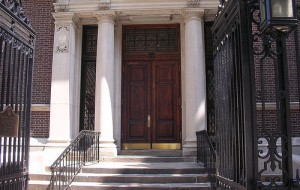
The entrance to the College of Physicians of Philadelphia, which houses the Mütter Museum.
It has been something of a guilty pleasure, but I have always loved off-beat museums. Here in Philadelphia, we have something of an embarrassment of riches: the Mummers Museum, which the Fancy Brigades keep lively on New Year’s Day; the cabinet of curiosities that is the Wagner Institute of Science; and there is even the Insectarium!, an all-bug museum with the largest collection of insects in America. But, the place every visiting tourist must not miss is the Mütter Museum at the College of Physicians of Philadelphia. Below is my love-letter to this house of wonders.

Making friends at the Mütter Museum: this guy's tattoos were based on an artifact in the museum. Photo courtesy of Rebecca Fuller.
I was never that concerned with the fact that my childhood experience did not include being a Boy Scout. Really, the pinewood derbies and jamborees just never sounded that appealing. That said, it would have been great to spend just one night in a sleeping bag, looking up from the floor at the bones spotlighted in the dark Dinosaur Room, during one of those nights at the museum. These days, though, I would totally trade in the Jurassic bones for the creepiness of the 139 human skulls peering from the shelves of the Hyrtl collection inside the Mütter Museum.

Just a few examples of the Hyrtal Skull Collection: 139 human skulls.
Even many locals are unaware of the oddities that lie behind the grand façade as they drive up 22nd Street on their way to Trader Joe’s. It’s a place where former employees have literally left pieces of themselves behind. Walking into the lobby of the oldest medical organization transports you into another time; it’s a cold, dimly lit, unsettling setting. As part of The College of Physicians of Philadelphia, recently dubbed the “Birthplace of American Medicine,” the Museum’s mission is first and foremost to be a resource to the aspiring physician, but their most vocal fans love the shock of the medical abnormalities. Many in the “oddities” subculture miscategorize the Mütter, grouping it with vaudevilles like P.T. Barnum’s sideshows and The Bunny Museum in Pasadena, when in fact it is more in line with the institutional purviews of David Wilson’s The Museum of Jurassic Technology or Corinne May Botz’s The Nutshell Studies of Unexplained Death. Yet as striking as they might be, every object in the vault is either cast from parts or actual specimens of the human body preserved in formaldehyde—far more ghastly then any Damien Hirst shark, cow, or sheep.
Summer Travelogue

Front door in Kerameikos
Upon arriving in Athens, several curious and helpful people gave me every warning to stay far away from the Kerameikos and Metaxourgeio neighborhoods, which was exactly where I was headed, for ReMap KM 2. Settled by new immigrants from Egypt, Iran, Afghanistan, and Lebanon, and dubbed Little Bangladesh, these neighborhoods are defined by poverty, drugs, petty crime, and prostitution.
Just as I was about to head into the first gallery, Nice & Fit from Berlin, a teenager came barreling around the corner, ran out into the intersection, and was gone without a trace. Six of Athens’s finest gave chase for a couple blocks before giving up the pursuit. Perhaps the bad reputation is sadly deserved. But there was a tremendously festive spirit that night. Hundreds of brave art appreciators were following maps, strolling between abandoned buildings where the 21 international galleries and 16 independent projects had set up squats. It felt like we visitors had set up a block party on derelict pedestrian streets after the residents had agreed to disappear for the night.
Many of us ended our tours at Breeder Gallery’s elegant new space at the end of the nearly empty Iasonos Street. Co-owner George Vamvakidis explained to me that these seedy blocks were once part of Athens’s most affluent neighborhood, the grand homes creating a romantic passageway. As the city expanded, younger residents moved to further out suburbs, their parents died, and the crumbling facades were left to decay. I asked George if it had been a good idea to relocate his gallery to oblivion. He said he liked the action the street gets—all types of action—and that the foot traffic increased as the city grew darker each night. As it turns out, the vast majority of the seemingly abandoned-looking buildings were far from empty. Rather, they had been adapted into brothels, woven into the massive web of Greece’s legal sex trade.
Early the next morning, when I returned to the area to take a few photos in the light, I found myself walking behind the only other person who was out and about. He was dressed smartly, with a polo shirt tucked into his jeans and I assumed him to be a fellow tourist, perhaps a gallery-hopping collector, as we were both fumbling maps while walking. Suddenly he stopped, looked left, looked right, steadied himself, and then bolted through the front door of one of the brothels. I was left alone in the middle of the walkway completely surprised.
Perhaps it isn’t so shocking, the intertwining of ad-hoc galleries amongst prostitutes. Certainly, artists have long investigated the links between the two ancient professions. Marlene Dumas famously wrote, “lf a Prostitute is a person / who makes it a profession/ to gratify the lust of various persons / for economical reasons or gain, / where emotional involvement may / or may not be present— / Then it seems not so far removed / from my definition of an artist.” And six years ago, Andrea Fraser debuted her video, Untitled. She had sex with an unnamed collector who had paid her $20,000, then displayed the bird’s-eye-view footage in galleries around the world. (The $20,000 apparently did not cover the full girlfriend experience. They commenced with intercourse, engaged in a bit of talk, and then exited to opposite sides of the frame.)
With great pleasure, artistic provocateurs have explored every angle of the sex trade, but my recent European vacation made me wonder about the exploitative nature of the art viewer. See, in full confession, not long after I saw the john in Athens, I engaged in my own degrading activity — only mine took place at the entrance gate of an art museum in Venice.
The best is not quite over…

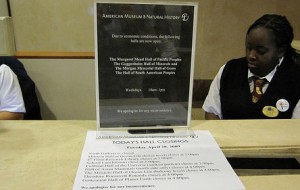
"Economic Times Hit The Nat Hist Museum" by uncleboatshoes on Flickr (http://www.flickr.com/photos/uncleboatshoes)
One of the first rules for the nouveau riche is to save a little for a rainy day. Unfortunately, in the doom and gloom that has come with daily announcements of museum staff layoffs, slashed exhibition budgets, and shrinking endowments, a common thread between the High Museum of Art, Kemper Museum of Contemporary Art, and the Art Gallery of Ontario, amongst many, many others, is an attempt to live beyond their means. Each institution emptied the piggy bank to take on an expansion, a downtown satellite space, or a $275 million Frank Gehry “Transformation,” respectively. And what exactly do we expect these new editions to become—international tourist destinations on the scale of the Guggenheim Bilbao? Above all, the greatest disservice trickles down to the artists, who are overshadowed in wake of the starchitect. Now without a staff to enliven them, these spaces will morph into nothing more than mausoleums of past ambitions and egos.
Most astonishing are the museums that are witnessing the current upheaval, yet seem determined to stay the course. The Isabella Stewart Gardner Museum recently laid off 12 employees while fundraising for a $140 million expansion; the Miami Art Museum has announced reduced operating costs, staff cuts, hiring freezes, and a mandate to host less temporary exhibitions, but will not let fear affect their upcoming $220 million (gorgeous) Herzog & de Meuron designed expansion; and, incredibly, the Art Institute of Chicago has taken creative solutions towards paying off their new $300 million “Modern Wing—similar to a bunch of college roommates in the winter, they’ve lowered the temperatures in the galleries to reduce their Exelon bill. Thankfully, not all institutions are living in the moment, as the St. Louis Art Museum, the Indianapolis Museum of Art, and the Austin Museum of Art have postponed groundbreaking ceremonies until the economy hits an upswing. The Parrish Art Museum, situated in the wealth of the Hamptons, set its eyes on its own Herzog & de Meuron, but director Terrie Sultan vows not to have a groundbreaking until 80% of the target has been achieved.
Is it really that catastrophic to downsize, consolidate, or collaborate with other nonprofits? How much programming must be sacrificed in the name of projecting an affluent appearance? Is it a sign of weakness for board members, trustees, and managing CEOs (the professional title that replaced Executive Director) not to have a sleek new Zaha Hadid or Renzo Piano? Sure, it’s not glamorous to endow operating costs, but without healthy nuts and bolts, the sensation of opening night will be unsustainable. We mustn’t forget that many of these generous donors who have been whispering dreams of expansion in the ears of directors are often the same hedge-fund Wall Streeters that helped propel us into this nationwide hangover. And this disingenuous promise that the new square footage be filled with revenue-generating cafes, bookstores, and rentable black box theatres—we cannot base the future of our cultural landscape on the nature of speculative retail. The greatest mistake a small-to-midsized organization can make is to grow beyond original institutional model. Perhaps this unbridled growth is just another example of the American Dream, but the ‘mom and pop’ museums seem to be weathering the storm with fewer casualties. Or, in the case of the Jacksonville Museum of Contemporary Art and Portland’s Museum of Contemporary Craft, these two smaller institutions have realigned themselves with universities to emerge from the recession on more solid footing. Eli Broad has neither the money or, I’m sure, the interest in bailing out museums across the country, and passing on costs through higher admissions in the midst of rampant unemployment is just unethical and contrary to most nonprofit missions. We all want the biggest and the best, but at what cost?
My fellow Americans, let’s roll.
On March 28th, Philadelphia hosted a day-long marathon dialogue on the intersections of art and the possibility of social/political change. The day’s events included a symposium on Curating and Activism at the Moore College of Art & Design and a local stop-over of Jeremy Deller’s It Is What It Is: Conversations About Iraq. Continuing from his last post, Daniel Fuller, Senior Program Specialist at the Philadelphia Exhibitions Initiative, recaps Deller’s project.

Photo by Tasha Doremus
After being obsessed for years with books and TV documentaries on the conflict in Iraq, Jeremy Deller conceived It Is What It Is: Conversations About Iraq, as a mobile museum that would bring the emphera of war to American towns. Deciding it would be disingenuous to preemptively respond to and articulate a partial history of an unfinished war, he decided to bring together those with first-person experience in Iraq to talk about it while others, including himself, listened. Deller admits, “I’m a nosy person.”
So, with the help of Creative Time curator Nato Thompson, Deller assembled a road trip crew. Jonathan Harvey, an Army Platoon Sergeant (and Philadelphia native); Esam Pasha, an Iraqi-born translator, artist, and journalist; and Lonnie, the road manager, joined Deller and Thopson and headed out on a three-week, thirteen city, cross-country tour. After nearly six weeks at the New Museum, the crew spent two days in the South—in Washington, DC, right on the National Mall and on the campus of Virginia Commonwealth University in Richmond. We were lucky enough to persuade them to make a loop up to Philadelphia before heading west to Cincinnati.

Photo by Tasha Doremus
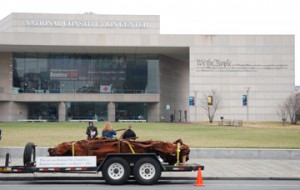
As soon as we broke for lunch, the vast majority of the Curating & Activism panelists and observers hustled out to the Parkway in hopes of hailing a cab to take us over to the National Constitution Center on Independence Mall. A visitor to this section of Old City on a Saturday afternoon is generally greeted by reenactors adorned in colonial costumes, Ride The Ducks tour quacks, and horse-drawn carts on cobblestone streets. On this particular day, as we pulled up to the Mall, we saw a Winnebago towing a demolished, burned-out car parked in front of the “We The People” wall of the Constitution Center. In 2007, a car bomb was detonated on Al-Mutanabbi Street in an intellectual and literary Baghdad neighborhood. The vehicle housing the bomb was obliterated, but the shell of a car we saw in Old City had been parked further down the same Baghdad street. Serving as something of a monument for the 38 people who lost their lives to that bomb, it was a heartbreaking visual spectacle.
During our short lunchtime assembly, it was great to see the project being received so sincerely by an audience of tourists patriotic enough to spend a day in the cradle of the American Revolution. Pasha and Harvey seemed completely at ease, putting faces and voices behind a country and war to which we Americans are all now inextricably tied. They engaged the viewers in a dialogue that connected to the sting of alienation some of us feel when we have no place to express our grievances. The pair was respectful to all exchanges, all ideologies, and offered in return the best straightforward, non-partisan responses they could provide given the messy, unresolved situation. The day was not about headlines sanitized through the media and it didn’t try to draw definitive conclusions. It was about direct connections with those that have survived the ongoing Iraqi violence.
As a nightcap, our entire symposium again trekked over to a packed Slought Foundation where we were treated to further explanation of the project and a question-and-answer session with Deller, Nato, Pasha, and Harvey. Throughout the conversation, the four maintained their mission was not a formal declaration of their stance on the war. Some audience members called this provocation and accused them of being morally bankrupt. Of course, as informed rational beings they each have a position on the conflict, but the RV—with its dreadful object towed behind—is not intended to be about them. They are presenters, impartial facilitators of dialogue. For me, it seemed in the end that whichever side of the issue you fell on—anti-war or pro-war (like the Catholic nun who stopped by the RV in the afternoon)—viewing the destroyed car would reaffirm your position. Perhaps the greatest benefit to this project has been for soldiers who were able to share unscripted, cathartic tales with others who have been through similar ordeals. As a civilian, watching from afar, I cannot begin to fathom coming to terms with the aftermath of their job. A video on the project’s website (where you can follow the project’s cross-country trail) shows a college-age veteran calmly trading horror stories with Pasha and Harvey as his girlfriend quietly, uncomfortably, stands by. It is clear as you watch her face that he is telling stories she had never heard—that what he is sharing are things he thought he shouldn’t burden her with.
As Harvey pointed out, military humor is macabre, its darkness a coping mechanism and a way of distancing soldiers from the situation. They have a special way of looking at their job—to “keep rolling,” to “stay the course.” Even in the dimness of violence, “it is what it is.”
Curating and Activism at Moore College of Art & Design
Daniel Fuller, Senior Program Specialist at the Philadelphia Exhibitions Initiative, recently helped organize the Curating and Activism symposium at Moore College of Art & Design. The following is a recap of a day of public conversations, on issues of responsibility, and a short interview with the artist Sharon Hayes.

From L: Martha Wilson, Lorie Mertes, Steve Kurtz, Adam Pendleton, Sharon Hayes, Stamatina Gregory, Srdjan Jovanovic Weiss, and Michael Rakowitz. Photo by Gabrielle Lavin.
This past fall, when Janet Kaplan and Lorie Mertes first approached us at the Philadelphia Exhibitions Initiative about co-organizing a symposium on curating and activism, it was an exciting time. Ours: Democracy in the Age of Branding was at Parsons, Creative Time’s Democracy In America: The National Campaign was coming to a conclusion at the Convergence Center at the Park Avenue Armory, and Elizabeth Peyton was hustling to add her portrait of Michelle Obama to the New Museum retrospective. Everyone was gearing up for a historic election and there seemed to be a massive groundswell of grassroots organizing, both in the art world and everywhere else. The times have certainly changed since we first started planning the symposium, and that Saturday’s symposium was about how to maintain the level of fervor that propelled so many to the streets in the lead-up to November.
We conceived of a series of grouped conversations that would examine multiple ways in which curatorial activities can be directed toward social and political activism. The three panels included:
Curating and Self-Organization—Facilitating Interactions
featuring Katherine Carl/Srdjan Jovanovic Weiss + Michael Rakowitz + Carin Kuoni
The Project of Performance—The Body and the Public
featuring Sharon Hayes + Adam Pendleton + Martha Wilson
Models of Participation and Modes of Activism
featuring Stamatina Gregory + Steve Kurtz + Anton Vidokle
By bringing architects, artists, curators, and academics to the table, we hoped to provoke various opinions and strategies on how to effectively navigate the power dynamics involved in curating for social change. The general themes which seemed to be revisited with each panel were thoughts on participation and accidental activism. We repeatedly listened to a number of approaches to finding loopholes in the language of the law.
In regards to the battle for empowering “calls to action,” Martha Wilson got the crowd’s attention early when she declared that, “all art should be activist art and that all other is crap,” but Anton Vidokle made a plea for artists to be “radical,” not just use the “wishy-washy” term “activist,” saying that he sometimes goes to demonstrations “not as an artist, but as a person.”
In the aftermath of the symposium, I was able to reconnect via email with one of my favorite artists for a little follow-up question-and-answer. Coming of age in performance through identity politics in the downtown dance scene, New York-based Sharon Hayes works in performance, installation, and the production and perception of linguistics. Her staged speeches create opportunities to re-present the theater of politics in yesterday into contemporary public spaces. Her recent project for Creative Time, Revolutionary Love 1 & 2: I Am Your Worst Fear brought together 100 performers from the gay, lesbian, and transgendered communities of Denver and St. Paul to simultaneously read a love letter outside of the Democratic and Republican National Conventions. The script employed confessional texts from the Gay Liberation movement of the 1970s to confront audiences through a critical examination of love and war.

Sharon Hayes, Martha Wilson, and Lorie Mertes, Rochelle F. Levy Director & Chief Curator of The Galleries at Moore. Photo by Gabrielle Lavin
Daniel Fuller: This will be a bit out of context, but I’d like to quote you from Who Cares: “War changes everything and nothing.” Six years after the invasion of Iraq, it seems as though Obama’s exit strategy includes leaving through Afghanistan. As this or these wars drag on, so many become numb to the situation–as something going on “over there.” How does the probability of these wars being further extended impact or influence your work? Do you also find this numbing or is it strangely inspiring or reinvigorating to your artistic work?
Sharon Hayes: To me, a citizen of the U.S. whose government and military have been occupying, bombing, and leveling sanctions on Iraq and Afghanistan to greater and lesser degrees for my entire adult life, the continuation of these policies and activities are never inspiring or reinvigorating. On the other hand, I also wouldn’t say that the Obama administration’s plan for Afghanistan causes me numbness. Rather, I must admit I am perplexed and anxious, perplexed as to why Obama decided to escalate the fighting there and anxious about the impact it will have on the people in the region, the project and efforts to close Guantanamo, etc. In terms of my work, I have felt the need since the inauguration of Barack Obama in January, to work collectively with friends and colleagues to read, write, talk and think about the change (because I think it is a change) that Obama brings and brings to our work as artists.
DF: It’s been said that activism too often begins behind a computer, but if it stays there, it’s dead. Is participation, real live participation—a gathering in a town square—already a form of activism?
SH: I remember you asking this to the last panel and what popped into my head immediately then and still sticks now is NO! Participation, in and of itself, is not activism. People participate in activities, conversations on the internet, baseball games, college basketball tournaments, paint ball games, etc…and these things are not activism just because of their participation in them. It seems by “a gathering in a town square” you are already placing the frame of some political engagement onto your hypothetical scenario, but even still, going to a town square meeting that John McCain organizes during his presidential campaign is also not activism—political participation, sure. And perhaps many people who attend consider themselves activists in other facets of their life, but their attendance pure and simple does not, in my mind, constitute activism.
What your question begs is a clarified definition of activism, which is one of the questions and needs that came up on Saturday. Someone else can offer an abstract definition of activism. I can say the kind of activism that I am interested in is collectively engaged, potentially disparate, fragmented, and even pathetic activities whose aim is to increase the ability of poor, disempowered, disenfranchised, marginal groups and individuals to live lives that are safe and fulfilling to them and to resist the powers that decrease and impede on such safety and fulfillment. That includes increasing the access we all have to the resources we need to maintain a shared healthy, safe, and fulfilling set of lives over time.