Obama Special, Part 2

February 19th, 2009
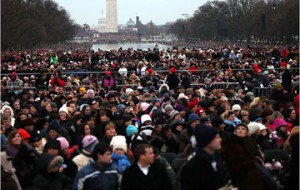
Photograph of President Obama's inauguration by Doug Mills/The New York Times.

Photograph of President Obama's inauguration by Doug Mills/The New York Times.

This continues my previous post about the laptop DJ/performance artist Girl Talk, in which I situate him in a lineage of intersections between art and music and suggest a link between his concert on November 16, 2008 at Terminal 5 in New York and the election of Barack Obama a week and a half earlier.

Girl Talk’s referencing of Obama through video projections at this performance made explicit his connection with the then-president-elect—not a personal but a formal affinity. The form in question is, simply put, miscegenation: the elimination of difference through the blending of categories. This form was stressed throughout Obama’s campaign, both as a personal attribute of the candidate himself and as his fundamental message that he would transcend Bush-era ideological polarization and unite the country behind common goals. Likewise, in Girl Talk’s mixture of fragments of highly recognizable popular songs, different genres coexist in delirious combination—an effect exploited in his concerts, in which the crowd is invited onstage to take up the role of performer. This is from the opening moments of the 11/15 show at Terminal 5:

You need to a flashplayer enabled browser to view this YouTube video

Why compare an arty DJ and our current president? To make a case for the value of art that entertains.

Continue reading »

International Geographic: Interview with Nato Thompson

January 31st, 2009

* Revised February 4, 2009.

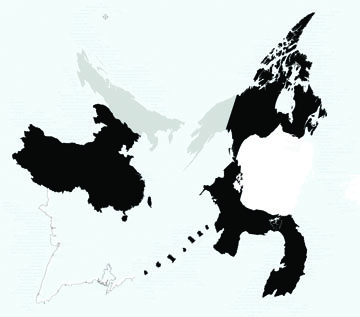
Lize Mogel, Mappa Mundi, digital print, 2008. Courtesy Melville House.

Lize Mogel, Mappa Mundi, digital print, 2008. Courtesy Melville House and iCI.

Melville House and iCI recently co-published the exhibition catalogue for Experimental Geography, an exhibition of contemporary art that engages geography organized curated by New York-based Nato Thompson and organized by iCI. It will be on view at the Rochester Art Center in Minnesota from February 7 to April 18 and then travel to other institutions. The following interview about the project was conducted with Thompson over email.

Daniel Quiles: How did the idea for the Experimental Geography exhibition come about?

Nato Thompson: I have long been a friend and colleague of the artist Trevor Paglen, who has been quite influential in the development of this practice. As an artist and geographer, he is often borrowing from these fields in order to produce methods for interpreting space. As much as the world at large still believes firmly in the categories of the Enlightenment, such severe distinctions between fields of study can be unhelpful if not absolutely misleading.

Looking around the contemporary art world today, we find numerous practices interested in experimental methods for understanding space itself—from the important work of the Center for Land Use Interpretation in Culver City, California, to the experimental walking tours of Francis Alÿs in Mexico City, to poetic interpretations confounding body and place such as with artist Ilana Halperin. The practices are out there and it felt as though the often used lens of art history was simply clunky in interpreting this work. So the exhibition is an opportunity to construct a new lens from an emerging form.

Trevor Paglen, The Salt Pit (Shomali Plains northeast of Kabul, Afganistan), Chromogenic print, 2006.

Trevor Paglen, The Salt Pit (Shomali Plains northeast of Kabul, Afganistan), Chromogenic print, 2006.

DQ: A number of the artists and collectives involved in the show trace their roots back to Chicago, in particular the School of the Art Institute of Chicago,and some of whom were featured in the recent group exhibition you curated at the Armory, Democracy in America. How would you say the Chicago milieu conditioned the formation of some of the practices outlined in Experimental Geography?

NT: Well I will admit I went to graduate school at SAIC and also remain an avid admirer of the non-object-based collectivist practices that have been maturing in Chicago for over a decade. Artist and activist Daniel Tucker started a phenomenal journal titled AREA, which looks at urban space in Chicago from a variety of lenses including art but also those of race, gender, policy, minority histories, and on and on. This magazine has allowed numerous communities to come together under the specific frame of the city they live in. It’s a compelling umbrella that has many associations with Henri Lefebvre’s approach to geography in the 1950s.

But I should also say that the Center for Urban Pedagogy based in Brooklyn is doing important work as well. In their case, they are focusing on pedagogy and urbanism. And then we would also have to look at the incredible work of the Italian collective Multiplicity, who utilize aesthetic considerations of contemporary art to interrogate specific spaces from the Mediterranean Sea to Israel and Palestine.

.The Center for Land Use Interpretation, Project Poster, Inkjet Print, 2007. Courtesy Melville House.

The Center for Land Use Interpretation, Project Poster, inkjet print, 2007. Courtesy Melville House and iCI.

DQ: What is the place of form in contemporary art that is so closely wedded to other fields, such as journalism or activism? Do you feel that the traditional opposition between “form” and “content” still holds, or that contemporary artists have found new ways to integrate them?

NT: As much as the onslaught of cultural production over the last fifty years has radically altered capital’s relationship to aesthetics, it has also made us much more aware that knowledge has a form, and that there are a myriad of forms for the delivery of information and the production of knowledge. Basically, knowledge is a performance, whether it is the stage of the classroom, or the aesthetics of a typeface in a book, to the performance in a street, to a multi-channel video projection. Now that many forms of anthropology and geography tend to be more reflexive, we find more room for ambiguity, which typically is the purview of artistic practice.

There are many types of work in the exhibition, ranging from some that are deeply poetic while others are slightly more didactic. These approaches can still remain under one umbrella but their sense of urgency and their techniques of information delivery vary.

Continue reading »

Artiste Avec Des Frontières

January 29th, 2009

Ana Blohm, West 171st, archival pigment print, 14 in x 9.3 inches, 2006.

On February 5, the New York University Hospital Library will host Interior Life, an exhibition of Ana Blohm’s photographs. They consist of geometrically organized shots of spare interiors, typically with beds and couches in the foreground and isolated details of decoration, such as framed pictures or light fixtures.

Ana Blohm, West 192nd, archival pigment print, 14 in x 9.3 inches, 2006.

Born in Venezuela and based in New York, Blohm’s work represents a complicated case. She is a working doctor at Mount Sinai Medical Center who trained in photography (with Jack Lueders-Booth and Chris Killip) while studying biology at Harvard University. Her images document the interior spaces, with their drably functional objects, of the East Harlem and Washington Heights residents who are her patients. Sinai is one of several institutions currently pioneering programs that restore the “house call,” or home visit by a physician, in an attempt to save resources and manage chronic illnesses outside of the hospital.

Ana Blohm, West 128th, archival pigment print, 14 in x 9.3 inches, 2008.

Blohm represents an important limit case for art. This is an artistic practice that is an offshoot of medical labor. Unlike the many practices of the past two decades that have been labeled “relational” or “service aesthetics,” the service here is resolutely in the category of “not art.” Art is only produced at the point at which Blohm feels the impulse to represent something, in a mode of representation that is not of conventional use for medicine.

Ana Blohm, West 187th, archival pigment print, 14 in x 9.3 inches, 2007.

In some cases, Blohm includes her subjects in the photographs. As in the above image, they are turned away from the camera, refusing its gaze. It is here that the difficulty of her project is most apparent. In the instant of the photograph, she is no longer a service provider, but a documenter of a normally invisible group. Representation is not, in the end, the beneficial service that medicine is ideally supposed to be; it is not “for” someone, but “of” him or her. Art takes something, and brings into view for others. It is in precisely this sense, however, that art might be of use for medicine itself, offering a moment of self-reflection on the who and how of treatment.

Obama Special, Part 1

January 26th, 2009

What follows is just a bit late for the inauguration, which is appropriate. It is essentially old news.

Let’s start with the “Flash Points” question of the week: how can art effect political change? I worry that this question is a bit loaded. Ordinarily useless and “unreal” art is placed in a subservient position to political “reality,” which demands use value from cultural production. Art has to “do” something for politics; it has to serve the political. But one finds that the political “does” politics much more directly and efficiently than art. Thus the question is whether we can take art and aesthetic experience on their own terms, as valuable in themselves. I am not arguing for a conservative notion of “art for art’s sake,” but a more paradoxical proposal: art’s political contribution is found in art itself, in art’s ways and means. So, to rephrase the question: what does art do with politics, or alongside politics? What is its value as a parallel practice that perhaps intersects but never fully becomes politics (at which point it would cease to be art)?

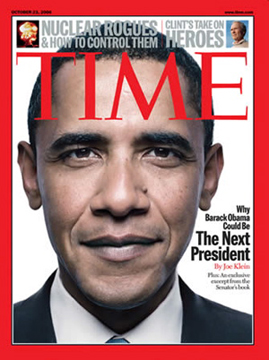
Time Magazine, Barack Obama cover

These are big questions, and I’ll spare you their exhaustive discussion within art history and criticism. Instead, I offer an example that I see as relevant to the present shift in American politics. At a Girl Talk concert at Terminal 5 on November 16, 2008, an image of Barack Obama on the cover of Time magazine was insistently and repeatedly projected on a screen behind the performance. This was more, I contend, than a crowd-pleasing gimmick a little more than a week after the euphoric outcome of the presidential elections. Girl Talk, a.k.a. Greg Gillis, was connecting his form—that of his music and performances—with that of our new political world, and its leader.

Terms for a debate over the canonization of postwar intersections of music and art are now coming into view. On the side of an interdisciplinary redefinition of “high” art is Branden Joseph’s recent book, Beyond the Dream Syndicate: Tony Conrad and the Arts after Cage (A “Minor” History), which positions the artist, filmmaker, and musician Conrad as a profoundly influential figure in postwar cultural production, albeit one who kept a quite consciously low profile to avoid assimilation into late-capitalist “spectacle.” Joseph’s approach represents the austere side of the debate in privileging works of art that look critically at their own means of production, and in the process unveils a wealth of relatively overlooked collaborations between artists and musicians. The effect of this text has been swift; Conrad is featured in MoMA’s latest reconfiguration of its contemporary collection.

Conrad, along with his frequent collaborator Tony Oursler, also appeared in Sympathy for the Devil: Art and Rock and Roll Since 1967, an exhibition of collaboration between artists and musicians and art-about-music curated by Dominic Molon, that recently ended its run at the Musee d’Art Contemporain in Montreal after opening at the Museum of Contemporary Art in Chicago last year. In contrast to Joseph, the curators’ understanding of appropriate material here was far more democratic (although it was an conspicuously white selection of musicians, lascivious Funkadelic posters notwithstanding), ranging from promotional posters and album covers designed by artists to Dan Graham’s video Rock My Religion, from art star Christian Marclay’s use of records and record covers as materials to the ‘zine production of Throbbing Gristle in the 1970s, which bears a striking incorporation of conceptual art’s design and humor. Molon gave equal time to both experimental and popular music, treating both as fair game for artists.

If Joseph relies on the caché of the “experimental” to separate Conrad out from a crowd of interlopers between art and other fields of cultural production, Molon places his faith in the interruption, through aesthetic contemplation and the creation of a “work,” of the immediacy or myth that allows popular music to operate and dominate consumer taste. Art (or the figure or imagined intellect of the artist) mediates, as “not-music,” between music and the listener. Both projects speak to the staggering volume of material that is only beginning to be unearthed in the interstice between contemporary art and music.

Image from the final Terminal 5 show, November 18, 2009

Within these coordinates, Girl Talk presents a “problem.” He is an increasingly popular figure (the categories of “musician,” “DJ,” or “artist” do not quite fit) who uses avant-garde aesthetics to produce highly accessible music and a mode of performance grounded in ecstatic and collective immediacy. In short, he enters the forbidden territory of “fun” anathema to many cultural critics, for whom all forms of leisure are mere complicity with the overarching capitalist machine.

Continue reading »

Back to “reality”

January 22nd, 2009

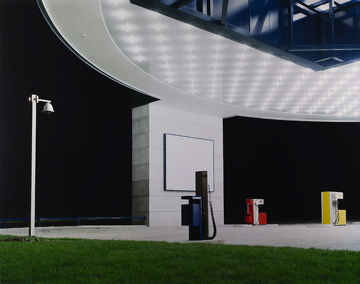
Julian Faulhaber, Tankstelle [Gas Station], Chromogenic print, 2008, courtesy The Metropolitan Museum of Art, New York

Reality Check: Truth and Illusion in Contemporary Photography, curated by Mia Fineman, is currently on view at The Metropolitan Museum of Art in New York, where it seems intended to serve as a counterpoint to the nearby 19th-century galleries and typical Met fare such as Art and Love in Renaissance Italy. The show unites heterogeneous tendencies in contemporary photography under the banner of a play between reality and illusion, one perhaps inspired by post-structuralist discussions of the unreliability of the photographic document in the 1970s. While there are some examples of portraiture, the dominant genre here seems to be landscape, and in particular the alienated “late capitalist” landscape of corporate architecture, malls, gas stations, and the like that has been a point of fascination for a number of German photographers, some of whom studied with Hilla and Bernd Becher at Künstakademie Dusseldorf.

Where the Bechers spent many years making serial black-and-white photographs of defunct industrial architecture that foreground the photograph’s status as a document of what was before the camera, their more recent inheritors, among them Frank Breuer and Thomas Demand, have created a body of images in which either real spaces appear unreal or fictional spaces are made to look believable. While Demand typically photographs models of indoor spaces, a number of these artists engage landscape photography. In Julian Faulhaber’s Tankstelle (Gas Station) (2008) above, a newly completed gas station looks like an enlarged Lego set; the photograph is used against itself to produce a glossy world that could not possibly be populated by human beings. These photographers have frequently praised for their savvy questioning of photographic truth and confrontation of the hyper-real alienation present in our contemporary land- and cityscapes.

In this quasi-canonization at the Met (all the works on view are in the Permanent Collection), one is particularly aware, however, of just how painterly these large-scale photographs are, and how elegant. Their proximity to the austerity of Ingres and Whistler feels appropriate; art, it would seem, still prizes the same values of pristine pictorial organization and sober contemplation. The “alienation” of the contemporary world, it would appear, is merely a requirement to get in the door. The truth is that no matter how depopulated, how overrun by capital, this “postmodern” world of ours can still be made to look beautiful and thereby hang on the wall; a source of comfort, however cold.

It was therefore a relief to me to find the image below, Israeli photographer Shai Kremer’s Panorama, Urban Warfare Training Center, Tze’elim (2007), included in the show. It is here that a different sort of “reality” intrudes: that of the political present. Kremer has photographed Baladia City, a site used for military training by the Israeli Army (built with U.S. funding) that simulates an entire Muslim urban area, complete with apartment blocks and minarets that play recordings of prayers. Sampling the 19-century tradition of the panoramic image and utilizing the minarets as a central vertical around which the shorter buildings seem to pivot, Kremer organizes our vision through a history of earlier images of cities. The eerie lights in place of windows in the minarets signal the simulacrum at hand, yet at the moment that we intuit the unreality of the site, we cannot help but think of the real lived spaces and their inhabitants upon whom this training will, and has, been used. It is only a slight shift to move from aseptic spaces that banish human presence to focus on the literal violence implicit in certain false landscapes. The power of the documentary photograph is thusly restored within this very back-and-forth between real and unreal. Here Kremer has lit a path by which sophisticated photographic techniques might inform a new hybrid of art and journalism.

Shai Kremer, Panorama, Urban Warfare Training Center, Tze’elim, Chromogenic print,

Hello

January 20th, 2009

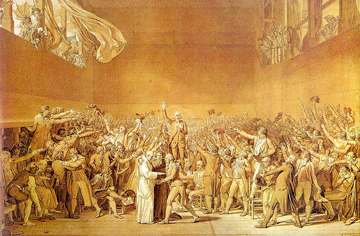
Jacques Louis David, “Oath of the Tennis Court,” pen washed with bistre and white highlights, 1791.

Hello everyone. I’m writing on an enormously significant day not only for United States governance and politics, but for its future cultural production as well. It is no great leap of faith to note how many key shifts in art have resulted from major changes in political context, and one can only hope that the present one is both dramatic and positive for the creative worlds that we hold dear and rely on for insight.

In my week-and-a-half of guest blogging, I will be endeavoring to shed light on practices and trends that highlight ways in which art is at present intersecting with other fields of production. I will also do my best to report on some of the best exhibitions currently taking place in New York City, where I am based.

A longer entry is coming tomorrow. For now, enjoy the inaugural glow!