A better “we” through art? AREA Chicago’s Daniel Tucker on art and community

March 6th, 2009
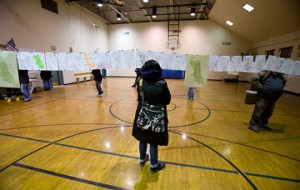
"Notes for a People's Atlas of Chicago" exhibition of Chicagoan maps of the city. Photo By Jason Reblando. 1-15-09 opening at Wicker Park Field House, Chicago.

"Notes for a People's Atlas of Chicago" exhibition of Chicagoan maps of the city. Photo By Jason Reblando. 1-15-09 opening at Wicker Park Field House, Chicago.

This post is written as a dispatch from California, where I was at the College Art Association conference and speaking in classes at CalArts, SFAI, and the CCA Social Practices studio.

Initially when invited to contribute, I was challenged by the prompting question, “how can art effect political change?” because of how broad it was and because I didn’t think that I could begin to address that in one short post. It is one of the central concerns of my work. But the challenge was interesting and offered an opportunity to try to communicate (somewhat) concisely some of the lessons I’ve learned from many years of practicing socially engaged art at various levels.

Off the cuff, I should be clear that I work in many different places and in many different ways, which strongly influence my ideas (hence my forthcoming eclectic listing and ranting). Most often the place is in Chicago, and the most consistent method or form I work in has been a biannual publication, AREA Chicago. I also find myself working on numerous other projects simultaneously. That diversity of tactics and approaches is both informed by my life situation, which requires me to work in different ways and different places to earn a living. It is also a recognition of the fact that there are limits to all forms and there is much to be learned by trying new ones. So you’ll find on my website that my time is also spend writing essays, organizing conferences and exhibitions, lecturing extensively, and working on various kinds of documentary and research projects.

Last Wednesday, while speaking on a panel discussion entitled “Relocating Art and its Public” at the CAA conference here in LA, I was compelled to think through the work that I care about and am involved with as it relates to audiences and participants. I realized I could not clearly talk about any of this without spelling out what kind of relationships I wanted to have in this world, in a broader sense. That is not to say that the work I’ve been involved in has always succeeded in creating those relationships which I desire and want others to have. But the work that I do is so informed by a political concern about people’s potential to self-actualize in a world which stifles that possibility that I have to be up front about it. This is how I intend to address the question posed on this blog.

I concluded my presentation by recounting the provocation put forth to me by my friend Chris Carlsson in San Francisco: that the challenge for those opposed to capitalism and in favor of a different (“anticapitalist”) organizing principal for life and economies is to take the “anti” part of our perspective and make it into something that we can all strive for together. A further elaboration would be that a challenge for anticapitalist cultural work is to articulate and represent a life better than the competitive and commodified social relations that currently dominate how most of us relate to one another. One step in that direction would be to create contexts that allow us to see our relationships in ways that both benefit from our diverse experiences and insights needed to face everyday challenging situations, and that also allow us to be powerful enough together through organization so we can tackle the big stuff we all face. I honestly think that most of us barely know what free feels like or looks like. We need each other to figure out how to know how to get there. In the last eight years, most of the projects that I have been involved with  have had some component that was about articulating a different kind of “we” or collective toward the ends described above. Admittedly, they are on a pretty micro scale. To the extent to which any transformed social relations are actually realized, the impact beyond the people directly involved is limited, rendering it primarily symbolic and experimental.

DSLR Call For Participation Spring 2001. For more information about DSLR and other critical public art in Chicago from 2000-2005 see "Trashing the Neoliberal City" bookley (free download) by Tucker/Forman at http://www.learningsite.info/trashing003.htm

DSLR Call For Participation Spring 2001. For more information about DSLR and other critical public art in Chicago from 2000-2005 see "Trashing the Neoliberal City" booklet (free download) by Tucker/Forman at http://www.learningsite.info/trashing003.htm

I’ll now summarize few of the events with which I have been involved as a participant or organizer that have tried to articulate a new or different “we.” The first is the Department of Space and Land Reclamation (DSLR), which took place in Chicago in April of 2001. The “campaign”  was organized through an open call for participation circulated in email and via heavy postering throughout the city. It asked for people who are concerned about the state of public space in the city to come together and launch a coordinated and highly visible collective effort to highlight potential uses for public space, as well as to articulate criticisms or protests about how space was being controlled. This took many forms. Some were quite playful, such as poetry slams on El trains or ladders leading to nowhere placed on fences to suggest potential over-comings or transgressions. Others asked neighbors to sign petitions in order to get sidewalk kiosks to be accessible to everyone, not just real estate developers. There were over 70 similar small scale temporary initiatives that took place throughout the city that weekend. The effort, like so many complex social projects that involve people from many political persuasions and cultural backgrounds, had its successes and failures. One general success is that temporary space, opened up through coordinated space reclamation, allowed for housing activists, graffiti writers, urban planners, activist educators, pirate radio broadcasters, and critical artists to see themselves in relation to one another through a shared concern about public space in Chicago.

The DSLR spawned many relationships and catalyzed many new projects that continue to this day. By 2005, some of the folks who met through that work, along with others with overlapping interests, got together to develop the biannual publication AREA Chicago, of which I am still an editor. AREA has built on this methodology of creating a lens through which various practitioners and concerned citizens of the city can see themselves in relationship to one another. We have done that through 8 “local reader” publications, the collection of hundreds of hand-made personal maps about subjective experiences of the city into an archive entitled “Notes for a People’s Atlas of Chicago,” as well as over 50 events in the last 4 years.

Continue reading »