Fabricating the DNA Fingerprint

September 13th, 2009
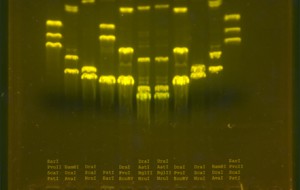
Paul Vanouse, “Latent Figure Protocol”  Figure was produced with the DNA of bacterial plasmid pET-11a.  Enzymes used to process the DNA are listed in each column.  Image produced December 06, 2006. Courtesy of the artist.

Paul Vanouse's “Latent Figure Protocol" was produced with the DNA of bacterial plasmid pET-11a. Enzymes used to process the DNA are listed in each column. Image produced December 06, 2006. Courtesy of the artist.

The most exciting moments of the intersection of art and science, for me, are when artists’ use of scientific materials and methods reveal new aspects of their media. Genetic evidence is becoming increasingly important in both winning and overturning criminal convictions, yet the methods used to produce this evidence have been found to be inconsistent and subject to error and manipulation. In Paul Vanouse’s Latent Figure Protocol (2007), artistic self-reflexivity is transformed into an imminent critique of the methods of DNA fingerprinting. While such fingerprinting is conventionally used to create an image that uniquely identifies a person, Vanouse uses the same molecular biological techniques to create images that are – literally and figuratively – generic. For example, a copyright symbol is created as an apt “portrait” for an industrially produced microorganism whose genome has been patented.

Paul Vanouse, “Latent Figure Protocol,” Performance still: explaining DNA imaging process. ARS Electronica 2007, OK Center, Linz, Austria. Courtesy of the artist.

Paul Vanouse, “Latent Figure Protocol,” performance still explaining DNA imaging process. ARS Electronica 2007, OK Center, Linz, Austria. Courtesy the Artist.

Latent Figure Protocol is a live demonstration of the process of producing these images, which Vanouse performed most recently at Exit Art. Video documentation of the experiment is now available online. His presentation mirrors that of a professional scientific research paper, including a detailed description of his materials and methods, images and diagrams of the results, and a discussion of the implications he draws from the data. Vanouse’s reserved performance ironically deploys his own technical expertise in the service of the critical goal of the project which, in his words, is “to downgrade the scientific authority of the ‘DNA fingerprint’ to the status of a ‘portrait’ (an association aided by my own status as ‘artist’ rather than ‘scientist’).”

The force of the artwork lies in Vanouse’s sophisticated and unconventional use of DNA testing techniques. He summarizes his methods as follows:

Continue reading »

Hybrids

September 11th, 2009
Vesna_NewMitosis

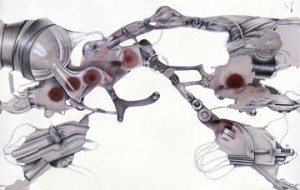
Vesna Jovanovic, "New Mitosis," 2008. Ink spills, graphite, pencil. Courtesy the Artist.

In an exhibition currently on view at the International Museum of Surgical Science in Chicago, artist Vesna Jovanovic both courts and antagonizes the intersection of art and science in the role of the medical illustrator. In this traditional division of labor, science provides the content and the standards of representation, while art serves as the means of communication. Where other artists have inverted this relationship by employing scientists and scientific techniques as means for producing novel artifacts [such Eduardo Kac's transgenic organisms or Gary Schneider's Genetic Self-Portait (1998)], Jovanovic works within scientific conventions of realism to explore how they have been internalized and how they might be transformed by artistic practice.

This year’s exhibition of Anatomy in the Gallery, on view until October 16, juxtaposes work by students and faculty from the University of Illinois – Chicago’s Biomedical Visualization program with Jovanovic’s series of drawings based on ink spills, Pareidolia. ‘Pareidolia’ is a psychological term for the common tendency to perceive order or significance in random visual or auditory stimuli, like seeing the shapes of animals in clouds, or faces in the moon. Jovanovic uses ink spills, like rorschach tests, for exploring the ways in which scientific imagery and concepts reside in our collective unconscious—where, it seems, medical instruments, chemistry equipment, organs, and blood vessels grow and mutate into monstrous chimeras.

eva-web

Eva Sutton, still from "Hybrids," 2000. Installation on LCD flat-panel.

I had the opportunity to see selections from Pareidolia, along with pieces from Jovanovic’s Hybrid series, in another scientific venue, the Gordon Center for Integrative Science at the University of Chicago last May. In Timekeeper (Self Portrait) (2007), inkblots are replaced by medical images that reflect a lifetime of the artist’s ailments and injuries. In the shadowy images produced by x-rays and MRI scans, Jovanovic discerns, through a process that could also be likened to pareidolia, a kind of physiological unconscious. The result is an anachronistic cyborg composed of new and old machines, human and animal parts, a body that is at once imaginary and hyper-real.

Continue reading »

Unnatural Histories

September 2nd, 2009

“On the Moon and Beyond” June 10-September 14 2009, Courtesy of the Streaming Museum. “Natural History of the Enigma” transgenic artwork by Eduardo Kac. Selections from video oratorio, “Paradiso” by avant pop composer, Jacob Ter Veldhuis, video artist Jaap Drupsteen.

Forty years ago Americans watched in awe as a spectacle of scientific achievement unfolded on their television screens. From the comfort to their 1960s living room sofas they watched as astronauts bounced over the surface of the moon and issued eloquent exclamations at the human capacity to transcend the physical and imaginative horizons that bound our recent ancestors. While the Apollo 11 mission is now remembered much more for its political value in demonstrating American technological dominance over the Soviet Union than for any great contribution to scientific knowledge, the fortieth anniversary of the moon landing has renewed flagging enthusiasm for scientific endeavors whose main purpose is to set new frontiers for the pursuit of scientific glory.

In projects like the proposed colony on Mars, in which a great boondoggle is reincarnated as an end in itself, science seems to verge on becoming art. The transfiguration is rendered complete in the video exhibition “On the Moon and Beyond” that is on view until September 14th at the Streaming Museum, Streaming Museum the web-based gallery of the Chelsea Art Museum’s Project Room. What intrigues me about this exhibition is how it retrospectively renarrates the moonwalk of 1969 as a performance artwork, and thus implicitly asks whether it wasn’t always, on some level, a kind of moon dance.

“On the Moon and Beyond” mixes selections from Dutch composer Jacob Ter Veldhuis and video artist Jaap Drupsteen‘s video oratorio, “Paradiso”, a composition based on Dante’s Divine Comedy, with images and text from Eduardo Kac transgenic artwork “Natural History of the Enigma” (2009), which was on view at the Weisman Art Museum in Minnesota from April 17th to June 21st. Kac is well known for his work with genetic engineering, most famously, for “GPF Bunny” (2000), an albino rabbit that was genetically modified to express a jellyfish protein that glows fluorescent green under black light. The work provoked heated debate about how far we should go, as artists or scientists, in altering natural phenomena for our own purposes. As an artwork, Alba the fluorescent bunny functioned as a magnet for widespread anxieties about the development of transgenic mice, rats, bacteria and other organisms used in biomedical research and agriculture.

Continue reading »