William Harsh on Tradition, Anonymity, Picasso and the Barbaric Yawp

November 4th, 2011

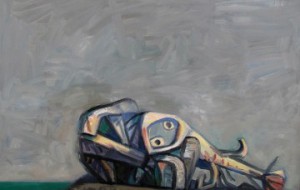
William Harsh. Untitled. Courtesy the artist.

This past summer, San Franciscans were treated to an art smorgasbord from Paris’s Banquet Years, before the Great War. A Picasso exhibition came to the de Young Museum, and an exhibition of the Gertrude and Michael Stein collections came to the San Francisco Museum of Modern Art. Cubist faceted planes were everywhere, and artists who had been taught to dismiss Picasso as irrelevant (inconceivable to earlier artists!), got a belated lesson in art history—assuming they went. Painter William Harsh certainly did, because he reveres “old Pablo” as “a freak or a monster of nature” and “the kind of genius that only comes around very infrequently, every five hundred years or so.” Recently I visited Harsh’s studio in the small port city of Benicia, north of San Francisco. While his recent works are better than ever (with ambiguous creatures reminiscent of Theo Jansen’s walking sculptures now emerging from the Surrealist junkyard wastelands), a review is not the subject of this article; Harsh’s insightful comments, as we chatted over wine on his backyard patio, are informed by his forty-year study of Picasso, Max Beckmann, Giorgio di Chirico, his former teacher, Philip Guston, and many others. In 2003 I cited Guston’s Old-World drinking ritual in an article:

Musa Mayer likens her father’s all-night chats with friends [including the author Philip Roth] to the Russian men’s custom of “drinking vodka, brooding, reciting grievances,” Razdirat’ dushu, to “tear out” or “bare one’s soul,” (And of course Guston’s kvetching with Roth would have produced such literate philippics.)

While my conversation with Harsh was jocular rather than lacerating, the issues raised are worth considering in our current cultural climate. Excerpted below are a few of Harsh’s passionate, erudite, ironic, self-deprecating comments about painting, art history and the mystery and melancholy of esthetes, stumblebums and holy hermits alike.

William Harsh. "End of the Line," 2008. Oil on canvas. Courtesy the artist.

“I am interested in painting because it seems to feel like the right medium —and it has for a very, very, very long time—for what I am groping and struggling to say. … Anybody who is visually inclined …is going to see that the most profound and sophisticated repository of visual images is contained within the whole tradition of painting…. Painting can express certain things that other media can’t, and no doubt other media can express things that painting is too limited to do, but I am definitely a painter…. I have chosen to go deeply into that.”

Continue reading »

Andy Vogt’s Everyday Science

November 2nd, 2011

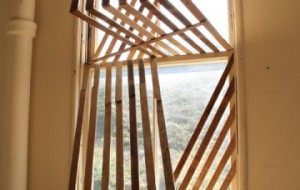
Andy Vogt. Untitled studio piece produced at Headlands Center for the Arts.

Certain contemporary artists find so much to explore in one material that artist and medium become almost fused in the art-collective consciousness: think of Richard Serra and rolled steel, for example. San Francisco sculptor Andy Vogt has created, over the past decade or so, a series of wall-hung relief works, drawings, sculptures and now installations that exploit wooden lath, those rough-cut redwood strips, a quarter-inch by one and a quarter inches, that were found, coated with plaster, in every house, before the advent of the sheetrock era. Vogt scavenges the discarded old, worn sticks from dumpster bins and employs them to construct planar reliefs that suggest their origins. They read both as partial models of stick-frame houses with shattered roofs and splintered wall paneling, their beams and trusses dissolving as if corroded by space and light, and, with their exaggerated or collapsed perspectives, as sophisticated abstractions like the playful 2D/3D geometric paradoxes of Josef Albers and Al Held. Vogt’s lath works combine the dumpster and blueprint, the geological and the architectural, merging manmade and natural environments.

Andy Vogt. "Shade Shape," a door-sized lath lattice (or ladder) that derives from the shadows generated by Vogt’s Hayes Valley installation. The 3D/2D/3D creative hall of mirrors could, theoretically, continue forever.

Andy Vogt's "Central Pane" reprises the artist's Southern Exposure Gallery window piece on a smaller scale. Parallel lath stripes simulate the descent of light rays through the glass (and perhaps the cross-hatching used in drawing to create half-tones) but they also generate complex shadows on walls and floor.

Recent installations at Southern Exposure Gallery and Adobe Books, a public sculpture in the Hayes Valley area, and a residency at the Headlands Center for the Arts in rural Marin County west of the Golden Gate Bridge have expanded Vogt’s practice even further. Vogt detailed, in a discursive, object-based conversation we had recently at his Headlands studio, his new interest in how the environment inflects and affects the artwork, the changing sunlight transforming his sculptures into generators of complex but transient shadow “interference patterns” (which, photographed, become themselves the subjects of new artworks). Concurrent with this expanded area of investigation is his experimentation with new materials: lights, lenses, mirrors, dichroic glass and time-lapse digital photography. Vogt’s Headlands studio show (now ended) and his current show in the Project Room at Electric Works in San Francisco reveal his work in transition, headed toward a tripartite “second phase” comprising, probably—can art writers predict the future, like esthetic versions of Minority Report Pre-Cognitives?—immersive installations (possibly executed in more permanent materials than lath) enlisting sunlight as a “drawing element” and animation source; more use of digital photography and video to explore the mechanics of perception; and, for gallery work, an embrace of the new digital printing technology.

Andy Vogt. Installation view of presentation at Headlands Center for the Arts Project Space.

The Curious Creations of Cyrus Tilton

October 26th, 2011


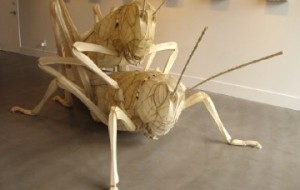
Cyrus Tilton. "Lovers," 2011. Steel, muslin, nylon, beeswax, damar. 11' L 6'W x 5'H.

If you saw the science fiction movie Starship Troopers a few years ago, you have already seen Oakland sculptor Cyrus Tilton’s handiwork—both literally and figuratively: the hands mangled in that alien-bug movie were made from molds on his hands. The exploding brains were also his concoction: Karo syrup and red food coloring (Tinseltown’s traditional recipe), plus breadcrumbs and scrambled eggs from Tilton’s catered lunch. That film’s director, Berkeley’s special-effect wizard, Phil Tippett (The Empire Strikes BackDragonslayerJurassic ParkDinosaur!), gave Tilton his first job when he moved to the Bay Area after art school in Seattle; his current employer is Ron Holthausen, a scientifically-inclined artist whose design/display company, Scientific Art Studio (SAS) in Richmond, north of Berkeley, has adopted the apt motto, Natura artis magistra docet, Nature is the teacher of art.

SAS does work for museums (dioramas, architectural models, reconstructed extinct animals and plants), fine-art collectors (murals, sculptures, tiles, paintings and installations) and films and television (scale models, creature design, special effects, paintings, and props). Tilton once wanted to work in sci-fi/horror movies (and still confesses to a love of the “lowbrow”), but his work as SAS’ Art Director and Lead Artist has given him invaluable scientific and technical experience—perhaps exceeding what he could have learned in computer-graphics-driven Hollywood genre films. When I visited the artist at his workplace recently, Tilton, surrounded by SAS props, maquettes, and tools, looked around the vast warehouse, and reflected on the relationship between his job and his fine-art work: “It’s very cause-and-effect. It [the exchange of ideas] becomes second nature, and you get paid for it.”

Cyrus Tilton at his work bench at Scientific Art Studio.

Prop/work in progress from Scientific Art Studio.

Prop/work in progress from Scientific Art Studio.

That day-job creative flow is evident in his surreal, mysterious sculptures of humans and animals. In 2010, his show at Oakland’s Vessel Gallery, A Place In-Between, featured human-machine hybrids that elicited from this writer a comparison with Guillermo del Toro’s disturbing and enchanting film, Pan’s Labyrinth. For a show last spring, Tilton created sculptures of animal protagonists—ant and grasshopper, fox and grapes—taken from fables and folklore. Tilton’s current show, The Cycle, is no less suggestive in its satirizing of humankind’s conformist and consumerist instincts: we’re like locusts, grasshoppers that overbreed when conditions are right and, at a certain level of tactile stimulation from overcrowding, mutate from solitary feeders to billion-bug superorganisms that devastate crops wherever they land—the entomological equivalent of slash-and-burn Third-World agriculturalists or their technologically but not morally advanced First-World analogues.

Continue reading »