Migration Patterns
Each year the tide of the art world carries hundreds of young artists into Chicago’s several art schools to earn their MFAs. And each year the tide also carries a number of newly credentialed artists away, usually to NYC or LA. The money apparently flows more freely there and the media pays attention. I’m sure this phenomenon is familiar to any US city (other than NYC and LA) that has a strong art school. These are constantly heard gripes amongst those of us who remain. The opportunities appear to be elsewhere. And what if we decide to stay? Is there any hope that we’ll actually kickstart this thing—like LA did in the 90s (the good folks at the Bad at Sports podcast have regularly aired these grievances)?
Although my adopted hometown seemed infinitely more exciting and even glamorous this year, particularly as motley thousands thronged the Loop on election night, this year’s coastal flights were more poignant for me because several peers whose work I genuinely admire numbered amongst the recently absconded (I am laughing at myself as I write this for its obituary-like tone…).
Here are a few who took off in ’08:

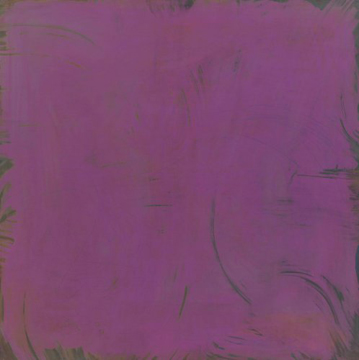
Aliza Nissenbaum paints large, usually squarish abstractions that seem to zoom in on gestural painting, picturing it at a granular level. The gestures don’t feel performative in an AbEx way, but neither are they allegorical, i.e. David Reed. That’s surely due to the materially denuded surfaces with their thinly applied paint and low value contrasts. Her paintings possess an intense, ghostly presence. Their atmosphere is one of unbearable intimacy, in which our senses of scale and direction are lost.

John Opera‘s photographic practice is two-fold: remarkably beautiful but melancholy landscapes (usually forests in upstate New York; the artist is originally from Buffalo) and abstractions that recall Bauhaus precedents (Moholy-Nagy’s photograms and Albers’ nested squares, in particular). In either case, he deals intelligently with the history not only of photography, but the more historically deep pictorial traditions of painting. I enjoy, for instance, how Opera’s positioning of the blasted tree in his Friedrich-like wintry landscape, Failed Branch (pictured above), nods to Barnett Newman’s zips in its vertical bisection of the picture, and its figuring of the artist and viewer’s upright posture before the image.

I thought perhaps that the art world in Chicago would close shop for good when John Parot left for LA this past summer. His contagious laughter has resounded for years at openings. His works on paper (usually combining drawing and collage) and installations deserve a much broader audience. In much of his work, Parot embellishes pictures of men clipped from fashion and porn mags with patterns rendered in gouache. His busy decoration of the handsome faces is too manic to be simply affectionate, masking, if not totally obliterating, the likenesses of his muses. I like to think of Parot as an aesthetic cousin to Art:21 artist Lari Pittman, whose sense of pattern and decoration has a similarly disturbing edge to it.

I can’t tell whether Melanie Schiff‘s photographs are chanced upon or choreographed, casual or careful. Whether it’s two green bottles provocatively balanced lip-to-lip or a rainbow formed by the artist spitting water into sunlight, her work, although composed, always has the feeling of being bound to a single moment. Her photos almost always picture light as it passes along and through glass and water in the context of the detritus of everyday life. A lot of artists set themselves the task of finding beauty in the mundane, but I’ve seen few do it in such an intelligent and disarming manner as Schiff.
Gay Witches, Part 3
Continued from “Gay Witches, Part 2″…
![“Ghost Boys [Massimo & Pierce]”, photo by Phillippe Christin, 2003. Courtesy of Black Sun Productions.](http://blog.art21.org/wp-content/uploads/2008/12/ghostboys1.jpg)
3. The work of sound, visual, and performance artists, Massimo & Pierce, aka Black Sun Productions, could easily be discussed in the What’s So Shocking About Contemporary Art? thread on this blog. Their sexually explicit performances in Europe supposedly spurred police to raid their Zurich offices in 2003, although I haven’t been able to find any archived news items on this, other than anecdotal info on the Wikipedia entry on them and in reviews of their records. Not to cast doubt on the verity of these events, but Massimo & Pierce’s origin story itself has a mythological flair. After the two former sex workers met and became romantically involved, they decided to dedicate their partnership to an artistic and magical multimedia exploration of love. The duo take pornography seriously as an art form, casting it via sex magic as a theatrical ritual of transformation and connection. They achieved some international visibility in 2002 when they toured their Plastic Spider Thing performance with Coil. The performance was akin to an SM scene between two lovers’ spider and fly spirit animals. My favorite project by Massimo & Pierce, however, is less straightforwardly engaged with the symbols and processes of magic: their musical adaptation of the poetry and lyrics of Bertolt Brecht, operettAmorale. Musically, it is a combination of cabaret atmosphere, electronic drones, and chanted vocals. They manage to inject an extra dosage of darkness and debauchery into Brecht’s famously paradoxical words without seeming redundant. It is both disturbing and quite funny, particularly the campy “Pimp Ballad.” You can listen to some of their music on their Myspace page, as well as get additional information on their many different projects and collaborations.

4. William J. O’Brien is a Chicago-based artist who works in multiple media, including painting, sculpture, drawing, fiber, and ceramics, all of which he submits to an intuitive, seemingly casual sensibility. Most of his work has a rough, totemic quality that might superficially look like the type of work gathered for the Unmonumental show at the New Museum, but is ultimately too earthy and emotional to sustain that comparison for long. Credit those qualities of earthiness and emotion to O’Brien’s feel for materials and sense of touch. My favorite amongst O’Brien’s recent work are his ceramic heads, an installation of which are pictured above; a few more examples can be seen here. They make me think of Moche portrait vessels found in ancient tombs, only expressionistically rendered. The melted and scarred likenesses pinched and gouged from clay are like faces recalled from a nightmare or past-life regression. Or maybe O’Brien is recapping the Modernist principle of truth-to-materials as a kind of animism, as if it were the faces of spirits inhabiting the clay that he ultimately coaxed from the stuff.
Gay Witches, Part 2
As promised, here is a list of some recent artists and projects, about which I am particularly enthusiastic, that explore the occult from a queer perspective.

1. Originally from Toronto, and now based in Paris, Scott Treleaven is probably best known for his occult/queercore zine This is the Salivation Army (recently compiled and co-published by Printed Matter, Inc. and Art Metropole as The Salivation Army Black Book) and his darkly erotic collages, although he has also made a number of hypnotic, Kenneth Anger-like films. His collage works usually picture young men engaged in mysterious, ritual-like activities. The pictures combine heterogeneous sources and surfaces. We might find any combination of original and found photography (some of it likely film stills), historical prints illustrating alchemical and mystical ideas, cut chiyogami paper, and atmospheric fields of watercolor, etc. Generally, his compositions possess a hieratic quality, achieved through pronounced symmetry and conspicuous framing devices. We know immediately that we are in a mythic space when looking at one of his pictures.
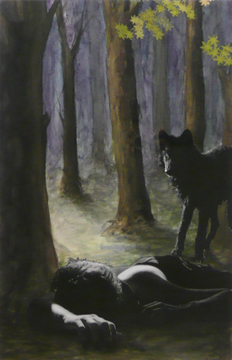
So, what is the nature of the spell cast by Treleaven in his collages? I have a hunch it has to do with imagining some form of ecstatic fraternity as an alternative to the forms of community that are available in contemporary society, including the gay mainstream. I am thinking of the wolves that appear so frequently in his work. They are certainly cyphers for unfettered desire, but their significance also seems to lie in their highly social nature. His boys run in packs. I’ve also noticed that the young men in his pictures either appear alone or in groups of three or more. Rarely are they arranged as a duo, which would connote more conventional ideas of romantic desire. The collaborators he has brought into the fold for his films also leads me to believe that he is trying to reimagine a queer community based on creativity and sprituality: AA Bronson, Genesis Breyer P-Orridge, and the performance art duo, Massimo & Pierce (see below), amongst others, have been featured in his films. I highly recommend Treleaven’s essay, “My Little Underground,” in Generation Hex (ed. Jason Louv, Disinformation Co. Ltd., 2005), which chronicles his search for identity and community in the occult, queer, and punk subcultures.

2. My favorite record released this past year (which can neither be rightly called a new recording or a reissue—more below on that) is Coil’s The New Backwards. For those unfamiliar with their work, Coil were a post-industrial, experimental electronic band founded in 1983. Along with Psychic TV and Chris & Cosey, they rose out of the ashes of industrial music pioneers, Throbbing Gristle. Although many collaborators have come and gone Coil were, at their core, a duo comprised of John Balance and Peter “Sleazy” Christopherson. A great archive of Coil-related info is maintained by the good folks at Brainwashed here. Describing Coil’s music is difficult as they transformed their sound regularly but, generally speaking, they offered a poetic and emotional take on electronic noise, with Balance’s warm, sometimes foreboding, voice floating through the psychedelic bedlam. Listen here.
Gay Witches, pt. 1

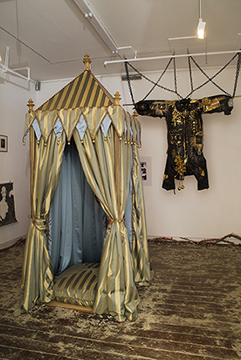
The show I most wanted to see this past year but didn’t was AA Bronson‘s School For Young Shamans at John Connelly Presents. It seems to have culminated from, or at least focused, the recent critical mass of queer artists interested in magic (or magick, if you’re an acolyte of Aleister Crowley). The show combined early and recent work by Bronson, along with two collaborations (a soothsayer tent with Scott Treleaven and two joined stalls connected by a glory hole with Terence Koh) and work by Christophe Chemin, Michael Dudeck, Scott Hug, Item Idem, Sands Murray-Wassink, Naufus Ramirez-Figueroa, J.X. Williams, Bruce Labruce, and Andrew Zealley. When I first became aware of the show, a month or two in advance of its opening, all I could think was that I wanted to matriculate (two videos of the deeply convivial Bronson discussing the exhibition can be viewed here and here).
Amongst the several unfinished essays littering my desktop that I still fantasize about finishing is one about magic and contemporary art. Initially galvanized by Scott Treleaven‘s exhibition, My Dear, My Darling, Do You Hear Me Where You Sleep, at Kavi Gupta Gallery in 2006, I’d intended the essay as a cheeky response to what was then the hot topic in my graduate painting seminar, the apparent schism between theory and practice in contemporary art. The problem was felt at the time as an either/or choice between theory (resulting in artworks merely illustrating ideas gotten from elsewhere, particularly literature and philosophy departments) and practice (with the consequence of churning out pretty but dumb market fodder). Lane Relyea was one of my professors at the time, and his essays, “Allover and At Once” (X-Tra, vol. 6, no. 1, Fall 2003) and “Theory and Painting” (Flash Art, vol. 37, no. 239, Nov.-Dec. 2004), helped me understand that particular fork in the road as a false choice. In fact, I still find those essays to be useful maps for navigating this particular minefield in contemporary art.
So how does one magically rejoin theory and practice? For starters, magic stakes itself on practice; it is meaningless apart from rituals, spells, and other material activities. And imputing magical efficacy to art causes artists to clarify their intentions and take responsibility for their artworks’ effects, whether real, exaggerated, or imagined. Magical thinking makes less visible aspects of art objects–like politics and context–magically appear by pushing intention and result into the foreground. That is the moral, so to speak, of William S. Burroughs’ famous sentence: “It is to be remembered that all art is magical in origin–sculpture, writing, painting, and by magical I mean intended to produce very specific results.” Whenever I look at an artwork, I like to ask what kind of spell is it casting, and if it is achieving the desired result.
I don’t really have any speculations as to why the overwhelming majority of artist-magicians working right now are queer (or why so many queer artists are interested in magic or, if not magic, then with re-enchanting art, i.e. Paul P., Hernan Bas, etc.). “Gay Witches, pt. 2″ will list some of my favorite current practitioners and projects…