Off the Page: Flat Daddies and Other Live Photographs

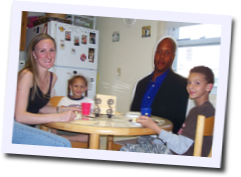
On September 30, 2006, I read an article in The New York Times that I don’t think I’ll forget. “When Soldiers Go to War, Flat Daddies Hold Their Place at Home” was the headline of Katie Zezima’s report on the Maine National Guard’s “Flat Daddy” or “Flat Soldier” initiative, in which life-size waist-up photographs of deployed soldiers were given to their families waiting at home. (1)
According to Zezima, the Flat Daddies became part of daily rituals—some came to soccer practice and sat at the dinner table—some were there for special occasions such as weddings, a 50th birthday party and even a pre-kindergarten graduation. One Flat Daddy almost made it to a Denver Broncos game, but in the end he had to wait in the car because it was raining.
Sergeant First Class Barbara Claudel, director of the Maine National Guard’s family division remarked on the popularity of Flat Daddies: “‘The response has been unbelievable….The families just miss people so much when they’re gone that they try to bring their soldier everywhere.’”
When I read that quote I thought maybe I had accidentally grabbed The Onion instead of the The New York Times—in the face of unnecessary deployment, the National Guard’s perfunctory gesture struck me as downright tacky. But Flat Daddies were indeed going like hotcakes—over 200 had been requested and distributed in the first nine months of the program and were clearly very meaningful to their recipients. Continue reading »
Welcome to the Good Life

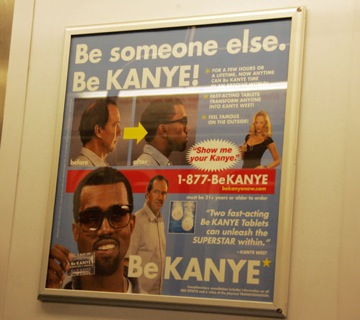
Until recently, it hadn’t crossed my mind that I could be Kanye West. I did a double take the first time I saw the advertisement one morning on a downtown C-train: “Be someone else. Be KANYE!” the large print suggested. “For a few hours or a lifetime, now anytime can be Kanye time in an Absolut world…. Fast-acting tablets transform anyone into Kanye West,” it continued. Even Kanye himself—who as we know, doesn’t mince words —promised: “Two fast-acting Be KANYE Tablets can unleash the superstar within.” By dialing 1-877-BeKanye or visiting bekanyenow.com, the transformation could be mine.
Did I want to Be Kanye? The bling beckoned. But what, I hedged, might be the side effects. Deciding I’d wait for official FDA approval, I turned my thoughts to wondering how this peculiar and politically incorrect endorsement had elbowed its way into the subway’s ad space. My assumption was graphic guerilla tactics—someone had snuck onto the train late at night and replaced an NYPD recruitment poster with the suggestion of Being Kanye as an alternative route to self-improvement. It was not until I got to work that morning and as first order of procrastination, went to bekanyenow.com, that I learned that BeKanye is Absolut Vodka’s new ad campaign.
At a glance, or even a look, you are not meant to know that ingesting BeKanye Tablets stands for drinking Absolut Vodka—the brand name is only printed twice and in both cases, through clever graphic maneuvers, it is practically invisible.
Why would an advertisement conceal the brand-name it endorses? Continue reading »
Give Up and Laugh About It

The other day I had accidentally hit the strikethrough function in Microsoft Word and so as I was typing my carefully chosen words, they were simultaneously being crossed out. “Okay, I get it,” I said to my MacBook, irritated that my machine was mocking my toil.
Two of this summer’s group shows addressed the sense of futility I felt: Cancelled, Erased & Removed, at Sean Kelly Gallery, included works spanning 1960-2008 that took as their subject paradoxical instances when the opposing forces of making and unmaking, growing and disintegrating, presenting and concealing are inseparable. Meanwhile, a distinctive vein of humor in Marion Goodman Gallery’s Deep Comedy, which covered 1970-2008, was the absurdity of meaningless gestures.
The historical cornerstone of Cancelled, Erased & Removed was Robert Rauschenberg’s Erased de Kooning (1953), in which the artist took an eraser to a drawing that the Abstract Expressionist Willem de Kooning had given him—thus the obliteration of one work gave birth to another. Knowing Rauschenberg’s plans, however, de Kooning challenged the younger artist by giving him the most heavily marked drawing he had, and indeed, Rauschenberg was not able to entirely rid the paper of its original image; faint traces of ink and crayon remain.
Fast forward half a century: in Mike Bidlo’s suite of 16 Erased de Kooning drawings (2005), one of which was up at Sean Kelly, Bidlo meticulously copied de Kooning’s drawings of women, photographed the replicas, erased his own work and then attached the photographed drawings to the backs of the their “originals.”
Rauschenberg’s act was art historically Oedipal: overtly hostile to Abstract Expressionism, the transformation of de Kooning’s dark drawing—via painstaking labor—to an essentially blank page signaled a revolt against AbsEx’s emphasis on universal expression, and the celebration of the unique painterly mark spilling forth from the tortured artist-genius.
Bidlo’s work is focused around a different, if related, set of issues—primarily the implications of appropriation. There are of course many ways to read this work, but one aspect of its meaning is that through its excess, Bidlo’s reprise pushes Rauschenberg’s gesture into the realm of the absurd. To spend endless hours mimicking the work of one artist (de Kooning) and to then un-do that work by mimicking the work of another artist (Rauschenberg) and to save the record of the original effort in a place where no one can see it (on the back of the erased drawing), is a colossal act of deadpan self-effacement.
Enter Deep Comedy. Curated by the artist Dan Graham with independent curator Silvia Chivaratanond, this exhibition brought together work that critiques social, political and artistic institutions through formal and conceptual strategies involving play and an inclination toward the absurd.
One of the strands within the show featured works that represented great amounts of energy being expended on pointless or fruitless activities, epitomized perhaps by Allen Ruppersberg’s Honey, I rearranged the collection (The Red and the Black) (2002). This poster-size silkscreened image of a fancy domestic interior is covered in Post-It Notes that offer desperate, funny, and poignant explanations of the work’s title: “Honey I rearranged the collection to separate works which seem to be about ideas from those which are truly splendid”; “Honey I rearranged the collection because that is all there is left to talk about”; “Honey I rearranged the collection but everything remained the same only more so.”
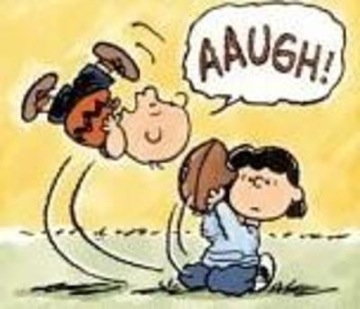
Humor is subjective, of course, but within the genre there is a lineage predicated on reaching too high, undertaking Sisyphusian tasks, and other acts that will most likely be wastes of energy ending in failure. When, against all odds, the underdog triumphs, we feel good; when he doesn’t, we’re supposed to think it’s funny. Lucy in the candy factory; Charlie Brown with his football; Corky St. Clair waiting for Guffman. What is it that’s so funny about futility?
“Qué Hay Que Hacer Mas?”: Reflections on “The Disasters of War” at Peter Blum SoHo

I’m hard-pressed to remember the last time I found a thank you note from a President Elect presidential candidate in a gallery exhibition’s press file. But there it was, at Peter Blum SoHo, sandwiched between praise from the New York Times and the Village Voice, a letter from Barack applauding Peter for the timeliness of his gallery’s current exhibition: Francisco de Goya’s Los Desastres de la Guerra (The Disasters of War) print series.
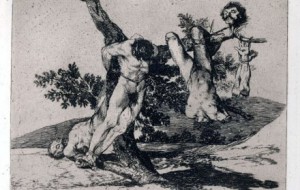
Goya (1746-1828) made these etchings circa 1810-1820 in response to Spain’s War of Independence against Napoleon’s armies (1808-1814). Filtering traditions of history painting through caricature, irony and emotional immediacy, this complete set of eighty prints (first published in 1906) retains its power to conjure the visceral horror and inhumanities of war. Physical atrocity is expressed in Great Deeds! With Dead Men! where the dead weight of the central figure pulls against the ropes that bind his naked body to a barren tree, which is decorated by the body parts of his comrades; equally disturbing, in I saw it, is the terror on the faces of the father and child who look at something beyond the picture frame—rather than revealing the it, Goya uses these facial expressions to give license to our darker imaginings. Throughout the series, the aftermath of war is shown in desiccated landscapes where vultures pick at corpses.
Matching the arresting content of these prints is their compositional ingenuity: in They Do Not Agree, nearly half the plate was left unetched; the chaotic foreground gives way to the background via a single face that fades from dense to sparer hatchmarks and eventually to a blank page—a formal operation pulverizes a figure into thin air. 200 years after it was created, this work remains formally, psychologically and, unfortunately, thematically relevant.
It’s generous of Peter Blum to show us The Disasters of War while probably dispensing with a summer’s worth of exhibition-generated gallery income. And judging from Obama’s thanks to him for “the countless ways you’ve supported our campaign,” this is not all he’s doing for the Democratic Party.
Still, standing in this white box in SoHo, the surprise of flipping from the familiar layout of the New Yorker’s art listings to Barack’s official red, white and blue letterhead made me wonder what it could really mean if the contemporary artworld “took action.” So a thought experiment: what if the exhibition were revised from Goya’s Disasters of War to OUR Disasters of War and instead of the 80 prints wrapping around the elegant gallery space, a sign in its window that read: “Peter Blum SoHo is closed through November while its staff works for the Obama campaign wherever Barack needs us.” (Imagining this on a large scale serves up the appealing image of the rural south being flooded by New York gallerina/gallerino transplants working for the future of our country.)
A similar idea was posed by the artist Mary Kelly when she suggested to Connie Butler, curator of the recent exhibition WACK! Art and the Feminist Revolution, that the exhibition consist not of objects, but of participatory consciousness raising sessions about the issue of feminism.
I was inspired by seeing both The Disasters of War and WACK!, but with a whole host of upcoming shows on theme of Democracy in honor of the election season (previews to come), I think it’s worth considering what contemporary art and its artworld can and can’t do to effect Change We Can Believe In.
Goya’s Los Desastres de la Guerra (The Disasters of War) is on view at Peter Blum SoHo, 99 Wooster Street until August 1 and will reopen August 26-September 1.