The Immeasurable Distance of Market Value

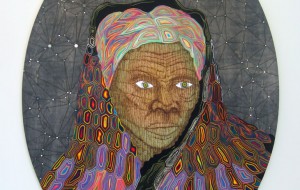
Matthew Day Jackson, "Harriet (Last Portrait)," 2006. Woodburned drawing, yarn, aniline dye, mother of pearl, abalone and black panther eyes on wood panel, 243.8 x 182.9 cm.
Carol Vogel of The New York Times wrote last month that, “Optimism has returned to the multibillion-dollar art market.” She was keen on a 1932 Picasso painting, Nu au Plateau de Sculpteur (Nude, Green Leaves, and Bust), and mentioned she’d be surprised if it wasn’t a record-breaking sale. Eight days later on Tuesday, May 4, a painting that Picasso made in a single day grabbed $106.5 million, making it the most expensive work of art ever sold at auction. The sale trumped the previous record of $104.3 million paid for Giacometti’s Walking Man I in February of this year, making for back-to-back record sales in the first two quarters of 2010. Even with Sotheby’s posting a narrower-than-expected quarterly loss ($2.2 million compared to last year’s loss of $34.5 million, according to Reuters), these auction sales make a real statement about the comeback of the market.
The real optimism, however, which is arguably more reliable than any wavering value cast by the market, is in Vogel’s portrayal of Matthew Day Jackson as the unsung hero of this year’s blue chip auctions. The artist drew $928,330 for a painting estimated to garner just less than $62,000 at a February auction at Christie’s in London, an incredible feat by any estimation. If any artist were to represent the future possibilities of the market, how deeply appropriate that it be Jackson, an artist whose very work seeks out and explores the potential of mankind.
A 2006 painting by the artist, Harriet (Last Portrait), to be auctioned on Wednesday, May 12, at Sotheby’s in New York, is already estimated at $300,000 to $400,000, and could very well break a million if the current circumstances continue to play out. Vogel’s description includes characterizations of Jackson as an “it” artist, and while I believe that the attention is more than well-deserved, exorbitant overnight rises in the prices of work probably create more questions than they do answers. One independent dealer I spoke with thinks it could create an illusion of value, potentially causing collectors to start flipping works.
“It takes all the reasonable planning and normal thought process, and chucks it out the window,” Bill Arning says of the near-million-dollar figure for Jackson. Arning, who is the director of the Contemporary Arts Museum, Houston, was the curator of Matthew Day Jackson: The Immeasurable Distance, which debuted at the MIT List Visual Arts Center in May 2009.
“This isn’t bad news for Matt, but it’s not all pluses,” Arning says. “Speculators—and we have to assume there are speculators—might decide this is a really good time to flip work because of the buzz… Matt is just too good an artist to let the whims of the auction market dictate the way his career goes.”
The irony is that Jackson’s painting, which depicts an unwavering Harriet Tubman in a cloak of brightly colored patterns against a backdrop of interconnected stars, can be understood as a portrait of human potential, while Jackson’s future represents a similar promise in a market poised to bounce back swiftly. Is it too early to cast Jackson as the helmsman of the new blue chip? Can we expect to see million dollar auction prices for him moving forward, or is this a temporary spike? What’s certain is that Jackson’s work is compelling enough to present the questions in the first place.
Realness: The House of Newsome

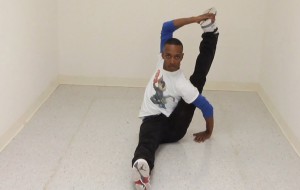
Rashaad Newsome, still from "Untitled (New Way)," 2009. Silent single channel HD video; 6:48 min. Collection of the artist; courtesy Ramis Barquet, New York.
My partner and I throw a monthly gay dance night in Cambridge with some DJ friends of ours. For 10 months, most dancing has been reserved for the last hour of the party, when the line for the bar has lessened and patrons are at their least inhibited. This month, that hour was marked by a small crew of thin, glamorously hooded men voguing on the dance floor and using the bar’s bathroom hallway as a runway.
The giant smile across my face was due not only to the fact that the entire display was intensely fierce, but because I couldn’t help but wonder if Rashaad Newsome had anything to do with it. If Madonna is the first star to bring voguing to the masses, Newsome is certainly the second. One of two videos featured in the 2010 Whitney Biennial, Untitled (New Way) (2009) features a dancer voguing for the camera in a small gallery space, performing movements taken from footage of several vogue dancers, which Newsome edited to choreograph into a new dance.
In March, the Whitney staged FIVE, a performance organized by Newsome, which included several vogue dancers whose movements were recorded in a live action drawing generated by real time video processing software. Based on the five essential components of voguing (“Hands,” “Cat Walk,” “Floor Work,” “Dip Spins,” and “Duck Walking,” as described by Newsome), the performance was separated into just as many “acts.” Each featured different choreography and musical score, including both an MC and a chamber orchestra, richly conflating ideas of cultural and historical contextualizations. In a statement on his Vimeo site, Newsome says of the performance, “FIVE encapsulates three core approaches I apply to my art practice: exploring the formation, evolution, adoption, and ownership of cultural signifiers; capturing the essence of historic art structures using modern urban symbolism and cultural references, particularly in the form of expression; and leveraging technology to elicit my artistic expression. ”
Paris is Burning, the seminal film about New York voguing balls, drag queens, and transgendered people of color in the mid to late ’80s, keenly documents the emphasis on “realness,” or the extent to which each competitor’s persona — whether butch or femme — appears authentic. Newsome’s work is wholeheartedly real, and his work eloquently brings to light cultural histories long relegated to the dusty shelves of subverted gay culture, doing so with the same confrontational elegance captured by the vogue dancers themselves. Work!
The Intangible as Object

Ryan Trecartin, "K-Corea INC. K (Section A)," 2009. HD Video, 31 minutes, 20 seconds. Courtesy the artist and Elizabeth Dee, New York.
In September of last year, Kelly Klaasmeyer, the Houston art critic and Glasstire.com editor, made a pretty deft observation. Writing for the Houston Press, she noted that, “Internet content is the ‘found object’ of the 21st century.” And rightly so. While the web will almost certainly be used as a medium for decades to come, its cultural influence may inevitably become more visible and more pervasive than invoking the Internet itself. What kind of work can we expect to see from generations of young artists breastfed on social networking sites, webisodes, pornography, and video blogging?
Artists like Ryan Trecartin and Ivan Lozano might have the answer. The chaotic and gender-bending characters in Trecartin’s films use a unique vernacular of hyperglobalization consumer-speak, and his work—often jarring and non-linear—effectively captures the extent to which the web has become embedded in our lives. His videos are a complete mind-fuck and just as disturbing to watch as they are captivating.
- Watch more Videos at Vodpod.
Artists like Ivan Lozano are using the web not as inspiration, but as source material. His 2007 video, 21st Century Machines: A Technodrama for Future Generations, uses found footage from peer-to-peer (P2P) networks to depict a star-crossed gay cyborg love affair soured by technological incompatibility. Works like these are precisely what Klaasmeyer is describing, and they point to a seemingly immeasurable landscape of artistic possibilities.