Packaging a Music Experience: Ryan Catbird and Catbird Records

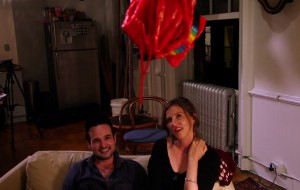
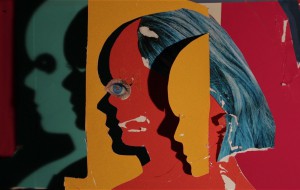
Moviola, “Dead Knowledge”. Catbird Records, CBR010, 2007. Image courtesy of Catbird Records.
Ryan Catbird has commanded a silent influence on the independent music scene since he began his blog, The Catbirdseat, in 2002. Ryan could possibly be credited for bringing bands such as Destroyer, Beirut, Frightened Rabbit, Pete and the Pirates closer to the public spotlight. Anyone who follows his blog would probably agree: Ryan Catbird has an honest, sincere, and genuine passion for music, with no pretense attached whatsoever. Which is why Ryan would probably never credit himself for “breaking” a band…and also why you would expect him to do more than just write about music.
In 2005, Ryan took this passion a step further by launching a boutique record label, Catbird Records. Through over 20 releases, the label has not just built a foundation of releasing reputably great music, but they’ve also managed to add a touch of personality by way of packaging and presentation. Jewel cases be damned—just about every release is a reflection of the care that went into the overall process. Machines didn’t put these packages together; people did.
The label’s most recent release is an LP reissue of the 2002 Unbunny album, Black Strawberries—the album’s first-ever vinyl pressing. This was no ordinary release, however. In one of the more exciting uses of the Kickstarter, Ryan was able to fund the entire process, releasing not just an album, but also an entire experience. I recently spoke to Ryan via email to learn more about this latest release, as well as his process.
Jessica Stockholder | Form
DOWNLOAD VIA ITUNES | SUBSCRIBE VIA RSS
EXCLUSIVE: From her home in New Haven, Connecticut, Jessica Stockholder discusses the strength of form and the difficulty in articulating the meaning behind abstract shapes.
A pioneer of multimedia genre-bending installations, Jessica Stockholder’s site-specific interventions and autonomous floor and wall pieces have been described as “paintings in space.” Her work is energetic, cacophonous, and idiosyncratic, but closer observation reveals formal decisions about color and composition, and a tempering of chaos with control.
Work by Jessica Stockholder is included in the exhibition Embrace! at the Denver Art Museum. The exhibition includes site-specific installtions by 17 artists, spread throughout the museum’s Frederic C. Hamilton Building. Stockholder’s installation, titled Wide Eyes Smeared Here Dear, spans several levels of the Daniel Libeskind-designed building. Embrace! is currently on view at the Denver Art Museum through April 4, 2010.
Jessica Stockholder is featured in the Season 3 (2005) episode Play of the Art:21—Art in the Twenty-First Century television series on PBS. Watch the full episode online at PBS Video
VIDEO | Producer: Wesley Miller and Nick Ravich. Interview: Susan Sollins. Camera: Mead Hunt. Sound: Merce Williams. Editor: Jenny Chiurco and Mary Ann Toman. Artwork Courtesy: Jessica Stockholder.
Culture Wars: Trivial Tunes with Mary Heilmann

Left: Mary Heilmann. Art in the Twenty-First Century, production still, 2009. Season 5, Episode: Fantasy. © Art21, Inc. 2009. Right: Sleevefacin’ the Art21 Culture Wars soldier.
What better way to soundtrack an art and pop culture event than to invite an in-tune-with-pop-culture artist to curate a selection of their favorite music?
Mary Heilmann was a natural fit for our inaugural Culture Wars trivia event, and we were thrilled when she accepted our invitation to create a soundtrack for the evening. We really could not have asked for a better pairing. Culture Wars participants were treated to selections from Mary’s music collection—hand picked by Mary herself—as they entered the main stage at the 92YTribeca, and they were treated to more between scoring sessions during the halftime intermission and after the second half.
With Mary on hand at the trivia event, it seemed only fitting to create an entire music-themed “audio” round. Titled Personnel Changes, the round was inspired by the announcement of Jeffrey Deitch’s upcoming appointment as the director of the Museum of Contemporary Art in Los Angeles. The questions involved 10 bands or musicians where a personnel change affected their musical output. Each question included a snippet of a song, and we asked the players to name the band or musician in question (for 1 point) and to briefly state the personnel change (for another point).
A video of the audio round from the January 28 event, along with Mary Heilmann’s playlist, is included below. Play along at home and let us know how you did!
Mark your calendars: The next Culture Wars night is on Wednesday, March 24, at the 92YTribeca.
Ask Art21 a Question

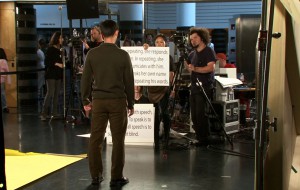
Filming Mary Heilmann in Bridgehampton, NY, 2008. Art in the Twenty-First Century, production still, 2009. © Art21, Inc. 2009.
Why are there only 4 episodes a season, and 1 season every 2 years? How do you choose the artists to feature? What is it like filming [INSERT ANY ARTIST] in their studio?
Here’s your chance to ask us these questions or anything else that you’ve ever wondered about Art21.
Earlier this year, associate curator Wesley Miller gave us a look inside the curatorial process. That same week, series producer Eve Moros Ortega took us behind the scenes of the production process. This week, both Wes and Eve are back to field questions from our audience. The latest installment of the Inside PBS blog’s Q&A series opens the door for you to ask us anything—anything—about what we do here at Art21.
Please feel free to leave a question either here or on the Inside PBS blog, and Wes and Eve will try to answer as many as possible. The answers will be posted next week on the Inside PBS blog.
Need to refer to Season 5 episodes for inspiration? Not to worry, we’ve got you covered on the PBS Video portal! Just interested in a discussion about clowns? Well, the PBS Facebook audience has you covered there!
What’s Cookin at the Art21 Blog: A Weekly Index
Cindy Sherman’s studio. Art in the Twenty-First Century, production still, 2009. Season 5, Episode: Transformation. © Art21, Inc. 2009.
Season 5 may have wrapped up this week (cough, cough…watch it online now before it’s gone on November 13…cough), but the Art21 Blog plows on, cookin’ up the goods with our pictureless-no-more writers and contributors. All treats and no tricks this past week on the Art21 Blog—here’s what you may have missed:
- In this week’s Letter from London, Ben Street takes a look at the London art scene in light of the Frieze Art Fair
- Catch up on the posts from departing guest blogger, Nathan Townes-Anderson
- Welcome to San Francisco-based guest blogger, Kelly Huang. This week, she’s: presented questions on global art and the art market; reflected on the work of German artist, Tino Sehgal; and discussed food and community with Chicago-based artist and “problem solver,” Theaster Gates.
- Nicole Caruth rounds up the recent on-goings of Art21-featured artists, representing all 5 seasons of Art:21
- In this week’s Teaching with Contemporary Art column, Art21 senior education advisor Joe Fusaro draws parallels between the teamwork-based approach of Allan McCollum and the collaborative approach to successful art education classes
- In this month’s installment of Art 2.1, An Xiao sits down with artist Rachel Perry Welty to discuss the role of social technologies in art, exploring the use of Facebook for her project, Rachel is
- Catherine Wagley considers the challenges of contemporary public art in the latest installment of Looking at Los Angeles
- Georgia Kotretsos takes us inside the studio of Berlin-based visual artist, Joulia Strauss
- This week’s exclusive video finds Jeff Koons recounting memories of Versailles and inspiration from Louis XIV
Jeff Koons | Versailles
DOWNLOAD VIA ITUNES | SUBSCRIBE VIA RSS
EXCLUSIVE: From his studio in New York City, Jeff Koons discusses his 2008 exhibition at the Château de Versailles in France. Koons explores the power and sensuality of the grounds at Versailles, citing Louis Quatorze (Louis XIV) as an inspriation for his 1992 piece, Puppy, a large floral sculpture made out of 60,000 large flowers.
Jeff Koons plucks images and objects from popular culture, framing questions about taste and pleasure. His contextual sleight-of-hand, which transforms banal items into sumptuous icons, takes on a psychological dimension through dramatic shifts in scale, spectacularly engineered surfaces, and subliminal allegories of animals, humans, and anthropomorphized objects. The subject of art history is a constant undercurrent, whether Koons elevates kitsch to the level of Classical art, produces photos in the manner of Baroque paintings, or develops public works that borrow techniques and elements of seventeenth-century French garden design. Organizing his own studio production in a manner that rivals a Renaissance workshop, Koons makes computer-assisted, handcrafted works that communicate through their meticulous attention to detail.
Jeff Koons is featured in the Season 5 (2009) episode Fantasy of the Art:21—Art in the Twenty-First Century television series on PBS. Watch the full episode online in the PBS Video portal (available for a limited time, through November 13, 2009).
Jeff Koons. Split Rocker, 2000. Stainless steel, soil, geotextile fabric, internal irrigation system, and live flowering plants, 441 x 465 x 426 inches. Installation view, “Jeff Koons Versailles,” Château de Versailles, France, October 9, 2008–April 1, 2009. © Jeff Koons. Courtesy the artist.
VIDEO | Producer: Wesley Miller & Nick Ravich. Interview: Susan Sollins. Camera: Martial Barrault & Joel Shapiro. Sound: Mark Mandler. Editor: Paulo Padilha & Mark Sutton. Artwork Courtesy: Jeff Koons. Special Thanks: L’Etablissement Public du musée et du domaine national de Versailles.
Mary Heilmann | Inspiration
DOWNLOAD VIA ITUNES | SUBSCRIBE VIA RSS
EXCLUSIVE: In her Long Island studio, Mary Heilmann discusses two inspirations for her work: tea bowls that adhere to the Japanese aesthetic philosophy of Wabi-sabi and the cartoon color pallette used in The Simpsons television show. Heilmann contrasts her working method with that of the Abtract Expressionists, preferring to find “the easiest way to do it” which often involves thinking through the compositions and colors with a computer. The video features ceramics and paintings installed as part of the artist’s traveling retrospective To Be Someone at the New Museum and the Wexner Center for the Arts.
For every piece of Mary Heilmann’s work—abstract paintings, ceramics, and furniture—there is a backstory. Imbued with recollections, stories spun from her imagination, and references to music, aesthetic influences, and dreams, her paintings are like meditations or icons. Her compositions are often hybrid spatial environments that juxtapose two- and three-dimensional renderings in a single frame, join several canvases into new works, or create diptychs of paintings and photographs in the form of prints, slideshows, and videos. Heilmann sometimes installs her paintings alongside chairs and benches that she builds by hand, an open invitation for viewers to socialize and contemplate her work communally.
Mary Heilmann is featured in the Season 5 (2009) episode Fantasy of the Art:21—Art in the Twenty-First Century television series on PBS. Watch the full episode online in the PBS Video portal (available for a limited time, through November 13, 2009).
VIDEO | Producer: Wesley Miller & Nick Ravich. Interview: Susan Sollins. Camera: Mark Falstad & Joel Shapiro. Sound: Roger Phenix. Editor: Paulo Padilha & Mark Sutton. Artwork Courtesy: Mary Heilmann. Special Thanks: Wexner Center for the Arts, Columbus, & The New Museum, New York.
Carrie Mae Weems | Thirteen Questions for Wynton Marsalis & Cornel West
DOWNLOAD VIA ITUNES | SUBSCRIBE VIA RSS
EXCLUSIVE: As part of a panel discussion moderated by Baraka Sele at the 20th National Black Arts Festival in Atlanta, Georgia, artist Carrie Mae Weems poses thirteen questions to musician Wynton Marsalis and professor Cornel West, followed by an impromptu song and dance by the participants and audience.
Weems’s vibrant explorations of photography, video, and verse breathe new life into traditional narrative forms—social documentary, tableaux, self-portrait, and oral history. Eliciting epic contexts from individually framed moments, Weems debunks racist and sexist labels, examines the relationship between power and aesthetics, and uses personal biography to articulate broader truths. Whether adapting or appropriating archival images, restaging famous news photographs, or creating altogether new scenes, she traces an indirect history of the depiction of African Americans for more than a century.
Carrie Mae Weems is featured in the Season 5 (2009) episode Compassion of the Art:21—Art in the Twenty-First Century television series on PBS. Watch the full episode online in the PBS Video portal (available for a limited time, through November 13, 2009).
VIDEO | Producer: Wesley Miller & Nick Ravich. Camera: Joel Shapiro. Sound: Evan McIntosh. Editor: Paulo Padilha & Mark Sutton. Thanks: Wynton Marsalis, Baraka Sele, Dr. Cornel West, and the National Black Arts Festival.
Josiah McElheny | History & Originality
DOWNLOAD VIA ITUNES | SUBSCRIBE VIA RSS
EXCLUSIVE: Artist Josiah McElheny discusses the relationship between artworks and the context in which they were created, highlighting the distinctions between history and the personal and interpretive reinvention of historical facts.
Josiah McElheny creates finely crafted, handmade glass objects that he combines with photographs, text, and museological displays to evoke notions of meaning and memory. McElheny’s work takes as its subject the object, idea, and social nexus of glass. Influenced by the writings of Jorge Luis Borges, McElheny’s work often takes the form of historical fictions. Part of McElheny’s fascination with storytelling is that glassmaking is part of an oral tradition handed down generation to generation, artisan to artisan. Sculptural models of Modernist ideals, these totally reflective environments are both elegant seductions as well as parables of the vices of utopian aspirations.
Josiah McElheny is featured in the Season 3 (2005) episode Memory of the Art:21—Art in the Twenty-First Century television series on PBS.
VIDEO | Producer: Wesley Miller and Nick Ravich. Interview: Susan Sollins. Camera & Sound: Kurt Branstetter, Joel Shapiro, and Tom Bergin. Editor: Jenny Chiurco. Artwork Courtesy: Josiah McElheny. Special Thanks: Donald Young Gallery, Chicago and MoMA QNS, Long Island City.
Full Episodes of Art:21 Available Online!
Earlier this week, with help from the fabulous team at PBS, we added the complete Art:21—Art in the Twenty-First Century series—16 full episodes from Seasons 1 through 4—to the PBS Video portal. This, of course, was only the beginning. Season 5 episodes will be added throughout the broadcast season for a limited period of viewing on the morning after the national broadcast, every Thursday in October.
The PBS Video portal, launched earlier this year, offers free and immediate online viewing of full-length episodes from PBS’s wide range of programming. One of the many things that we love about our relationship with PBS is the opportunity to participate in such resources—resources that are vital in presenting content to as wide of an audience as possible.
Art:21 is in good company over there, sitting next to videos from POV, Craft in America, Austin City Limits, and many other amazing PBS programs.
With a Season 5 DVD and Blu-ray release set for the end of the month, there will be plenty of ways to catch episodes from our latest season: you can watch the broadcast on PBS, set your DVR to watch the episodes at your convenience, catch a preview screening in your community, and now watch episodes straight from your computer. So, what’s it going to be?