James Bishop at The Art Institute of Chicago and The Modern Wing
A Focus exhibition of drawings and paintings by James Bishop opened this week at The Art Institute of Chicago. Bishop, who is American but has lived in France since the 50s, creates exquisite and poetic drawings and paintings, calling attention to the physicality of color. Most of the works in the exhibition are from the artist’s personal collection.
Ed Ruscha and Photography is also on view at The Art Institute until June 1, 2008.
It is worthy to note that to witness the progress of the construction of the The Art Institute’s new building, The Modern Wing, is a truly remarkable thing. The building, designed by architect Renzo Piano, is to be completed in 2009 and will house the museum’s contemporary and modern collection as well as increase gallery space for the institution. It will be an incredible addition to not just the museum but the city of Chicago.
Gordon Matta-Clark at the Museum of Contemporary Art Chicago

“You Are the Measure,” the first retrospective in twenty years of work by Gordon Matta-Clark (1943 - 1978) curated by Whitney Museum of American Art’s Elizabeth Sussman has come to Chicago’s Museum of Contemporary Art. It seems fitting that exactly 30 years ago to the month the exhibition opened, Matta-Clark cut into a townhouse near the MCA’s original building and created Circus or the Carribean Orange.
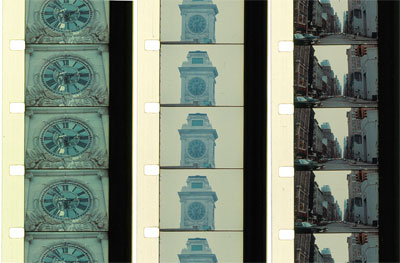
Conversations at the Edge , which is sponsored by the School of the Art Institute’s Film, Video and New Media Department, in association with the Video Data Bank and the Gene Siskel Film Center (Chicago’s most incredible resources for viewing film and video work), has been hosting a series of Thursday night screenings and lectures. This Thursday, the Edge presents several of Matta-Clark’s films including Office Baroque (1977) and City Slivers (1976). Jane Crawford, documentary filmmaker and Matta-Clark’s widow, will be speaking. The screening begins at 8pm at the Siskel Center.
Lilli Carr√®’s The Lagoon

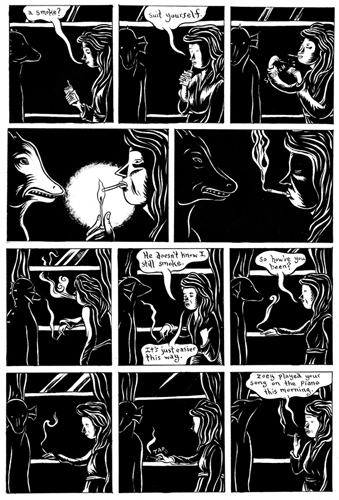
Chicago-based filmmaker, illustrator, and comics artist Lilli Carr√® just completed her new book The Lagoon which will be available in October through Fantagraphics. You can view excerpts here. Her comic story “Hums Like a Bee” will also make a second appearance in Paper & Carriage, a local quarterly arts magazine.
Current gallery exhibitions in Chicago

This is gonna take one more night, an exhibition of photographs by Chicago-based artist Jason Lazarus has opened at Bucket Rider Gallery. Lazarus’s work has always re-defined notions of self-portraiture and self-representation using the photographic image. This exhibition is exemplary in that it allows photographs from several disparate series (NIRVANA, Self Portrait as an Artist, Living with a Portrait series) to exist in one gallery space as cohesive, succinct unit. Yet each photograph remains an individual depiction of a particular wonderland or an odd and even sometimes dark personal moment which Lazarus masterfully captures without using his physical presence. The last rose of summer on my nightstand, a collection of found photographs and text collected and curated by the artist, and a catalogue of recent work is available through Bucket Rider gallery.
Down the street at Rowley Kennerk Gallery are a group of intense yet quirky canvases thick with acrylic paint in mystifying color combinations by School of the Art Institute of Chicago MFA graduate Molly Zuckerman-Hartung in her first solo exhibition at the gallery entitled She-male Guitar Solo. You can read an interview with the artist by the gallery owner here.
In the same building at Tony Wight Gallery (formerly Body Builder and Sportsman) is an exhibition of new paintings by John Phillips and, in the project room, a video animation by Ken Fandell.
John Phillips makes an appearance in Caleb Lyons’s (artist and co-owner of an apartment gallery in Chicago’s Humboldt Park neighborhood- Old Gold) show Slow Dance backinblackisblackisblackisblacisback as a grave digger who makes little progress in a mesmerizing and eerie video work shot in the backyard of the artist’s childhood home in Michigan. Here, the strobe effect and warped soundtrack of folk music disorient the viewer into thinking the digging man is making headway through the dirt the more one watches. Slow Dance backinblackisblackisblackisblacisback is on view at Three Wall’s Gallery 2A space until March 29 and Lyons will be speaking this Friday, March 20th at 7pm.
Weekend: Robert Heinecken, Times New Viking, Onibaba
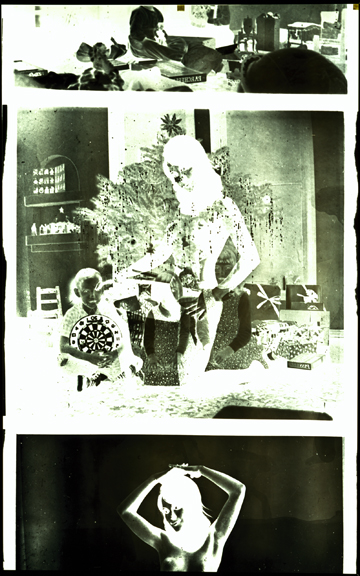
Robert Heinecken: Dream/Circles/Cycles opened at Rhona Hoffman Gallery this past Friday. The first gallery show since his death in 2006, this exhibition features work created between 1964-1973, much of which has never been exhibited before and includes seminal bodies of work such the series Are You Rea (1964-1968), a group of gelatin-silver contact prints from magazine pages. Every piece in the exhibition is a favorite, particularly Christmas Mistake - a 1972 black and white film transparency illuminated in a light box. Imagine a mix-up at the photo lab where negatives of a nude pin-up model were accidentally developed with family Christmas photos.
On Saturday I attended the Society for Contemporary Art of the Art Institute of Chicago benefit and auction where I was taken by the works of Richard Hawkins, Nathan Hylden, Florian Morlat, a group of glittered collages by the TM Sisters, and a photograph by New Catalogue (collaborators Luke Batten and Jonathan Sadler) from their new series Tiger Afternoon (a Jean Luc-Godard version of a John Hughes film). I ducked out early to catch the $5 Warhammer 48k side project - Cave - and Times New Viking show at Mr. City press.
Dani Leventhal, a UIC MFA grad who now lives and works in Rosendale, NY was in Chicago this month showing several of her short video works at Gallery 400. I was only familiar with her sculptures and so I watched five videos by the artist on Sunday. The visuals were complex, personal, beautiful, darkly humorous, abrupt and abstract; an exploration of Jewish identity that is both subtle and raw.
I also saw Onibaba (The Demon), the 1964 black and white Japanese horror film directed by Kaneto Shindô followed by the silent Super 8 footage documenting the making of the film. The film itself is visually astounding. The lighting alternates constantly and without warning only making the oppressive heat and brutally dry landscape of swaying bamboo reeds so realistic that it was hard not to feel physically affected by the creepy plot. I look forward to seeing more films by the director including The Naked Island (1960).