An Interview with Simone Leigh

May 21st, 2009
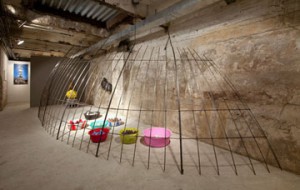
Simone Leigh, "The Gods Must Be Crazy," installation view, 2009. Courtesy Sculpture Center and the Artist.

Simone Leigh, "The Gods Must Be Crazy," installation view, 2009. Courtesy Sculpture Center and the Artist.

Simone Leigh is a new world artist/ceramicist of the highest order. Her gnarly yet incredibly beautiful objects and installations provoke, inspire, and remain with you. She works her particular brand of heady and arty mash-up in a fabulous new installation at the Sculpture Center.  Our recent email interview about The Gods Must Be Crazy is below.

Simone Leigh, "The Gods Must Be Crazy," installation view, 2009. Courtesy Donald Suggs and the Artist.

Simone Leigh, "The Gods Must Be Crazy," installation view, 2009. Courtesy Donald Suggs and the Artist.

Kemi Ilesanmi: Simone, your objects carry such an incredible energy as you play with diverse art historical tropes and poke fun at ethnographic blindspots. One of my favorite elements of the installation is the mix of textures, shapes, and sheens—boot prints, shiny points, colorful plastic buckets (so familiar in black and brown spaces), high yellow automotive paint on the pot diptych which sits on lowly cement blocks. How did you approach corralling all this into one installation?

Simone Leigh: I built the entire installation around the archeological term, skeuomorph. A skeuomorph is a derivative object that retains material metaphors and ornaments of original object. Skeuomorphs serve to make the viewer/user more comfortable with the surrogate object by reminding the viewer of the original. My recent work combines my preoccupation with almost obsolete forms, like the terracotta water pot, with more contemporary surrogates like the plastic bucket or the woven bag made in China and used internationally as luggage. In The Gods Must Be Crazy, I incorporate biomorphic objects that I make by hand  and recent artifacts, as well as their surrogates. The piece investigates how nostalgia can alter perception and how antecedent meaning is delivered through surrogate forms.

Planet of the Apes poster, 1968.

"Planet of the Apes" poster, 1968.

KI:  Tell me about the cage. By the way, it appears to have no point of entry, or escape.

SL: I was thinking about the central cage in Planet of the Apes but when I started making drawings I realized it was more like the structure of a Central African teleuk. Probably because I had just become aware of Steven Nelson’s book, From Cameroon to Paris: Mousgoum Architecture In and Out of Africa, that details how these domed structures became a part of the colonial project and therefore became another kind of ethnographic object signaling authenticity. There is a chapter called “The Pineapple in Paris” that discusses the Paris Colonial Exhibition of 1931. I’m very obsessed with this exhibition and artifacts from it often inform my work.

Continue reading »

An Interview with Paul Mpagi Sepuya

May 20th, 2009
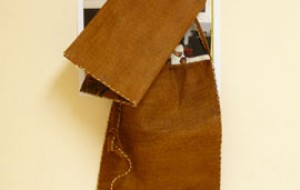
Paul Mpagi Sepuya, "As-yet-untitled work," 2009. Photograph, Ugandan bark-cloth bags, screw. Courtesy the Artist.

Paul Mpagi Sepuya, "As-yet-untitled work," 2009. Photograph, Ugandan bark-cloth bags, screw. Courtesy the Artist.

I met the artist Paul Mpagi Sepya when he worked at Creative Capital a couple of years back. I’ve followed his thoughtful, evocative, and beautiful photo portrait work ever since.

Last week, I got to check out his latest series, which is part of Homebase IV, an installation of work by an international array of artists in a former nursing and rehabilitation center on the Lower East Side in New York City.

Though his father is Ugandan, Paul grew up in San Bernadino, CA and has never visited Uganda. For this series, he photographed friends who have been to Kampala and objects they brought back from those visits. Following is the entirety of an email interview I conducted with Paul about his Homebase project.

Paul Mpagi Sepuya, "Homebase" project, installation view, 2009. Courtesy the Artist.

Paul Mpagi Sepuya, "Homebase" project, installation view, 2009. Courtesy the Artist.

Kemi Ilesanmi: How did this year’s current “Homebase” location in a former medical facility help inspire this project? How did you work with this very particular historical, aesthetic, and psychic context?

Paul Mpagi Sepuya: The location was a definite catalyst in me thinking about home in this way. With both parents being in medicine, I spent a lot of time hanging out after school or volunteering as a kid in hospitals. My mom was big on that. There was a lot of sensory memory there. The space itself had a lot of content that I was not sure how directly to address at first. I began thinking of my idea of ‘home’ related to migration and stories because I imagine the medical profession is what set off my father’s journey that led to his children’s (and my own) peculiar relationship to Uganda.

Aesthetically, the building presented its own challenge. It is totally gutted! Hospitals are uncomfortable enough for a lot of people, and to walk into a medical center in New York City in that state made it even more so. But I thought it was very interesting that those conditions are often romanticized by western travelers who go to developing countries. It suggested a connection, I thought, between ‘here’ and ‘there.’ So I left my space as it was.

Paul Mpagi Sepuya, "Jonathon, Brooklyn, NY," 2009. Courtesy the Artist.

Paul Mpagi Sepuya, "Jonathon, Brooklyn, NY," 2009. Courtesy the Artist.

KI: Since you usually work with subjects whom you already know and share a narrative with, I couldn’t help but wonder at the stories that passed between you and the sitters. Yet, I felt locked outside a certain knowledge even as I was intrigued by the rich exchanges that I imagined. Is that kind of tension between knowing and looking an important part of the portrait for you?

PMS: Yes! I’m really into establishing the foundational knowledge of a connection/narrative, but positioning it so that the content of that narrative is a private exchange. In a sense it’s my hope that those details are not important to the viewer’s experience, because I’m not spelling out the story but making projects that suggest how a narrative itself can work. Within that there is a lot of space for the viewer to fill in his own content—to imagine! To think about their own experiences that may relate.

That made this project somewhat difficult for me. Although all my projects are informed by my life, I have never made an autobiographical work that reveals the underlying stories… The difference between a memory, a portrait, a resolution, and even the Proofs projects only suggest at the stories behind them. Now I’m actually putting up family snapshots!

KI: I love the juxtaposition of the formal portraits of friends with the casual family snapshots. For me, it also highlighted the starkly different journeys on display: on the one hand, Americans headed to Uganda, perhaps for adventure or Peace Corps stints, and on the other, your father making his way across continents for a better life, the American Dream, or thereabouts.

PMS: The snapshots are of me as a baby. The portraits of me with my father in the red living room are at my mom’s parent’s house in Louisiana. It is a contrast in journeys, and the idea of ‘formative experiences.’ I like the tension given to the idea of how one’s experience is valued. What kind of journey, and how long must you go to claim an authentic experience?

Continue reading »

Solomon: Wherefore wisdom?

May 18th, 2009
Kevin Jerome Everson, "Something Else," film still, 2007. Courtesy the artist.

Kevin Jerome Everson, "Something Else," film still, 2007. Courtesy the Artist.

While I love living in New York City, there are nights when I long for the simplicity of only one truly art-worthy thing to do in town. Tonight is one of those nights. Two of my favorite venues have competing events and I’m wishing for a clone so I can do both.

Kevin Jerome Everson, "Second and Lee," film still, 2008. Courtesy the artist.

Kevin Jerome Everson, "Second and Lee," film still, 2008. Courtesy the Artist.

Light Industry of Sunset Park, Brooklyn (a nearby candy factory always has me sniffing the air in joy) is showing several of Kevin Jerome Everson‘s short films and the filmmaker is in attendance. Based in Charlottesville, VA, Everson often explores African-American working class life and joy in his experimental works. He mixes documentary style and scripted elements to high poetic effect. Even though he’s a Creative Capital grantee, I’ve only ever seen Cinnamon, a 2006 feature length film that peeked into the world of African-American drag racing down south through the experiences of a black woman who serves as a bank teller by day. I want more!

Fence, Winter 2008-09 issue.

Fence Winter 2008-09 issue

Or, I could go to the Kitchen to checkout the Fence Books reading. Since 1998, both in a biannual journal and through a book publishing arm, Fence has published some of the best experimental poetry, fiction, art, and criticism out there. Without them and other similar presses (oh, so few!), many writers who create on the edges of convention wouldn’t have a space.  Tonight will feature readings from their two newest poetry collections: Elizabeth Marie Young’s Aim Straight at the Fountain and Press Vaporize and Laura Sims’s collection Stranger. Oh, did I mention they’ll have a circus?  Yep, Circus Razz will perform between readings!

Elizabeth Marie Young, "Aim Straight at the Fountain and Press Vaporize," Fence Books, 2009.Laura Sims, "Stranger," Fence Books, 2009.

L: Elizabeth Marie Young, Aim Straight at the Fountain and Press Vaporize, Fence Books, 2009. R: Laura Sims, Stranger, Fence Books, 2009.

I told a friend of this dilemma and she called it my Sophie’s Choice, while I immediately thought of Solomon’s crafty decision to split the baby into two… Yes, I’m taking votes.

Going Fast!: Treeless Mountain

May 14th, 2009

homeimageleft1

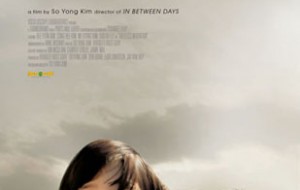
One of my favorite films of the year is ending its New York run at the Quad Cinema tonight! Treeless Mountain is a beautiful, quiet, and moving film by So Yong Kim that tells the tale of two young girls who are abandoned by their mother and then shuffled among relatives and landscapes. Set in South Korea, Kim’s birthplace, and starring several marvelous untrained actors, the film strikes a common chord of loss, resilience, and abiding hope. It’s a small film in the best sense.

homeimageright1

It’s also worth keeping an eye out for Bradley Rust Gray’s (Kim’s husband) film The Exploding Girl, which recently won an acting award at the Tribeca Film Festival. It stars Zoe Kazan (remember her in Revolutionary Road with that lovely old-fashioned face?) in a love letter to confused youth, elusive love, and the city of New York.

Free & Clear: Exhibition and the Free Store

May 12th, 2009
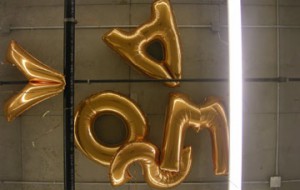
Filip Gilissen, "Vamos," installation still, 2009.  Courtesy the artist and Exhibition.

Filip Gilissen, "Vamos," installation still, 2009. Courtesy the artist and Exhibition.

Is free sometimes the best value for art?  Well, it certainly can be when artists and curators turn an inquisitive and critically-engaged eye towards the nature of exchange, regeneration, and artistic creation. Two recent projects in New York City demonstrate the value of free art, free imagination, free form, and free rewards.

I happened upon the fabulous Exhibition in Nolita when I met one of the 5 organizers of this temporary art space for lunch just last week.  This six-month long continuous art experiment is being programmed by Elena Bajo, Eric Anglès, Jakob Schillinger, Nathalie Anglès, and Warren Neidich.

Exhibition installation still, 2009. Courtesy Exhibition.

Ana Prvački and Boško Bošković, chocolate rabbits, 2009. Courtesy Exhibition.

One accounting of the simple premise is:

1. The site is a storefront lent by a luxury condominium development at 211 Elizabeth Street.
2. The site is open from March to August 2009, Wednesday to Sunday, 12 to 6.
3. The site hosts a single unfolding exhibition.

1. The work is not for sale and belongs to no one.
2. The work is an intervention upon interventions.
3. The work can be modified, parasitized and destroyed.

1. The artist is drawn from a hat.
2. The artist works in areas determined by a roll of dice.
3. The artist discusses these conditions in conversation and on-site.

Fantastic!  At least every three days, there is a new artist intervention, and while they can make whatever manner of changes inside the space, artists may not remove their own art works afterwards. When it comes in, it stays.

Art21's own Trong Gia Nguyen! Intervention with divinity, toilets, graffiti, and beer, 2009. Courtesy Exhibition.

Art21's own Trong Gia Nguyen! Intervention with divinity, toilets, graffiti, and beer, 2009. Courtesy Exhibition.

Last week, I took in an exuberant gridded landscape of colorful confetti on the floor by Liz Linden along with Filip Gilissen’s mostly deflated “Vamos” ballons, as well as sometimes cryptic pencil drawings and tracings on the walls…and that’s just what I noticed in a quick visual sweep.

In 2 months, Exhibition (which can also be followed by blog) has already invited over 26 artists to intervene and freely create in the space and they hope to work with up to a total of 100 by the end of August. In the meantime, I look forward to visiting the space as often as I can.

Continue reading »