Mythic Environments: Robert Smithson and Eames Demetrios

November 16th, 2009
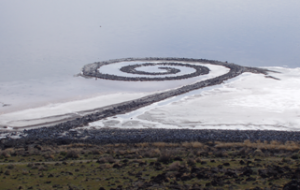
Robert Smithson, "Spiral Jetty", 1970

Robert Smithson, "Spiral Jetty," 1970

When I first saw that this site’s new Flash Points topic was Art and the Environment, I immediately thought of two artists: Robert Smithson and Eames Demetrios. They are not contemporaries. Smithson, a seminal land art pioneer, died tragically in the height of his career in 1973. Demetrios, a currently active artist and filmmaker, is the namesake of his designer grandparents, Charles and Ray Eames. Demetrios is creating an elaborate global installation called Kcymaerxthaere, a manifestation of what he calls “3-dimensional story telling.” These two artists provide compelling arguments for the value of natural resources precisely because neither deals with the topic directly. Rather, both engage in a form of artistic practice that stretches back to prehistory. By creating monuments to complex mythologies and situating them in both a physical and historical context, the apparent value of these sites is renewed.

Robert Smithson is most famous as an early proponent of the land art movement. His most famous work, Spiral Jetty (1970), is a 1,500 foot curled protrusion into a remote part of the Great Salt Lake in Utah. It’s made of truckloads of basalt rock, salt, and earth. It’s easy to mistake Smithson as simply a precursor to someone like Andy Goldsworthy. While Goldsworthy’s earthworks draw attention to the beauty of the site with delicate and sensible interventions, Smithson’s approach was not nearly so tidy. Smithson was fascinated by entropy, the unstoppable loss of energy, and increase of chaos, within natural systems. Far from a zen-like harmony with nature, Smithson’s interactions with the natural world hinted at an apocalyptic tension. For an example of a very un-Goldsworthy Smithson work, check out Glue Pour (Vancouver, 1969).

In the case of Spiral Jetty, Smithson’s intervention in the landscape manages to inspire compassion for the natural world despite his sometimes brutal approach. Smithson selected the site for its pinkish red water. In an essay about the work, he explains, “Chemically speaking, our blood is analogous to the primordial seas. Following the spiral steps we return to our origins, back to some pulpy protoplasm, a floating eye adrift in an antediluvian ocean.”

Smithson was intent on situating Spiral Jetty not only at a specific site in Utah, but also within the epic sweep of geologic time. In a film he made to document the piece, he intercuts a map of the Jurassic Period, about which he said, “I needed a map that would show the prehistoric world as coextensive with the world I existed in.” This is where I find a clear connection to the recent work of Eames Demetrios. As I mentioned earlier, Demetrios is six years in to a global series of site-specific installations known as Kcymaerxthaere. Kcymaerxthaere consists of a series of sculptural installations and faux historical bronze plaques, each one telling a portion of a story about a fantasy world that parallels our own. It’s a bit like trying to read a Tolkien novel spread out across 63 sites in ten countries, in locations as diverse as the Australian outback and the bottom of the ocean off the coast of Scotland.

Continue reading »

ArtPrize: An Experiment in Decentralized Curation and Competition

August 27th, 2009

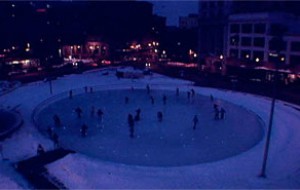
Maya Lin, "Ecliptic"

Maya Lin’s (Season One) “Ecliptic” in Rosa Parks Circle, Grand Rapids, Michigan. (Production still from the Art:21 episode, Identity, © Art21, Inc. 2001.)

There’s been a fair bit of talk lately about how the recession is affecting artists, the art market, and art institutions. And with good reason, pocket books are tight everywhere, and most art, no matter its intended relation to market forces, can’t exist without some kind of capital. It’s not a coincidence that this is also the era of the rise of social media. Facebook, Twitter, and the like are facilitating massive realtime networks that are free (as long as you’re connected). These networks become a conduit of exchange for new kinds of goods, and value is now being measured in new ways. Stock prices still matter, but Google rankings are starting to matter, too. Content is aggregated by algorithms that calculate value from the unconscious input of millions of users.

How does this new method of exchange and valuation affect the art world? If social networks naturally become markets, placing value on instantly exchanged bits of info, what would happen if we gave that value a monetary correlation, apart from a traditional marketplace? I’ve been working to help develop an new art event that seeks to do exactly that. ArtPrize is a radically open art competition. The annual event will run September 23 to October 10 in Grand Rapids, Michigan. Hundreds of artists from around the world have created online profiles, which are a cross between an artist bio and an open-ended proposal. Hundreds of property owners, institutions, and public spaces in downtown Grand Rapids have volunteered to open their space to artists. We’ve built ArtPrize.org to enable these artists and venues to connect to one another, without a central curator or jury. If that weren’t unorthodox enough, the winner of the cash prize (currently the world’s largest, at $250,000, with additional prizes for the rest of the top ten) will be decided by public vote. Anyone can come to Grand Rapids, register to vote for free, and rank each entry with either an up or a down vote, online or by text message.

Continue reading »