Why Here? Part 2

August 1st, 2010

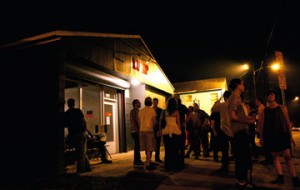
Outside Lump Gallery in Raleigh at a 2008 Benefit. Photo courtesy Goodnight Raleigh (http://goodnightraleigh.com).

Low on the southeast side of downtown Raleigh stands a nondescript grey building with a facade marked by four orange letters: LUMP. This cinderblock outpost houses the Lump gallery and project space — an artist-run enterprise in its fifteenth season. Lump does not represent artists and is explicitly committed to exhibiting work without commercial compromise. The vision of Bill Thelen, Lump’s founder and director, and the collaborative efforts of the swirling cast of artists who comprise Team Lump make the gallery home to some the most consistently rewarding and exhilarating exhibitions in the area. Thelen (an artist himself, with a new show opening in October at Vox Populi in Philadelphia) sees his role as more a facilitator of exchange than a traditional gallery owner: “I view the gallery space as an importer of artists, curators, exhibitions, ideas, and Team Lump as exporter of NC artists. We focus on getting exhibitions outside of North Carolina.”

Indeed, the Team — a variable, curated assortment of practitioners — gets around. In 2009, they traveled to London to install DIY Rapture at Cell Projects. Currently, their show Skins and Skeletons is at AVA in Chattanooga, TN. The team’s ready ability to serve as NC envoy — in addition to Lump’s sterling reputation as a gallery — means that Lump, more than almost any other independent arts-based enterprise in town, is pushing the Triangle’s rapport with a broader contemporary discourse.

Team Lump, "Next Level/Heaven Can't Wait." Installation view. 2009. Cardboard, wood, paint, felt. 18' x 20' x 5'. Courtesy Team Lump.

As a locus and center of gravity for this kind of energy and conversation, Lump’s presence reverberates in strong ways through the terrain of contemporary practice here. The project’s reliability, consistency and rigor have inspired a generation of forward-thinking artists in Raleigh and beyond. I spoke with Harrison Haynes and David Colagiovanni — two artists based in other corners of the Triangle — about Lump and its impact on their practices, as well as about the broader issue of working in the South.

Continue reading »

André Leon Gray’s Eye Gumbo

July 28th, 2010

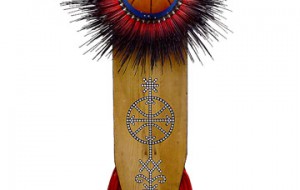
André Leon Gray, "Black Magic (It's Fantastic)," 2005. Acrylic, rhinestones, basketball, synthetic braided hair, street sweeper brush, shoe laces, headband, miniature clay pots, wood, cowrie shells on wood ironing board, 67 x 31 x 9 1/2 inches. Courtesy the artist.

One of the most striking things about the new West Building at the NC Museum of Art is its curatorial strategy. From almost any vantage point in the gallery, the experience is a hybrid one in which contemporary impressions blend with the historical, and expected categories and constraints like geography and milieu loosen their grasp.

From the entry, amidst Jaume Plensa’s Doors of Jerusalem, I, II & III, the presence of the museum’s African collection makes itself known. A recent commission by El Anatsui lurks straight ahead in a gallery flanked by similarly scaled pieces by Sean Scully, Gerhard Richter, and Anselm Kiefer.

One encounters the African gallery by way of a phased entry from the contemporary collection, via Mustafa Maluka and Ledelle Moe — whose Congregation spreads over the anterior wall — or from the main entrance, marked by a splendid Yoruba Egungun Masquerade Costume. Nestled near the center of the hall is a piece called Black Magic (It’s Fantastic), by Raleigh artist André Leon Gray. The appearance of the totem among more historical media plays on a surprising counterpoint — it first seems right at home among the alters, flags, and costumes in the gallery. Then one notices the rhinestone pattern, the basketball, the headband with the Air Jordan logo. The radiating quills encircling the ball are, upon closer inspection, a street sweeper’s brush. The assemblage is mounted on a plank — wait, an ironing board. (The piece made its world debut at the DUMBO General Store and Gallery in Brooklyn in 2005. It will be on view until April 2011 at the NC Museum of Art.)

Gray affectionately calls his mixed media assemblages, sculptures, installations, tar paintings, and drawings eye gumbo — its eclectic appeal belies its complexity in terms of materiality, origination, and potent intent. As he describes it, the work is “thickened with a roux of Black culture, marinated in social commentary and seasoned with consciousness.” Gray’s work surreptitiously coaxes its way into an audience’s psychic safe spaces, only to explode with meaning and provocation once inside. In a recent piece, emblematic iconography and shades of an easy pun become a knockout punch of historically-anchored prophecy once one gets to the work’s title, Temporary Government Housing, and realizes the piece is painted in tar. In Head Full of Doubt, nostalgic hues and the apparent comity of a schoolhouse scene yield to perennial existential questions and the lingering equation: x(N – 3/5) ≠ C. As Amy White writes: “It’s an equation about inequality, the centerpiece of which echoes the ‘three-fifths compromise’ of 1787, which pertained to the taxation and representation of nonwhite people under the Constitution of the new United States. Every time it appears in one of Gray’s works it serves as an elegiac coda. It signals the unspeakable, abbreviating the highest degree of injustice without allowing us to escape it.”

Continue reading »

Why Here?

July 26th, 2010

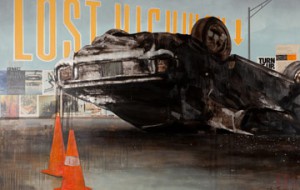
Shaun Richards, "Lost Highway," 2010. Mixed media, oil, and silver leaf on canvas, 96x132 inches. Courtesy the artist.

What does it mean to live and work as an artist in the South? It would be foolhardy to suggest there is a single, unified answer to this question. I think prevailing sentiments and themes emerge, however, through even a cursory glance at a scene like the one here in Raleigh and the Triangle (for strangers to the area, the “Triangle” is a piedmont region in North Carolina, loosely demarcated by neighboring Raleigh, Chapel Hill, and Durham). I grew up here and continue to practice here, and I maintain that there are compelling reasons to consider the changing landscape in this New South as the catalyst for some important American art.

Raleigh is perhaps not your prototypical Southern town; Wake County — in which the city is situated — has surged this decade to become the most populous county in the state, according to recently released data. And the cultural scene is, in many ways, thriving. (It’s finally feeling, at least, like our institutional and informal structures are catching up with the last two decades’ influx of people and energy.) This year alone we’ve seen the opening of the NCMA’s world-class West Building, designed by Thomas Phifer, and the long-awaited breaking of ground for CAM, Raleigh’s Contemporary Art Museum. The public presence of art here has never been stronger, in terms of both state and municipally-supported projects and private initiatives like the creative conference SPARKcon, which rules downtown Raleigh in early September. (Actually, this fall, SPARKcon will share the city’s stage with the Independent Weekly’s massive Hopscotch Music Festival, the likes of which this town has never seen.)

In the broader Triangle, exhibitions and programming at the Nasher Museum of Art at Duke University have upped the ante in regards to the presence of internationally significant contemporary work and critical discourse in the area. Aaron Greenwald has revamped the Duke Performances series in amazing ways. Full Frame and the American Dance Festival happen here. In Chapel Hill, there’s the University, which boasts the Ackland Art Museum, a top Studio Art program and another great Performing Arts series. Neighboring Carrboro is home to the Cat’s Cradle — and the continued importance of that nationally renowned club to the cultural scene here, in my opinion, cannot be overstated.

This is fertile ground for artists and practitioners. (Not to mention, rent is cheap.) But, insofar as the critical radar of contemporary art writ large only tends to register New York, L.A., and a few select places in between, it often feels as though making the choice to practice here is to accept a place outside the broader dialogue. Still, practicing here is a choice many of us happily make. Over the course of the next week, I’ll be taking a closer look at the often shrewd emotional, strategic, geographic, computational, and occasionally mystic logic behind the choice to practice in the South, particularly this New South of upper-mid North Carolina. I’ve asked a carefully crafted (yet ultimately somewhat subjective) selection of artists practicing in the Triangle to respond to the prompt: why here?

Continue reading »

Lightness

July 22nd, 2010

Lincoln Hancock, "A Bird, Not A Feather," mixed media, 2010. Courtesy the artist.

In a lecture delivered at Harvard in 1985 (posthumously published in Six Memos for the Next Millenium), Italo Calvino describes lightness as expressive of a certain kind of possibility in face of “the weight, the inertia, the opacity of the world.” Calvino’s talks at the Charles Eliot Norton lectures were centered on literary values, but painting — indeed, the entirety of the art experience — has always been about this for me. In art, I look for a space outside of the enumerable into which to leap.

This urge is pervasive. Art is a practice that informs life, and provides ways to elude Medusa’s gaze. Calvino takes the myth as poetic allegory: “Perseus’s strength always lies in a refusal to look directly, but not in a refusal of the reality in which he is fated to live; he carries the reality with him and accepts it as his particular burden.”  So, to fly up and out of the panopticon of fixed meaning and moral surveillance is not a wanton act. It is a creative, meaningful gesture enabled precisely by an acknowledgement of its situatedness and necessary relationship to the world. As Calvino indicates, lightness entails looking at the world “from a different perspective, with a different logic and with fresh methods of cognition and verification.”

I’d read and loved Invisible Cities and If on a winter’s night a traveler, but only learned of Six Memos earlier this year — Elliott Earls mentioned the book in a piece in Emigre No. 35. (I was looking back over some of Earls’s writing, as my colleague Dan McCafferty and I had invited him to NC State for our graduate symposium on Design, Community, and the Rhetoric of Authenticity.)  Calvino posits lightness, quickness, exactitude, visibility, and multiplicity as five characteristics of an art that might hold within itself room for the future. (Esther Calvino notes that Italo wanted to title the sixth lecture “Consistency.”)

This summer, as I assembled work for my second solo exhibition, I returned to Calvino’s notion of lightness. In many ways it represents the attitude I feel challenged to cultivate in my own practice. And in terms of an explicit theme, the images I created repeatedly referenced places and experiences that stand for me as exemplars of interpretive possibility. Lightness is not about fancy so much as a meaningful embrace of the distance inherent in conscious experience. We live in the world, yet we are always already free to make it anew through our creative practices.

Continue reading »

Thoughts on the Practice

July 19th, 2010

You need to a flashplayer enabled browser to view this YouTube video

I spent yesterday with two of my oldest friends. At ten, Ben and Neill came over. We’d cleared our schedules to hang and create material for A Weavexx Yuxtapongo. Weavexx is the operational name of a thirteen or fourteen year-old improv music project we began in Ben’s parents‘ basement on weekends and summers off during college. The model for the Weavexx jam was always Can — the persistent Kraut rhythm provided the ground on which we’d build wacky, heinous, uncanny rock spectacles for our own expansion and enjoyment (and ultimate commitment to Maxell audiotape]. We don’t meet often to play music together anymore, but the principle still holds: spontaneous, creatively-centered interaction and collaboration for hilarity and poignance.

Yuxtapongo is Neill’s monthly cable-access show devoted to experimental video, broadcast in Raleigh, Chapel Hill, Carrboro, and Durham, North Carolina. (More on the show and project of Yuxtapongo in future posts.) Though the program has an expanding international cast of contributing artists, Neill produces much of the content each month. Collaboration and spontaneity oil the chassis. Yesterday’s shoot and editing session was a pretty brilliant example of what this kind of work scenario can be: maudlin, exhilarating, stupid, fraught, hysterical, mundane, sublime and finally, somehow, completely satisfying. Starting from nothing, we called it quits with three finished pieces of totally different video, interpolations of experience documented and remade into something I’m going to go ahead and call art.

Figuring out that the things we did in our parents’ basements qualify and stand as records of creative, intentional engagement with the world is a pretty big deal. For me at least, these unstructured, oblique, contraproductive projects were always for their own sake, manifesting zones of transcendence wherein I didn‘t have to correspond to any reflective or higher-order processes or considered decisions or plans. The immediate was the grail. The realization that I seek these spaces as part of a practice has been parcel of my fundamental appraisal of my life as an artist, which is relatively young in title even as I begin my thirty-fourth year. Practice, of course, connotes mindful intent and skillful engagement in a particular scenario. As I move forward, I look to these signposts to indicate where I might find rich ways to meet the world.