Problematic | The Artist As Entrepreneur

August 16th, 2011

Most artists assume the role of an artist, perhaps by going to school, perhaps by having a studio, or not. Bruce Nauman made it simple by deciding that anything he did in his studio was art. With that out of the way, artists assume all kinds of other roles. Artist and filmmaker, artist and professor, artist and writer, artist and curator are some of the more popular ones. (Note the and, which spans, while it also emphasizes, a gap between two distinct nodes.) An institutionalized art context encourages categorization and, in turn, the harboring of split personalities. Some artists go so far as to christen their various professional identities with individual names. However, identity can be as slippery as a new hardwood floor and we don’t necessarily accessorize like the President does, one hat for each job title. Sometimes we take on two or more roles at once – the Artist as (Fill in the blank) – and the oft-overlooked role of Entrepreneur is particularly relevant in today’s frenetic roller coaster economy.

Erik van Lieshout's Online Shop, www.erikvanlieshout.com.

Artists like to get paid as much as the next guy, but particularly for us, there is no singular path to get that paper. Warhol, the perennial entrepreneur, had a factory among many other things. Paul McCarthy did too – a temporary, yet fully functional chocolate factory housed in 6,000 square-foot space of Maccarone Gallery in New York. Actually, a lot of artists maintain studio-factories nowadays. Murakami built a creepy-cute empire of branding and merchandising. Damien Hirst clearly knows how to make money, but he also owns a classy-casual harborside restaurant just for kicks. Maybe this makes him an Artist and Entrepreneur, although his record-breaking sales record might suggest more of an Entrepreneur as Artist. Phil Collins has a bar. Spencer Sweeney has a club. Carol Goodden and Gordon Matta-Clark opened Food to explore the performative aspects of cooking and eating food, while presumably making a little cash on the side. Andrea Zittel’s Smockshop is a somewhat more socialist twist on a production model of outsourcing. Erik van Lieshout camps out in a mall saying, “Real luxury is buying nothing,” while turning an empty store space into a working studio and mall-goers into active participants. Andrea Fraser simply says, “If I’m going to have to sell it, I might as well sell it.”

This is the picture of the Artist as Entrepreneur: one who may emulate and enact business practices for the sake of art and/or money.It is with this in mind that I profile several artist-initiated, entrepreneurial-minded projects that ride the murky line between art and money, business and pleasure.

Continue reading »

A Problematic Introduction

June 7th, 2011

It’s complicated.
Last year, over 3 million Facebook users willingly adopted this dubious relationship status even after the drop-down menu expanded to accommodate eleven statuses, including newer options like civil union and domestic partnership.

Facebook relationship status options

This status is apt for those who want to publicly define the grey area that is his or her personal life, although its ambiguity may technically make it the only non-status, aside from simply hiding the option altogether. Tucked into the Basic Information page, the brief two (or rather, two and a half) words proclaim something like this: “I may or may not be formerly, presently, or  subsequently interacting with one or more person(s) or thing(s) in a manner in which I define by the fact that I can not or choose not to define it!” In this sense, the complication evades categorization by problematizing, flaunting the complexity and ambiguity of a SimCity in fog. Although it may lurk ominously in the domain of relationships, the complication is also a creative force.

When unpacking sticky situations, one should not expect to discover anything less sticky. With appropriately viscous expectations, I (artist and guest blog alum, Lindsay Lawson) present Art21’s newest column, Problematic, aimed at diffusing, rather than shedding light on subjects that are particularly tricky, paradoxical, and well… problematic. The column borrows its name from friend and artist, Guthrie Lonergan, who suggested “Problematic” as an exhibition title, playing on its buzzword status that has become all too ubiquitous, peppering the rhetoric of art discourses. But everything is problematic if you look hard enough; you just have to will it so.

Continue reading »

The Complexity of the Do-Over

March 15th, 2011


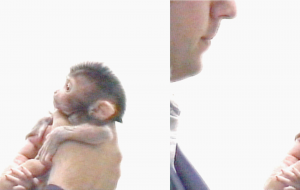
A newborn macaque imitates tongue protrusion. Photo from Evolution of Neonatal Imitation.

There is something strangely satisfying about the act of repeating. Perhaps this is because as children we begin our lives mimicking adults to learn language and behaviors that are essential to succeeding as a human. In these early years, many of us pleaded to hear the same stories over and over again, establishing power, through recognition and memorization, over the printed words we could not yet read for ourselves. This comfort in taking the road more traveled does not entirely leave us as we mature. As adults, most of us appreciate some form of structure in our lives in which we can expect certain outcomes. I, for one, have been known to consistently follow the same routes to minimize the stresses of driving in Los Angeles. This kind of behavior simultaneously reinforces two opposing mental processes: the mindless repetition of and conversely, the deeper understanding of something already learned.

This human repeat tendency has not gone unnoticed by moviemakers and its implementation has many names: remake, reinterpretation, do-over, reboot, cover, shot-for-shot, reimagining. At its worst, the remake is attractive simply because it is easy for both the creator and the audience. The initial work has been completed, judged, and perhaps passed the test of time. Many remakes are considered lesser accomplishments than their originals (e.g. Psycho, The Karate Kid, Godzilla, Planet of the Apes, The Wicker Man), but even those that fail to impress have succeeded in adding another layer to the stories they reinterpret by showing us a parallel universe where things could have happened another, perhaps less cinematically viable, way.

Continue reading »

The Cave of the Mind

March 10th, 2011

Inhale. As you exhale your body relaxes. Exhale moving into a deep quiet place inside you… You can see off in the distance what appears to be a cave. As you approach the cave you see that there is a large opening. Enter the cave…

You need to a flashplayer enabled browser to view this YouTube video

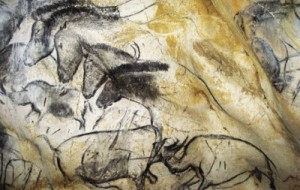
About 32,000 years ago, humans inhabited the Chauvet Cave in what is now southern France and covered the walls with art. Predatory animals like lions, bears, rhinos, and hyenas are etched into the smoothed wall surfaces next to a chimerical half-human-half-animal figure, abstract lines and dots, and a few unidentifiable winged things. Experts believe that the paintings had some kind of shamanistic purpose for those Aurignacian cave people. Some of what they were painting clearly came from within the mind, rather than what was running around, pouncing, and attacking cave people in the physical world.

32,000 year old painting in Chauvet Cave. Photo by Jean Clottes/Chauvet Cave Scientific Team.

A distinctly separate inhabitation of the Chauvet Cave occurred during the Gravettian era about 3,000 years later. Most of the paintings covering the cave walls were made during the earlier Aurignacian period, so these later cave dwellers would have been confronted with the physical marks of memory, the traces of an earlier people. Perhaps the Gravettian cave people were not of artistic and ritualistic inclination, or did not value the act of mark-making for posterity, since they left only charred remains, smoke residue, and a single child’s footprints. That cavechild was likely the last human to look upon the paintings until three speleologists rediscovered the cave in 1994. For about 25,000 years, a cave full of pictures sat unnoticed in France, a country with a rich history in painting, but those pictures afford a glimpse into the imagination of the prehistoric mind.

Continue reading »

Interesting Times

February 28th, 2011

Man wakeboarding in the Nile, January 28, 2011. Photo by Lindsay Lawson.

May you live in interesting times…

This ambiguously Chinese curse implies that interesting (i.e. historically significant) times are usually not peaceful ones. They are times of change and therefore, times of uncertainty, insecurity, and sometimes violence. Shakespeare’s brooding Prince of Denmark, Hamlet, would have agreed completely, lamenting “that the time is out of joint.” For him the times are all too “interesting” – his uncle killed his father and married his mother to take the throne – and unfortunately for Hamlet, his dead father’s ghost haunts him, pleading Hamlet to take revenge, curing the ailing kingdom. But time can be out of joint in another sense not relating to societal ills, but rather to experience itself. From moment to moment, our experiences are conditioned by the traces of non-present time, memories of the past and anticipation of future, which meander through our unfolding present, forging connections and producing meaning. Times may not always be interesting, but time (and space, at that) is always out of joint.

I am writing this on February 25, exactly one month after the demonstrations-turned-protests-turned-revolution began in Egypt. On January 25, I was returning to Cairo from Alexandria on a violently bouncy micro-bus via the not particularly picturesque desert between the two cities. I was to spend the rest of January in Cairo after completing a workshop lead by Alex Freedman and myself at MASS-Alexandria, a new residency program for young Egyptian artists founded by Wael Shawky. After 30 years of Mubarak’s rule, the Egyptian Revolution began the day after our workshop (aptly titled Future Tense) ended and times were certainly interesting. Marty McFly accidentally traveled 30 years back in time, forcing him to reconstruct the past so he would still be born in the future. Now, one month later, I am reconstructing my experience backwards in time, down the slippery Slip ‘N Slide® of synchronicity, attempting to make meaning out of a very strange month in my life.

Continue reading »