(UC Crisis) Post 2: The Feeling of Embalming Education
In a series of special posts, guest blogger alum Marc Herbst and regular contributor Catherine Wagley chronicle the University of California education crisis. Following is Herbst’s second installment. — Ed.
Creativity doesn’t occur in a vacuum. Cultural and political expression find a unique voice in relationship to context. As Dada can’t be understood without World War I, nor Jackson Pollock without the Cold War, the creations of the University of California art professors I discussed in my last post should be understood in a field of wider aesthetic, rhetorical, and historic action.
The University of California occupation movement, which gathered Ricardo Dominguez’s and Ken Ehrlich’s productive energy, occurs in this state of affairs: budgets are tight, social services are slashed, corporations are bailed out. The priorities seem clear: profits over people.
At the turn of this decade, the inversion of that phrase, people over profits, was a clarion call for the globalization movement. Though equally radical in tactics, the emergence of the social imagination spawned by a global Internet allowed artists and activists to embody an entirely different creative frame. Emerging with the pageant-like protests of this era was a language of hope. Social space, utopia, other worlds — the globalization movement allowed for these sort of dreams.
But as California beggars itself and its crowing institutions — cutting classes, raising costs, outsourcing labor — dreamy talk just does not communicate.
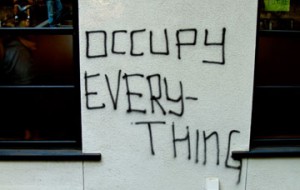
Therefore instead of “Another World is Possible,” students, faculty and staff who began occupying the central and northern California campuses of the University of California this fall say, “We Have Decided Not to Die.” “Occupy Everything, Demand Nothing.” “We Are the Crisis.” “We Want Everything, Demand Nothing.”
Thus emerges a movement out of the graveyard.
(UC Crisis) Post 1: The Story of a Movement – Overview
To explain the recent investigations into the web-art projects of both Ricardo Dominguez and b.a.n.g. lab collaborators at UC San Diego and Ken Ehrlich of UC Riverside is to tell a story of social movements. This is the first of a several blog-posts written by myself and Art21 Los Angeles correspondent Catherine Wagley that tell the story. In this post, I will summarize the basic facts around what happened and provide the simplest of backgrounds to the case.
With the announcement of a 32 percent tuition increase, the antagonism between the UC systems directing regents and many of their students, faculty, and staff was on the rise. Spurred on by a powerful manifesto and an inspiringly radical movement of campus building occupations that began in Northern California in September and only continued to build, March 4, 2010 was planned to be a major day of protests around education throughout California. March 4 proved that the movement was spreading well into what had been the relatively quiet UC campuses of Southern California. The radical edge of the movement has been built upon a variety of very evocative slogans, including We Have Decided Not to Die, We Are the Crisis, and No Future.
….
On the morning of the fourth, Ricardo Dominguez, formerly of the Critical Art Ensemble and now with the Electronic Disturbance Theatre, set up and publicized a virtual sit-in, an Electronic Civil Disturbance (ECD) attack on the UC Office of the President website from the UC-sponsored b.a.n.g. lab server. The theatre piece, set up as contemporary protest, allowed people to act in solidarity with the day’s protesters by loading up a constantly updating webpage. With enough participants in the online protest, the act can slow down or, if you will, blockade a website.
Public Space and Prop8

Feel Tank Chicago. Image related to their Parade of the Politically Depressed. (It happens on the street on MayDay)

No on 8 rally. Weird Space in LA. Photo by Nancy Popp
I’ve been asking myself the following questions: what would an increased activity or access to public space do? What is the actual output (politically and culturally) of mixing and proximity, of a public life? For New Yorkers, this question might seem superfluous; for those of us in more dispersed cities, this question is the link between a truism (public space=good) and lived experience.
Over the past x number of years, there has been an interest in public space (InSITE and Just Spaces are just a few of the recent stuff here in LA). Additionally, neoliberal urban planning regimes have been recreating cities to be more “public” within a corporate rubric. I am interested in projects that bring more of the whole of the human experience to the public… emotionality in particular. Feel Tank in Chicago does this brilliantly. Check out one collective member’s great reflections on their project Pathogeographies. The piece also talks in a very detailed manner about the particular interpersonal interactions of art in public space.
Los Angeles has been seeing forceful public responses to the passing of Prop8. The marches have been huge and, what’s more, uncontrollable. I went to one in the early downtown. By the time I biked two miles back to my house, the march had gone much further then I thought. Several hours later, I heard from Sunset Boulevard (five blocks below my house) the clamor of a march. Sure enough, a spirited group of 100 or more had splintered off and were marching the long distance through Echo Park to Hollywood. Astounding. The paired horrors of Prop8 and the hope of the recent elections has generated a lot. I met Nancy Popp (who took the protest photos) at the march and we talked a bit. She and collaborators discussed the need for continued contact after mobilizations…contact being one victim of our space here. To prove the point, along Sunset Blvd, after the crowd passed to the accolades of onlookers, I overheard a conversation in Spanish repeating the lies of the yes on 8 conversation… but no one was around to dispel the myths.
On a final note, an event at Sea and Space Explorations, A Solo Show, is an interesting way to bring 100 private spaces into the gallery. Makes for really interesting curation.
Crowds and Power

Image via innis22mara on Flickr
I’m away from LA this weekend, missing what, by several heated emails, is a curious event at the MOCA. Struck by a financial crisis, a public meeting is being held at the behest of the private, mostly downtown institution. Without too much info on the affair, the tidbit about the seemingly grassroots organized chat that most intrigued me was this tidbit from the LA Times blog: “MOCA Mobilization [a new Facebook group], formed by artist Cindy Bernard, currently boasts more than 200 members. Its mission is to ‘generate support for the Museum of Contemporary Art, Los Angeles…disseminate information on the current financial crisis, discuss options, and advocate for an autonomous MOCA if necessary.’”
Self-organizing a kind of museum on strike? A People’s MOCA? Think of what a fabulous moment that would be and think, how that could be be possible? How does one distill the academic work, the selective hierarchy, the collective labor of top-down management into a suddenly turned-out museum?
One wonders if the result of such a project would be half as interesting as the road to it. The terms seem far more challenging to navigate than the outcome (we do know what a MOCA looks like). I find the questions of social organizing as interesting as the performance of the completed institution…stillborn projects make a fascinating study.
Recently I had the fascinating experience of being in a near-riot at a mall (please believe me when I say I really don’t go to malls that often). For fire-code reasons, the mall was blocked off; too many people inside were celebrating (?) a christmas tree lighting. Hordes of people on the outside wanted to get in, blocked by security guards at all pedestrian entrances (this was the worst of LA malls: a block of turned-in walking city shops around Italianate town squares). I was meeting someone at a movie that had already begun and so I had no choice but to wait at the shuttered gates of the mall money pile. Upset shoppers and restaurant goers streamed up to the guards trying to work their own little deal to be let in. After walking around the whole block, I was certain there would be no entrance. Soon too, I noticed that no one in the waiting crowds was talking to one another; the sole focus of those outside was to get in, and if not then to cut deals with an unbending security staff. I imagined I was with an operative of the Center for Tactical Magic and asked myself, “if they were in this situation what would they do?” I began giving unsolicited advice to those around me, “Go home.” “They don’t need your money tonight. Read a book instead.” “Go knit your own clothes instead of shopping.” Though it was 7:30pm in front of a mall in SoCal (or because of that), my action to create a timely network of subversive power was frighteningly easy and also so frighteningly singular. It was clearly a moment when counter-narratives to the mall culture inside were very effective.
(The old book Crowds and Power by Elias Canetti is pretty amazing. Up next, if all goes up to plan is a post involving the recent Prop8 protests that have swept across the city).
A brief back-note…
I saw this online yesterday as it occurred in my city. A project done by an LA-based Iraqi Veteran Against the War set out 4171 toy US Soldiers at a gas station late at night (since the action, the number of US soldiers has climbed to 4,193). Not that many people probably saw this, but the art project (what else than a Tom Friedman homage this protest be?), it reminded me of an article my brother, Robby Herbst, wrote thinking about antiwar art and activism. Disparate actions towards a disparate climate (ie. no 3 tv networks, net 2.0, yadda yadda yadda) make a heck of a lot of sense.
7
At a recent Journal meeting with my co-editors, Christina Ulke and Robby Herbst, we were considering how the current climate would affect our work. While some of our ideals would imagine no substantive change with the recent election, we agreed optimistically to assume otherwise (I mean, Echo Park had a really good street party election night, which is distinct but not entirely unprecedented; this enthusiasm alone is something optimistic). Seizing this long moment, we thought, involved asking what a progressive social practice would look like 4 years down the road, 6 1/2 years, or more, and that we should start acting that way today.
We figure, like many around us, that our efforts at researching, investigating, and creating grassroots culture (note the two verbs before creating because rarely can an art project or any singular scene for that matter constitute community—here too) and activating said groups will continue to be a central project, made more so by the new administration’s call to lead them to water.

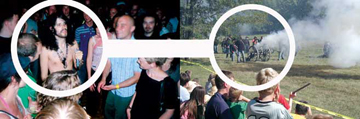
Image by Mark Rodriguez. Devendra and Civil War Re-enactors
Over the course of my stay here, I started imagining an agenda of outlining, in practice and experience, the 7 forms through which cultural change is advanced. This list is made up to include posts on the aesthetic sphere, the relational sphere, the organizing sphere, the social sphere, the institutional sphere plus 2 more I hadn’t yet written… seven’s such a solid number. It was to be a bold piece of writing.
I thought then to write only about precursors to art and cultural projects, as this past weekend brought me to several art spaces in transition but no actual openings. I don’t actually know if this will be the plan, but that’s a good image on which to leave. At the moment, I am into what makes things tick in terms of bringing out the now and in terms of how to plan for the future.