Sweet Tactility…

November 20th, 2009

You need to a flashplayer enabled browser to view this YouTube video

In my last post as your guest blogger, I want to indulge a bit and quickly acknowledge my un-quenchable lust for the artist’s book. No, I don’t mean the artist’s book that is widely published and circulated amongst coffee tables of the world in its glossy radiance and clever contemporary design. I cannot get enough of handmade or editioned artist’s books and zines in all of their intaglio, found material, random texture, sincere approach, unconventionally bound, dorky, blind-stamped, and subtle glory…. And yes, I am a stalker of Printed Matter, self-published gems at Blurb, college presses, and dusty shelves of alternative bookstores.

May I recommend that we all tune in for PBS’s upcoming expose on paper folding entitled Between the Folds? And who else’s imagination goes on a strange journey when they see these new possibilities of the pop-up book, courtesy of MIT above? As much as new media threatens to destroy the book arts and put paper way behind us, this artist/writer/blogger/researcher/designer thinks paper is not that easy to overpower when it comes to the viewer’s experience. Cheers to the book!

Photo? Art? History?

November 18th, 2009
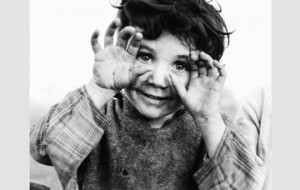
Alen MacWeeney, Bernie, Cherry Orchard, gelatin silver print, dimensions variable, circa 1976, Courtesy of www.alenmacweeney.com

Alen MacWeeney, "Bernie, Cherry Orchard," circa 1976. Gelatin silver print, dimensions variable. Courtesy www.alenmacweeney.com.

It hardly seems fair that in today’s world of the point-and-shoot dominated landscape, where a common tourist can not only take a professional photograph but adequately circulate it via the internet too, that we are seeing an influx of historic photography in the art market. Yes, the images are certainly of interest, but haven’t we redefined our relationship with the image in a daily existence of friends tagging us in Facebook shots? What in history is so contemporary? How are New York and California art dealers and auction houses, such as Phillips de Pury, working up the nerve to charge thousands of dollars for a vintage photograph unearthed from the dusty photography studio? And speaking of the studio, where does the photographer as the artist fit in all of this? Where does craft and precision? I don’t know that I have all the answers, but I do know that documentary photography looks darn good on contemporary white walls. It seems this may be the new place for it, for better or for worse, as bulky photography books make their comeback in all their design glory and new standards for print quality.

Alen MacWeeney, Willie Donoghue and Children, gelatin silver print, dimensions variable, circa 1976, Courtesy of www.alenmacweeney.com

Alen MacWeeney, "Willie Donoghue and Children," circa 1976. Gelatin silver print, dimensions variable. Courtesy www.alenmacweeney.com.

Not too long ago, it seems, I was Assistant Director of the Steven Kasher Gallery in Chelsea and had received a crash course on the true marketability and value of the photographs many a contemporary collector may take for impostors in the art world. And, I have to say, much like the art world in general, value is a questionable entity, as it is assigned by a handful of pioneers willing to be the first to put historical documentation up on white walls and call it art. Oh, and of course attach the appropriate price tag. What else could explain the booming sales of mugshots from the 40s and 50s? Yes, they are available on eBay for fraction of the gallery cost, but the juicy ones with notes on crimes such as “loitering” and “looking suspicious” and the ones with the wildest hairdos will cost you. Take a look at more here. And should we speak of the collectors of photography as art, who seem to feed their collections with images of high value and fetishized subject matters? It would be easy to pick out, for instance, Diane Arbus as being on the other side of this deal (the photographer living as artist and not thinking much of it). Arbus, whose photography and ephemera has been widely exhibited in the art world and sold (see, again, Phillips de Pury last year) for incredible prices.

Continue reading »

A Cage Went in Search of a Bird…

November 15th, 2009
Premnath_Sreshta_a cage went in search of a bird 2009

Sreshta Rit Premnath, "A Cage Went in Search of a Bird," 2009. Digital C-Print, 27” x 45”. Courtesy the Artist.

“A cage went in search of a bird.”
— The Zürau Aphorisms of Franz Kafka

What is so frustrating, yet so sublimely pleasing about conceptual work? Is it the slight feeling of the guilt of making a big something out of seemingly nothing? As the viewer, allowing yourself to walk in on someone else’s private meditation? Is it exploitative of the art form? Exploitative of us?

I think of contemporary conceptual artmaking as a word which is said so many times over that it somehow abstracts, heaves, turns inside out, and becomes something else. That’s the transformative power of working with ideas and allowing them to stand on their own: the indulgence of making a big something out of seemingly nothing. A passing thought, a political agenda, a literary phrase regurgitated by the wonder of the human brain. It somehow makes life grander, doesn’t it? Other disciplines seem to fall away, as there are no rules with this one. We can be writers, philosophers, children, designers, photographers, drawers, painters, performers. The idea leads. It is unadulterated. Now isn’t that noble? The image above is from the latest series of work by Sreshta Rit Premnath, an art practitioner living and working in New York City.

Surrender (from the series “A Cage Went in Search of a Bird”), 2009, 90”X45”, Digital C Print Triptych, Courtesy the artist

Sreshta Rit Premnath, "Surrender" (from the series “A Cage Went in Search of a Bird”), 2009. Digital C-Print Triptych, 90”X45”. Courtesy the Artist.

From his statement about the work:

In this series of photographic interventions, images culled from the US Navy’s website, linked to the operations being carried out against pirates in Somalia, are cropped, cut, reassembled and reframed under the headings “Surrender” and “Surround.” The lexicon of the sublime landscape is collided with that of military operations. While the sublime landscape is said to surround the viewer thus enticing his soul to surrender, strategic operations are carried out by the Navy in order to surround the pirates and force them to surrender.

The ocean is explored as territory that lies outside the realm of governmentality – a site of awe and threat. Day and night enormous quantities of cargo – the embodied process of the distribution of commodities – ply these waters silently, transparently. It is only at the moment of their disappearance that they suddenly become present to us all. Suddenly, when an oil tanker goes missing, its enormous body comes into focus. It is then that the cage goes in search of the bird. Law must be forced upon the lawless in order to make the absent present. In order to, once again, make the present disappear.

Continue reading »

Four Questions with Alicia Ross

November 11th, 2009

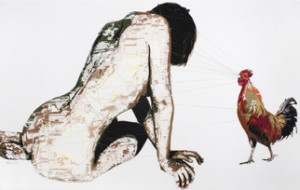
Alicia Ross, Motherboard_6 (A Chicken Waits for a Good Cock), cross-stitch on cotton, 72 x 41, 2008 Courtesy of the artist

Alicia Ross, "Motherboard_6 (A Chicken Waits for a Good Cock)," 2008. Cross-stitch on cotton, 72 x 41. Courtesy the Artist.

This young artist’s Motherboard series features appropriated Internet porn—nubile women sprawl across large cotton panels, cross-stitched in silver and gold thread with digital precision…Witty videos filter sex scenes through those round eye-test patterns of colored dots you might remember from grade school. Substantially more men than women are color-blind—Ross offers one way to subvert the “male gaze” amid the Internet’s panopticon of voyeurism. — Village Voice

In pursuit of finding more groundbreaking contemporary work that explores the self (and the shame of being the self), I had thought of Alicia Ross. I remember the first day I met her, when I was doing a photography project at a company she then worked for in Cleveland. She is bubbly, kind, outgoing, and (I mean this as a true compliment, Alicia) vulnerable. In other words, she is so Midwestern that I long for her kind of smile as I now wander the streets of ice cold NYC. When she handed me the catalog to her recent exhibition at the Black and White Gallery in Chelsea, I was blown away. Her work is truly provocative, sublime, rich with color, texture, and questions. I wanted to have four of those questions answered, and like a good Midwestern girl, one that likes to cross-stich and embroider pornographic images at that, Alicia responded.

Alicia Ross, Motherboard_5 (The Siren) (detail), cross-stitch on cotton, 36 x 51 in, 2008 Courtesy of the artist

Alicia Ross, "Motherboard_5 (The Siren)" (detail), 2008. Cross-stitch on cotton, 36 x 51 in. Courtesy the Artist.

Maria Stenina: Your work is so sinful. It is not a woman’s place, after all, to explore pornography and overt sexuality with such craft and beauty. Can you address your dealings with the grotesque and the sensual?

Alicia Ross: My work isn’t necessarily an exploration of the grotesque or the sensual independently, but rather an examination of the marriage between the two. The tension that I am specifically interested in is the domestic woman vs. the woman of sexual desire or the conflict between mother vs. mistress. The work isn’t necessarily taking sides between the taboo or the ladylike but materializing the balance for the viewer to decipher.

I think it’s interesting you would use the word ’sinful.’ Unless you see sexuality as sinful, I don’t think the work is sinful at all, but honest. I do think it’s precisely a female gesture to take something taboo or grotesque and want to make it beautiful. Just like the work is taking pornographic images and through manipulation and sometimes by sheer output, is transforming the images into a more widely excepted form: embroidery. To me, the whole point of the work is to question two often clashing, feminine impulses.

(Interviewer’s note: I should have said “deliciously sinful,” as I meant it to be a positive kind of sinful.)

Continue reading »

Dermatographia

November 9th, 2009
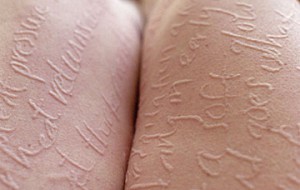
Ariana Page Russell, “Index”, C-print, 2005. Courtesy www.arianapagerussell.com

Ariana Page Russell, “Index,” C-print, 2005. Courtesy www.arianapagerussell.com

Hello Art:21 interweb world! I hope to do you justice with my musings and bits and pieces of contemporary art knick-knacks. I think as an artist and designer working today, it is imperative to give the art object more consideration than in the days of yore. Is it our preoccupation with being somehow truer to our practice? Our wanting to make a smaller and smaller footprint with each step? To reflect the confused state of our environment in any meaningful gesture thrust out into existence? Maybe… A struggle exists between the artist floundering to retain value of the crafted final “piece” of exhibition material and her trying to speak with less residue. I am thinking that the Art:21 Season 4 episode Ecology is a perfect demonstration of this, as artists struggle to reflect the needs of the environment while having to use materials such as wood and move trees around. What I notice, though, is that as practicioners of contemporary art making/doing, we are still desperately searching for an avenue of release from heavy use of materials, postmodernist references, the cords and motors of technological possibilities, and grand gestures of sweeping gallery galas…Perhaps it is a quest for sincerity?

You need to a flashplayer enabled browser to view this YouTube video

So I wonder, could it be that the new “environmental” art is that which is sinfully crafted in private? Just…you know, for the love of it? Can we win back the love for ourselves and the practice (the grotesque and the sublime of it), or has the market killed it all? What happens with a lot of younger contemporary artists, as I see it, is a quiet revolution of smaller gestures, alternate materials, a kind of closing off in favor of exploring the self, the dream, the body and traditional ways of “making.” The artist above is named Ariana Page Russell and she has a skin condition known as dermatographia (the immune system exhibits hypersensitivity, via skin, that releases excessive amounts of histamine, causing capillaries to dilate and welts to appear, lasting about thirty minutes when the skin’s surface is lightly scratched). Her process of making involves manipulating her body as a form of self-exploration and that of coping with her condition, which became obvious to her as she was often teased for blushing excessively. She does consider herself to be as much of a photographer as a performance artist, IF one chooses to use the word performance here. What intrigues me most is the privacy of the act of manipulating skin yourself. Of experimenting with your body and only exhibiting a piece of paper as a document of the act.