The Lexicon of Alisha Kerlin

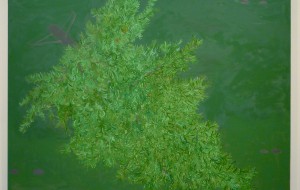
Alisha Kerlin, "A State of Mind in Which Someone Is Or Seems To Be Unaware Of Their Immediate Surroundings," 2011
I’ve held my own definition of literacy for some time now: that becoming increasingly literate is essentially seeing the world with increasing nuance. Greater literacy means grasping the many shades of difference that might be attached to any one object or idea. Knowledge, on the other hand, is the way we make useful all of that nuance, organizing it and making connections between it. In this way, literacy and knowledge are codependent yet somewhat counterproductive forces of language. Literacy expands while knowledge consolidates. To me, one of art’s great uses is its ability to restructure the paths that knowledge builds between information without abolishing the delicate nodes of nuance whose recognition come at the price of careful observation and imagination.
I didn’t immediately connect Alisha Kerlin’s paintings with this idea of nuance and knowledge. My first impressions were of solitude and the isolated objecthood they depicted. And these things certainly exist in the work. In fact, Kerlin’s words for the press release of her current show echoed my own thoughts by giving direct prominence to the ‘solitude’ of the playing cards, the carrot, or the tree in her paintings. But the isolation she imposes on her subjects gets far greater mileage than a simple feeling of aloneness, and goes beyond a metaphor for the long-laboring studio artist (or the lonely painting on the wall).
It is precisely the solitude in her work that allows layers of nuance to move around and reconnect in unexpected ways. In their isolation, Kerlin’s paintings function much more closely to the slippery, meaning-stuffed, ever-evolving nature of language itself. They read like entries in a lexicon, but not so much a dictionary, more like a thesaurus, in which the identity of the central component is in a swirl with its tangential comparative other selves. The title of her current show at Zach Feuer in Manhattan, Perceptible by Comparison, certainly points to this idea. Through an applied solitude, the paintings, the things depicted in the paintings, and the viewer alike are loosened of their normal connections to one another and to their own selfhood and enter a kind of drift or hovering. What follows seems to be a desire to mark out the undefined and unnatural place of the rectangular painted surface and to reconnect meaning between the various parts. Such was my reaction to Kerlin’s paintings of measuring tapes stretching across amorphous fields of paint, or subtly plotted gestures that often appear in the corners of her paintings. Absent normal associations, we feel the need to reorient ourselves by plotting a new set of guides.
Quit Grad School.
Well, that title may overstate it a little and perhaps it comes from a sullen mood, but in recent days I’ve found myself ruminating about giving up on grad school altogether; unplugging from the system. More and more I feel that art schools have nothing to teach. But, in equal portion to my growing disenchantment grows my satisfaction with how thoroughly I’ve been educated while in graduate school. I have no use for my education, and yet in two swift years it propelled me from a squandering and teetering artist-hopeful to someone who feels confident about having a legitimate practice for many years ahead. Nothing can be taught and yet I’ve learned plenty. So, what accounts for the difference? What have I learned and how did I learn it?
But first, why do art schools have nothing to teach? For most artists, being a good one means a tremendous amount of education just as in any other advanced field. Pointed, nuanced, daily lessons and long hours of labor accompany the slow growth of one’s trade. Further, just as art production has become granularly nuanced to the desires of individuals, their educational needs are individually specific. In order to accommodate the growing curiosities of artists, art school curriculum panned backward, increasing scope of possibility while decreasing in details and determined instruction (life drawing in grad school?! Ha!). Prioritizing inclusivity over specificity, schools abandon skill for cognition, then cognition for validation, then validation for oblique encouragements. Perhaps rightly so, but the spiral of what not to teach has left us in a place where the only thing agreeable to teach is essentially how to teach one’s self. Personally, I support that. But if we are able to teach ourselves, what need is there for the ensconced institution of school to continue?
Yet for every whining lament I make about the system holding us down, my artistic life would not be anywhere near as full and sustainable if I had not attended. The fact is that my grad school experience is helping me to do without it, or more specifically, to want to do without it. I don’t think that is the case with many schools. Whether through debt burdens or outmoded lessons (we certainly have our share of each of these), many programs leave young artists at the exit without a clear idea of how to continue making their work. (That is most definitely not to be confused with “how to make it in the art world.” That cancerous aim awaits the radiation of my next diatribe. The last thing we need are expensive art schools telling us how to earn money with our art to pay for the expensive art schools we attended.) The only truly effective plan that schools give students is how to get into the school, not out of it.
A recent SVA poster advertisement superbly illustrates an art school disguising its total lack of direction for students with bizarrely opaque warm-fuzzies in the form of a motivational quote from President Obama: “In reaffirming the greatness of our nation, we understand that greatness is never given, it must be earned.” Oh yeah, and the quote surrounds a pretty flower. Again, this is an advertisement for advanced study in art.
Yes, the aim of art school should be to write itself out. And now, three generations into our current structure, we’ve had ample time and example to create a roadmap to swiftly adapt away from the staggering influence of institutional teaching. So, to balance my gratitude with my curmudgeonly rants, I’ve briefly addressed a couple very basic and important lessons that graduate school has given me and that one doesn’t need graduate school to get.
Meandering art school, advocating outsiderness
Beginning with the writings of Michel de Certeau, over the past several months, I’ve thought a lot about the idea of meandering an institutional presence. That thinking bled into my musings on art school as well. What would it mean to think of art school as an institution to be navigated? How much of an institutional presence is art school to the practice of an artist? What impediments does it place for the artist to work around? What is the gravity that holds us so ubiquitously to it?
Art graduate school is now an institution in which we invest our selves. In an age where we are expected and needed to think on our own, most of us simply don’t. When there is the clear, if dispiriting, option of pursuing meaningful questions and experimentation with no one’s acknowledgment but our own and that of those close to us, instead we choose to surround ourselves with people ordained in one way or another by power structures larger than ourselves who have the authority to promote us in those same structures. We desire admittance into the hierarchy more than the freedom to operate without it. If we ask ourselves, ‘what is the point of an artist going to graduate school?’ we might also have to ask ourselves, ‘what level of independence do we expect of our artists?’
Life After Graduation
by Matthew Newton and Jeffrey Augustine Songco
First, Matthew interviews Hunter College alum Jules de Balincourt on the occasion of his solo exhibition at Deitch Projects, followed by Jeffrey’s look at what his peers are planning to do after graduating from the San Francisco Art Institute.
Matthew Newton, “The Continuing Education of Jules de Balincourt”

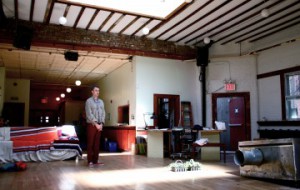
Jules de Balincourt in his Bushwick studio following his solo exhibition opening at Deitch Projects in SoHo
In discussing the topic of “life after graduation,” it is important for me to call it “life after graduation from Hunter College.” The personality of this school is so different from others I’ve encountered that the qualification seems necessary. As compared to our many high-profile private and Ivy League neighbors, Hunter is the rugged, under-funded, scrappy underdog; a public school pulling out surprising back-door success stories, of which Jules de Balincourt’s is one of our recent favorites.
Jules has the “life after graduation” story that most MFA hopefuls privately expect, and yet only a tiny percentage actually experience. It’s a narrative that pretty much any young artist would want: arrive at school, start making work, get noticed by an up-and-coming gallerist, have a roundly loved solo exhibition (or two), get glowing reviews from important art critics, sell a lot of art, buy a big studio and keep working. And after all of that, graduate with your MFA. Jules’s arc from just another kid in Brooklyn making art to having important exhibitions worldwide is as sharp as it is unusual.
As a current Hunter student wondering how to stitch together my own career, I sat down with Jules on the occasion of his solo show Premonitions at Deitch Projects — his first since leaving Zach Feuer Gallery and the second-to-last exhibition ever at Jeffrey Deitch’s iconic SoHo gallery — to discuss his time at Hunter, the years following, and to track the circumstances that contributed to his enviable rise.

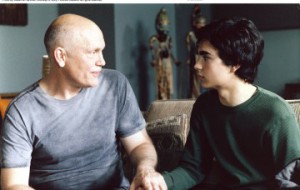
Still from "Art School Confidential." Left: John Malkovich as Professor Sandford, Right: Max Minghellas as Jerome. Photo by Suzanne Hanover, courtesy of Sony Pictures Classics, all rights reserved (c) Sony Pictures Entertainment Inc.
Art21′s Open Enrollment column is a forum for nine people currently enrolled in some form of art graduate study to take on a variety of topics and to challenge some of the existing conventions concerning the education of artists and art professionals. It will also serve as a document on the current state of advanced study in art.
Over the next several months, we eight will speak from our very different perspectives to cover a variety of topics: the crit, life after graduation, the educational canon, the role of history in art practice, the studio vs. the field, interdisciplinary study, competition, and many others.
So, to introduce you to ourselves and to the Open Enrollment column, Vency Yun and myself, Matthew Newton, have profiled our fellow bloggers and their schools to give you some perspective on who we are and how we are being educated.
First, Vency presents Lily Rossebo, Jeffrey Augustine Songco, Oliver Wunsch, and Daniel Ingroff while I profile Mike Brenner, Corina Reynolds, and Carrie McGath. Please enjoy this peek into our worlds, feel free to comment on this and future posts, and thank you for reading!
Vency Yun: It is 3pm in France and I’m sitting in my apartment with my afternoon café crème in hand, waiting for Lily, who lives in Edinburgh, Scotland, to Skype me. In many ways, this feels like the first day of school, where I’m about to meet four of my classmates: Lily (Edinburgh College of Art), Jeffrey (San Francisco Art Institute), Oliver (Williams College), and Daniel (The Mountain School of Arts) for the first time. Except our school is in cyberspace where they, like me, have registered for this Open Enrollment virtual classroom, to share and to write about our graduate school experiences. So this entry will be like a diary, where I note down what I so humbly learned from each person in contrast to the experiences that I’ve had at Concordia University in Montreal — because after all, I am a student who learns from her peers.