Relational Aesthetics is the New Black: DIY Art School

January 7th, 2011

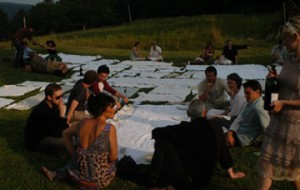
Barbie's Bruegal Picnic, 2009. Picnic at Mildred's Lane. Courtesy of J. Morgan Puett.

Relational art functions as a response to the technological advances of everyday life, with virtual profiles acting as surrogates for human interaction.  Less obvious are the ways in which the art institution embraces or rejects it.  How does the alternative model of education reiterate artists’ philosophies of social practice and how has the myth of the “Art School Crisis” become a catalyst for these alternatives? The popularity of artist-run schools like Olafur Eliasson’s Institut für Raumexperimente and Mark Dion’s Mildred’s Lane Project prove that social practice has moved out of the white cube and into the educational system to become a vital influence on contemporary art education.

Consider Eliasson’s Institut für Raumexperimente in Berlin and Mark Dion’s Mildred’s Lane Project in Pennsylvania where the curriculum is a direct consequence of the artists’ practice.  In these settings, art must make a connection between working, living, research and experimentation.  According to Eliasson, the problem with traditional art education is clear.  “The hierarchical transmission of knowledge practiced in many art schools is clearly unproductive: the inflexible categories of ‘teacher’ and ‘student’ working in a sealed-off environment…have taken responsibility away from the students, distancing them from real work in real life.”  As a laboratory, his Institute promotes experimentation as a means to “make the voice of art heard” while its participants form a relationship with the members of the community.  Dion’s Mildred’s Lane, situated on 92 acres in rural Pennsylvania, is a collaborative long-term experiment between artists Dion and J. Morgan Puett.  The research-driven art projects encourage the connectedness of art practice to everyday life by questioning students’ art practice in relation to their environment.  To rethink the studio, the students visit alternative farms and discuss cooking and cleaning as part of the course of study.

Continue reading »