What’s so great about…
Hello again and goodbye for now, Art21 blogging community. As a guest blogger for the past couple of weeks, I’ve loved sharing thoughts on contemporary art in New York City and hearing your comments. If you’ve enjoyed my videos, I hope you will visit my website for free downloads or subscribe to my iTunes podcast (as you may have done for Art21’s exclusive videos).
In parting, let me share a few further thoughts on and pictures of a few of the most thought provoking exhibitions Chelsea at the moment.

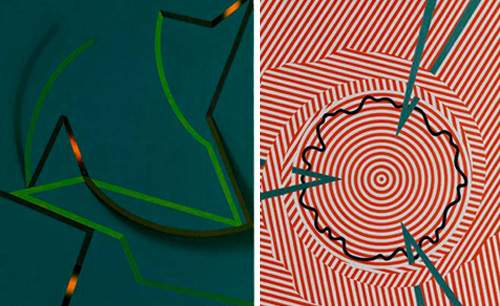
Tomma Abts’ tiny paintings have the power to stop a speeding art critic. The pressure to see as much art in as little time as possible (a bad approach, I know) usually has me racing in and out of galleries making snap judgments about whether to pause, come back, or move on. Abts’ show at David Zwirner Gallery literally arrested my attention, surprising me not least because the small canvases could have easily been lost on vast white walls. Instead, they zing with energy, particularly Feio, which brings to mind Russian Constructivism, Bridget Riley, and a cheap decoder ring rolled into one jittery vision.
A few years back, I stumbled on Abts still tinkering with the installation of her work at a press preview. As she intensely scrutinized a perfect painting hung perfectly on a perfect wall, it helped me understand why her work looked determined to within an inch of its life. Though they appear so controlled, paintings like Bilte pioneer their own spatial relationship between figure and ground; colors and forms are just beyond familiarity and some electric charge–like the three flashes of orange brightness here–animates each geometric composition.


Anne Chu was dubbed “one of the best figurative sculptors around” by Roberta Smith after her 2003 solo show at 303 Gallery, an accolade the likes of which doesn’t come often or easily. Smith didn’t go into detail about her criteria, but Chu supplies plenty for viewers to ponder, nodding to art history with subject matter taken from canonical sculpture and pushing her materials in challenging directions. My first impression on entering her recent show at 303’s 21st Street space was that the new work bore an affinity to Matthew Monahan’s recent sculptures that also incorporate figures from folklore and art history. But Chu’s characters are more forthright, directly confronting the viewer, not merging with other imagery or the base. They want to interact; each figure in the show turns to face the front door with the exception of From A Hanging Garden which resembles both calligraphy in space and a complex wood carving and offers a place at the center of the show to stop and converse.


Dana Hoey had to overcome her success to make good work. Nearly ten after having been included in the influential show of female photographers, Another Girl Another Planet, then lumped together with a group of so-called “girl photographers,” Hoey’s strong show at Friedrich Petzel Gallery makes the case for her independence (another reluctant alumni of the “group,” Nikki S. Lee, is coincidently showing across the street at Sikkema Jenkins and Co, but could take a page out of Hoey’s book about moving on). Using a genre-busting mix of narrative, portraiture, and nature photography, Hoey tells a loose tale of environmental apocalypse. Dividing the gallery into four sections, she imagines the effect of ash fallout, a freeze, thaw, drought, and flood on the landscape and its inhabitants without creating an environmentalist parable or easily read storyline. Instead, the eclectic mix of shots is in turn gorgeous, haunting and sobering leaving us wanting to know more.
Trenton Doyle Hancock in Chelsea (with video!)
At last! An update from Art:21 Season 2 artist Trenton Doyle Hancock’s Lower Realm has reached us in Chelsea. Hancock recently opened a new chapter in his ongoing saga of the war between a race of emaciated mutant Vegans and their fleshy Mound counterparts in Fear, his fourth solo show at James Cohan Gallery. But instead of painting scenes of all-out warfare, Hancock captures super-charged moments of tense waiting or vivid torture, suggesting that his epic narrative has reached a crossroads.
Hancock once explained that conflict compels him as an artist but in this show, confrontation itself is his topic. Instead of continuing to develop his elaborate storyline, he has arrived at an introspective moment in a tale so intricate that it no longer matters who’s winning or losing. A grid of paintings, each featuring a set of huge eyes peeping over a horizon line, suggests that their owners are either conducting surveillance or hiding out. The fear alluded to in the show’s title and written in black drops (blood? sweat?) on the walls isn’t anchored to a specific event. Pieces like Descension and Dissension (2008), which looks like a torture scene in which a bound Vegan (St Sesom?) is drained of mound meat yet at the same time enjoys a shower of life-giving color, are equally hard to pin down.
It’s been over a decade since Hancock began elaborating his storyline and detailing the complex identities of his host of characters. His hilarious The Trenton Doyle Handbook, Vol. 1 is a great resource for piecing together a who’s-who of the Vegan underworld. But given Hancock’s absorption in his self-created universe it’s not hard to imagine that his cosmology would grow too complex for anyone other than committed fans to keep up with. So the more abstract quality of this show not only opens his project to newcomers and recommits to the ambiguity that has made his work relevant to so many conversations: religion, race, politics and more.
I recently had the opportunity to talk to him about Fear in a public discussion organized by the New York Center for Art and Media Studies and hosted by James Cohan Gallery. Hancock provided insights on his themes and working methods, his performance art, his project Cult of Color with Ballet Austin last spring, and hinted of major changes to come in his work. The entire video interview is posted here, but check the video page on my website: for a shorter version and transcription coming soon.
Perfect Strangers – Man or Beast?

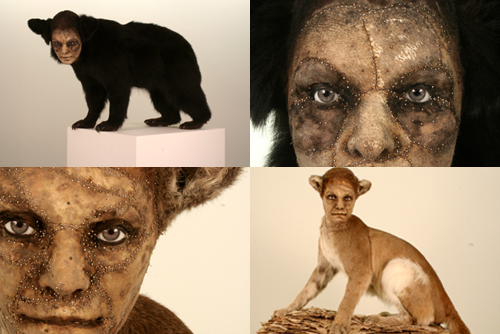
Surely one of the stranger sights in the Chelsea galleries this month is the running coyote pack in the window of Claire Oliver Gallery. In sculptor Kate Clark’s first New York solo show, she debuts animal portraits with an unnerving twist; her taxidermied bear, cougar, fawn and gazelles have human faces. Sounds like a recipe for kitsch, but the presence of the bizarre man-beast creatures is arresting.
Clark explains that her work is the opposite of trophy presentations made after a hunt. Rather than man conquering nature, the two have merged. The work has none of the humor of, say, Maurizio Cattelan’s recent untitled sculpture in the New Museum’s show After Nature, for which he mounted the rear end of a horse high up on the wall. But it’s precisely the complexity of each face that saves the work from ending up as a one-liner.
“So many people know so little about the natural world,” Clark says, “that the animals are a symbol of a wild creature and not necessarily a cougar, for example.” Titling the show Perfect Strangers, Clark underlines the alienation between mankind and wild creatures as people and animals increasingly encroach on each other’s territory. The best pieces have an Aslan-like benevolence and restrained power that make it easy to imagine a folklore in which man saves beast or vice versa. But high on their pedestals, Clark keeps them splendidly aloof, all the better to savor their nuanced characters.
Check out my video interview with Clark, in which she explains the pieces’ symbolic content and goes into the nitty gritty of working with such unusual materials.
24th Street Showdown: Cindy Sherman v. Richard Prince
Score a victory for female artists in Chelsea galleries this month. Women are still routinely underrepresented in museum collections (see Jerry Saltz’s debate-sparking tally of MoMA’s permanent collection), but not so in the commercial realm in December, where exhibitions by the likes of Cindy Sherman, Anne Chu, Tomma Abts and others stand out as the best of the moment. I found myself pitching an all-female list of reviews to an editor last week–probably a first for me in over ten years of writing art criticism.
Representations of women, however, are another thing. Two prominent cases in point are Richard Prince’s show at Gagosian Gallery and Cindy Sherman’s at Metro Pictures, both a study in how to demean their prominent female figures. But while Sherman demonstrates her staying power by incisively skewering the absurdities of conspicuous consumption, Prince is churning out product to pass off to said consumers.
Channeling a Gauguin-in-Tahiti impulse and apparently referring to his birthplace, the Panama Canal Zone, Prince’s giant collages pair porn shots of women with occasional Rastafarian characters in a tropical setting. Whatever civilizing impulse reigned Prince in with his merely suggestive ‘nurses’ and ‘girlfriends’ series in the past has evidently given way to an orgy of bad taste compounded by the sheer volume of monotonously similar work crammed into Gagosian’s cavernous space. The mixed race encounters recall Hannah Hoch’s Dada collage, but eighty years of cultural theory later it’s hard to see Prince’s more graphic version as anything other than gratuitous sex and offensive stereotype whether or not it’s intended to be tongue-in-cheek.
Meanwhile, down the block, Cindy Sherman’s new photo series admittedly also debases her subjects but without removing all of their dignity. Once again, she dons a range of disguises and this time, adopts an enormous scale to convey the grandeur that her new subjects (ladies-who-lunch) would presumably like to project. She masterfully evokes the foibles of a “too much money, too little taste” crowd and certainly doesn’t seem to be afraid of alienating the percentage of her audience who must fall into this category themselves. The enormous size of the photos reads as a jab at the current art world taste for splashy big artwork with high production values, revealing Sherman to be at the top of her game over thirty years after she started her landmark Untitled Film Stills series.
What do you think of these two new bodies of work? Check out the exhibition review I shot on video this weekend of Sherman’s work, and post a comment.
The Obamas arrive at the New Museum

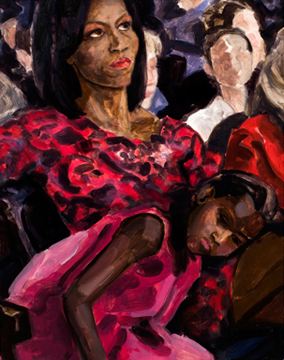
Two big attractions of the season—Carsten Höller’s hotel room and Pipilotti Rist’s video (see my Dec. 2 and 3 posts)—occupy a serious amount of space in their respective museums. A third, Elizabeth Peyton’s portrait of Michelle and Sasha Obama at the New Museum of Contemporary Art, is tiny but carried much intrigue when it was unveiled on November 5th. To a flurry of press coverage, Michelle and Sasha Obama listening to Barack Obama at the Democratic National Convention August 2008 joined portraits of Peyton’s friends, lovers and idols in the painter’s retrospective, Live Forever.When I visited this late addition to the show, I was surprised to find that the painting had its own security detail. Or at least that’s what it looked like. In fact, the hovering guard was waiting for some contractors and soon disappeared, ruining my fantasy that the piece was so portentous that it needed special protection. Truth was, I wanted to be more impressed by the painting than I was.
Though the portrait was surely meant as a tribute, it is anything but flattering. Notably, Peyton chose to emphasize a puffiness around Obama’s mouth, reversing her usual practice of prettying up her subjects (take, for instance her 1994 version of Ludwig II of Bavaria who, with hair flying, red lips pursed and a distant dreamy gaze, is more fashionista than monarch). In the same gallery, a portrait of a harrowed-looking Matthew Barney suggest a modern day, tortured Van Gogh character via which his expression and surroundings. But while the layered line and color on Barney’s face give him a weathered gravitas, the same technique leaves Obamas’ features streaky. Maybe Kehinde Wiley can give Peyton a lesson in depicting a range of skin tones, though it probably won’t be necessary since the closest she normally comes to portraying diversity is painting her partner in an afro wig.
Michelle Obama’s character continues to be the subject of national debate, but Peyton gives the future first mother and first lady an ambiguous expression that is simultaneously bored and tired though infused with a glint of excitement. Likewise, it’s unclear what Peyton had in mind with Obama’s pose, which seems too casual for the momentous occasion. During a moment of high energy, the family looks wiped out, which may indicate their sacrifice, but not much more. Of course, Peyton is painting not from life or the experience of meeting her subject, but from appropriated news footage. But her distance, even her lack of apparent enthusiasm, keeps the painting from being persuasive political art much less portraiture. Its understatement is the antithesis of the elation or disappointment felt by the nation on November 5.
What do you think of the painting? Is it good political art? Will we even remember it in a year or two? Post a comment.
MoMA’s Womb

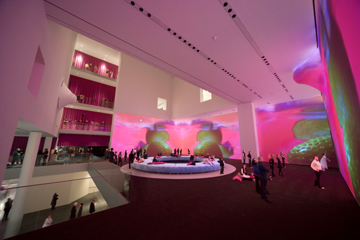
The ‘wow factor’ in Swiss artist Pipilotti Rist’s buzz-generating new video installation in the Museum of Modern Art’s atrium is huge. Featuring fields of flowers, Pour Your Body Out (7534 Cubic Meters) recalls MoMA’s ill conceived installation of Monet’s Water Lilies there four years ago. But while the towering space diminished Monet’s painting, memorably prompting critic Peter Schjeldahl to compare it to a “big, soiled Band-Aid,” the sullied beauty of Rist’s piece is deliberate; it has no problem commanding the area and overwhelming viewers.
Pour traffics in familiar clichés about the closeness of women to the natural world without adopting any particularly critical point of view. A modern-day Eve chomps apples and swims nude while lily pads, giant strawberries and other fruit bob around in the water. Watching her romp through a flower farm, caress an earthworm, and snap heads off flowers is sheer visual pleasure. Her lighthearted impersonation of a wild boar running through a grassy field is hilarious.

In a video produced by MoMA, Chief Curator of Media Klaus Biesenbach likens the site-specific piece to a pool in which the audience sits inundated by projected light. When the protagonist’s menstrual flow turns the waters blood red, the atrium takes on the aura of a womb or birthing pool. “You don’t need to be a feminist critic,” writes New York Times critic Karen Rosenberg, “…to understand the significance of a female artist unleashing a red torrent on MoMA’s immaculate white walls.”
Like Doug Aitken’s video projection on MoMA’s exterior a few years ago, Rist’s piece is an attractive spectacle. But it also radically feminizes a normally cold and masculine space (Barnett Newman’s Broken Obelisk first installed there alongside Monet’s Water Lilies set the tone nicely), not only with its subject matter but with the gaudy drama of several stories of fuchsia colored drapes and a enormous circular couch that invites visitors to lounge, chat and even sleep. As children played and one visitor slipped into a tai-chi routine, the atrium didn’t seem so much feminized but humanized, recalling MoMA architect Yoshio Taniguchi’s guiding vision “…to create an ideal environment for the interaction of people and art.”

Bedding Down at the Guggenheim

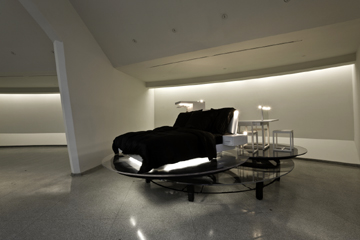
Spending the night in a museum is a childhood fantasy that would seem to better suit the crowded treasure troves of the Metropolitan Museum of Art than the more Spartan Guggenheim Museum. But when Carsten Höller’s Revolving Hotel Room went on sale as part of the museum’s current theanyspacewhatever show, it sold out within hours to the likes of Chloe Sevigny, New York magazine art critic Jerry Saltz, and dozens of others willing to pay between $259 and $799 for a night in the Guggenheim.And what did they get for their money? Besides the chance to settle in on a series of revolving circular platforms housing a bed, table and wardrobe, a guest and up to one companion per night received a private tour of the exhibition and the run of the place (more or less) from closing time to the next morning. The stage was set for a once-in-a-lifetime experience, so how did people take advantage of the opportunity?
Guggenheim press reps stress the privacy of the experience, but several participants wanted to share, including two members of a New Zealand family celebrating their birthdays who “skidded down the circular walkways in their socks.” Judging by the video they took, V Magazine bloggers Erin Krause and Greg Foley preferred to spend their time at their laptops, though their stay included a museum tour in their pj’s. Renowned bloggers Alaina Browne and partner Anil Dash checked in under the watchful eyes of BBC cameras, and London’s Sunday Times writer Susan D’Arcy recounted every detail and every amenity while reveling in her museum experience sans obnoxious hoi polloi. Sounds pretty mundane.
Thankfully, the always-enthusiastic Jerry Saltz also roamed the ramps in his pajamas but was more intent on having a transformative experience. After lying on the floors and standing in empty galleries, “paranoia set in” as he began to feel watched. After a bout of insomnia, he woke to find that the museum, “looked utterly new to me. I was in love with the place.”
One problem seemed to be the hermetic nature of the show, an encapsulation of the relational aesthetics aesthetic, which encourages audience participation but not always a great deal of visual stimuli. New York Times critic Roberta Smith applauded the Gugg’s “loosening up,” and jokingly suggested a new sign on the rotunda reading, “The Guggenheim Museum, Temporarily an Alternative Space, Inclusive and User-Friendly,” Time Out critic Howard Halle hit it on the head when he wrote, “Viewers can certainly be forgiven for wondering if the curators forgot to put up a show: the space looks half-empty, but it’s really just devoid of ideas.”
Overnighters needed to pack their own ideas, a concept reinforced by Philippe Parreno’s flashing marquee on the museum’s exterior, which either sets the museum up as a stage where anything can happen, or suggests that it’s just there for entertainment. Considering one of Höller’s past pieces, a series of slides installed at the Tate Modern last year, maybe the artist just wanted his audience to have fun – skidding in socks, etc.
Rising to the challenge of enduring or enjoying a night at the museum is tempered by the rules – only two guests can stay at any given time and a guard is always present at a distance. But Höller apparently intended his audience to think big – the piece is paired with a model of a proposed floating utopian community from 1928, which has been installed on the Guggenheim roof and viewed via live feed inside. The museum may itself be that peaceful utopia (for one night only), or Holler could be recruiting newly enlightened disciples to go forth into each cold morning with a new sense of place and possibility.
Were you one of the lucky ones? Post a comment if you stayed the night at the Guggenheim or have participated in a similar overnight in a museum.
Let’s Tour!
‘Tis the season to get out and about and New York’s museums and galleries are perfect places to meet up with friends or enjoy a little downtime in the holiday season. Join me, an art critic and founder of New York Art Tours on the Art:21 blog during the next two weeks for a guide and commentary on the city’s latest must-see contemporary art.
Crowds flock to the Met’s Christmas tree and 18th-century Neapolitan nativity but equally pilgrimage-worthy artworks beckon in other museums. Over the next three days, we’ll visit Carsten Höller’s hotel room in the Guggenheim, Pipilotti Rist’s eye-popping video installation in MoMA’s second floor lobby atrium and Michelle Obama’s recently hung portrait in Elizabeth Peyton’s retrospective at the New Museum.
Later in the week, our tour will make an extended stop in Chelsea where we’ll hit the biggest and best shows, including a visit to James Cohan Gallery to check out Art:21 artist Trenton Doyle Hancock’s latest solo exhibition. Then it’s on to the Lower East Side, where an entire budding gallery scene has opened around (and before!) the opening of the New Museum, a year ago today.