Island. Then Island Again.
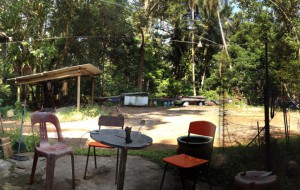
In July I went to a residency program on Pulau Ubin Island, which is off the main island of Singapore. (Yes, I was on an island off another island). Pulau Ubin is tiny. It would take me just 45 minutes to bike across the entire island. But it represent a very unique contrast: in Singapore, a city state, where most people live in high-rises, spaces are highly regulated and controlled. The majority of of Palau Ubin Island’s natural resources are preserved. On weekends it is a popular destination among Singaporeans for hiking and biking trips. On the island, the artist residency living situation is basic, but sufficient. The electricity is powered by solar panels and water is pumped from a well. Compared to the rest of Singapore, it is a throwback to the past, with some charm and lots of mosquitoes. The residency is set up by a Singaporean art collective called the Artist Village. The aim of the program is to give artists an opportunity to work with nature, or so says the website. Yet, to me, it represents a little bit more than that.
Perhaps it would be useful for me to briefly introduce Pulau Ubin and the Artist Village. Pulau Ubin Island was just like the rest of the country, during the 1960’s anyway. Its population was about 4000 strong, all living in kampong-style houses, which can be found throughout Southeast Asia. But the country was moving forward. Post independence from Malaysia, Singapore government launched massive public housing projects (commonly referred to as House Development Board flats, or HBD flats) to replace kampongs and slums in the mainland. Meanwhile, urbanization never took place on Pulau Ubin; ways of life on the tiny island did not change very much. Well, except the population has dwindled to merely 50 residents while I was staying there. Yup, nothing really could get in the way of me and nature!
New Hairdo for a New Era
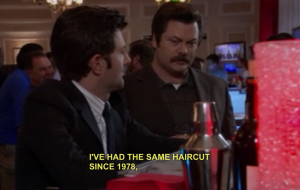
I have this fear of going to barber shop to get a haircut. I’ve had it for a long time. I don’t really know why that is. I know I hate barbershops because all the mirrors make me feel self conscious. I hate making small talk with barbers and hair stylists. I hate the smell of hair products. Yet all of these are peripheral things and do not fully explain my anxiety about it. Finally, two days ago, when I went into a barbershop for the first time in a year, I realized where my fear lies: in the problem with language.
As you know, going into a barber shop or hair salon requires one to explain what kind of hair she/he wants. The majority of that explanation is done through words. For me, this is where words fail miserably. I feel that I don’t have the right vocabulary to explain the complicated form and shape of the hair I want. This results in me feeling defeated every time the barber holds up the mirror behind my brand-new haircut. Not that I am a particularly fashionable (if at all fashionable) or neurotic individual, but when there is cash involved and a service exchanged, I do want satisfaction. When it is not there when I walk out the door, my fear and anxiety get the best of me.
But there are people who get good haircuts. I have seen them on the streets. Sometimes I even turn around and stare at them for a few seconds longer, wishing the same thing could happen on my head. These people must have the command of words that I lack. These people must knew the nuance of each word they conjure up to achieve an image that is understood perfectly between him/her and the hairdresser. How come I can never achieve such command of words for my hair?
What it comes down to, I have to conclude, is that I just don’t have the sufficient lexicon to describe hair: the form, the flow, the angle, the volume, the direction, the curvature, etc. Probably deep down I just don’t care about hair enough to really acquire these words. Then I realized, it’s not really about hair at all. My real anxiety has to do with my relationship with language. I want my words to succeed.
Talking to Kai Lam about Performance Art, Invisibility, and “Art Laws” in Singapore
First, before I start, I would like to complain a bit: Singapore prides itself on being a city of electronic gadgets and connectivity-on-the-go. There are many people watching videos on their handheld devices on the bus, the subway, and in line at the post office. Though not as dumb as Americans who text-and-drive, a lot of people here are staring at their little screens while walking. As skilled as they are at walking and watching videos at the same time, it still very much annoys me. So if you are one of those people, please stop watching crappy TV shows or crappy movies. Enjoy your bus ride. Enjoy your walk. Enjoy waiting in line at the post office!
Okay, back to art: I met Kai Lam about a year ago at a performance event at the now-defunct Post Museum. Kai has been a very active person in the art community over the last fifteen years, especially in performance circles. In 2003, he co-founded Future of Imagination (FOI), an international performance event. In 2009, Kai co-initiated Rooted In The Ephemeral Speak (R.I.T.E.S) which gives local and international artists a regular platform to showcase performance practices and time-based art.
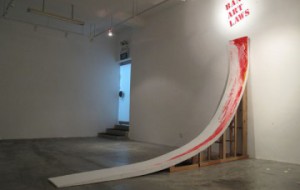
This past June, Kai had his fourth solo show in Singapore. The show was called Untitled (Wildlife). Inside the Substation gallery space, there was actually very little to see. There was a wooden container constructed out of scrap materials. On the other side of the gallery there was a wooden ramp. On the adjacent wall there was a text that read “Banish Art Laws.”
Before the opening, Kai sent out email invitations which included a letter in which he described the night he spent on Pulau Ubin, a small island off the main Singapore Island. Here is an excerpt:
“For an unassuming while, I was humored by my own helplessness in such ‘wilderness,’ possessing a limited knowledge of the natural environment, and told myself to learn more about it when I got back to ‘civilization.’ I then picked up the fishing line-spool, [where] clipped onto the line is a note, written with waterproof ink: “For all my wants, here are my unwants…. XXX,” and tied to the end of the fishing line is a rock-bait. I cast the line into the air, towards the sea, the trapping debris flew in a slow-motion movement, about twenty meters above the water surface just like the distance (I thought) of my close proximity to the wild boars, and predictably splashed into the steady-moving sea waves. I felt the rock-bait hit the bottom of the seabed and the sea’s underwater current, pulling on my rock-bait invisibly. The wait continues again.”
Those who know a bit about the geography of Singapore know that Pulau Ubin presents a contrast to the main Singapore Island. Most roads are still made of dirt, there are lots of stray dogs, and trees that are not planted. This place is as natural or wild as Singapore gets. I like the imagery Kai Lam sets up for the viewers, and their strong metaphorical content: away from the center (civilization, materialism, modern progress, etc.), the artist-figure awaits on the periphery with a fishing line. The fishing line is a double-sided one; once it hooks, it binds the debris to the artist, and the artist to the debris.
I caught up with Kai Lam to ask him about his exhibition, as well as the state of performance art in Singapore.
Mike HJ Chang: I found the letter your wrote to be very romantic. It provides the audience with an image of the artist as a contemplative figure. Can you talk a little bit about the idea behind it, and how the letter relates to the exhibition?
Kai Lam: For me, the exhibition is about developing something outside of how I usually work. I wanted to break out of my usual norm and process. Therefore, the time spent waiting, contemplating, thinking, all these processes become more important than the exhibition itself. That’s why the exhibition space is so empty to start with. For me, the show is about a certain invisibility. So in this aspect, the letter deals with my position as an artist at the moment. My position, not just in Singapore, but overseas, in a general way. When I travel to Europe, I feel that when people find out that you are an artist, then they think that what you do is something very important. But in Asia, overall there are different perceptions about artists. A different outlook and mentality about what artists do, and what artists should do. Therefore the letter is a metaphor about being on the outside, away from the city, away from the mainstream core. I have been thinking a lot about how we can position ourselves as artists in Asian society. Not by promoting our importance, but by promoting a way of thinking of the artist as a social commentator, a philosopher, and a thinker. Artists are an important part of the process for a nation maneuvering in this kind of climate. Singapore, like many post-colonial states, is still very young, still experiencing all kinds of newness, like democracy, institutional transparency, capitalism, etc.
Arts Funding, Censorship, and Writing in Singapore
Soon after writing my first post for this blog, I realized how unnecessary it was for me to point out that things are different between the States and Singapore. Isn’t that a given? Even Peter in 5th grade would know things are different between Canada and Mexico. That pretty much goes without saying. Also, I have little interest in playing games of “spot the difference” between two pictures. So, what is it about living in Singapore that made me, an American, feel really confused and disoriented? Hopefully at some point, my analogy will be The Man Who Knew Too Much (1956), instead of The Man Who Knew Too Little (1997). In both films, the protagonist is involved in an assassination attempt while “on vacation.” I think the “guest” status applies here, as I consider my own position on this island.
On my way to visit a friend’s studio in Goodman Art Centre, a newly-converted art studio and gallery space, (really nice studios, funded by the National Arts Council, but I cannot apply since I am not a citizen–so I am bitter), I was thinking about funding for the arts here in Singapore. Spaces like this, set up by government funding agencies, are rare in the States. I have seen State government subsidized artist co-ops, but nothing like these large-scale studios for artists, offered at a pretty affordable rate. This is one stark difference between the States and Singapore: Singapore’s government aggressively puts money into the development of art, but to me this seems to be more of an act of compensation to balance out the small private sector. (I myself have already been involved with three shows that are funded by the National Arts Council). I wanted to learn more about how Singaporeans feel about working in this kind of environment; luckily, the friend I was visiting happened to be an artist and curator named Guo-Liang Tan, who recently guest-curated the exhibition We Who Saw Signs at ICAS (Institute of Contemporary Art Singapore). That show featured many internationally-known artists including Ho Tzu Nyen and Adad Hannah.
First, I asked Guo-Liang about his experience writing on art in Singapore, where there is a lack of regular art periodicals. He points out a periodical called Focas: Forum On Contemporary Art & Society, edited by artist Lucy Davis, which had a good run for a year but ultimately met its demise due to lack of funding. He jokingly said that the only people who need art publications are artists. I thought that was humorous but true. In a small country such as this, the small population of artists simply cannot fuel publications centered on art. And it is not a coincidence that the newspaper Strait Times’ art coverage falls under the “Life” section, together with articles on home decoration and holiday travel. Guo-Liang points out that there aren’t enough art writers here, though some, like Lee Weng Choy, June Yap, and T.K. Sabapathy, have been very influential in developing the local art scene. Guo-Liang notes that, given the lack of art periodicals in Singapore, much of the art writing now takes place within exhibition catalogs. This means that artists who are not exhibiting their work publicly are left out of the contemporary discourse. In earlier days, Singapore’s art writers had followed a select group of artists and supported those artists’ practices by explaining them to the public. In contrast, much art writing today seems more impersonal.
A Classroom Chat with Artist and Farmer Louisa Conrad
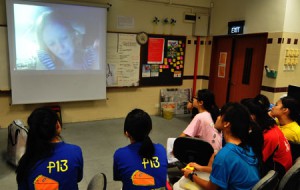
As the artist-in-residence at an all-girls high school in Singapore, I have been working on an environmental project with the students. Twenty students and myself have each been carrying an IKEA bag in which we’ve collected our personal trash. I figured the best way to see how much junk we produce on a daily basis is to not throw any of it away. So, for the last sixty days, I have been carrying my IKEA bags everywhere I go, as a performance art piece that now weighs about 4kg [almost 9 lbs]. The girls–who I think are very brave to do this–have to explain to their mothers why they are keeping trash. I think this is awesome, because it is not exactly a very “lady-like” thing to do.
Teaching art in the school is great, especially because there is time set aside for the art students to learn art history (which I myself didn’t do until I went to university). Besides some local Southeast Asian art history, a good portion of the art history curriculum is based on Western art. The students are taught Romanticism all the way to Pop Art. Since I get to design some of the courses, I can teach a little bit of performance art, Land Art, and Conceptual art, which are my favorite dishes. Just last year, the school had its first-ever art trip to London and Paris to let the students see all the great masterworks in person. The experience was as invaluable as it was magical: the textbooks came alive!
This also points to one of the problems of teaching art on an island nation. Resources are somewhat limited, and every place else is a flight away. But Singapore’s advantage as a port city is its special relationship to the rest of the world (through economic trade, etc). I thought I would use that to my own advantage by bringing artists a little bit closer to the classroom. I have been running Foxriver, a small art space in the school, where I invite friends from different places to send works to be exhibited. Last year I had artists Gala Porras-Kim, Juka Araikawa, Krister Olssen, Josh Miller, Guan Rong, and Lindsay Foster, along with many other artists who participated in a comic book show curated by John Burtle.
The highlight, though, was when I invited Gala Porras-Kim to have an artist talk via Skype while her exhibition was on view in the space. So this week, I brought Louisa Conrad, a friend of mine from California Institute of the Arts (CalArts), to chat with the students about her experiences as an artist and her interest in environmental issues. Over the last three years, Louisa has spent time in Iceland photographing volcanic landscapes, researching sea pollution, and investigating the impact of industrial development on salmon. She has traveled throughout the Northwest Territories and the Canadian Arctic, and she now lives and works on a goat farm in Vermont called Big Picture Farm.
Below is an excerpt from our classroom’s Skype conversation with Louisa.
In Your Court
Before I start, I have to confess: let’s just say writing about/for other people is not my strong suit. Writing about other people’s art gives me the nausea. Writing about another culture makes me want to make an excuse to get out of the guest blogging stint. Embarrassingly and unprofessionally, I thought about lying to the editor about a family emergency so I don’t have to write. (Also feels weird about lying using family emergency as an excuse, just feels like a bad omen.) I am one of those people who believe languages have a certain mythical power, so from now on, you can expect a “writer” who would almost lie but respects words too so much so he could not commit.
One of the reasons why I ended up in Singapore after grad school, or the reason that I tell everyone, is that I felt too American. I wanted to be somewhere else so I could think differently about my own practice, worldview, etc. Singapore seemed like a good place, a good transition for whatever comes next. I got to teach art, everyone speaks perfect English, and there is lovely weather. Speaking English is a big part for me because my work deals with language and spoken words, but what I realized soon is that I assume people who speak the same language should be able to understand each other. Man, was I wrong. I feel comically related to Bill Murray’s character in The Man Who Knew Too Little (1997), in which he plays an American visiting London but gets caught up in spy activity. The whole time, he thinks that he is part of a street improv theater while all the criminal euphemisms, spy codes, and threats (not to mention British humor) completely go over his head. Yet he is able to play along and amusingly diffuses a bomb attempt. To a certain degree, that’s how I feel being a foreign artist trying to produce work; I can hear and understand sentences, but feel lost in Singapore’s history, culture, and narrative.