The Bronzed Fonzie and Threats of Being Shived in the Shower

October 8th, 2010

The last year my art gallery, Hotcakes, was open, there were a number of significant yet manageable setbacks, but when Milwaukee’s Convention and Visitor’s Bureau got into the business of public art, I drew a line in the sand.

My nonprofit art service organization, the Milwaukee Artist Resource Network (MARN), had been working with Milwaukee’s Eastside Business Improvement District (BID) for a few years trying to build an arts incubator. We got grants to hire a number of different consulting firms and went though a feasibility study, did program development, and completed an architectural analysis of all the available properties in the neighborhood. The BID got a line on a $150,000 incubator grant from the state of Wisconsin, and found an investor willing to buy a gorgeous 30,000 sq. ft. building and lease it to us at a very reasonable rate. Then the consulting group we hired to write our business plan came back NOT with a business plan but a warning. They had apparently spoken with all the major funders in the city, and were told nobody was interested in funding MARN’s arts incubator. Why? Because another arts service organization in Milwaukee, founded after MARN but with all the right old men on its board of directors, had gotten hundreds of thousands of dollars of funding and had been totally unsuccessful. Their past had destroyed our future, and any hope of me ever getting paid a livable salary for running MARN.

Around the same time, Hotcakes was invited to show in Miami during Art Basel Miami, the second largest art fair in the world. There is big business done that first week in Miami every year. It’s a who’s who of the international art-buying world, and it was growing exponentially. I saved for over a year to come up with the roughly $10,000 it cost to cover all the expenses of exhibiting at one of the thirty-seven art fairs for four days. I showed twenty-six Milwaukee artists at the Aqua art fair, but ended up only selling $6000 worth of art; this meant after my commission that I had lost $7000. Based on my experiences doing Art Chicago, I knew it would take a few years of doing fairs in Miami before I could expect to make any money, but I had hoped to do much better.

Continue reading »

Running a Gallery on a Shoestring Budget

October 7th, 2010

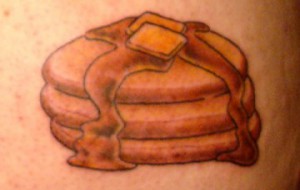
Mike Brenner's Hotcakes tattoo

Had I sat down and written a business plan first, I may not have opened my art gallery, Hotcakes. In a post I wrote for Art21 in April, I broke down my monthly expenses to roughly $1600. After a couple years though, I was forced to find creative ways to scale that back to a much more manageable figure. At closer to $1000, even if I had a couple months of slow sales, I could cover my nut (the gallery’s fixed costs) with freelance design work and the meager stipend I was getting paid as Executive Director of the Milwaukee Artist Resource Network. I pushed every boundary I could to make my budget work, but a lot of months, I couldn’t afford much more than the gallery’s expenses, which lead to some tough decisions and bizarre experiences.

I remember being in line at McDonald’s one afternoon when a homeless guy came up and asked if I could spare a dollar. I just shook my head and laid $2 of nickels and dimes on the counter to pay for my Extra Value Menu meal. I ate so many McChickens and double cheeseburgers while I owned the gallery that it got to the point that I would gag if I even smelled a cheeseburger. One summer day though, I was in line in the drive-thru and overheard a guy order a double cheeseburger “plain but with Big Mac sauce.” I was so overjoyed with my discovery that I mentioned it in a lecture to a bunch of art students. Two weeks later, McDonald’s started charging extra for Big Mac sauce.

In Wisconsin, the utility company can’t shut off the power or heat in the winter, and every year I would put off paying that bill as long as I could. One Friday in April, three hours before Milwaukee’s quarterly, city–wide Gallery Night, a WeEnergies employee came and shut off my power. I immediately sped to their offices and paid the bill. The woman behind the bulletproof glass smiled as she told me they wouldn’t send anyone to turn my lights back on until the next day. I sat in my gallery for over an hour imagining how I would explain a gallery opening by candlelight. Luckily, I had a very handy friend and neighbor who was able to yank out the circuit breakers and run live wires from the breakers of my apartment (which was in the same building) to Hotcakes’ electrical panel. The building didn’t burn down and nobody was the wiser.

Continue reading »

So what ARE curators looking for?

October 4th, 2010

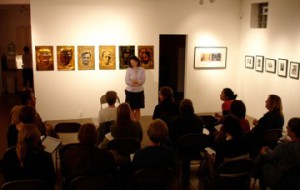
a MARN workshop held at Hotcakes

I know this isn’t what you want to hear, but every curator has different expectations and criteria. Think of it like dating. Some people are always attracted to the smart, nerdy type, some fall for a pretty face or a smooth talker, some just want to hang with the cool kids, some pursue who they THINK is good for them, some chase the popular girl just so they can tell their friends, and some seem to end up in the same relationship over and over. In the four and a half years I owned Hotcakes, I fell into most of those categories at one point or another. Like I said, every curator is different, but every professional curator wants to work with artists that act like professionals.

I mentioned in my first post that I also co-founded a nonprofit art service organization, the Milwaukee Artist Resource Network (MARN). MARN has an ongoing series of workshops that bring in industry experts to lecture and answer questions based on a number of topics relating to professional practice in the arts. Each year for our most popular workshop, “How to Approach Galleries,” I would bring in a couple different gallery owners and museum curators to share their very personalized techniques for choosing artists to show.

One museum curator said that for one full day every couple months, he would sit down and go through all the proposals that had accumulated on his desk. His technique was to first read an artist’s statement. He felt that if the statement wasn’t well written — if the artist couldn’t communicate about her art or her process — then she certainly couldn’t make work developed enough to merit a show in a museum. Spelling mistakes also got proposals immediately rejected.

Continue reading »

How NOT to Approach a Curator

September 29th, 2010
stray2004

part of Hotcakes' booth at the Stray Show in 2004

The first year after opening Hotcakes, was a blur. Locally, the gallery was getting a ton of great press, and after being a part of the Stray Show, Thomas Blackman’s more adventurous satellite fair during Art Chicago, artists started coming out of the woodwork to show at the gallery. One to five artists, from all over the world, would contact me every day. Needless to say, it was totally overwhelming, and artists continually found new and creative ways to overstep every possible boundary.

In the beginning, I was a total pushover. Some guy would come into Hotcakes and after looking at the art for two minutes and complementing my artistic vision for ten, he’d mention that coincidently he was also an artist. That his work would fit perfectly into my very clear mission to present affordable art in a comfortable environment in order to grow a group of young art collectors in Milwaukee. I’d earnestly tell him I was excited to see his art. I’d explain that he should send me 10-20 images of his work, an artist statement, and a list of past shows, and that he could click on the “Show at Hotcakes” link on the gallery’s homepage to get a better idea of exactly what I was looking for.

Hotcakes' Booth at Art Chicago in 2005

Then he’d start giving me the hard sell. Say that slides didn’t do his work justice… I needed to see his paintings in person… His work was totally unique… Would change my life. That he lived just a couple blocks from the gallery, and it would only take 10 minutes. Admiration quickly turned into not so subtle statements suggesting that I was some sort of bourgeois prick who didn’t really care about artists at all. Before I knew it, I’d be sipping Two Buck Chuck out of a handmade ceramic mug in some guy’s attic, staring at 40’x10’ surrealist paintings of the astral plane that he was willing to let go for as low as $18,000 each (before my commission, of course). An hour later and only an eighth of the way through his rooftop retrospective, I would have to leave cause his three cats, that had obviously NEVER been brushed, were making my nose run so badly.

Continue reading »

Owning an Art Gallery Was Something I Fell Into

September 27th, 2010

One of the first MARN workshops

From February of 2004 to August of 2008, I was the owner and curator of Hotcakes, but owning an art gallery was really just something I fell into.

I was living in this old furniture warehouse a couple miles southwest of downtown Milwaukee that had been converted into live/work space for artists. I was paying my bills by doing freelance web design for local nonprofits and friends who were trying to start up small businesses. I set up desks in my loft, so it looked more like an office than an apartment, but it was still awkward bringing clients into a space that had a queen-sized bed in it. For months, I kept thinking that if I had a dedicated studio, I would be able to hire some interns and expand my business.

I just didn’t have enough work to justify the extra expenses of even a small commercial lease. I was also Executive Director of the Milwaukee Artist Resource Network (MARN) at the time. MARN is a nonprofit arts-service organization I founded with five other artists in May of 2000 to provide business and educational resources for literary, performing, and visual artists. In the early years, the founders worked hard to bring together all the little cliques of artists around town, advocate for artist-friendly legislation, and be the one-stop shop for Milwaukee arts information. We held networking events, exhibitions, and professional development workshops around Milwaukee, but MARN was primarily known as an online resource because of the hundreds of artists that used our website and listserv everyday.

As Executive Director of MARN, I fielded a lot of phone calls and emails from artists new to the city who were looking to connect with the local arts community, or just looking for inside information on where to live and find cheap studio space. I would often tell them about a handful of events I planned to go to over the next couple weeks, and invite them to meet me there so I could introduce them to a bunch of other artists. Milwaukee’s arts community is like a big family now, but it can seem insular to newcomers. If someone isn’t brought in and made a part of the local arts scene within their first six months in a city, there seems to be little hope of them sticking around.

At the end of the summer of 2003, a painter who grew up in Milwaukee, went to art school on the East Coast, and moved back to town, emailed me with questions about the art community. I had Susie meet me at an art show in Riverwest, the in-transition neighborhood where most of the artists in Milwaukee live, and she told me about a 1300 sq. ft. storefront studio she found nearby for only $300 a month. When she asked if I knew anybody who was looking to share studio space, I jumped at the opportunity.

Continue reading »