War Is Over! (Part 2)

October 24th, 2009

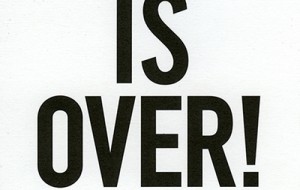
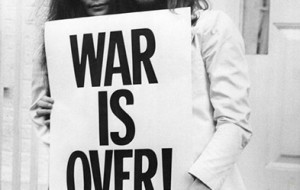
John Lennon and Yoko Ono, "War Is Over!", 2007.  Exhibition postcard, ?" x ?".

John Lennon and Yoko Ono, "War Is Over!," 2007. Exhibition postcard, 5.5" x 3.5".

WHAT! …an interview with Carl Ostendarp

October 23rd, 2009
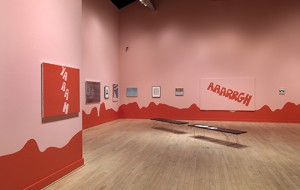
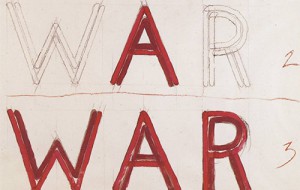
Carl Ostendarp, "Pulled Up," 2009.  Installation view.

Carl Ostendarp, "Pulled Up," 2009. Installation view at the RISD Museum of Art, including "Aaarrgh," 2009.

Carl Ostendarp is an artist and teacher based in Ithaca, New York. A survey of his work was shown at Elizabeth Dee Gallery in New York City in 2007. He has also created mural installations at the RISD Museum of Art in Providence in 2009 and the Museum für Moderne Kunst in Frankfurt, Germany in 2007. After admiring his work for some time, I was recently able to ask Carl some questions about his curatorial projects and his interests in music.

Nathan Townes-Anderson: What’s the last rock show you went to?

Carl Ostendarp: I saw Black Dice play not too terribly long ago. It was at an opening party for a friend’s show, crowded and LOUD. The music was great, very physical and thought-killing, but actually the best part was watching people attempting to carry on their conversations, everyone yelling “WHAT!” over and over.

NTA: Rumor is that you don’t listen to CDs too much, but prefer vinyl and tapes…any particular reasons for this?

CO: The tapes and whatever CDs I have were brought in to play during studio classes [at Cornell University]. It makes an atmosphere for the work to go on in and I try to play a fairly wide range of kinds of things and invite the students to contribute as well. It structures the time and precipitates conversations.

At home, I mostly play vinyl. When I lived in New York, I used to carry a High School/College collection around in milk crates from apartment to apartment, never having space to unload and play them. When my son was about to be born, I realized that I had to pass them on, so I gave them to a friend who had the room and the interest. Then, after moving to Ithaca and renting a small house, I bought a turntable and a few used discs, at first replacing old favorites. Naturally, it’s become a problem which I justify to myself by thinking of medieval Irish monks preserving civilization during the dark ages.

I like the fact that the album (the whole package) is the experience – visual and aural.

NTA: I heard you brought in some LP covers to show some students last year. Which LPs did you end up bringing?

CO: Graham McDougal, a friend and colleague, was teaching a graphic arts course and asked me to bring some records in to show his students as examples of a kind of lost visual language. I remember choosing pretty obvious things: Pedro Bells’ Funkadelic covers, Blue Cheer’s Vincebus Eruptum, Sex Pistols’ Never Mind the Bollocks, Kyuss’ Welcome to Sun Valley—about 25 things in all, pretty much what you’d expect.

Continue reading »

The Grave is Empty, Wildberry

October 22nd, 2009

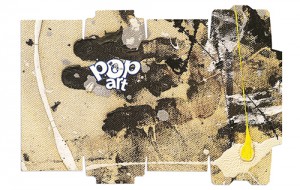
David Dixon, "The Grave is Empty, Wildberry," 2007.  C-print, 14" x17".

David Dixon, "The Grave is Empty, Wildberry," 2007. C-print, 14" x 17".

More work by David Dixon can be found at daviddixon.net. Dixon has also recently completed his second feature film, David Dixon is Dead.  A recent interview on this film and its predecessor, “Unloosed and Root,” can be found here.

UJ3RK5

October 22nd, 2009
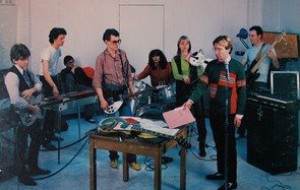
UJ3RK5, S/T EP, 1980.

UJ3RK5, "S/T EP," 1980.

The UJ3RK5 sounded like a typical post-punk group, the kind that in those years (1978-80) might have been carried by the British Rough Trade label. Lyrics predominate in their songs, and their fast, hectic drums never get “groovy,” but often in their nervousness they place a higher priority on the tautological doubling of the singer’s emphasis than on building an independent rhythm of their own. Songs produced by bands like these represent a number of hard-fought negations. By negating the playfulness and aimlessness of hippie culture on one hand and its commercial and bombastic variants on the other, punk had discovered a form that, in a certain sense, reconstructed the song as an authoritative form. An old, traditional form had suddenly become the goal of a movement that in every other respect consisted of fractures and leaps out of history. The futurism of punk and new wave, which UJ3RK5 also embodied, could only function by means of a purposeful and targeted reference to the past. Only by way of a break with the continuous lengthenings of hippie musical culture and its naïve relationship to seamless and continuous growth could there be a history – a past and a future – once again.

— Diedrich Diedrichsen, “How long, baby, how long…?”

See also: UJ3RK5 Then and Now, UJ3RK5 Rehearsal, UJ3RK5 EP

Vitrine

October 21st, 2009
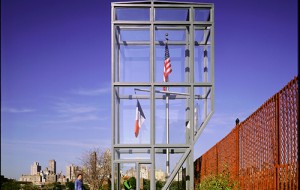
Douglas Ross, "Vitrine," 1999.  Steel, acrylic architectural glazing, concrete, rubber, hardware, latex paint, 13' x 30' x 5.5'.

Douglas Ross, "Vitrine," 1999. Steel, acrylic architectural glazing, concrete, rubber, hardware, latex paint, 13' x 30' x 5.5'.

“Like a museum for one object, built around an existing New York City Parks Department flag pole at Socrates Sculpture Park, LIC, NY.”

—Douglas Ross, home.bway.net/douglas/

Then and Now

October 21st, 2009
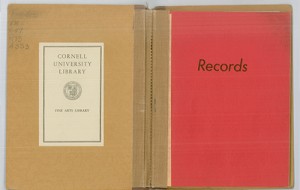
Ed Ruscha, "Records," 1971.

Ed Ruscha, "Records," 1971.

In the 1960s and 70s, American artist Ed Ruscha conceived, designed, and distributed a series of books. Their titles, such as Thirtyfour Parking Lots (1967), Some Los Angeles Apartments (1965), and Various Small Fires (and Milk) (1964), described the books’ contents with deadpan accuracy. Despite their relatively small editions, ranging from a few hundred to a few thousand copies, Ruscha considered the books to be mass-produced commodities and sold them at a low price through commercial outlets (1).  As books, Ruscha hoped they could have a presence in culture beyond the limits of the art world. “The way they’re supposed to be seen,” he said in 1981, “is when someone hands someone else just one book at a time and place where they don’t expect it.”

To this end, Ruscha’s works borrowed from common book design and utilitarian photography instead of traditional art practices.  Still, despite their familiar appearance, Ruscha’s books represented an ambiguous new genre situated between narrative and index.  This unstable ontology is emphasized through the titles’ puns and non-sequiturs as well as the books’ multiple modes of information, which include linguistic, photographic, and indexical signs (2, 3, 4).  In this way, Ruscha transformed books into artworks and information into poetry.

Of course, we now recognize Ed Ruscha’s books as historically significant artworks that mix pop, surrealist, and proto-conceptual sensibilities. Ruscha himself has characterized them as his most “Duchampian” work. However, because of this recognition, it is now difficult to experience the books in the way Ruscha originally intended. Not only have the works become overly familiar, but the books’ rarity have made them the exclusive property of institutions. For this reason, Ruscha’s books are now mostly seen through the glass of museum vitrines, where they are more artifacts than artworks.

The books’ loss of their original function is not only due to an inevitable art historical process. It is also an outcome of the work’s failure as a mass produced commodity and its failure, finally, to transcend reification. It may be instructive in this case to briefly compare the books to their inspiration: Marcel Duchamp’s Readymades.

In contrast to Duchamp’s recreations of his famous Readymades, Ruscha has neglected to re-release his books (5, 6). The books’ obsolescence reveals their status as mass-produced commodity to be historically contingent, as if the books had an expiration date that has long since passed. Not even Ed Ruscha, it seems, can keep up with global capital. It is also interesting to note that the dissemination of information on Ruscha’s books has deadened, rather than enlivened, their affect. When grouped together and schematized, as I have done here, Ruscha’s particular brand of surrealism seems methodical rather than mystical (7). By comparison, the Readymades seem to better resist categorization due to their comparative variety and Duchamp’s own inconsistent recounting of their histories and meanings.

All this is to say that Ruscha’s books now exist in a kind of artistic afterlife, still tied to their previous functions and meanings but seemingly retaining less and less of them. We know what they meant, but the question of what they will mean has been left open. That was then, this is now.

Continue reading »

Parallel Stress

October 19th, 2009
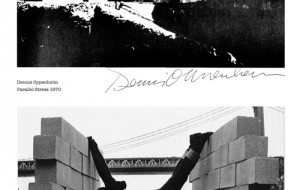
Ruth Oppenheim, Parallel Stress, 2005.

Ruth Oppenheim, "Parallel Stress," 2005. Digital Print, 46.8" x 33.1".

“Parallel Stress” is a reenactment of a 1970 art work by Dennis Oppenheim.  The project unfolds not only as a reenactment but also as a search for the artist’s approval, and the attempt to locate the original site of the piece. By reenacting Oppenheim’s work and signing my last name next to his, I create a forced inheritance of his artistic legacy and shift his work 35 years into the future.

—Ruth Oppenheim, www.rutopp.net

I Remember

October 19th, 2009
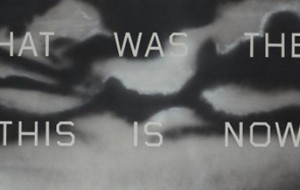
Ed Ruscha, That Was Then This Is Now , 1989, Oil on canvas, 42" x 96"

Ed Ruscha, "That Was Then This Is Now," 1989. Oil on canvas, 42" x 96".

I remember the first time I got a letter that said “After Five Days Return To” on the envelope, and I thought that after I had kept the letter for five days I was supposed to return it to the sender.

I remember the kick I used to get going through my parents’ drawers looking for rubbers.  (Peacock.)

I remember when polio was the worst thing in the world.

I remember pink dress shirts.  And bola ties.

I remember when a kid told me that those sour clover-like leaves we used to eat (with little yellow flowers) tasted so sour because dogs peed on them.  I remember that didn’t stop me from eating them.

I remember the first drawing I remember doing.  It was of a bride with a very long train.

I remember my first cigarette.  It was a Kent.  Up on a hill.  In Tulsa, Oklahoma.  With Ron Padgett.

—excerpted from I Remember by Joe Brainard, 1975.

Bite Me

October 16th, 2009
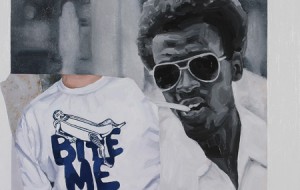
Leslie Brack, Bite Me, 2004, Oil on panel, 13.5" x 14.5"

Leslie Brack, "Bite Me," 2004. Oil on panel, 13.5" x 14.5".

More work by Leslie Brack can be found at www.lesliebrack.com. She has also organized, along with Suzy Spence, the exhibition The Mood Back Home, inspired by the 1972 collaborative project Womanhouse. As part of that exhibition, the curators researched and built a website archive for Womanhouse, found at womanhouse.refugia.net.

Moon

October 16th, 2009
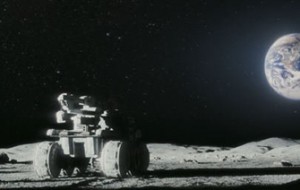
Still from Moon, 2009, Directed by Duncan Jones, Distributed by Sony Pictures Classics

Still from "Moon," 2009. Directed by Duncan Jones, distributed by Sony Pictures Classics.

“The peculiarity of the self is a monopoly commodity determined by society; it is falsely represented as natural.” – Max Horkheimer and Theodor Adorno, Dialectic of Englightenment

Moon (2009), directed by Duncan Jones, is a reiteration of such iconic science fiction films as 2001: A Space Odyssey (1968), Solaris (1972), and Blade Runner (1982). This is not unintentional: in Moon’s press kit, the director admits that he has, “always wanted to make a film that felt like it could fit into that canon.” To this end, Jones worked with Bill Pearson, the supervising model maker on Alien (1979), and shot the film at Shepperton Studios in London, where both Ridley Scott and Stanley Kubrick made sci-fi masterpieces.

When compared to Kubrick or Scott, then, Jones’ direction is decidedly conventional. He prefers to repurpose, recombine, and/or directly steal aspects of these earlier works rather than embody these directors’ restless “genius.” Moon is relevant to our contemporary moment because of this reiteration, rather than in spite of it. This moment might be characterized in terms of the contingent or the ephemeral, rather than the absolute or the timeless. In this way, Moon does not aim to transcend its predecessors, but instead desires to reanimate these canonized works at any cost.

A similar struggle is enacted by the protagonist of Moon, Lunar Industries employee Sam Bell (Sam Rockwell). Sam/Sam longs to realize himself as a subject amongst the fragments of Moon’s late capitalist world. Here individuals are controlled and manipulated (i.e. de-subjectified) in order to produce profits. The means of this manipulation are a variety of oppressive technologies, from a robot companion named GERTY (voiced by Kevin Spacey) who communicates in “emoticons,” to the repetitive pop music blaring from Sam’s clock radio.

As with anyone, it is difficult to tell if Sam’s actions and choices are truly free in any sense.  He seems less a human being than a simulation of one. A clone is to a human like the Moon is to the Earth.

“Even when the public does – exceptionally – rebel against the pleasure industry, all it can muster is that feeble resistance which that very industry has inculcated in it.” — M.H. & T.A.

Before attempting a daring escape, Sam lays an earlier generation to rest on the lunar surface. From my seat in the theater, I felt as if I were burying my own father, now exhausted and confused from a lifetime of work. Jones’ father is none other than musician David Bowie, and this scene signals a transition to a new wave of artist/soldiers.

The ending is disappointing, but perhaps purposely so.

“The paradise offered by the culture industry is the same old drudgery.  Both escape and elopement are pre-designed to lead back to the starting point.” — M.H. & T.A.