Concerning “newMedia” as one word

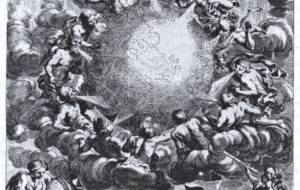
Front Page of Mundus Subterraneus by Athanasius Kircher as used in "Deep Time of the Media" by Siegfried Zielinski
For my last guest post and in response to Kelly’s question, I thought I’d address the way that I spell newMedia and my intentions behind doing so. As I mentioned in my first post; I don’t work exclusively with new technology, or even with new forms per say. However, I feel as though the content of the word addresses or is linked to concerns in newMedia art. So with this in mind, I want to take the emphasis away from the “newness” of this art form, and to readjust the focal point of this genre to be based in cultural commentary as opposed to gadgetry. Although there are some superior newMedia art pieces that implement new technologies (for instance The Dumpster by Golan Levin or Google is not the Map by Les Liens Invisibles), these project address the specific cultural implications that we are hampered with as a result of our growing integration/co-habitation with technology.
These cultural association are not something particularly new. Our relationship with technology has been a long development process, and can be traced back several hundred years. The Media Archaeology field of study has emerged in recent years in order to chart this relationship and how it has manifested itself in several time periods. Siegfried Zielinski and Erkki Huhtamo stand out as two representatives of this study and offer up alternatives to our otherwise limited notion of media art history. Jon Cates has also been tracing and tracking alternative media histories that run through Fluxus, conceptual art of the 60s, performance, and in particular, early video art based out of Chicago. In doing so, these individuals influence me (and others) to acknowledge the un-newness of newMedia culturally and historically. Oftentimes I find myself mired in gadgetry fanaticism; glorifying the new for providing solutions to problems we never really had, or giving us “new” ways to say the same old thing. This obsession—or better, preoccupation—with newness often limits the cultural productivity we could otherwise be engaging with. To recapitulate the same stale productivity in new cyberspatial ways does not justify a work. Furthermore, this speed and rate in which digitally technology is developing leaves little room for self-reflection or awareness, thus perhaps perpetuating the need for the new, and to allow our commentary on it to be so limited.

Sample photo from "Stolen Identity Project" by Andrew Schroeder
As I’ve said earlier, the ideological significance of newMedia art is vested on the metamorphosing relationship we’re experiencing with digital technology. The above image is a photography project by Andrew Schroeder that I often think of as being a good example of non-new-technology-newMedia-art. The project is a series of photographs released as a book/catalog that follow individuals that stole Schroeder’s identity in 2006. Instead of immediately reporting these individuals to the authorities he decided to tour the locations they had visited using his VISA, and take tourist-like photographs of these locations. In a strange play, he beings to tour himself, tracking himself vicariously through others passing off as him. The piece addresses the growing dissociation we’ve experienced as a result of our digital selves taking more precedence over our physical bodies. In following his captors, he isn’t concerned with who they are, or why they have done this (necessarily), but instead questions if his own identity is represented fairly by these thieves (ie, would he stay where they stayed, what would he have eaten differently in such-and-such diner, etc). The dislocation between self and identity is captured magnificently in this project, by exposing our digital privacy as containing little to no reflection on our physical identity.
Another such project that incorporates reflection on our integrated circuit as well as the media histories I have spoken about above is Sal Randolph’s Free Words project. This work incorporates using public space as a venue for distributing free literature and books. As a conceptual observation on the proliferation of mass-produced publishing, Free Words aims to undo some of the tension found in the economy of information dissemination. Using a framework that could possibly function easier on the web, Sal takes the project to the streets in order to encourage active participation with the pursuit of information/knowledge. Free Words’ “publications” are found in typical book stores across the country, and are tagged by stickers to notify interested parties. Although this project can also be viewed as an art activist piece speaking against the isolation/profiteering of the book publishing industry, I like considering this project as newMedia due to its hacking/remodeling the idea of publishing being explicitly linked to making things available to the public.
McLuhan (I know, I know) states that the translation of messages between mediums accelerates its digestions: “For the ‘message’ of any medium or technology is the change of scale or pace or pattern it introduces into human affairs.” Because the breadth and speed of our digital networked lives, we have very little time for collective conscientiousness concerning the rate at which we consume (both culture/art and otherwise). As a result, we can succumb to the shiny, glossy, and immediacy of our media culture rather than perhaps its effectiveness in communication/observation. By simply removing the proper noun quality of “New Media Art” I tend to divert the attention away from the “new” part, as well as hopefully/playfully acknowledge that the history and culture of newMedia is not necessarily exclusive to art culture. This spelling also hopes to break away from the typical implication that capitalization provides to a genre: its solidity in time and place. newMedia art history and production is intrinsically hybridized and multi-threaded. I like to think of media art history as being a rope; the more intertwined strands, the stronger it becomes.
Indie Games +/or Games as Art
Invisible Threads, Double Happiness Jeans by Stephanie Rothenberg and Jeff Crouse
In continuing the thread (no pun intended with Double Happiness) of Play and it’s relationship to newMedia art, I thought an appropriate—perhaps unavoidable—topic would be Art Games. I can’t begin to talk about this genre without properly pointing towards the history/community of game modding and machinima. Not to say that these communities get overlooked, but I think this history/hystory and its subculture is essential in approaching the type of critical engagement certain artists putting forward with their work.
For instance, a couple of years ago JODI (browsers be warned) came to Chicago to give a retrospective-type talk at Conversations at the Edge (a screening program organized/curated mostly by Amy Beste and the department of Film, Video, and New Media at the School of the Art Institute of Chicago) and the question arose concerning the efficacy of making art games with regards to it being similar (if not identical) to other game mods developed by “fans.” JODI responded that essentially there was no difference and that their mods can be seen as either being in homage to this community or else a reflection upon different strategies of gameplay. Machinima, along with game modding culture, has inseparable roots in fandom culture/subculture; Machinima.com is surely a testament to thriving community that produces this type of work.
The rhetoric involved in game art includes a multitude of conversations; gameplay, interactivity, immersion of senses, virtual reality, and a growing (if not innate) dialog concerning cinema. Lev Manovich’s discourse on newMedia is heavily vested in the cinematic relationship in newMedia art, and points towards early cinema as being a visual and cultural gateway into the digestion and analysis of digital arts. He positions Dziga Vertov’s Man With a Movie Camera is the essential reference point in Manovich’s book as being a primary example and case of interest in mapping the emergence of newMedia as an art form. The self-reflexivity, the formalistic concerns, and interface (or HCI), are the particular elements that Manovich highlights that are relevant to the discourse surrounding Games as Art. When addressing the formal qualities of Game Art, a common solution, or route, I’ve notived artists employ involve one of two strategies of investigation; Self-reflexive machinima (see Brody Condon), or media vested in the language and history of experimental cinema (see Philip Solomon’s Last Days in a Lonely Place).
Although these works reflect on the cinematic qualities/possibilities of games as art, what has emerged as perhaps the most culturally potent engagement with this medium is how games themselves, unaltered (un-modded) or self-created, can exhibit a(A)rtistic qualities. It seems irrefutable that games as a source of entertainment are an undeniable mode of cultural production and media creation. The easy way of substantiating this is by observing how the finances of the game industry (profit/production/distribution) have surpassed the movie industry. A whole generation has grown up considering games—as opposed to “the movies”—as being the new industry to creatively delve into (as could be also evidenced by the growing number of academic institutions providing game development degrees and coursework). Games have exponentially grown to hold more and more cultural capital, and in doing so, museum/gallery society cannot refuse the force of this emergent form any longer.
Cowboyana Trailer by Mark Essen
Although I’ve probably gone on a tangent, I wanted to bring up art games, and using game engines for artmaking purposes, to accentuate certain aspects of Play and interactivity in newMedia creation and engagement. The above examples of game art, or indie games, provide good examples of some of the concerns I have with this genre. Mark Essen’s Cowboyana is an interesting example of re-purposing 8-bit aesthetic into a type of cinematic gesture; connecting the nostalgia for the “Old West” with Nintendo-esque graphics. Cowboyana also conveys a critical engagement with side-scroller shoot-em-ups/run and gun (of the Contra variety) gameplay, questioning the relationship of co-operative play as well as the frenzied feeling of this sub-genre of games.
The Endless Forest – chocolate and blue deer from Tale of Tales on Vimeo.
Tale of Tales’ The Endless Forest is perhaps one of my favorite Indie games right now. A “social screensaver, [and] virtual place where you can play with your friends” (quoted from TOT website), this game/social interactive environment directly deals with the critical argument about 3D art being merely “screen saver art.” The game works when your computer goes to sleep (a wonderful use of techonological metaphors) and uses this rest period to connect you to other cyber-dreamers. In exploring this mythical space (which is designed beautifully), TEF subverts notions of gameplay being related to vegetative states, and re-contextualizes this into virtual meditative space. The format, and the execution of this project encourages “breaks” in typical computer use, by forcing users/players to play this only during states of natural “rest.” This layer of engagement changes the dynamic of game play into a casual exploration as opposed to task/goal-based games.
(poor quality video) Suicide Solution by Brody Condon
Brody Condon’s Suicide Solution is perhaps one of the most intriguing and disturbing pieces of machinima that I know of. It traverses hundreds of suicides in 50 game engines over the course of 19 minutes. The piece, watched in its entirety, shifts from humor to disaffection, to abject horror. The process of self-obsessive killing reinforces notions of our digital-self being impermanent and malleable, but only through destruction and mutilation.
Invisible Threads exhibits a fascinating approach to destabilizing the connection between cyber-virtual environments and RL. In re-imagining the sweatshop through the potentially suspicious practice of crowd sourcing, we’re asked to rethink layers of media interactivity and productivity. In making “everyday” users of Second-Life into active participants in the decentralized manufacturing of paper clothing, the line between digital participation and exploitation becomes blurry. I feel like this project also asks the greater question of our willingness to put our faith of personal identity and representation into the hands of corporations (ie Second-Life being a proprietary product/service). By using the Second-Life engine and community as its production core, Invisible Threads poses the question of how games can produce cultural goods and breach/complicate our standard concept of the purpose of gaming environments.
Sketches from/of Cleveland
I was in Cleveland this past weekend for Notacon and Blockparty two hand-in-hand conferences concerning Hacker, DIY Electronics, and early web cultures (in a cursory nutshell). I had an amazing time there, spending the long weekend with collaborators Mark Beasley, jonCates, Jake Elliott, and Tamas Kemenczy, sharing and celebrating several aspects of the Demoscene. I was delighted to have been a part of the celebration and activities, and to be able submit to the Demo Compo (which I think I got 7th place based on audience votes).
As exciting and wonderful as the conference is/was, I was immensely captivated by Cleveland as a city (which these brief videos above capture not so well). To observe the architecture of Cleveland—and other “middle sized” East Coast and Midwestern cities—is to glance at very distinct moments of growth and prosperity in the city’s history. The two main epochs for me occur through the manifestation of turn of the century ornamental Neo-Classical early skyscrapers and Brutalist architecture. The CSU building above is probably one of the better examples that I could capture on video, but the Police Headquarters/Justice Center (here is another view with the “Correctional Facility”) is also a great example of the oppressive, aggressively stark architecture of the latter surge of growth. Apparently I’m not the only one that sees the Brutalism in Cleveland, however, I’m fascinated with how these two distinct architectural histories collide into a city that is currently dealing with its slow decline due to industry shifts.
Jon, having been in Cleveland for Notacon last year, said that he noticed the city going through a process of consolidation and condensing. I noticed a distinctive presence in the city of (possibly) forced urban rejuvenation and vitality. There were re-done squares, massive public parks, as well as maintained fountains and lawns. Most importantly the architecture from the Industrial Revolution (of the slightly Neo-Classical variety) had been kept in remarkable shape; these buildings were not only occupied, but seemed in demanding use (it seemed as though the famous Cleveland Arcade was being remodeled slightly during our visit). Somehow, I want to draw a thread here between working-class/blue collar ethics for utility and the refurbishing of these old structures for new application. Although I believe America struggles with the notion of preservation and maintenance (certainly in Chicago), Cleveland seems a rare example of renovating out of necessity and habit rather than for the purpose of a gimmick or spectacle. I could certainly be stretching this point a bit far, but it could be said this restoration is Cleveland applying a kind of Hack to its urban infrastructure; in undoing the history of architecture, and re-fabricating its utility and purpose, the city mobilizes a strong statement calling upon sustainable practices as a digestive process for looking forward.
Obsolescence as Cultural Production
Thinking about this topic often reminds me of a section of Invisible Cities, where Marco Polo is describing a city to Kubla Kahn in which its center is made of the latest, most expensive and impressive pieces of technology. This city is also composed of rings around the center, each layer containing the most recent detritus of the closest inner province. Marco Polo suggests that Kubla Kahn’s entire empire is just a succession of rings that surround the center of this magnificent mythical city.
The above video is an observation of a service repairman fixing a payphone I made while waiting for the subway in Chicago. My initial thought was that this fixing was somehow a superfluous action of maintaining an obsolete mode of communication; I thought, “who uses payphones anymore?” In the age of massive telecommunications cellular networks—flooded with iPhones, G1’s, and Blackberry’s—information (or staying within the grid) is more readily available by 3G technologies and mobile architectures than even a year ago. However, I felt as though the cyber-optimist in me was too quick to acknowledge the real-life fact that the grid does not reach as far and as wide as one would hope.
That being said, it made me want to address “obsolete” practices. Obsolescence as a mode of cultural production has many manifestations: hardware hacking, media reclaiming, data bending, etc. But I think the most compelling part of this type of practice is the politics of reclamation. In using “obsolete media,” artists and craftsmen/craftswomen alike inherently are making a statement concerning consumer electronics/economics and the growing problem of digital waste. I like to think that work of this kind makes a statement similar to the idea that, “We already have everything we need, we just don’t know it.” With works like Paul Slocum’s synthcart made from reprogramming Atarai 2600’s, and Christoph Hess’s sound performance installations/performances, we see obsolete media being performed, used, and reclaimed to create new and innovative procedures to reconsidering how to still engage with “old media.”
Obsolescence also comments on the issue of Hacking; taking something that had an original design and repurposing it for a different use (like the above projects show). The way in which we address the issues of Hacking and Hackers in mainstream media is certainly an outdated, obsolete way of thinking. Perhaps it is needless to say, but Hackers are far from the conventional stereotype of basement-dwelling malicious computer programmers that pilfer precious digital information from the government and exploit networks to steal our identities. I prefer (if it isn’t already obvious) to consider Hacking, and “The Hack,” as an appropriate metaphor for contemporary cultural production in general. McKenzie Wark uses Hackers and the act of hacking (in his A Hacker Manifesto) as an apt metaphor for an emergent class of cultural producers. Their efforts (and hopefully all our efforts), aim to undo the proprietary captivity of what he calls “vectors of information,” which ensnare us in the trap of perpetual oppression from traditional frameworks of power and capital. Hacking—and using obsolete media—speak to a need of renegotiating the terms of how we interact with our media technology. The planned obsolescence of our telecommunication gadgets (which a far beyond the point of merely being “toys”) force us into perpetual modes of consumption. Reusing/misusing technology that is no longer in maintenance provides a creative and wonderful outlet for reorganizing the methods of technological participation. It could be said that the model of consumerism that we typically abide by is obsolete; in the growing avalanche of change, we could use a bit of stability.
Perhaps this post brings me back to the idea of Play. A hack is not simply a reprogram, or a break in a system; it can circumvent the potential problems of a closed system and open it up to new possibilities. In doing so, a hack often renders the initial intended mode uninteresting and stale. In an interesting turn of creativity, hacking can reveal that the only thing obsolete about an object or an idea is our perception and our acceptance of its provisional use. Hacking destabilizes, recontextualizes, refreshes, reformats, updates, and very simply picks apart and rebuilds. Likewise, Play deals with turning something static into something viscous. It could be said that Play and hacking are interchangeable/interwoven paths and histories essential to media creation and involvement.
O hai :: Approaches + Modes

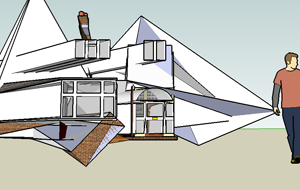
Nicholas O'Brien, Untitled still from an ongoing project made with Google SketchUp, 2009.
I thought before I get really started the guest blogging here, I’d speak a little bit about my intentions/directions/plans. BEFORE that, however, I’d like to thank Kelly Shindler for giving me this great opportunity as well as fellow Art21 bloggers and staff for their continued efforts and insight.
Although I hope not to linger too often on my own personal work while blogging here, I feel the need to provide slight context for what I will hopefully discuss. The easiest way I see myself establishing this context is through a brief examination of what I’m working on.
My academic and artistic practice (and these should be seen as being mutually influential or one in the same) filters through many sub-genres of what has often times been commonly dubbed newMedia Art (I prefer this spelling for reasons I might get into during my visit). Although I am sometimes in conflict with this classification and its specificity for mostly digitally-based artworks (according to some), I find it to be the most appropriate genre for me to identify with. Although my work encompasses Super-8mm film, photography, sound, performance, video, video games, and installation, I still feel most at home with wanting to associate with newMedia, even when the medium in which I’m working in is not often considered part of this genre, or even particularly “new.” In other words I feel as though newMedia is based more on ideology than on technology.

Nicholas O'Brien, Untitled still from a video sketch made in 2009.
With this in mind, what draws me to newMedia, and what I will be hopefully discussing her , is its possibility for multidisciplinary production. Recently, one primary concern deals with “the virtual.” In typical newMedia art narratives, the virtual is a common semantic replacement for cyberspace, or more simply the WWW. For my practice, however, I’m more interested in how/why this notion of the virtual has been primarily limited to digital experiences in cyberspace. In doing so, this bracketing overlooks a larger art historical discourse concerning representation in general being a virtual process. Virtuality extends beyond cyberworlds, refracting into different prisms; sculpted space, identity politics associated to land(scape), and memory. I feel as though we’re now seeing that the re-translation of virtual experience into physical manifestations is in disproportion to the initial transcription of ourselves into virtual realms; the machine is imperfect, the input is not (or is no longer) equal to the output. Our virtual selves contain more substance than our fleshy counterparts. We embody our tech more than we do our organs. To quote Erik Davis, “We have been cyborgs since year zero.”
Although I’m speaking somewhat abstractly (let’s get used to it), I plan on discussing these discrepancies through looking at works that are personally influential, as well as ones that represent/exemplify several stances on reconsidering the relationship between virtual spaces. Some approaches to this agenda include conversing about obsolescence (physical and cultural), art games/indie games, the disintegration/fabrication (a mutually implicated binary for me) of architectural space, rediscovering/reconsidering Home, reprogramming media myths, and exploring alternative histories(hystories) for newMedia Art.

Nicholas O'Brien, composite still from the Half-Life2 Game engine, made in 2009.
That all being said, one of the most distinct ways that I choose to trudge through this swampy mire is through Play. I love discussing Play (note capitalization, please) as an abstract ideal of cultural production. Play is enabling, empowering, and distinct in that it allows for a type of cultural liquidity that is hard to find in stringent artmaking. How can lolCats, OULIPO, Voltron, Half-Life2, and Philip Glass all be put on the same cultural pedestal without determining each element as pejoratively more or less culturally important? I’m not necessarily going to be providing answers for this, but I feel as though attempting to ask the question is testament to the subject material that I address in my work. The polymorphic significance of these different zones relate to the cultural leveling Barthes proposes in his examination of Wrestling (in Mythologies). I wish not to just analyze or observe anthropologically, I wish to engage (both skeptically and in celebration) how these environments or frameworks encourage and reinforce the importance of Play. To be able to weave through, without misappropriating/misrepresenting, these various lo(l)cals of Play is something that I hope I’m able to convey during my time with Art21.