Gastro-Vision | Lucy + Jorge Orta: Food-Water-Life

October 19th, 2012


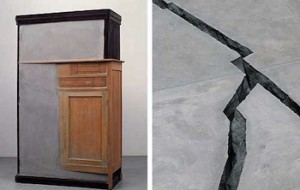
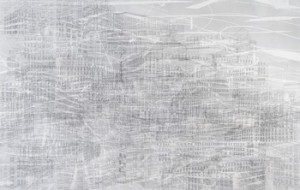
Lucy + Jorge Orta’s Food-Water-Life installation at Tufts University Art Gallery, 2012. Left: “Mexican Kitchen,” 2002-2008. Right, rear: “HortiRecycling Enterprise, act II–Conservation Unit,” 1997-2005. Photo: Alonso Nichols, Tufts University Photography.
For more than two decades, wife-husband team Lucy + Jorge Orta have contemplated global problems in food, water, shelter and land. Before meeting in early 1990s Paris, Lucy studied fashion-textile design in England while Jorge studied fine art and architecture in Argentina. Their individual practices were socially engaged and participatory. When they began to collaborate, the artists merged and expanded their methods of involving publics, art folks and non-art folks alike, in the process of making. Their activities range from hosting community banquets and recycling food waste to purifying water and issuing limited-edition passports. All of this is manifest in Food-Water-Life, the Ortas’ first major traveling exhibition in the United States, now up at Tufts University Art Gallery in Boston.

The Ortas founded their design studio five years before Nicolas Bourriaud coined the term “relational aesthetics” and their collaborative processes continue to be associated with this rubric. That seems an old-fashioned way of talking about their work today. The art world has since moved on to “social practice.” Although this field is nebulous and, apparently, suffering from identity crisis, one thing about social practice art is clear to me: food is a favorite ingredient. Being the great connector of people, it makes perfect sense as medium, as catalyzer. Food is also inseparable from issues of climate change, land and sustainability with which so many social practitioners are concerned. Food-Water-Life is an excellent instance of this or the artist as activist-slash-humanitarian. The Ortas’ large-scale sculptures and contraptions symbolize the potential of art to effect change in global conditions that go unnoticed, unchecked, unresolved. The artists raise awareness about, for instance, the growing scarcity of drinkable water, and the 13.6 percent of the estimated world population that suffers from hunger. To this, the Ortas manage to bring optimism, whimsy and lots of color.

Continue reading »

Gastro-Vision | Supersonic (After Cage)

September 21st, 2012


Lisa Meyers and Autumn Chacon. “Noise Cooking” at Art Gallery of Ontario, 2012.

Toronto resident Lisa Myers is like many cultural workers in that she wears a few different creative hats: artist, curator, writer, and musician. What is maybe atypical is that she’s also a chef. At first, Myers cooked to make a living while she sang and played guitar in bands and also studied new media. She eventually decided to obtain, in addition to other college credentials, a diploma in culinary arts. Myers had kept her various jobs and interests “kind of separate.” Then, a few years ago, all of her pursuits began to merge. The following video, Jimmie Durham’s Quick Biscuits, is a perfect example.

Quick Biscuits is a collaboration between Myers and New Mexico-based writer and performance artist Autumn Chacon. The women met earlier this year while in residence at Canada’s distinguished Banff Centre. Chacon, who conceived of the piece, directed and recorded Myers as she “performed” the biscuit recipe. Chacon gives us an intimate view into the bowl, but the emphasis here is not so much on the look of the ingredients as the sound of them. Contact microphones attached to Myers’ cooking utensils amplify every pour, stir, scrape and pummel of flour, baking soda, salt, and yogurt. For Myers, Quick Biscuits is like a concert: “The recipe is the score. The cook is the musician. The foods are the instruments. And then the implements—the knives, the bowls, the whisks, the peelers—act as microphones.” For me, Quick Biscuits is worse than a Skrillex track. Of course, I have taste for certain sounds like I have tastes for certain foods.

Continue reading »

Gastro-Vision | Summer Round Up

July 27th, 2012


Rainer Prohaska. "Floor Cuisine, ACF New York," 2012. Ink on paper. 16.6 x 23.4 in. Courtesy the artist.

The heat and humidity of New York City summers make walking into a cool gallery all the sweeter. When you’re ready to come inside, here are six local exhibits on which to feast your eyes:

Our Haus @ Austrian Cultural Forum
On view through August 26

Rainer Prohaska’s latest culinary project Cuisine à tous les étages (Kitchen on every floor) winds from the top to the bottom of this multi-floor group exhibition. A series of cooking stations, set up between each flight of stairs, provide food items, a cutting board, cooking utensils and instructions. At the opening reception, Prohaska led guests through the preparation of vegan beef tartare. An empty dinner table remains in the basement as a remnant of the communal dinner and continues to encourage conviviality. Visitors can make use of the table when partaking of Mathias Kessler’s interactive beverage installation Das Eismeer. Die gescheiterte Hoffnung (2012). Kessler invites visitors to remove and enjoy a cold Budweiser from a small refrigerator, and in so doing help him to create another object. The repeated opening and closing of the door adds layers of ice to a small sculpture behind the freezer flap–a replica of Caspar David Friedrich’s icy landscape of the same title. Curated by former Eyebeam director Amanda McDonald Crowley, Our Haus commemorates the ten-year anniversary of the building and the Forum’s ongoing efforts to be a space for cross-cultural exchange. Crowley writes, “With a kitchen in place, we will surely celebrate with food, as many of the finest conversations begin over good food.”

Continue reading »

Gastro-Vision | Absinthe and the Art World

June 15th, 2012

Edgar Degas. "L'Absinthe," 1876. Oil on canvas, 36.2 in × 26.8 in. Collection of Musée d'Orsay, Paris.

Absinthe is the famed drink of the modernist avant-garde. Degas, Gauguin, Van Gogh, Toulouse-Lautrec, Manet, Modigliani, and Picasso were all known to partake of the spirit. As the story goes, they weren’t just enjoying its mildly bitter and licorice-like flavor. Absinthe’s main ingredient, the wormwood plant species artemisia absinthium, was believed to contain mind-altering compounds. As Oscar Wilde told it, “After the first glass, you see things as you wish they were. After the second glass, you see things as they are not.” Not everyone extolled the high of “the green fairy.” Critics claimed absinthe was addictive, caused permanent lunacy, and contributed to social degradation. In vogue among the creative class of late 19th century France, by 1915 it was outlawed in most European countries and the United States.*

Tales of absinthe-era France will often cite Degas’ L’Absinthe (1876) to illustrate the drink’s supposed psychological effects and Manet’s A Bar at the Folies-Bergère (1882) as portrayal of Paris nightlife where the drink flourished. But mainstream art history will seldom (if ever) show us how absinthe spread from France to its colonies, namely the island of Martinique in the French Antilles. Though better known for its rums, absinthe has been produced in Martinique since the 1800s and continues to be part of the culture. Artist Marc Latamie brings this to light in a lovely solo exhibition now up at The Americas Society.

Marc Latamie. "For Rent" (detail), 2012. Sheet metal, variable dimensions. Courtesy of Americas Society. Photo: Wilson Santiago.

Continue reading »

Gastro-Vision | From Seeds to Sprouts, Greens Across Manhattan

May 18th, 2012


Rob Carter. "Faith in a Seed (Darwin)," 2012. Video still. Courtesy the artist and Art in General.

For the past couple of years, I’ve been following artists who grow food as part of their practice. Trust me when I tell you there are plenty. I won’t go too deeply into the artist-as-cultivator trend here, though I will say that these types of projects are often steeped in greenwash and two-word phrases that people like to hear—environmentally conscious, locally grown, sustainable minded, and socially engaged. However well-intentioned they might be, artists sometimes fail to give us new ways of thinking about and seeing food production. But there are also artists like Rob Carter and Jenna Spevack, both of whom have solo exhibitions right now in Manhattan, who help us to reimagine foodways and make the practice of growing food something to behold.

Rob Carter: Faith in a Seed

Rob Carter’s multimedia installation Faith in a Seed is the latest in Art in General’s New Commission Program. On approach, it doesn’t look like much more than a big plywood box. Ocular lenses embedded along its perimeter afford a look inside. Allow me to wax sentimental: I understand how the character Mary Lennox must have felt when she unlocked the door to The Secret Garden—Carter’s landscape is intimate and wonderful. Plants of dandelion, bush bean, and corn surround three miniature paper houses, replicas of 19th-century estates that belonged to Charles Darwin, Henry David Thoreau, and Sir John Bennet Lawes. Each represents a different way of seeing the world and, as Carter told me over the phone, “the shifting role of architecture in the ongoing dialogue about feeding mankind.”

Continue reading »

Gastro-Vision | Queer Cakes for a Country Cookout

April 20th, 2012


Jacolby Satterwhite. “Country Ball 1989-2012, Appendix (detail),” 2012. Digital video & 3-D animation. Courtesy the artist.

In Country Ball 1989–2012, Appendix, a new performative video and 3-D animation from artist Jacolby Satterwhite, cakes are not delicious desserts but strange architecture. Some spiral up like Towers of Babel and their tiers serve as platforms for performance: Satterwhite appears on top of them — in multiples of himself — posing, swaying, bouncing, voguing. Other cakes peak like roller coasters and add to the general spirit of amusement park here; a phallic carousel slowly rotates at the center of this cakescape. In one scene Satterwhite werqs a “cake runway.” Occasionally, his body spurts neon-colored fluids. It’s unclear what these substances are but breast milk, cum, and frosting can’t be too far fetched. Cake is one of many pleasures in this sort of queer candy land, where idealized male bodies toil and play alongside the artist. What’s most extraordinary about this world Satterwhite has created is how his family figures into it.

Jacolby Satterwhite. “Country Ball, Appendix (detail),” 2012. Digital video and 3D animation and screenprints on Coventry paper. Courtesy the artist.

On view at the Studio Museum in Harlem, Country Ball incorporates video footage from a 1989 Satterwhite family cookout along with drawings made by the artist’s mother, Patricia Satterwhite. It’s implied that a product of her ongoing mental illness is a compulsion to draw. Since Jacolby’s childhood, Patricia has created over 10,000 schematics for clothes, jewelry, utilities, and foods. Those curious cakes and other objects we see in Country Ball represent 35 of her designs, digitally traced by Jacolby and then made into 3D models. He limited himself to Patricia’s drawings of cookout materials: cakes, watermelons, fast food packaging, aprons, barbecue grills, pots and pans, playground structures, a lemonade pitcher, a jeep. In Country Ball some of these larger objects function as projection screens for the cookout footage. But more than we actually see that event, we hear its mixtape soundtrack and the joyous cacophony of family. Jacolby likens the process of putting these various pieces together, and essentially “reperforming the cookout,” to playing a game of Exquisite Corpse:

“My method of putting together the narrative is very strange. I write down key words that are in the drawings, [my mother’s] text, and then I give myself two minutes to write down a concrete poetic essay. Then, when I go to the animation drawing board, I have to actually execute what I wrote in a stream of conscious way. It’s the same way with my movement, or the improvisation dancing that happens in my studio. I go into the green screen and I do four hours of improvisational dance that’s influenced by modern dance and voguing. Then I take all that footage to the computer, I trace all my limbs, and I think, how does my movement and body inform these objects and world that I’ve created, and how can I string it together in a nonsensical fashion?”

Jacolby’s surrealist mindset allows no conflict between lived experiences and imagined ones, fantasy and actual fulfillment. Country Ball seems a boundless space partly because any boundaries that might exist between Patricia’s naïve pencil drawings and Jacolby’s glossy video game aesthetics, between grainy footage of the Satterwhite family dancing in the 1980s and the artist’s costumed movements in a modern-day high-tech studio, have been erased. One form feeds another.

Continue reading »

Gastro-Vision | Watching What You Eat

March 16th, 2012

Andy Warhol. "Hamburger," 1985-1986. Acrylic on canvas, 50 x 66 x 1 1/4 in.

In recent months, news outlets have reported that Paula Deen, Southern queen of heavy eating, has Type 2 diabetes; “pink slime,” though no longer in McDonald’s burgers, might soon be in your child’s school lunch; and in other culinary crimes, Taco Bell and Doritos have teamed up on the Locos Taco, taking fast food to a new level of awful. With these headlines, it shouldn’t surprise anyone that obesity and food-related illnesses continue to be serious problems in the United States. What is remarkable, however, is that museums across the country are trying to help.

Let’s Move! Museums & Gardens, part of First Lady Michelle Obama’s larger Lets Move! campaign, encourages cultural institutions to join the fight against childhood obesity. Over 500 art museums, sculpture and botanic gardens, historic houses, and science centers have taken up her charge. Last October, representatives of these institutions came together for the one-day conference Feeding the Spirit: Museums, Food, and Community, organized by the Center for the Future of Museums (CFM), a branch of the American Association of Museums. In February, CFM offered a webinar of the same title, showing recorded presentations by the culinary historian Jessica B. Harris; Growing Power outreach coordinator and artist Erika Allen; Batali/Bastianich Hospitality Group’s food safety and sustainability director Elizabeth Meltz; and Yale School of Public Health professor Jeannette Ickovics, co-organizer of Big Food: Health, Culture and the Evolution of Eating, currently on view at the Yale Peabody Museum of Natural History.

As I watched the webinar, listening to these speakers share startling (though commonly repeated) statistics and make compelling arguments for food-related programming in museums, I kept coming back to the same question, which others also asked in the live chat: Do museums have a responsibility to raise issues about food? Among other things, I couldn’t help but think that not so long ago museums were suffering the recession. Shrunken budgets and endowments led them to trim exhibition schedules, public programs, and staff. Post-recession, many museums are still experiencing financial woes. All these things considered, our eating habits and body fat measurements can seem terribly trivial. Yet the CFM is making a strong case for exploring food in museums now.

Continue reading »

Gastro-Vision | Iraqi Cuisine Goes Mobile

February 17th, 2012

Michael Rakowitz. "Enemy Kitchen," 2004-present. Courtesy the artist. Photo: San Francisco Chronicle/Paul Chinn.

Michael Rakowitz made media headlines in December when U.S. marshals seized a critical part of his culinary project Spoils: the dinner plates. As it turned out, the elegant black and gold trimmed tableware, purchased on eBay, had been looted from the former palace of Saddam Hussein. Now repatriated, the artist has created a set of limited-edition paper plate replicas that accompanied the launch of his latest food endeavor, Enemy Kitchen (Food Truck), an Iraqi eatery on wheels.

Commissioned by the Smart Museum of Art for their exhibition Feast: Radical Hospitality in Contemporary Art, Rakowitz’s food truck is the newest iteration of his ongoing project Enemy Kitchen wherein he invites people to help him cook a meal based on the recipes of his Iraqi-Jewish mother. The conversation that takes place over the course of the event is perhaps more significant than the food that gets made. The artist notes, “On one occasion, a student walked in and said, ‘Why are we making this nasty food? They (the Iraqis) blow up our soldiers every day and they knocked down the Twin Towers.’ One student corrected her and said, ‘The Iraqis didn’t destroy the Twin Towers, bin Laden did.’ Another said, ‘It wasn’t bin Laden, it was our government.’”

With Enemy Kitchen (Food Truck) Rakowitz extends the possibility for dialogue and debate to the neighborhoods of Chicago. Every Sunday and Monday throughout Feast the artist and his rotating staff of local Iraqi cooks (who prepare the food) and Iraq War veterans (who act as sous chefs and servers) will be cruising the city in search of hungry customers. Following are excerpts from a recent interview with Rakowitz in which he discusses his goals and overall relationship to food.*

Nicole J. Caruth: What prompted you to make Enemy Kitchen mobile?

Michael Rakowitz: It was one of the extensions that had always existed in my mind after the variant that I started in New York and then produced in different places across the country. I thought about some of the things that had been so dynamic and exciting for me as it pertained to Return, which was another project I did with Creative Time, where I imported Iraqi dates and operated a storefront. What was really great about that was, for the few months that the project was up and running, it was an excellent hub where conversation could happen and also a place where New York’s really small Iraqi population could convene with some regularity. I really enjoyed that. It was where my interest in urban space and interventionism could intersect with my love of story telling and conversation.

Continue reading »

Gastro-Vision | Simone Leigh and the Fruits of Her Labor

January 20th, 2012

David Levinthal. Untitled from the series Blackface, 1996. 20×24 Polaroid Polacolor ER Land Film, 40 x 33 ½ in (framed). Image via blog.artspace.com.

Watermelon is a leitmotif of Blackface memorabilia that flourished during the late 19th and early 20th centuries. Depictions of African Americans ravenously eating the fruit helped perpetuate the myth of our collective fondness for it; and reinforce ideas of an inferior race, stereotyped as being shiftless and “interested only in such mindless pleasures as a slice of sweet watermelon.” [1] Ceramic knickknacks like the one pictured above are typical in that the fruit wedge mimics the grin of the eaters. It also serves to emphasize their exaggerated red lip-color and darkly-painted skin, features that starkly contrast the whites of their bug-eyes. Sadly, these minstrel caricatures are not the worst of them. Depictions of adult men could be far more grotesque; they were often portrayed as having mouths as big as a watermelon itself. While this kind of imagery is seen less frequently today, it’s certainly not a thing of the past. Google search President Obama and you’ll find plenty.

Simone Leigh at work on her cowrie shells, 2011. Image via kenyaworkspace.com.

New York-based artist Simone Leigh had the watermelon stereotype in mind when she began casting molds from the fruit five years ago. From them she has created nearly 100 ceramic forms now installed at The Kitchen in her solo exhibition You Don’t Know Where Her Mouth Has Been. “I could have used any gourd to make molds,” said Leigh. But she saw her sculptures as an opportunity to build a new narrative, to “rewrite the watermelon.” To my surprise, Leigh called the stereotype not disgusting or debasing (as I might have) but of all things “ironic.” Then she explained: watermelon happens to evoke the same language that has been used to negatively brand the black body as “too large, overgrown, fat” and generally “lacking control.” Leigh described the fruit itself as being “kind of preternatural.” At the same time, watermelon is sensual, a so-called aphrodisiac that elicits the words juicy, ripe, and refreshing — expressions often used to compliment or objectify black female bodies. It is in fact how black bodies have been discussed and displayed over time that concerns the artist by and large. [2] To tell you the truth, her work isn’t about food at all.

Continue reading »

Gastro-Vision | It Was a Sweet Year

December 23rd, 2011

At the end of 2009, I looked back on the year through meat, recognizing a proliferation of protein in contemporary art and popular culture. In 2010, with the help of two food-savvy art writers, we surveyed the world of food art and produced an epic post. And now I bring you a year-end roundup all about sweets. Here’s ten projects that caught my eye in 2011:

Monica Martinez of Don Bugito
Headlands Center for the Arts, Sausalito, CA

Monica Martinez of Don Bugito. Mealworm toffee with vanilla ice cream with amaranth and cactus syrup, 2011. Courtesy the artist. Photo: Michelle Edmunds.

When you picture yourself eating a big scoop of ice cream you probably don’t think about worms as a topping. Who does? Bay Area artist Monica Martinez. Her new food venture Don Bugito grew out of earlier works concerning informal food economies like street food carts in her native Mexico City, and her ongoing interest in edible bugs. This year, Martinez partnered with Critter founder Philip Ross, and Mezcal Factoria de Santos to prepare a dinner of Edible Insects & Other Rare Delicacies at Headlands Center for the Arts. Guests were served, among other things, wax moth larvae corn custard, and mealworm toffee over vanilla ice cream with amaranth and cactus syrup. How have people responded to Martinez’s “mini livestock” gourmet? “Amazingly,” she says. With an incubator kitchen already backing the artist, Don Bugito is poised to become a long-term fixture in the Bay Area food scene.

Naomi Huth of Where Am I
Prospect Heights, Brooklyn, NY

Claire Lieberman. "Desert Jell-O Grid," 2006. White alabaster, plexiglas, rubber, 9 x 18 x 1 in.

Naomi Huth — curator, artist, and founder of the roving gallery Where Am I – has turned a row of empty Brooklyn storefronts into an urban sweetscape. Cakes painted on old cookbook pages, Polaroids of candy-adorned bodies, and jell-o-ee video performance are the goodies of Huth’s exhibition Food Lust: Shock Candy. A personal favorite of mine is Desert Jell-O Grid by Claire Lieberman. (Yes, that’s desert not dessert.) Lieberman’s manipulation and juxtaposition of firm and flexible materials like marble and Jell-O reveal their similarities perhaps more than their differences. Food Lust comes ”just in time to offer an interesting contrast to the regular holiday displays.” The exhibition is on view at the corner of Classon and Lincoln (map) through January 3.

Victoria Yee Howe
Arabica Lounge, Seattle, WA

Victoria Yee Howe. "Bruise Cakes," 2011. Courtesy the artist.

Artist and pastry chef  Victoria Yee Howe, who has been featured on this blog before, continues to push the boundaries of frosted art. This year, she participated in the first ever food + art residency at Seattle’s Arabica Lounge. Twice a week for eight weeks she has created the Lounge’s dessert specials, some of them more “avant-garde” than others. For instance, her series of Bruise Cakes. Made from a strawberry-purée batter (a southern classic known as “Pink Lady”) and layered with fresh blueberry preserves, these cakes sound heavenly until Howe explains the inspiration for their title and coloring: each is topped with a photo-transfer of different bruises that past lovers have left on her body. “I have always taken photos of different cuts or scrapes I have had, accidental or consensual or whatever,” says Howe. “…I love the idea of playing with people’s conceptions of what is desirable and edible and maybe even making them a little uncomfortable with their hunger.”

Peter Nadin
Gavin Brown’s Enterprise, New York, NY

Peter Nadin. "Raft," 2011. Honey, terracotta, wood, twine, bank run, wax and ham, 288 x 288 x 9 1/2 in.

Honey was medium and merchandise in First Mark, this year’s highly praised solo exhibition of works by artist-farmer Peter Nadin. (Writer Andrew Russeth, who contributed to our food art survey last year, beautifully captured the show for his blog 16 Miles of String.) Nadin’s honeyed objects included Rafta rather monumental pond of the sticky substance, with terracotta, wood, ham, and other materials rising from its surface. Any cravings this work might have inspired could be satisfied in a pop-up shop of sorts, a buying club temporarily hosted by the gallery that offered honey and maple syrup produced on Nadin’s farm. The artist himself is fully immersed in the stuff of bees and honey: In 2006, he was a delegate at the South American Beekeepers’ Conference.

Continue reading »