Practical propaganda: Amy Franceschini reinvents the Victory Garden

March 1st, 2009
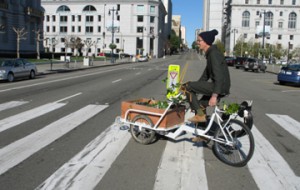
The Victory Garden Trike in action in San Francisco

The Victory Garden Trike in action in San Francisco

Amy Franceschini is my favorite kind of propagandist: she creates enticing imagery you can’t help but rally around, but backs it up with dirt-under-the-fingernails pragmatism in service of a nearly indisputable cause: resurrecting San Francisco’s legendary wartime Victory Gardens program.

When I first stumbled upon Franceschini’s work at a small gallery in San Francisco in 2007, I saw it through the lens of the Iraq war that then seemed like it’d never end. The art related to her then-new Victory Gardens project: a prototype rainwater harvester, and documentation of items used to plan and implement trial gardens. Across town at SFMOMA, she was part of the SECA Art Award exhibition, which showcased related sculptures, including hybrids like the “bikebarrow” and “pogoshovel,” which struck me as the result of a collaboration between Beuys’s Green Party and TV’s Mr. Green Jeans.

But two years later, it’s easy to frame the work, which is created under the auspices of Futurefarmers, in the context of the current economic crisis. The 2006 version seemed to respond to an era when the president equated patriotism with shopping, whereas today’s version offers instruction in living in bounty through hard work, communal labor, and a sense of humor.

Victory Garden planting party fliers

Victory Garden planting party fliers

Catching up with Franceschini this week, I learned about the history of San Francisco’s World War II Victory Gardens and about her own background that makes this such a winning fit for her. At its heyday, San Francisco had the nation’s most vibrant system of Victory Gardens, plots planted to help grow food for citizens so government could use its reserves with the war effort. Some 250 plots were growing food on public land, but Franceschini says that’s probably a lowball figure, given all the gardens tended by private individuals on their own land. The last time the city studied it, in 1970, there were 1,800 acres of usable land. “If we’re thinking about the city as a farm,” she says, “networking all this open space as an 1,800-acre farm, that’s a pretty big food-producing area.”

Continue reading »

Where’s all the rightwing street art?

February 26th, 2009
Detail of an altered ad by "Princess Hajib"

Detail of an altered ad by "Princess Hajib"

Learning of Princess Hijab—a Paris-based street artist who culturejams advertisements to include her namesake headscarf—an old question came to mind: where are all the rightwing graffiti artists, stencil afficionados, and conservative interventionists? While we see strictly political graffiti on behalf of all sides in political skirmishes worldwide, I can’t say I’ve seen particularly artful examples on the right side of the political spectrum.

Graffiti that appeared in Minneapolis just before the RNC began.

Graffiti that appeared in Minneapolis just before the RNC began.

Around the time of the Republican National Convention, I pondered the question, to no avail, at my day job when a series of unsanctioned artworks started appearing around the Twin Cities. They all included the G.O.P. acronym, but it was clear this was a different GOP: “Greed Over People” or “Get Out Phascists” (which is confusing…Phish fan facists? Big Pharma fascists?). Since then I’ve noticed that while lefty street art is virtually eveywhere, from Noam Chomsky stencils to railroad cars tagged with BAILOUT, TORTURE and POVERTY, there was very little from the other end of the political spectrum (except for the brief blip in Nobama graffiti a few months back).

Freight graffiti by the "Abraham Lincoln Brigade"

Freight graffiti by the "Abraham Lincoln Brigade"

When I noticed Princess Hijab’s work today, I thought I’d come across the first interesting street intervention by a person who might, just maybe, fit the bill—if not politically, then culturally. (I recognize a limitation in my thinking: naturally, there are liberal and moderate Muslims who wear headscarves.) But upon further reading, her work seems to be more about covering the shame of omnipresent (and often sexualized) ads than in offering a critique of women’s bodies. Her “hijabizing” of French ads is part of a “Jihad,” she writes, but “she acts upon her own free will. She is not involved in any lobby or movement be it political, religious, or to do with advertising. In fact, the Princess is an insomniac-punk. She is the leader of an artistic fight, nothing else.”

As for rightwing graffiti, I’m not sure why we don’t see more. Are conservatives more respectful of personal property or more fearful of the law? Is their fight in boardrooms or ballot boxes instead of boxcars and subway station walls? Or am I just not looking in the right places?

When I posed the question on Twitter last night, A’yen Tran, a Brooklyn artist I met when the Miss Rockaway Armada was in Minneapolis a few summers ago, responded that perhaps The Splasher was the closest I’d get. The Splasher achieved some notoriety two years ago for defacing New York street art with paint and leaving behind a manifesto that seemed more anti-artist than in tune with the anti-art Dadaists it referenced: “The removal of this document could result in injury, as we have mixed the wheat paste with tiny shards of glass.” “[Y]ou could argue that the Splasher had some echoes of fascism despite a pseudo surrealist facade,” Tran writes.

So, more in the spirit of crowd-sourcing than conclusion-making, what do you think? Is street art an inherently left-leaning domain, or have I not been looking hard enough?

Chakkrit Chimnok’s banana-leaf utopia

February 24th, 2009
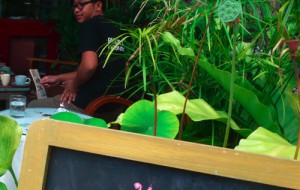
Chakkrit Chimnok at a cafe in Chiang Mai, Thailand (Paul Schmelzer)

Chakkrit Chimnok at a cafe in Chiang Mai, Thailand. Photo by Paul Schmelzer

Chakkrit Chimnok dreams of a “banana world,” a utopia in which overlooked or discarded items — specifically, the ubiquitous banana leaves that litter the streets in his home city of Chiang Mai, Thailand — can become the material for a renewed world. Chimnok’s recent forays into this idea (or ideal) transformed the ever-present leaves into clothing modeled after western haute-couture.

“One day I was sitting in a banana garden, when a banana leaf fell on me,” he told me last year. He picked it up and felt it: It was smooth and flexible, unlike the dried leaves many locals get rid of by burning. Senses piqued, he began paying attention to how the leaves had different characteristics, depending on where he found them, their age and the level of humidity where they grew.

Installation at Art Space, Japan Foundation, Bangkok. Courtesy of Chakkrit Chimnok

Installation at Art Space, Japan Foundation, Bangkok. Courtesy of Chakkrit Chimnok

He says he was struck by how perfect banana trees are. Both the fruit and the flowers are edible, and the leaves — as his explorations would later prove — could be made into apparel. Chimnok enrolled in a clothing-design class, taking 60 hours of instruction on sewing and pattern-making, and then set out to make functional objects, including a space suit and a dress (sized for his parents, pictured in the installation shot above), handbags, boots and tennis shoes.

Chakkrit Chimnok, "Body – Imagination – Dried Banana Leaf," 2006. Courtesy of the artist.

Chakkrit Chimnok, "Body – Imagination – Dried Banana Leaf," 2006. Courtesy of the artist.

This functionality is questionable — as the leaves dry, they become too brittle for regular use — but he appreciates the various layers of symbolism as well. He’s taking gentle jabs at both Thai and western cultures. To often brand-conscious Thai people, he offers fashions from one of the country’s most plentiful, banal and unbranded materials. He patterns his ensembles after western styles, forgoing patongs and flip-flops for western-style skirts and shoes, in order to put the designs both within the vocabulary of fashion but also starkly opposed (the hard, crunchy leaves also stand in contrast to the silk textiles for which Thailand is best known). “We always have the sense that the west looks at us as the third world,” he told me.

Shoes by Chakkrit Chimnok. Photo by Paul Schmelzer.

Shoes by Chakkrit Chimnok. Photo by Paul Schmelzer.

While his message addresses international audiences — it was featured in the 3rd Fukuoka Asian Art Triennale 2005 and was shortlisted for the 2008 Signature Art Prize by the Singapore Art Museum — it is, in essence, local. In his artist’s statement, he writes, “Following the west is viewed as part of destruction of community culture.” His art is a celebration of the local, he says, even if it celebrates one of that environment’s more overlookable features.

But he’s not Thai-centric about it. During the project’s showing in Fukuoka, Japan, he promoted a local variation of recycling. By the end of his three-month residency, he was showing at a fashion show the 20 kimono-inspired garments he’d created — from bamboo leaves.

Transcending protest: Looking for pragmatic or poetic art of change

February 23rd, 2009
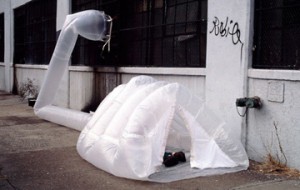
Michael Rakowitz, "paraSITE," 1998-present.

Michael Rakowitz, "paraSITE," 1998-present.

This weekend I went to an opening at The Soap Factory, a scrappy and often-excellent nonprofit art space a block or so off Minneapolis’ riverfront. The description of the work, a Clive Murphy installation called Almost Nothing, was intriguing enough to draw me there: he’d filled the entire space with a series of air-filled tubes created from black plastic garbage bags, mimicking the architectural geometry of the space—which, as its name states, was once a soap-making factory, reeking of lye.

But when I arrived, the piece immediately struck me as so much hot air. Here’s my progression of thought: it’s February in Minnesota. This building is virtually unheated. We’re facing twin catastrophes of economic downturn and human-made climate change. And this guy’s art requires electric air blowers to drone constantly on whenever the gallery’s open?

Murphy’s work is what it is—a project influenced by “radical architectural proposals from the sixties” and inflatable carnival games that examine “themes of hierarchy, inter-relationality, and meaning formation”—and I don’t knock it for that. But it isn’t what I’ve been looking for lately: contemporary art with immediacy, that pragmatically or poetically addresses the challenges we face today. Not all art needs to do that, but it’s what I’m looking for. Something more along the lines of another inflatable-bag art project: paraSITE, in which artist Michael Rakowitz collaborated with homeless people to construct temporary inflatable housing designed to leech warmth from heat outtakes from apartment buildings.

In considering “political” art—especially in a non-election year, especially facing the economic and environmental problems we do—I’m reluctantly coming to believe that art doesn’t have the power I once believed it did for bringing about social change.

Suzanne Opton's "Soldier: Birkholz" billboard

Suzanne Opton's "Soldier: Birkholz" billboard

Perhaps it’s creeping cynicism. As a journalist covering the Republican National Convention in St. Paul this fall, I saw magnificent, irreverent and funny artworks – from full-fledged contemporary artworks (including Ligorano/Reese’s The State of Things, gigantic ice letters spelling out the word DEMOCRACY, which melted away on the capitol lawn as time passed, or Suzanne Opton’s Soldiers billboard series) to creative protest signs and hilarious chants by nonviolent demonstrators (“You’re hot, you’re cute, take off your riot suit!”). Still, the police crackdown was powerful, unrelenting and sometimes violent—and, if hearing from Republican delegates on the convention floor is any indicator, protesters’ messages didn’t seem to register. The art was dismissed as mere protest.

My doubts also have to do with responses to my oft-asked (and admittedly naïve) question, “Can art change the world?” As an editor at the Walker Art Center and at  Adbusters Magazine, I posed the question to a number of people: critic Robert Storr; artists Rirkrit Tiravanija, Sam Durant, and Thomas Hirschhorn; Artforum editor Tim Griffin and independent curator Hou Hanru, to name a few. While they all said they hoped it had that kind of power, few wholeheartedly agreed it did.

But from some of these same people, I found hope for smaller incremental change—one heart (or mind) at a time, perhaps.

During a residency at the Walker, Art21 artist Guillermo Calzadilla told me his take. Art, unlike protest, is difficult to pin down, he said, and therein lies its power. Overt agit-prop is easy to spot, categorize, and therefore dismiss wholesale by opponents of the message it carries. But art is something… else. Something nebulous and multidimensional and hard to get one’s brain around.

Before we can dismiss it, we have to figure out what it is.

Continue reading »