From Here To There (and Back Again)

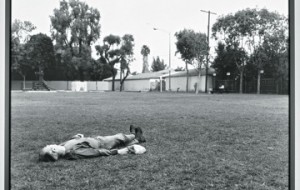
Jeff Wall, “Citizen” (1996). Gelatine silver print on aluminium panel, framed, 192 x 244 cm. Photo: Öffentliche Kunstsammlung Basel, Martin P. Bühler, courtesy Kunstmuseum Basel, © Jeff Wall.
Collection shows, by their very nature, often feel more like “Best of…” CDs than a well-curated mix-tape. They usually feature the hits—a stripe-y Barnett Newman, an invariably awesome Pablo Picasso—but context and a coherent thesis is usually, almost inevitably, missing. How to connect the Picasso to the Newman without invoking a stutter and hiss on the tape (as elucidated by the invisible crease in the white wall they share), by which we know that one work really wasn’t supposed to follow the other, and that a lucid argument about their relationship might be lacking?
These were some of my thoughts, anyway, on entering “Holbein To Tillmans” (there’s a leap for you), the Schaulager’s summer show of some 200 works culled from the Kunstmuseum Basel’s deeply quirky collection (Holbein and friends, an orgy of Swiss Alpine landscapes, a remarkable group of Ab-Ex works bought in toto on a trip to New York in 1958) as well as a few others from the Emanuel Hoffmann Foundation.
Matching the Schaulger’s own improbably seismic concrete-and-concrete space, deftly orchestrated by local heroes Herzog & DeMeuron, the exhibition’s scope—the Middle Ages to the present—is large in the extreme. The curatorial premise, by necessity, is vague in the extreme: to look at all the works “with today’s eyes,” and to perceive the “world around us by looking at people or things.” If this sounds doubtful, the show succeeds by merit of the works themselves, as well as by odd and inspirational pairings that together advance a kind of humanist argument: everything’s linked—past, present, future—and we’re all in this together.

Rodney Graham, “Allegory of Folly: Study for an Equestrian Monument in the Form of a Wind Vane” (2005). Lightbox, two parts, each: 306 x 141 x 18 cm. Photo: Tom Bisig, Basel, courtesy Kunstmuseum Basel, © Rodney Graham.
Chain Link Fence

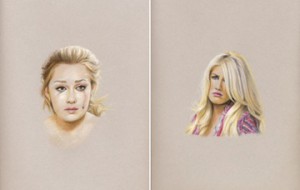
Left: Karin Bubas, Lauren Crying (2009). Pastel on paper, 9.5 x 12.5 in. Right: Karin Bubas, Heidi Pouting (2009). Pastel on paper, 9.5 x 12.5 in. Both images courtesy Charles H. Scott Gallery, Vancouver.
Some summertime offerings from the internets.
Pastels Not Dunzo: Joshua David Stein watches the cast of “The Hills” getting pastel’d.
“Chalk pastels are the soft focus of the art world — the Lifetime channel on paper — and for the characters of the notoriously high-definition, supersaturated “The Hills,” the medium is humanizing.”
Turn Your Back On Me: Jennifer Higgie turns her gaze on men who love women who turn away.
“She turns her back on you; this, it would seem, is her appeal. She’s been painted like this for centuries, and, more recently, photographed. Often she is naked, in a bathroom or bedroom, solitary, sleeping or day-dreaming….”
Pale Fire: Arthur Danto on Suzanne P. Hudson on Robert Ryman (Season 4) on everything.
“Suzanne P. Hudson’s Robert Ryman: Used Paint is the first book-length study of the artist’s achievement, and it comes with an interesting thesis, namely that his paintings exemplify what the author calls ‘embodied thinking,’ which I interpret to mean that his paintings are not the product of thought, but thought itself.”
Script Vicious: Lyra Kilston dissects Pablo Helguera’s panel freak-out.
“The play presents a public discussion between a cast of art world archetypes—curators, a collector, a thwarted artist and an arts administrator—as they meet to discuss the life and work of the artist Juvenal Merst, a character that Helguera named after the early second century Roman poet Juvenal, who is credited with developing the nascent genre of satire.”
Hey Papi: Ara Merjian takes to the work of Marco Papa.
“A hint of Joseph Beuys’s notion of ‘social sculpture’ perhaps echoes in Papa’s interdisciplinary, participatory affinities, as well as his investment in a kind of collective, symbolic catharsis around specific objects. But Papa steers clear of the specious naïveté that marked Beuys’s self-styled shamanism, with its quixotic faith in the autonomy of artworks.”
You Wish: Heike Munder assembles a list.
“‘Live in Your Head’ is a motto that could well serve to guide a revival of interest in processes, for the latter remain inconclusive, continually opening up new possibilities of interpretation. I should add the following keywords to my wish list: intellectually stimulating materials, forms and ideas.”
Soft Touch: Jorge Colombo’s iPhone finger painting archive. They’ve been the splash this summer, yes, but they’re just so nice.
Let Them Read Books/Play Records: Taschen, Plattfon, Stampa, Aniston

Spread from Helmut Newton's SUMO (1999). 464 pages. Courtesy Taschen, Cologne.
“This new edition is the fulfillment of an ambition conceived years ago. We jokingly referred to it as ‘Newton for the poor.’ ”
Oh, Benedikt Taschen, it’s quotes like these—and your line of über pricey, barge-like books like Helmut Newton’s SUMO, of which you speak—that always makes me wince at Taschen so. (Though, for us poor, there’s always been the oh-so-cheap stack of your invariably paper-thin monographs—Schiele or Klimt anybody?—in the remainder pile at bookstores everywhere.) Like some munchkin feather-weight wrestler, Newton’s original1999 monograph was two feet tall, with a weigh-in of 70 pounds. Mr. Taschen trumpets it as “The biggest and most expensive book production in the 20th century.” Today copies go for 10,000 euros. But in an ode to the book’s 10th anniversary, and with priceless recessionary timing, a smaller edition is about to be published for a mere $150, what Taschen reasons is “democratic dispersal.” Hmm.
If the publisher’s mania for printing books you can’t pick up and you certainly can’t afford (his editions for “the poor” notwithstanding) seems to auger well for the arrival of the recently released Kindle II (portable-to-the-extreme if not exactly cheap), I am not so convinced by his largess nor the technology that seeks to wipe it out. Nevertheless, with the constant heralding of the end of the publishing industry (despite Taschen, I don’t buy it) and the music industry (well, maybe) as we know them, I went to an opening last Friday night in Basel for a new record store cum art book shop cum gallery with the feeling that I might just be going back in time to a beautiful, beautiful place. Tonight there would be no Kindle, no online music downloading, just obscure CDs and LPs and posters and multiples and beautifully bound books with (printed!) text. Continue reading »
Kultur Klub

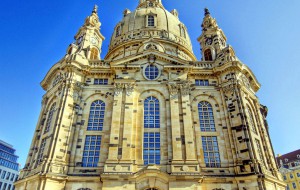
Frauenkirche (1726-1743, rebuilt 2005), Noitmarkt Square, Dresden, Germany.
For the past week, my mind has repeatedly strayed to an unsettling and provocative article that appeared in the New York Times on August 14. The article was one of Michael Kimmelman’s regular, and regularly insightful, culture-minded dispatches from Europe, where he—the Times’ chief art critic—has been living in Berlin for the past few years. The article’s dateline read “Dresden,” and it concerned the July courtroom murder of a pregnant Egyptian pharmacist who lived there. She was stabbed to death by a Russian-born German man who had previously called her an “Islamist, a terrorist and a slut.” After her murder, thousands of Muslim and Arab mourners marched in Egypt and Berlin—even the doubtful Iranian President Mahmoud Ahmadinejad denounced (ironically, all considered) Germany’s “brutality.”
If this horrific hate crime was obviously newsworthy, it struck me as a strange topic for Kimmelman to alight on, despite his admirable openness about his political concerns. As I was reading the piece I glanced up at the newspaper’s heading to confirm that I was indeed still in the Times’ Arts section. Then three paragraphs down, all came clear: “Dresden is one of the great cultural capitals of Europe,” Kimmelman intoned. And: “One wonders how to reconcile the heights of the city’s culture with the gutter of these events.” Wait, what?
Kimmelman evokes Dresden’s city center as a “marvel of civility, a restored Baroque fairyland surrounded by Socialist-era and post-Socialist-era sprawl. The rebuilt Frauenkirche, the great Baroque cathedral where Bach played, again marks the skyline with its bell-shaped dome, as it did for centuries.” And he seems aghast that in this bastion of “civility”—where Bach played even!—has come the steady rise of right-wing xenophobia and murders like the one he chronicles. But his umbrage seems, to me, incredibly strange. Take Paris and New York—two cultural capitals if ever there were ones—and cities where hates crimes, crime itself, happen with regularity. What if one were to say contrast the Metropolitan Museum’s pacifically high-minded Egyptian room and a murder that happened behind it in Central Park, and then pose the question: how could this crime happen in proximity to such artistic greatness? If I were to hazard a guess, the reaction would probably be: the twain don’t meet. Continue reading »
Ghost That Note: Harpstrings, Heartstrings, and Street Scenes

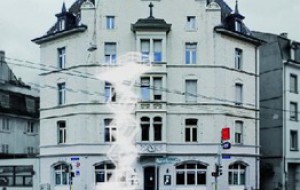
Rendering of "Ghost Notes, performance 1" (2009), Basel, Switzerland. Courtesy asiootus, Basel.
This past Sunday evening in Basel could have been like any other but it wasn’t. Not quite. My partner and I finished the strangely purple dinner I had crafted—beet pasta, plum tart—and rode our bikes over the Dreirosenbrücke, the wistfully named (and entirely rose-free) Three Roses Bridge that crosses the pewter-green Rhine into an industrial neighborhood of Northern Basel. There, at the dusk-darkened corner of Elsässerstrasse and Hueningerstrasse, we found ourselves watching a harpist perform from a precarious perch in the sky, just outside the fourth-story window of a pre-war building. The shadow of the harp loomed fairy-tale large against the building’s curvy façade. The delicate music—by Béla Bartòk, Benjamin Britten, John Cage, Erik Satie, and others—fell like water over the street. A man leaned out the window above the harpist, as enchanted as the audience leaning against their bicycles below. Mercy.
With the whirr of children and trams running by and streetlamps softly aglow, the bright, buoyant tones of the harp turned the entire street scene into just that: a scene. As the music moved from cheerful to sentimental to anticipatory to menacingly minimal, the now surreally cinematic street, totally ready for its close-up, morphed from a Fellini-esque comedy to a Nora Ephron romcom to a French Connection–like thriller to something far more noir. The scene was so wondrous it verged on the precious. Thankfully, the tall, boxy basket crane (itself recalling the scaffolding of film sets) that held the musician and her harp added some necessary levity, as did the costumes of the audience: flip-flops, beer cans, orange swimming bags (readers, it is August hot here). Continue reading »