Explosive Fragments: Poems and Photographs

May 9th, 2011

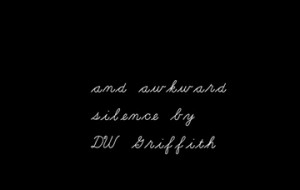
Jibade-Khalil Huffman, still/page from “Way Down East” in “James Brown is Dead and other poems” (Future Plan and Program/Project Row Houses, 2011)

At some time, somewhere I read or heard some one say something equating novels with films and poems with photographs. I think it had something to do with time and space, or girth or something. In any event, many of the artists I know who specialize in photography are deeply immersed in poetry, and many of the poets I know, consistently write about and take photographs. How remarkable.

With this in mind, I visited my friend Jibade-Khalil Huffman at his studio in order to further discuss. One of the busiest dudes around, he is a poet and photographer (in which order I know not) who, in recent years, has been staging performances. Two 35mm slide projectors, one loaded with words, stands next to a carousel meticulously edited with beautifully scene images complimented usually, by live music. Like his work, Khalil is often elusive, piqung interest before quickly ducking back into the shadows, slide projector or subway station.

Khalil Huffman: It’s the most narrative driven poem I’ve ever written, it has a plot. There is this scene that occurs at an emergency room. I was in Florida shooting and the bulk of that trip was spent just walking around at night with my camera. Sort of as this figure – this character the “I” figure of the poem. Shooting with that in mind, but never with specific lines in mind. Except this one evening I thought, “Well clearly tonight I have to go out and shoot outside this emergency room.” And after the fact, before actually shooting – twenty minutes later on the way there, “wait, what am I doing? This is too easy and obvious.

Rebecca Leopold: Too easy for you or too easy for the viewer?

KH: I think both.

Continue reading »

Sustain Ability

May 5th, 2011

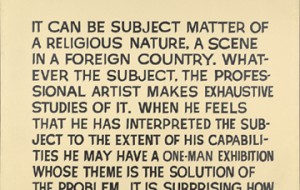
John Baldessari, "Solving Each Problem As It Arises," acrylic on canvas, 1967. Courtesy Yale University Art Gallery.

Thoughts, to an artist, writer, or any individual who wants to live thoughtfully

Influence. The personal narration that comes with cinematic fiction, the fragmentary staccato of poetry or song, the conversational conventions following television drama or the full frontal cynicism of network comedy. What will you fill your head with this day? Patterns of influence easily sketched, I have waded through the mire, the hyper-linked adaptation. An associative amalgam of anything and all: I am a glut for

Stimulus. Fill my head with points of interest in the hope that some how, some day there will exist a pellet of information I can call my own. Maybe it will sell for thousands, accrue a million hits, even be given an ISBN number in countless closed libraries city wide

Inspiration. I despise the word, rather: where does creativity come from? Influence. Doubt. Every thought followed immediately by its opposite. Delete a phrase before

Doubt dispelled. No new emails. Literary devices aside a blinking black line. I am alone and free to pace my apartment. Television set less

Life-style. The availability of the available. When all questions answered the impulse to ask

Decreases. The duality of discourse.

Community. Creative community. The influence that comes from thoughtful individuals living together, thoughtfully. Go to a school or job, swim around an art world, form a collective or organize an exhibition. The events of interest in the places of myth. If it does not exist, make it. Find the like minded &


Richard Scarry, “What Do People Do All Day,” color picture book, 1968. Random House Books.

Explosion. Utopic pockets of creative professionals. That is how to write it. Live it. Forgetting what unifies artists is their individuality. The complexities of the interior the intricacies of intimate life. Alienation accompanies being your self all the time

Transgress expectation. Habit & happenstance. Let go. Make a life fit for you. Doubt dispelled. No new emails. Literary devices aside a blinking black line. I am alone and free to pace my apartment. Television set less

Notes on Nostalgia

April 29th, 2011

The Romantic subject, who emerged roughly two hundred years ago as the prototype of the modern subject, who looks at a beautiful vista to see not the landscape but “an earlier instantiation of the self.”
– Ulrich Baer

You need to a flashplayer enabled browser to view this YouTube video

Products barely years old already bear the time-stamp of progress. Which is a more convoluted way of saying technology is rapidly changing, outmoding the inefficient and making useful objects historical artifacts before their time. Hardly a luddite, I love computers, gaming devices, streaming cinema, as well as cell phones and the multitude of new ways our time here is being recorded and distributed. It is the rapid romanticization of the obsolete I find so confounding.

I received my photographic education at an awkward technological moment, resulting in an acquisition and practice of techniques already expired. About a year ago, I was showing a friend and fellow photographer an image I had made and was rather proud of. “So beautiful,” she marveled as I puffed with pride. She continued, “Look at that grain! Film is just so beautiful, isn’t it?” Taken aback by her focus on format rather than content, I didn’t know how to respond.


Nostalgia is a comparative act and photographs have, for almost two centuries, remained its quintessential agents. Images enable us to look upon what has been or is being represented and immediately create a space for comparison. In between a fiction and a truth — the present moment and the one depicted. They are not simple either/or distinctions. The comparisons brought on by nostalgia are more exaggerated and complex manifesting in an ongoing state of distorted reality. “Unlike melancholia, which confines itself to the places of individual consciousness, nostalgia is about the relationship between individual biography and the biography of groups or nations, between personal and collective memory,” writes Svetlana Boym.

Continue reading »

Susceptible / Silent / Suggestion

April 27th, 2011

When the war came along, I decided to use only quiet sounds… There seemed to be no truth, no good, in anything big in society. But quiet sounds were like loneliness, or love, or friendship.
— John Cage

Ellsworth Kelly, "Lake II," oil on canvas, 2002. Beyeler Collection, Basel. © Ellsworth Kelly.

There are so many ways to form a sentence or express a thought. And there are so many thoughts to have! What should I think or believe this day? And then, which of these thoughts should I tell others? I often find myself considering a crisis of the authentic, the un/utter-able, the overlooked, even, and the quiet. Which is to say I usually find myself considering. I make photographs but often wish I wrote songs, or produced television. Editing images is not like piecing together a well-crafted interview, or cogent Op/Ed piece. It’s the difference between argument and suggestion.

I’m far more susceptible to suggestion, how about you?

The Internet is the perfect platform for us to go on discussing the ever-expanding ways in which we can have a conversation. Experts agree language is changing, as various historians remind us it has and will. But I finished grad school a number of years ago and I’ve grown weary of talking about talking. So I think I will just speak, regardless the medium.

When I was twenty I wanted to be Susan Sontag. It was in her work I first encountered the thoughts I wanted to posses. Where I first discovered the possibility of tearing down walls with words. I wrote furiously thereafter, formulated opinions and arguments based on chapters read and patterns found. I always thought I would grow into a me-shaped hole in the universe complete with accessories: my words, my ideas.

What I never anticipated is that there is not a book in existence that contains the point I am trying to make.

Rebecca (Marks) Leopold, "Library of the Ever & Anon," Chromogenic print, 2010. Courtesy the artist.