It’s Not Only Rock ‘N’ Roll, Baby!
Earlier posts by Marc Mayer and Ben Street have noted the relationship between pop culture, art, and music as well as recent attempts to curate this “magic.” It’s Not Only Rock ‘N’ Roll, Baby, at the Bozar Centre for the Arts in Brussels, is another such attempt. Taking a cue from its featured artists, the show is loud, flashy, and great at drawing crowds—making it an ideal headliner for the summertime, when sunshine, Batman, and vacation compete for attention.
In the curator’s note, Jerome Sans writes that the show “is a gathering of artists, most of whom were visual artists before becoming musicians, or whose visual roots at the heat of their artistic process are often little-known and viewed as separate from their musical fame.” Did you know Yoko Ono made art? Featured “musical legends” include Patti Smith, Brian Eno, Chicks on Speed, Fischerspooner, Devendra Banhart, Pete Doherty, Yoko Ono, Miss Kitten, Antony, The Kills, Bryan Ferry, Riceboy Sleeps, and David Byrne.
Here’s the rub: at admission, you choose between two pay exhibits: Rock n’ Roll or Mapas Abiertos, a traveling exhibition of contemporary Latin American photography, organized by “rituals of identity, scenarios, and alternative histories.” Given the choice between Rock and Maps, most museum-goers chose Rock. Shoot. If you’re under 26, see both: admission is only 1 euro ($1.57).
Rock ‘N’ Roll is uneven in its range from musicians who happened to go to art school to revered artists whose work embraces multiple disciplines–like Laurie Anderson (Season One), Yoko Ono, and Brian Eno. The curator chose to avoid hierarchy and chronology in favor of a “free passage into the universe of each artist.” In these universes, not all stars are equally bright. Moreover, some of the wall text seemed to serve less as an introduction than as a justification for inclusion in the show. An improvement would have been the excerpts from the catalogue interviews about how the contributors approach their visual and musical interests. I complain, but it’s a fun exhibit. With the rain as an excuse, I spent nearly an hour watching music videos from the recesses of a bean bag chair. These included two Pet Shop Boys videos, one by Wolfgang Tillmans and the other by Martin Parr. Even without the super-saturated color that’s a hallmark of Parr’s photography, the sense of humor is distinctly his.
Body Bakery

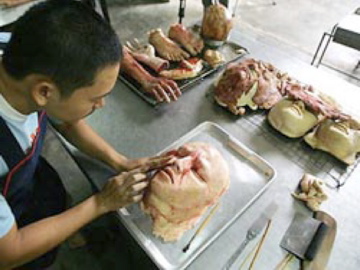
Kittiwat Unarrom is the son of a baker and has a masters degree in fine arts. His medium is bread; his subject is human flesh. Since 2006, he has been selling his wares impaled on meat hooks or on plastic-wrapped styrofoam trays behind a glass case in his “Body Bakery” in Ratchaburi, Thailand.
For pictures, text, and a video (in Thai) about the Body Bakery, check out this post via Shape+Colour. NOTE: this may be scary for children.
He is a virtuoso of the grotesque. The skill and attention to detail are impressive, but I am not sure what to make of his work. I can find little information about his intention and it is unclear whether this is primarily due to a language barrier or because he is not one to make artist statements.
His work makes me, coming from a Western perspective, think of the flesh-to-bread transformation of the Catholic Holy Communion, Hansl and Gretl, and Halloween haunted houses where grapes mimic eyeballs and spaghetti moonlights as intestines.
From what I was able to find, he is inspired by the Buddhist concept that one shouldn’t be misled by appearances; what you see may not be true to what you thought. He is quoted as saying, “Of course, people were shocked and thought that I was mad when they saw the works. But once they knew the idea behind it, they understood and became interested in the work itself, instead of thinking that I am crazy.”
Again, maybe it’s a translation issue but this feels like an overly simple and thus frustrating answer. If the goal was to push the idea of ’seeing is believing’ with home baked trompe l’oeil, there are many different directions to go with this. The painstaking realism of his goods and the faux-cannibalism they imply is an unnerving aspect of his work that this statement doesn’t really address.
I’d be really interested to know more about the interaction with his customers, their experiences buying his products, and whether his showroom functions more closely to a gallery or to a bakery. Do most come in for the novelty or are there repeat clients? What is the life of the ‘body bread’ after it leaves the store—is it served as ‘normal bread’ in a sandwich? What happens to pieces that aren’t sold by the end of the day? Bread is quick to mold in a humid climate… How are the pieces priced compared to a regular loaf?
DISCUSSION: What do you think about the Body Bakery?
Meat After Meat Joy

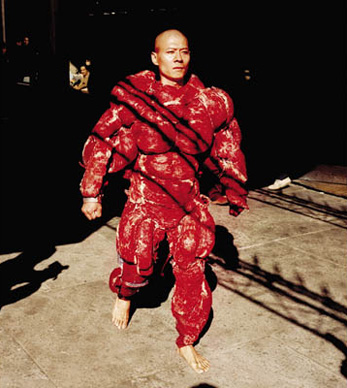
Zhang Huan, My New York, 2002, still from video performance. Courtesy of Pierre Menard Gallery.
One of the last shows I saw in the United States before leaving for Belgium was Meat After Meat Joy, an exhibit of 10 contemporary artists who use meat in their work, that was on display June 21- July 20 at the Pierre Menard Gallery in Cambridge. The title takes its cue from Carolee Schneemann’s performance/happening Meat Joy (1964) that explored flesh, gender, and the language of meat (in Schneemann’s case, “chick”)*. A video of Meat Joy is projected in the gallery but the other artists are ‘after’ Meat Joy—their works explore different significations of meat and raw flesh.
Exhibited artists included Tania Bruguera and Nezaket Ekici, Anthony Fisher, Betty Hirst, Zhang Huan, Tamara Kostianovsky, David Raymond, Dieter Roth, Carolee Schneemann, Jana Sterbak, and Jenny Walton.
Betty Hirst’s meat sculptures were only on display the opening night; July is not a friendly month for meat longevity. When I arrived, there were photographs on display instead. I liked Tamara Kostianovsky’s ’stuffed animal’ carcasses out of her own clothing. Although these pieces were the most cuddly and approachable of the works exhibited, the use of clothing encouraged consideration of our own hides and flesh and what lies beneath.
In addition to the emotional and symbolic connotations of meat, it is visually striking. “Meat is such a wonderful aesthetic subject,” says Phil Dmochowski, the gallery’s assistant director. “Its textures, color variance, striations and marbling are very seductive, really. There’s such a great history of painting meat,” he says, mentioning Rembrandt, Van Gogh and…Bacon (from The Weekly Dig).
The opening received a lot of publicity and subsequent protests drew further attention to the show. On July 9th, PETA (People for the Ethical Treatment of Animals) issued a press release to call for the closing of the show: “Unless you’re Hannibal Lecter, there’s nothing ‘artistic’ or ‘joyful’ about meat,” says PETA Senior Vice President Tracy Reiman. “If it’s unacceptable to kill humans for an art exhibit, then it should be unacceptable to kill animals too.”
The Pierre Menard gallery has images and introductory text that explains the significance of meat and the curator’s intent on its website.
Big Red & Shiny also has an interview with the curator, Heide Hatry.
(*We also have plenty of meat terms to objectify men—hunks, prime rib, grade A chuck etc..)
CarbSmart

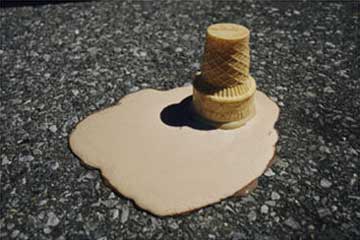
It’s summertime and, if you believe the junk magazines—I see that InTouch stashed between the pages of your ArtForum—carbohydrates will ruin you and your chances of bikini (or board short) bliss. They may just ruin your life. Luckily, there are many things to do with processed grains and refined sugar besides putting them in your mouth. Food has been used as an art material for many reasons, ranging from necessity (i.e. prior to the development of oil painting, pigments were bound with egg yolk in tempera), to novelty, to symbolic and conceptual value.
Here’s a (very) short list of artists known for their use of sugars and starch. This is by no means intended to be comprehensive so feel free to add to it below in the comments section.
1. Felix Gonzalez-Torres was selected to represent the United States at the 2007 Venice Biennale, becoming the second artist to receive this honor posthumously. He believed that politics infused all art regardless of intention and he once said that “the most successful of all political moves are ones that don’t appear to be ‘political.’” His candy spills and installations are among his signature works and touch on challenging themes and current events including the Gulf War and the AIDS crisis. Black licorice resembles missiles and piles of wrapped hard candies in his subtle protest piece Untitled (Public Opinion). Felix Gonzales-Torres is among Season 2 artist Do-Ho Suh’s favorite artists.
2. Joseph Beuys was drawn to food as art materials and to the concept of art as nourishment. The instability of food materials meant that they would change, somewhat unpredictably, over time. Beuys used chocolate, sausage, gelatin, margarine, and butter in his work. He was featured in a small show at Harvard called Eat Art. Honey was one of the materials that particularly interested Joseph Beuys, as it had mystical connotations. See Honey is flowing in all directions.
3. Chandra Bocci’s Gummy Big Bang II is a literal explosion of a gummies: an ark’s worth of eviscerated bears, worms, and tarantulas fill a 120 square foot space. This piece was originally featured in the 2006 Portland Art Museum Oregon Biennial and is currently part of a curated collection at the CW Network (the same CW that shows the Gilmore Girls). Gummy Big Bang I had melted throughout the course of an installation in Portland and was disposed of at the end of the show.
Quiet on the set: keep noise to a Minimum

I was rereading a batch of the previous posts to avoid being redundant, but that won’t stop me from piggybacking. Ben Street’s post “Best Supporting Artists” reminded me of a piece I’d seen in at the Los Angeles MoCA in 2004 as part of A Minimal Future—Art as Object 1958-1968, which was billed as a landmark exhibit in its focus on the emergence of Minimalist art in America. The show was expansive: sculptures, paintings, photographs, and drawings by 40 artists filled the entirety of the California plaza location. The show was quiet too and worked my mind with ideas about materials, production, and the relationships between art, space, and the viewer. Which is to say, I shouldn’t have been laughing. Well, tough.
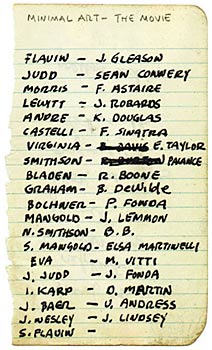
Mel Bochner’s drawing (above) is a tongue-in-cheek take on burgeoning art-stardom. That it’s written on a small notebook page packs the thrill of reading an inside joke in a cool kid’s diary and—no small thanks to MoCA—actually getting it.
Sean Connery takes a break from tormenting Ms. MoneyPenny to play Donald Judd. Kirk Douglas, exactly a decade after portraying Vincent V.G (a study in emotional excess) is invited to go minimal as Carl Andre*. I especially like Bochner’s modest choice of Peter Fonda (pre-Easy Rider) for himself. The positioning of the piece towards the end of exhibit added welcome levity and practically introduced the Conceptual jokers yet to come.
*Random fact: prior to becoming a sculptor, Carl Andre briefly worked for United States Army Intelligence.