Open Enrollment | Through The Looking Glass

October 26th, 2011

It is difficult to believe that only a year ago, I was beginning my MA in Art History at The Courtauld. In 2010, to inaugurate my beginnings on the British Isles and my time in London, I bought a mug inscribed with the words “Curiouser and curiouser,” a quote from Alice in Wonderland, printed alongside an image of the protagonist staring at her flamingo-turned-croquet-mallet. As the year progressed, and I journeyed through the next step of my education, the mug’s decoration seemed only fitting. The lessons and experiences I had felt a bit like a wonderland, and, in nine short months, it also felt like a quick-lived dream. Now, a year later, I’ve written my dissertation, graduated and moved into the real world. And here I am on the other side.

"Curiouser and curiouser," cried Alice.

In Through The Looking Glass, Lewis Carroll’s sequel to her first journey, Alice adventures once again, this time moving across the chess board of a parallel world from pawn to queen. And once again Alice’s story seems to fit just right.

Journeying through the looking glass.

Strangely, I now feel that I am somehow back at square one. I pursued a Master’s degree to further my study of the arts, yet I also believed that it would get me closer to getting an art-world job that would bring together my language, writing and research skills.  Yet, facing the realities of today’s economy, I have often fallen short because I lack the exact job experience required.

Once again, back at square one.

I now find myself working a full-time unpaid internship at an auction house in London, an opportunity I have been eager to undertake. I aim to gain insight into a more commercial art world, apply my skills, and evolve my previous understandings of the worlds of art. While I’m still only three-and-a-half weeks into the process, the internship has had its highs and lows. I seek to complete tasks set before me with professionalism and tact, but also hunger to learn more and put more of my intellect to work. The internship itself seems to be without structure. I still hope to find a mentor who will recognize my abilities and talents and put me to task. There are moments of frustration and moments of fulfillment in new beginnings. Tension stretches between knowing my intelligence and my capabilities, and completing the more simple jobs at hand. I am ripe for a challenge. There are times when I step back and look at my credentials and wonder what an education is worth. As many of the people who now work in the department started as interns, I wonder if the unpaid internship is simply a rite of passage into this art world.

The process thus far has been frustrating and challenging, humbling and instructive. While I like to think that the world is at my fingertips, many times it feels that it is just out of reach. Yet, as I move ahead, I have decided to face all challenges with equal enthusiasm and determination, and to seek out chances to learn and prove myself.

Part of me wonders if, like Alice, I will ascend in rank, or, at the end of it all, I’ll wake up and realize that it was all just a dream….

Will I ascend? Or wake up?

Open Enrollment | Nine Months Later, a Master’s Degree

May 11th, 2011

Open Enrollment

Last Friday, my invitation to graduation arrived in the mail. It seemed rather premature as I am but a fraction of the way through researching and writing my final dissertation, but it was also rather fitting since the MA program at The Courtauld is one of the shortest Master’s degrees in Art History around: a mere nine months from the first day of lectures to the receipt of the diploma. Taking a (most welcome) moment away from my dissertation, I thought about the value of the nine month journey.


Signing up for my graduation: the letters arrive

A full-blown immersive plunge into art history was what I was seeking. My degree brought me into challenging thought, interesting discussion, and engaging writing projects. But it all happened so fast! It makes me wonder if The Courtauld is better suited for those looking for a fast track to a PhD? What of those people, like me, who (at the moment) aren’t considering continuing the climb of the ivory towers?

In cooking, there is a process called blanching, which can be used for greens like spinach and wild garlic (currently in season here in the UK), consisting of boiling the greens for 2 minutes before submerging them in a cold water bath in order to extend their freshness in the freezer. While the culinary analogy seems incongruous (besides an immersion into all things art, I’ve also nursed my passions for yoga and, you guessed it, cooking), it is rather apt in this case. As a student, I was thrown into the deep end (the boiling water) and now, my gestation time (my 2 minutes/9 months) is just about up. Now for the cold water bath.

Continue reading »

Open Enrollment | On the Precipice of Reality: This and That

April 13th, 2011

Open Enrollment

For this month’s post, I’ve mulled and pondered, thought and reflected, yet I could not come up with any sort of brilliant topic for my penultimate post. So I thought I would just tell it like it is and lay out all that has been on my mind lately. To be honest, a lot is going on: dissertation research, job applications, and general rumination on life and the future. And in considering all these things, my emotions have run the gamut from worry to excitement, trying to remain steadfast throughout (much like the British Ministry of Information during WWII, who promoted the slogan: “Keep Calm and Carry On”).

Every now and then, I adopt this rendition of the WWII slogan

Like fellow Open Enrollee Melinda Guillen, I have been deflecting the question, “What’s next?” While I do have an unpaid internship lined up for the fall, I am still faced with the gaping hole of the summer and the reality of living in London, complete with the economic practicalities that come with it. In looking at jobs in publishing, auction houses, galleries, and museums, London seems like an ideal setting to cultivate experience in the arts. Every now and then, however, I ask myself, “What is an MA in Art History good for?” While the additional educational credential is definitely a plus, I find the requirements of current job opportunities rely more on previous job experience. No matter how enthusiastic you may be as a potential candidate, the offer doesn’t come down to future potential but, rather, to demonstrated past performance. It’s unfortunate but true.

Continue reading »

Open Enrollment | To Pick a Topic

March 16th, 2011

Open Enrollment

With the taught portion of my Courtauld MA degree in Art History concluded (the final exam completed last week), it’s now time to start thinking of dissertation topics and plunge into the final 10,000 words and final three months of my graduate degree. With this last stage at hand, I have had much time to reflect and wish to consider the importance and utility of the topics selected for papers and presentations in the field of Art History. Are these expositions merely personal intellectual indulgences? Is intellectual exploration more useful when placed within the cannon of academic thought around a specific topic? Is practicality/applicability even a valid consideration? These are questions that always seem to creep into my mind whenever I embark on a new scholarly endeavour bridging my love of art and writing within the discipline of Art History.

Auguste Rodin, The Age of Bronze, 1876.

Over the past five and a half months, I’ve written two extended essays and given three presentations on different topics. My first presentation was more of an assignment working with a set bibliography and a given work of art: I compared Walter Benjamin’s The Work of Art in the Age of Mechanical Reproduction and Auguste Rodin’s The Age of Bronze (1876). The resulting presentation unfolded the complexities of sculptural practice (modeling, replicating, founding) in light of ideas of reproduction/copy. Considered in a nineteenth-century context, ideas of the original and the copy were not at all straightforward, as emulation was an acceptable (and indeed commonplace) exercise for artists. Concepts of authorship remain clouded even today, as the debate continues.

Continue reading »

Open Enrollment: The What? Ah Yes, The Courtauld.

February 9th, 2011

Whenever I tell someone I am studying for my Master’s at The Courtauld, I get one of two reactions. “The what?” is the first, spoken by those who aren’t in the art loop. And the second is a response of excitement and praise, spoken by those working in the arts and knowing full well the caliber of the institution. Tucked into the north-west side of Somerset House and facing The Courtauld Gallery, The Courtauld Institute of Art finds itself at the epicenter of art historical education and conservation studies as well as in the heart of London, with a finger on the pulse of the art world.

An idyllic view of the courtyard of Somerset House, the location of The Courtauld. Photo: Stefan Zebrowski-Rubin.

After realizing that art needed to be central in my life (and that an additional degree was necessary to do so), I asked around about potential programs. The refrain repeated again and again: The Courtauld. With a focused, one-year (well, more like 9-month) MA, The Courtauld seemed to be just the type of academic and artistic immersion I was looking for in taking the next step towards a career in the arts.

Continue reading »

MontreART

September 24th, 2010

You need to a flashplayer enabled browser to view this YouTube video

Last August, Travel+Leisure ran the article Magnificent Montreal, in which Adam Sachs attempted to sum up Montreal, saying “it’s a college town, a dump, a city of art, placid parks, islands rigged for play and diversions, gray insular urban neighborhoods, and colorful suburbs. It is tiny by megacity standards but world-class in its weirdness, in its shifting, enduringly comfortable indigestibleness.” Many of the pronouncements are questionable – Montreal is hardly a dump (although it has some seedy areas) and its urban neighborhoods are neither gray nor insular (although they can be during our long frigid winters). Architectural historian François Dufaux, in that same article, aptly called Montreal “an imperfect America and improbable Europe.” Sachs does ultimately get it right in saying that the city defies classification.

In my conversations with the 8 artists I’ve written about in this series, Montreal shines in its vibrancy as a city that both fosters artistic production and encourages a great lifestyle. This city, with its slightly tumultuous history of linguistic divide, seems to be entering a time where there is a more effortless mélange of English and French. There is also a richness to the city because of its tight-knit integration of ethnicities (in Canada, the diversity metaphor isn’t so much a melting pot as a tapestry). Vida Simon summed it up best: “Montreal has such an inspiring texture, unlike anywhere else.”

There is a spirit to Montreal, a jouissance to life in the city often called the Paris of North America (although it also garners comparisons to Boston, Berlin, New Orleans…). Because of its diversity — linguistic and ethnic — a more liberal and tolerant attitude filters through the demeanor of Montreal’s citizens. This openness translates to the arts, as Cindy Poremba of Kokoromi Collective expressed, “people here seem to be much more open to seeing art of different types. They are willing to try things and get involved.” On the whole, there seems to be an interest and investment in the arts.

Continue reading »

What You Give is What You Get: Rafael Lozano-Hemmer

September 23rd, 2010

You need to a flashplayer enabled browser to view this YouTube video

Mexican-born electronics artist Rafael Lozano-Hemmer creates installations that could not exist without the participation of the public. His art, fueled by human energy, ranges from one-room displays to city-square-scale manifestations. Commissions for his work have included the Millennium Celebrations in Mexico City (1999), the UN World Summit of Cities in Lyon (2003), the 50th Anniversary of the Guggenheim in NYC (2009) and the Vancouver Winter Olympics (2010). In 2007, he was the first artist to officially represent Mexico at the Venice Biennale. He has been awarded two BAFTA British Academy Awards for Interactive Art, as well as a Golden Nica at the Prix Ars Elextronica in Austria. I met with the internationally exhibiting artist at his busy office in Montreal where he works with a team who helps bring his concepts to life.

Stefan Zebrowski-Rubin: Tell me about your work.

Rafael Lozano-Hemmer: After working for twenty years at the intersection of performance, architecture, and critical studies, I’m very curious about creating platforms for self-representation and participation. My work is incomplete and experimental in nature. The platforms require people to participate, they require people to be aware of the events and then take the piece in a direction that suits them. I have two types of work, one that is more ephemeral – interventions in public space – and one that is more for galleries, museums, and collections. In the gallery-based work, we use technology, surveillance, biometric sensors, all sorts of robotics networks and projections to create environments where the content itself is crowd-sourced, where it is people who in fact are leaving behind a memory of the event. To alter Frank Stella’s minimalist quip “What you see is what you get,” we believe “what you give is what you get.”

Continue reading »

Embodiment and Process: Vida Simon

September 23rd, 2010

Vida Simon, "Cantastoria: a drawn opera," performance-installation, 2010. Courtesy of Eman Haram (photographer).

Vida Simon enters her work. The Montreal-based artist creates gentle, introspective drawing installation/performances where we witness her artistic process live and in progress. She literally embodies her own art, working with practices of drawing, writing, object making, movement, and sound. Her often contemplative creations have been shared through performances and residencies across Canada, in the US, Italy, Mexico City, Finland, Estonia, Lithuania, Chile, Slovakia and Switzerland over the past sixteen years. Simon has recently been working with the enactment of projected drawings, wanting to bring the drawing process to life. Her resulting performances, while loosely improvisational, are thoughtfully considered, material and time-based installation works that breathe life, depth, and wonder.

Vida Simon, "Excavation Drawings," performance-installation, 2006. Courtesy of Guy L’Heureux (photographer).

For Simon, the canvas always felt too limiting. While finishing her degree at the Nova Scotia College of Art and Design, she began building 3D installations extending from her paintings, creating layers, becoming immersed, digging deeper. One of her most meaningful projects was Excavation Drawings (2006), a performance-installation in a hotel in Montreal as part of VIVA! Art Action (a showcase of international inter-disciplinary performance art organized by six artist-run centers in Montreal).  Over a week, a pyjama-ed Simon drew for 4 hours a day before a vagrant audience, the evolution of drawing unfolded as a means of communication, intensely exploring ideas of rootedness and rootlessness, solitude and community, cleanliness and the mess of process. The poetically visual, site-specific work inspired Simon to reconsider her home city through the locale of the hotel room. The immersive process of drawing also best illustrates the completeness Simon has been striving towards in her work. In its direct and simple execution, the drawing installation manifests as an extension of Simon’s self and her psyche.

Continue reading »

The Medium is Not the Message: Adad Hannah

September 21st, 2010

Raft of the Medusa (100 Mile House) #2 from Adad Hannah on Vimeo.

Adad Hannah’s videos are moving pieces of work. And they move, just barely. What started as a curiosity to see what happens to video when you strip it of all its defining characteristics – more closely reverting back to photography – has inspired a career full of artistic exploration. Featured in the Quebec Triennale in 2008 (curated and hosted every 3 years by the Museum of Contemporary Art of Montreal) and longlisted this year for the Sobey Award (a pre-eminent award for Canadian contemporary art), Hannah has been no stranger to accolades and attention. The Montreal-based artist’s work is created in a sensitive and poignant way. The result captivates, mining ideas of time, performance, and the role of mediation in artistic practice.

Eros and Aphrodite from Adad Hannah on Vimeo.

For his Prado Project, featured at the Quebec Triennale, Hannah explored the idea of viewing through videos and photographs. His videos, all filmed at the Prado, place two cloaked figures in front of Hieronymus Bosch’s Garden of Earthly Delights, a man and a woman close to kissing a double statue of Eros and Aphrodite, and two men staring into a mirror in front of Diego Velazquez’s Las Meninas. All played with the implied double representation of observing viewers. Particularly astute is the insertion of another mirror to draw attention to the one painted by Velazquez in his original composition (portraying the King and Queen); the viewers thus mire themselves in multiple levels of observation and interpretation.

Continue reading »

Game (as) Art: The Kokoromi Collective

September 20th, 2010

The Kokoromi Collective, "GAMMA3D," documenting photo, 2008. Courtesy of Simon Law (photographer).

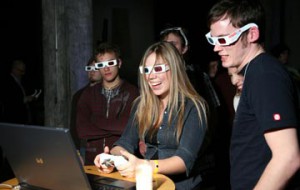
Trying to explain GAMMA is kind of like trying to describe Burning Man. The members of Kokoromi Collective best described their annual showcase for game creation and art as a “curated live game event organized in a party-like atmosphere complete with music, DJs, and VJs.”

It all began because of a request for an interactive game by the Society for Arts and Technology (SAT) for their event at Nuit Blanche (both events mentioned in my post, Augmenting Reality: Paul Warne). Game designer Heather Kelley took her hit game experiment Lapis (an innocent game for Nintendo DS console modeled on patterns of female orgasm, which won the sex-themed 2005 Game Design Challenge in Montreal) and adapted it for local artist Luc Courchesne’s Panoscope (a semi-sphere projector that becomes an immersive environment) with the help of fellow game designer Phil Fish and programmer Damien Di Fede.

Lapin d’hiver from Heather Kelley on Vimeo.

The infectious enthusiasm of first-time game-players teaching others how to play Lapis inspired Kelley and Fish to recreate this energy. And thus GAMMA was born. Game designers Kelley, Fish, and Di Fede were joined by digital media creator and curator Cindy Poremba to form The Kokoromi Collective. The collective has devoted itself to promoting video games as an art form and expressive medium. In 2009, the collective was featured in the BNL MTL (Montreal’s biennial spearheaded by the Centre International d’Art Contemporain de Montreal).

Continue reading »