Using contemporary art to help open conversations

January 8th, 2009

What’s the place of contemporary art in schools?  What’s the place of “controversial” contemporary art in schools? And what’s our responsibility as teachers?

The very best contemporary art speaks a language our students can understand. One of the great gifts of Art:21 is that we can introduce our students to artists who LOOK and SOUND like they do, and who are making art that deals with issues that are important to them.

Kids grapple with issues of sex and identity early on. Stereotypes abound: girls are princesses, boys are athletes; girls are good at art and boys are good at math. Beautiful people are tall, light-skinned, with clear complexions and good hair and are very, very thin. What’s a regular every day kid to do?

A few years ago we presented a show called Sugar and Snails. It was created in response to a desire to have open conversations with our students about issues of gender identity and body image. Even at very early ages kids deal with questions like these, and it’s our job to help them make healthy choices.

Samantha Salzinger’s Skin Deep Series provided opportunities for our middle and upper school students to directly confront issues about beauty. For adolescent girls AND boys conversations about eating (or not), complexions, hair, makeup, tanning, tattooing and piercing, exercising and all sorts of other physical issues are every day occurrences.  Salzinger’s large format portraits of patients recovering from plastic surgery called into question all of our assumptions, both student and adult, about the price of beauty.

samantha-salzinger.jpg

Samantha Salzinger, from the Skin Deep Series

Our students responded with works of their own. Human sexuality teacher Debbie Roffman asked middle school students to create collages that highlighted the stereotypes and subliminal sexual messages in popular culture. Their work showed their understanding that sex sells everything from beauty products to cars to home appliances. In their collages, the students created thoughtful, funny, often startling pieces and raised our awareness about how the media helps reinforce stereotypes.

nikkislee1.jpg

Nikki S. Lee, #7 from The Skateboarders Project (2000)

nikkislee2.jpg

Nikki S. Lee, The Tourist Project #9 (1997)

Photographer Nikki S. Lee’s work really called into question the whole idea of fitting in. In her Projects, Lee identifies a group (tourists, Hispanics, yuppies, elderly people, lesbians, and others) and works to transform herself to be as much like them as possible. That’s Lee herself in the foreground of the skateboarders piece and second from left in the tourist piece. Our students looked at works like these and (almost without fail) took a closer look at how they, too, reinvent themselves to conform to a group norm. It happens very early, doesn’t it, when “everyone” has a particular shoe or backpack or haircut? Nikki S. Lee’s work provides an opportunity to talk to kids about it.

It’s work like this that helps open conversations with kids about issues that make a difference.

Check out more about Nikki S. Lee in this month’s Art Education magazine: Identity in Flux: Exploring the Work of Nikki S. Lee by Amanda Allison. It includes lesson plans for grades 9-12 that explore identity within contemporary subculture groups. January 2009, Volume 62, No.1.

Carolyn Sutton is Director of Arts at The Park School in Baltimore and a member of Art21’s National Education Advisory Council.

Hallowgreen

October 29th, 2008

dsc00859.jpg

This week’s Teaching With Contemporary Art column is written by Carolyn Sutton, Director of Arts at The Park School in Baltimore and a member of Art21’s National Education Advisory Council.

Last October, inspired by the spirit of sustainability, Betsy Leighton, Lower School Principal at The Park School of Baltimore, challenged her students to consider the environment as they thought about Halloween. She coined the phrase, Hallowgreen, and students and teachers set about collecting various recyclable materials for costumes. Cardboard, empty containers, fabric scraps, old computer parts and broken toys filled “help yourself” boxes for the students to select from. It seemed like a perfect opportunity to introduce our youngest students, in grades pre-k to 5, to the contemporary artist Nick Cave.

Nick Cave’s Soundsuits are fabulous creations, made of thrift store finds, twigs, plastic bags, discarded thcotchkes, and just about anything else that strikes his fancy. Children loved seeing his work and guessing the materials they were made from, and seeing a video presentation of people inhabiting them. They enjoyed learning about his process, too. Often, Cave’s Soundsuits are assembled by a multigenerational, multicultural group of volunteers in his Chicago neighborhood.

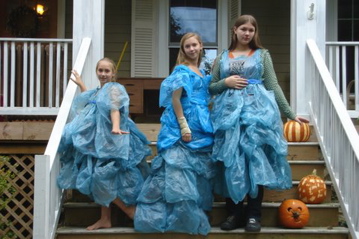
With the second Hallowgreen Challenge underway, I visited Obi Okobi’s fourth grade class at Park. The students talked about how Cave’s work influenced their thinking about artists in general: Naomi said he had stretched her thinking about what art is – that it can be much more than drawing or painting or sculpture. Olivia noted that he has the freedom to bring together two things he loves – visual art and performance – into something bigger and better. Henry commented that the pieces could be interpreted lots of ways, which the students found exciting. They were inspired by his use of materials and several talked about their own costumes using unusual materials. Connor plans to head to antique stores to look for inspiration. Atira thinks she may fashion her outfit using empty snack food wrappers. With the election in mind Naomi plans to become an election booth. Gabe wants to be a domino, and the entire class helped Meg work out possible materials to make wings for a butterfly. Last year the halls were filled with students dressed as computers, recycling bins. Max was a bubble-wrap snowman last year, and there were three lovely ladies (sisters!) dressed in gowns made entirely of blue plastic grocery bags.

While we often think of contemporary art and how our older students might respond to it, we are always pleased that our very youngest students are so enthusiastic about it, too. Nick Cave is one reason why.

image12360px.jpg

Cave, chair of the Department of Fashion Design at the School of the Art Institute of Chicago, brings together his interests in fashion, performance and sculpture while making reference to African ceremonial costumes. Watch a video of Nick Cave, produced by United States Artists: