On the Demuxing Post
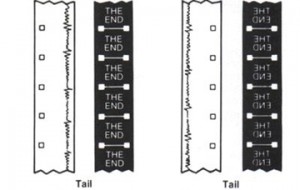
In one of my previous posts, I mentioned the life of certain obsolete terms taking on new meaning. As the clock runs out on my brief stint as a guest blogger, I’d like to consider this the “demuxing” post. This term probably isn’t familiar to most, but it comes from the term “multiplexing,” and it’s reverse “demultiplexing.” From wikipedia (multiplexing):
multiplexing (known as muxing) is a process where multiple analog message signals or digital data streams are combined into one signal over a shared medium. The aim is to share an expensive resource. For example, in telecommunications, several phone calls may be transferred using one wire. It originated in telegraphy, and is now widely applied in communications.
In working on some upcoming video screenings, I’ve come across the term “demuxing” in culling together source material, backing up DVDs, and converting video formats. The easiest way to describe what this term means is a separation of the audio from the video information. I suppose we’re demuxing the world all the time as we sort out the visual from the aural. Demuxing implies an undoing, working backwards to find the beginnings.
Likewise, reading a blog is like demuxing. As many bemoan the end of long form writing with the rise of blogs, I suggest that blogging is best appreciated in long form, over time, read from the most recent to the very earliest. As one who blogs, I appreciate that this form of writing allows for some permanence and a few reminders of the very recent events gone by, without an enormous amount of editing or predetermination. I’ll say good bye with two of my favorite articles on blogging, one by Andre Sullivan and why he blogs, the other on something called “Me Feeds.”
Look for more of my posts on Bad at Sports, and see some of my video work in Chicago and in New York.
Strength in Limitations

On the drive from Chicago to New York City in a Budget rental truck, I had a conversation with a friend of mine regarding an ongoing gallery project called MWNM that she had been a part of in New York. Between the three of us splitting a truck to move our lives forever away from the Midwest, we managed to make the perfect Tetris puzzle of 15 collective years in a city that allowed for un-crowded living. Under such circumstances, our conversation touched on the limited space and time for young curators and artists to show work in a city like New York. The thought occurred to turn these limitations into the modus operandi for showing work, rather than seeing them as limitations. Just as we expunged the excess shells and comforts of Chicago apartment living for greater mobility, the driving force behind showing work should be the conditions that are given, not those expected, desired, or even most preferable.

MWNM on the Lower East Side was procured through an arrangement with the realtors who were eventually looking to rent out the commercial space with a long-term lease. The assumption was that having someone in the space—imagine young artist-types—would draw attention and create an audience for some type of profiting business. This was not the idea of the realtor–far from it–but the lesson shall be: “ask and thou [might] receive.” The two women who run MWNM are none other than the two with whom I drove cross-country: Karen Archey and Alice Wells.
Imagine the way in which one might go about building a space. First, acquire the space: check. Next, come up with a name and perhaps some type of mission statement. For MWNM, this is where step one conflicted with step two. The arrangement for the space did not allow for any permanent identity, or even assurance that events planned for the future would not get canceled before they could be executed. How could one expect artists and others to rely on a space that could close next week? This was their limitation.
Not only would such a limitation affect the way they would go about hosting events and exhibitions, but it would also be reflected in the identity of the space. The letters M-W-N-M are an acronym for the first two shows held in the space, titled Meet Waradise organized by Alice Wells and New Mourning by Karen Archey. Naturally this means that the space had no name until these first two shows had come into existence. I’m familiar and quite fond of the idea of generative titling–coming up with a title and letting that determine what might spill forth–but in fact this is a reversal that embraces the spirit of limitations in favor of a more exciting possibility.
This post comes as MWNM prepares for its last week. In truth, every week was their last week, but this time it’s a sure thing. Their most recent exhibition, titled 93 DAYS, shares an archive of the space and the relationships that brought it about. Archey and Wells have also learned to work with the limitations of collaboration. Just as limitations should be embraced because they are the circumstances given, so should one’s community of artists and friends. I make note of this because I’m aware that there are many similar projects; this just happens to be the one closest to me.
For example, New York has been enlivened these days by the arrival of Elizabeth Dee’s X Initiative, a space set to exist for the space of one year only. I imagine X is a product of the collapsed real estate market, just as was MWNM. For those that say the recession is not good for art, I offer examples such as these to say: it might not be a qualitative shift, but it is indeed a shift, and that’s what counts.
The last series of events at MWNM will be on Sunday, March 29th at MWNM, 17 Orchard Street.
Emulsion To Emulsion

The term “emulsion to emulsion” has somehow stuck in my head from my undergraduate days, taking courses in photography. It is the phrase meant to remind you of the placement needed in order to expose a negative correctly: place the side that received the light down against the top face of the paper, also the light sensitive side. This is one of those phrases that may stick around – for the sake of scanning images, let’s say – but it will no longer bare any logical relationship to the original technical process, like using the “CC” field of an email, or hitting “shift” on a computer keyboard.
I started thinking about this because I have been working for the artist Mierle Laderman Ukeles to archive and organize her past projects. Mierle Ukeles has been an artist since the sixties, becoming well-known with her performances involving the city of New York City’s sanitation workers. She participated in the recent exhibition WACK! and has been canonized as a feminist artist of a certain generation. As I scan the only slides of these performances and other ephemeral works long-gone, I say to myself, “emulsion to emulsion.” This not only reminds me to place the piece of film the correct way in the scanner, but it also orients the slide in the same way it was held in the camera while capturing these past moments.
The slides I’m scanning for Mierle Ukeles are older than I am. There is an implied history in this process, but clearly “photography” is changing. I see more than a simple quantitative shift in our experience of photographic images. It is not just that there are more images and that they are easier to produce, but that images exist with the status of some vestigial agnomen, photography in name only, which relies on the premise that “photography” once existed.

Mierle Laderman Ukeles, "Maintenance Art Performance Series," 1973-74, Photograph of performance at the Wadworth Atheneum. Courtesy of Ronald Feldman Gallery
Image reproduction on the Internet has become a runaway phenomenon. It is widely understood as the largest threat to copyright law, but it sounds hyperbolic to say that the Internet alone has changed photography. (For the record, most reproductions on the Internet are protected by Fair Use precedents thanks to 2 Live Crew.) In the case of documented performance and ephemera, the concern about the sanctity of images is very real, but it is complicated by the very impulse that photography can also aim to dismantle the art object.
By now I’ve come to accept that the art of something sometimes lies beyond the thing itself. I’ve found this in my experience documenting and archiving for other artists as well as in my recent role as an intern for the e-flux video rental on Essex Street in the Lower East Side. Working with the extensive and growing catalog of videos, I have been responsible for insuring the continued life of the material, in all different formats, for the sake of this organic archive and exhibition. This has amounted so far to little more than copying “disk images” – another linguistic vestige derived from the “image” – onto a hard drive. This little image of a disk essentially emulates the commands of the DVD as well as the information stored on it. The immaterial image here has come to represent a set of functions to be carried out.

Much like that other use of the latin-derived “flux,” the projects at e-flux utilize the potential for enactment, the change possible through many iterations of representation. Both in their journal—which opts for a print-on-demand model—and in the e-flux video rental, the definitive physical form is not so much rejected as it is perpetually deferred. Through many reproductions one actually ensures the life of what is essentially there, which we know is not what is really there so much as it is the functions to be carried out. I’m reminded here, and with archiving generally, that truly the best way to ensure something carries on into the future is not to worry about protecting it, but rather to let it live, to copy it, reproduce, ensure its procreation. In the end, that sounds pretty human.
Art, Work, Power
Just last month I made the move that many young artists make. I left Chicago for New York City in what must seem like horribly bad timing given the many warnings from friends being laid off and rents still reflecting the inflated real estate market. I’ve heard more than one story of labor going unpaid simply because businesses that normally profit from the production, installation, or discourse of art don’t have the cash flow they once did. This, to get on the high horse momentarily, is an injustice that occurs simply because it is allowed. In short, freelance labor has no weight to throw around, unlike many of the other overhead costs in the arts. In addition, as one fellow freelancer put it, we are the fat that gets trimmed.
With this in mind, I made the move to New York knowing that I might get a little leaner. My one advantage has been my status as an MFA student at Bard College during the summer, which comes with a supportive community that has afforded me opportunities in freelance art handling, artist assisting and the like. These specific experiences will serve as source material for my writing to come, but hopefully not for ringing endorsements or rigorous critiques. Over the next two weeks, I will speak from where I stand.


Just a couple weeks ago I stood here, in front of Walead Beshty’s photographs at Wallspace in Chelsea. Offered a day of work to help install, I gladly moved towering photographic abstractions from one wall to the other as the artist and gallery directors worked out the systematic hanging of the show. This system, as it turned out, was absurdly over-determined — which I gather was the point — evidenced by the strange hanging of one work off the edge of the wall.

Production and process is grounded not only by the abstractions — photograms to be accurate — but also by the portraits of people, places, and machines involved in Beshty’s artistic output. Production is mimicked as both subject and object, while the photograph hovers between that which is and that which represents. As we paused during the installation process, Walead took a photo of me holding a rolled-up print.
Alienated by this labor as well as the photographic process, I worked the rest of the week for the Armory Show, which stormed through the city with little collateral damage. My feelings have always been that this art fair gets the attention it deserves, but it’s worth a mention for its ability to spark conversation about the state of the art world and the economy around it. This year it was the query: Is the economic bust “good for art” (whatever that means)?
Although in no need of attention, I found more at stake across town at the otherworldly Gagosian. This uptown affair might have gone under my radar had I not been hooked-up with a couple of days assisting the artist, Richard Phillips. At the time, his upcoming show at the most coveted gallery in New York was still hanging in his Chelsea studio, and that is where I first came to know his images.

Culled from sources of power and desire, his paintings might be easily dismissed as fashionably misogynist, if not for their sex appeal then for their welcoming at Gagosian uptown. A smiling nude woman bends over and poses in front of a backdrop that advertises The Kitchen; a portrait of two Bowery bums titled “New Musem” delivers quite simply a history of the art world’s tie to real estate and class divides; A marine looks straight out of the image with the Northern European landscape behind him, but in another image Castro is drawn on the stomach of a model who holds a cigar to his drawn lips. These combinations are in themselves contradictory, complicated, and therefore a risk, but it is not just in the images that Phillips plays his hand. Phillips appears not to shy away from his own complicity in the power of the culture industry. Few young artists have yet to accept that role when they blindly scramble for any gallery that will have them.
Balancing between cynicism and deference towards the powers that be, I’ll conclude with a conversation from Bettina Funcke’s catalog essay for Richard Phillips’s show titled “New Museum” (written upside-down):
“I like his work.”
“It’s weird, his painting.”
“It’s mysterious. I don’t understand it, and that’s why I like it… and I can see why people put all kinds of theory on it.”
“Do you think he needs to be a good painter to paint these images, I mean, in the sense of craft? It takes a long time, he says.”
“It’s all about if he achieves something…”
“Do you think he’s good?”
“Yes.”
“As a painter, I think he’s better than Jeff Koons. Not as an artist… But if you only compare Koons’ paintings and his, he’s better.”
“He’s very good.”
“He’s so weird. I like him.”
“There is no soft there… I mean, in the work.”
“But he’s soft as a person, especially for a successful man.”
“But probably not with everybody…”
“The titles are important.”
“He’s pretty reliant on the word.”
“He’s really into power.”
“He often shows images of subjugation. Or these other images of power, from the other direction.”
“These are the questions.”