Careful Not to Touch

January 28th, 2013
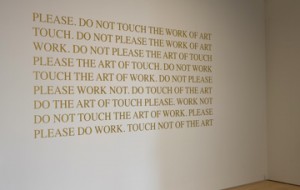
Raqs Media Collective. "Please do not touch the work of art," (2006). Courtesy the artists.

Raqs Media Collective. “Please do not touch the work of art,” (2006). Courtesy the artists.

I feel the impulse from time to time. A momentary desire to run a finger across the surface of a painting. It’s easily suppressed, however, and passes without another thought. Certain artworks reliably trigger the urge every time, while most do not. If you could touch one artwork, in any museum, which would it be? And what would you be seeking?

Children explore the world through touching, ceaselessly compiling a tactile catalogue of the visible world. In time, a child amasses a rich library of sensory pairings, the retinal impression reinforced with a comprehension of the physical. Gradually, after years of sensory stockpiling, the compulsion to handle everything subsides.

But in fact the need to touch things never truly goes away—it is easily reawakened in the presence of new and strange things. New designer products routinely seduce us with novel finishes, engineered to inflame our appetite for fresh tactile sensations. The impulse can also awaken at the promise of a known reward: we are moved to stroke velvet not to gain new knowledge, but because we know it will gratify.

Museums discourage all manner of touching. Although there are children’s museums, petting zoos and others that offer tactile experiences, those constitute a small minority. The prohibition against touching is so deeply entrenched in museum culture that it is seldom even stated: signs advise us when not to photograph, but only rarely tell us not to touch. Codes of behavior in museums are communicated to us subliminally, telepathically via architecture. But even while the rules aren’t articulated, most patrons readily abide by them.

And yet, museums are precisely the sorts of places where we might hope to encounter something strange and new, igniting our desire for sensory experiences. As touch-averse environments, museums restrict our experience mainly to the visual-cerebral. It’s fairly typical to see adults drift through museum galleries with their hands clasped behind their backs. I do this, too—possibly to suppress my own anarchic urges, or to communicate my subservience to the regime: I understand the rules; I pose no threat.

Continue reading »