Questionnaire for Ed Halter
Founded in 2008, Light Industry, which is run by Ed Halter and Thomas Beard, is already thought by many to be one of the premiere venues for cinema and new media art the world over. Bringing together artists, critics, curators, and academics from a range of fields, the frequently nomadic series has established a catholic sensibility that’s nonetheless recognizably its own: sometimes favoring the visceral, sometimes the heady, always looking for under-seen, lively, engaging work.
Light Industry recently teamed up with the online journal, Triple Canopy, and the educational institution, The Public School New York, to establish an arts-and-culture center at 155 Freeman Street in the Greenpoint neighborhood of Brooklyn. I posed some questions to Halter recently regarding the history of Light Industry and their plans for the arts-and-culture center.
Tom McCormack: What was the impetus behind Light Industry?
Ed Halter: We originally conceived of Light Industry as a kind of crossroads between the many fertile but disparate communities in New York devoted to cinema and the art of the moving image more broadly conceived. To this end, we created an ongoing series of weekly events that drew from these worlds: experimental film and video, the visual arts, the academy, documentary, new media, and the more adventurous channels of international feature filmmaking, to name only a few. Most weeks have been presented by a guest critic, curator, or artist and frequently conclude with a conversation. We also set out from the beginning to have our venue in Brooklyn, which at the time felt underserved by the kinds of programming we wanted to see.
TM: How has the series developed over the years?
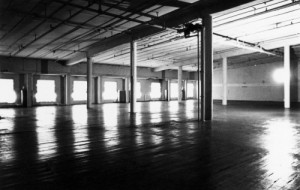
EH: In 2008 and 2009, we were located in Industry City in Brooklyn’s Sunset Park neighborhood, with a dedicated space carved out of an unused factory floor. In 2010, we moved to downtown Brooklyn to a larger space that we shared with two other groups, The Public School and Triple Canopy, and produced our events out of there for most of that year. Now, we’ve just signed a five-year lease on a new space in Greenpoint, which we will also be sharing with these same two groups.
From the beginning to now, our operations have remained relatively simple, with just a set of folding chairs and benches, film and video projectors on tables, and the image projected onto a white wall. Our roughly once-a-week schedule and minimal structure is something we don’t plan to change—we feel it best suits the work we show, and keeps things on an intimate, human scale.
Internet Connoisseurship
Since the 60s, cinephilia—obsessive movie love—has proved to be a particularly popular, durable, and visible form of connoisseurship. Susan Sontag wrote that camp aesthetics tried to address the question of “how to be a dandy in the age of mass culture”; it seems like cinephilia has often tried to address the question of how to be an intellectual in the age of mass culture while actually engaging in that culture. The critics at Cahiers du Cinema proposed one answer, which involved discerning personal visions in supposedly factory-made goods.
Since the early 00s, another kind of mass culture connoisseurship has reared its head, one typified by Internet surf clubs like Nasty Nets: what we might call webophilia. Webophilia addresses a new question: how to be a dandy, or maybe an intellectual, or something, in the age of the Internet. Surf clubs scan the WWW for provocative, or beautiful, or absurd, or spectacularly ugly things and post images or links to a central site. They recontextualize ephemeral phenomenon and make them objects for contemplation (of one sort or another). The more esoteric or bizarre the found image or text, the cooler it’s thought to be (just as cinephiles get points for having seen particularly hard-to-find movies on the big screen).
Both cinephilia and webophilia imply an intense dedication carried over time. The types of attention they imply, though, are very different. Cinpehilia implies concentration, a single-minded devotion to movies, sitting through one after another after another. Webophilia, on the other hand, implies a more polyamorous attention, because experiences of the web have no fixed duration and tend to pack more heterogeneity into smaller spaces.
Cory Arcangel and New Media One-Liners
New media artist Nick Briz has defined a “new media one-liner” this way:
The new media one-liner is a sub-genre of new media art. Enthusiasts and practitioners of the new media one-liner are drawn to the practice by its “reference-pleasure.” Reference-pleasure refers to the satisfaction one receives from experiencing a new media one-liner whose “one-line” is a reference to some aspect of either Internet/digital culture or media arts history/critical theory. These are usually puns or humorous “digitizations” of other artworks/practices. This can be a play on words, for example, switching, in a title of a work, the name of the Frankfurt school critical theorist/philosopher “Adorno” with the open-source hardware/software platform “Arduino.” New media one-liners are often these kinds of conceptual jokes which could exist simply as a title or thought but are often executed works of new media art. The new media one-liner can be fully appreciated at surface level in the instant of the encounter but is often the site for extraneous discussions/digressions for artists and critics alike.
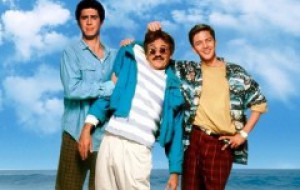
I thought of this when I saw that Cory Arcangel had programmed the 1989 comedy Weekend at Bernie’s in conjunction with his exhibition at The Whitney. From the program notes for the event:
Known as one of the classic comedies of the 1980s, Weekend at Bernie’s tells the story of two junior insurance agents who—after discovering fraud at their agency—find themselves in the midst of a mafia murder plot. When they arrive at their boss’s swanky summer home only to discover him dead, they decide to conceal his murder in order to protect themselves. The movie is a classic example of the “high concept” genre of cinema, in which the hook or plot of the movie can be summed up in a sentence, or even the title—a structure mirrored in the work of Cory Arcangel.
Arcangel has become kind of the king of the new media one-liner.
Street Photography and Google Street View
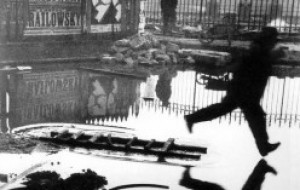
In her essay “Certainties and Possibilities,” Janet Malcolm offers a brief genealogy of what she sees as a particularly American form of street photography. Malcolm starts by talking about European photographers like Henri Cartier-Bresson, André Kertész, and Brassaï, saying that these artists “pluck their pictures from the flux of street life and fix with their small cameras the fleeting moment that no brush or pencil (or even eye, sometimes) is fast enough to seize.”
Cartier-Bresson provides Malcolm with the best illustration of this mode of photography. His thoughts on “the decisive moment” provide further elaboration, this being Cartier-Bresson’s term for what he sought out, the instant at which the photographer can take a perfect picture because the action perfectly summarizes, or somehow metaphorizes, itself. In a somewhat deflating way, Malcolm argues that Cartier-Bresson’s “decisive moment” occurs at the intersection of two events: “when (1) the gesture or expression or relationship or anecdote in question is at its highest peak of intensity, and (2) the picture’s composition achieves (or retains) the appearance of a formal work of art.”
Malcolm then argues that it was Swiss-born Robert Frank, with his book The Americans, who broke this mold of street photography, and for a very specific reason. “Frank’s important discovery… was that you can’t get (2) in this country [America], and you shouldn’t try. This country is too messy and ugly—there are too many cars, signs, billboards, plastic baby strollers, women in pink curlers, garbage bags, high-rise buildings.” A photograph taken in this context cannot obey classical rules of composition, and Frank’s genius, in Malcolm’s system, was to embrace this “disorder” and “vulgarity” and to seek out the highest peaks of intensity by impulse, with a blatant disregard for giving his pictures the appearance of a formal work of art. This lent his photographs an aura of blunt and brutal facticity that has often been imitated and exaggerated, not least by Frank himself in his later Polaroids.
It’s interesting to think of Malcolm’s arguments in the context of globalization. The elements of America that made it immune to the Cartier-Bresson feeling of stolen elegance—particularly cars, signs, and billboards—have metastasized (a process that was already well underway when Malcolm wrote the essay, in 1975). One wonders, too, if the growth of spectacle has impeded the process of searching out Malcolm’s (1). Finding the “highest peak of intensity” of a “gesture or expression or relationship or anecdote” might be difficult in areas where everything is perpetually raised to a high peak of intensity. What would a photographer in Times Square or Shibuya Crossing or Piccadilly Circus look for, exactly? How would she know what was important?
I would argue this is some of what’s at stake in Jon Rafman’s incredible project, “The Nine Eyes of Google Street View.”