Poetry, Prose, and Pamphlet

October 21st, 2011

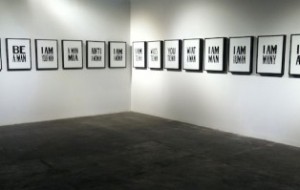
Hank Willis Thomas. "I Am A Man," 2009. From the series I Am, Amen. Photo: Tricia Van Eck.

Recently, I visited three shows– September 11, Untitled (12th Istanbul Biennale), and Creative Time’s Living As Form – all of which I highly recommend. The shows were a treasure trove in that they presented three distinct ways of curating art that reference the world around us, and offer ways to navigate that world. I’m categorizing these three different exhibition types as poetry, prose, and pamphlet.

Poetry

September 11 at MoMA’s PS1 is gorgeous, elegiac poetry. Marking the tenth anniversary of the US attacks, it shows, by way of almost 70 works, how our perception of the world–and correspondingly, how we look at artworks –has changed as a result of what happened on September 11, 2001. Walking through the exhibition, I couldn’t help but think how different the world would be if the United States’s response at the time would have had more of the tone, mood, and contemplation that is present in the show. Only one work was made after the attacks: Ellsworth Kelly’s Ground Zero, 2003, an abstract green field hovering above an image of Ground Zero that was printed in the New York Times. Yet Kelly’s abstraction is the frame through which curator Peter Eleey evokes a way of thinking about the present, past, and future as a result of 9/11.

Beautifully installed, the exhibition has a meditative resonance that is both open-ended and disarmingly sad. Much has been said about the central room that contains Roger Hiorns’s ash from the remains of an airplane engine splayed on the floor, in the middle of George Segal’s woman sitting on a park bench, and Harold Mendez’s empty bulletin boards. (Full disclosure: I own one of the bulletin boards by Mendez, a Chicago artist–bought with money I didn’t spend on a cell phone). Emblematic of the power of those associations that resonate throughout the show, it offers an individual witness to the trauma and a sense of resulting emptiness that hovers over the show. Upstairs, Eleey installed Janet Cardiff’s transcendent The Forty Part Motet, forty speakers arranged in a large circle at human height, which allows the viewer an intimate engagement with each of forty separate voices. Eleey placed the work in the same space it was immediately after the attacks, and has said about the work: “The particular combination of the individual voice and the collective song for me, and I think for many people, evoked the many personal effects of the tragedy and their sublimation into national tragedy.”

Janet Cardiff. "Forty-Part Motet," 2001. Installation view of work as it was presented at The Tate Liverpool; lent by Pamela and Richard Kramlich and the American Fund for the Tate Gallery, fractional and promised gift, 2000.

Continue reading »

Money/Market

October 20th, 2011

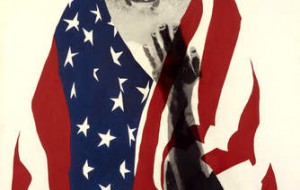
David Hammons. "America The Beautiful," 1968. On view in "Now Dig This! Art and Black Los Angeles, 1960 - 1980," at the Hammer Museum, Los Angeles.

Let’s face it. Occupy Wall Street, and just about everything else, is about money – who has it and who doesn’t – and how the market can help or hurt these two groups.

Money

I recently bought an iPhone. While this may seem trivial, I hadn’t had a cell phone for over 10 years. Although most people consider a cell phone a necessity, I didn’t–although artists without studio buzzers who had to watch for my arrival would probably disagree. In my last post, I mentioned the power of the purse, which is usually considered a way of holding back funding so that the money goes somewhere else. One could say I held back money from Verizon, and since the average cell phone bill is roughly $50 a month, it amounted to $6000 over ten years. In that same post, I proposed that we should buy what we value; so what could I have bought, if art and community are what I value?

Here are some innovative ways in Chicago that community-supported commerce can foster art and the spaces that present and support artists:

1. Threewalls’ community supported art share is patterned after community-supported agriculture (CSA) “shares” or subscriptions, which offer produce in a box (in threewalls’ case, art). Threewalls sells 31 shares for $310.

2. Artist Jennifer Mills’s Dealing With New Demands, part of The Happiness Project, presents original, affordable artworks as a sales event with proceeds going to the artists, curator, and Street-Level Youth Media. The sold work becomes a catalyst for conversation in the collectors’ homes about quality-of-life issues, and the red “sold” dots suggest a booming art economy created by artists.

Jennifer Mills. "Dealing with New Demands," 2011. The artist "performs" as an art dealer and will "sell" the ideas of happiness as well as the works of art themselves, which are about happiness and quality of-life-issues.

3. Hornswaggler Arts sells hand-crafted cocktails at art openings, and with the proceeds, they purchase a work from the show, which then enters their collection and loan program.

4. According to the local Alderman, in one night Kegs for Kids raised enough money last year to hire a public school art teacher and expand the school’s art programming.

These are small-scale, local initiatives where my $6000 would go far. (If you have additional community-supported commerce ideas that foster art, please share them with others so that they, too, can grow). On a larger scale, in Chicago’s 49th ward this year Alderman Joe Moore began the first US participatory budgeting project, originally developed in Porto Alegre, Brazil in 1989, in which citizens identify, discuss, and prioritize public spending projects. Six citizen committees (one of which promoted art) were organized in order to decide which projects should be put on the ballot. Fourteen projects were ultimately selected by 1,600 people to receive $1.3 million in funding for capital infrastructure. In the 48th Ward, which aims to be a new artistic center of Chicago, artist Kirsten Leenaars, in conjunction with The Happiness Project’s Under Construction, is working with local citizens to film how democracy can function, at the same time as 48th ward Alderman Harry Osterman launches a citizen master-planning process for his ward.

Continue reading »

What Is To Be Done?* Conversations, Commerce, and Collaborations

October 17th, 2011

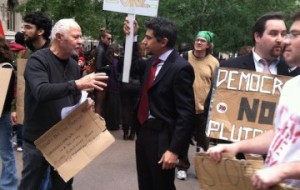
At Occupy Wall Street. Photo by Tricia Van Eck.

Canceled: Exhibiting Experimental Art in China, presented at The Smart Museum of Art in Chicago in 2000, was a metaphorical representation of It’s Me, a 1998 Chinese experimental art exhibition that was canceled by the Chinese government the day before its opening, not just because of its contents but also for fear of the public gathering and seeing it together. With hundreds of protesters being arrested across the US, it is important to ask, what is the danger in peacefully assembling and associating? Could it be that it leads to conversations, debate, and dialogue?

Following up on my last blog, where I asked the question “what is to be done?,” I now look to curator Naomi Beckwith’s Art 21 Blog post Lily Ledbetter*Art, and the ability of the 3R’s of the green revolution– reduce, reuse, and recycle–to affect change. To these I add the 3C’s–conversation, commerce, and collaboration.

Conversation

While Chicago’s Experimental Station on the South side and Mess Hall on the North side for years have fostered communal space encouraging conversation and critical thinking, increasingly more artists, galleries, and institutions are initiating conversations. Artist Jason Lazarus’s recent exhibition The Search invited a cross section of strangers to engage in an hour-long conversation within a ziggurat that they ascended and descended together. From Green Drinks to the upcoming Motiroti pot-luck by Columbia College Chicago, to reading groups organized by Alderman Exhibitions or Brian Holmes’s Slow-Motion Action/Research Collective at Mess Hall–which helps explain and analyze the current economic and political situation–artists are gathering together.

Jason Lazarus. "The Search," 2011. Courtesy the artist and Andrew Rafacz Gallery.

For me, the opportunity for public discussion within the public realm and open to all is one of the unique opportunities created by Occupy Wall Street. All types of people are engaging in debates touching on topics ranging from questioning short sales, to founding a third political party in the US, to asking if given the opportunity would the 99% become the 1%? Amidst this is the People’s Library–donated books for people to become educated on a number of issues–as well as a Food Station, a Media Station, a First Aid Station, a PR Station, a Silk Screening Station, and an Empathy Station. When I asked a woman named Susan who was working at the Empathy booth how she defined empathy, she said empathy starts with sharing a common ground–which reminds me of my favorite poster: 99% + 1% = 100%. If we are all in this together, what should we do together?

Continue reading »

Happiness as an Aesthetic Strategy

October 12th, 2011

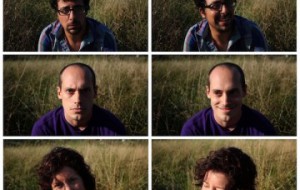
Gwyneth Anderson. Stills from "Laughing Video," 2011.

After 22 years of Richard M. Daley, the longest-serving mayor in Chicago’s history, our city has a new mayor, Rahm Emanuel. While artists often greet new politicians with a screed of demands, The Happiness Project, which opens in various spaces in Chicago in November, invites artists to illustrate what happiness might look like for themselves, others, and the city. What might a city that advances the collective goal of happiness look like? How might it function? What kind of conditions and policies would that city create?

After spending some time at Occupy Chicago this week and Occupy LA a few weeks ago, it is clear that many people across the United States are not happy. On October 11 in Chicago, during the Futures Industry Association’s and Mortgage Bankers Association’s annual meetings, a group of activists known as the Robin Hoods greeted the bankers as they entered Renzo Piano’s bridge to the Art Institute of Chicago. As the bankers walked high above the crowd to attend their party, the crowds of people below chanted, “We are the 99%.”

You need to a flashplayer enabled browser to view this YouTube video

From February to June the Museum of Contemporary Art, Chicago (MCA) presented artist Susan Philipsz’s sound works We Shall Be All and Internationale, reflecting Chicago’s rich labor history which includes the 1886 Haymarket Affair and the creation of the International Workers of the World (IWW). Also in Chicago in March, artist Paul Durica organized a reenactment of the 1915 Parade of the Unemployed, which at the time demanded hunger relief and public works projects. Both artists draw parallels to the similarities between then and now. So, what is to be done?

Recently addressing Occupy Wall Street, critical theorist Slavoj Zizek said, “We don’t want higher standards of living; we want better standards of living.” The current paradigm for measuring standard of living is the GNP (gross national product) index. However, because consumption of products doesn’t necessarily correspond to one’s standard of living–as evidenced when traffic jams increase gasoline consumption–the country of Bhutan has proposed the GNH (gross national happiness) index as the new “standard of living.” When the Dalai Lama visited Chicago in June, he urged people to pursue happiness. The next day, the United Nations’ General Assembly encouraged its Member States to give importance to happiness and well-being in measuring and achieving social and economic development.

Continue reading »

Encounters with Generosity, Cooperation, and Community

October 10th, 2011

6018NORTH.

The unpredictable and often ephemeral encounters that occur when art, community, audience, and ideas intersect are what excite me most about working with artists. For my last project at the Museum of Contemporary Art, Chicago (MCA)– I left in June 2011 to start 6018NORTH, which I will explain below–we invited artist Mark Bradford to do a community residency. It began immediately at our staff meeting since, instead of me introducing Mark to the staff, he turned it around. He wanted to know what it was the staff did, saying that because they work at the MCA, they each have cultural capital. He then asked, how could they share that capital with others in their field, and in their community? This type of generosity–which Mark brought to the communities in the Lower Ninth Ward in New Orleans, where he sited his ark for Prospect. 1– is important to foster, and it is especially important during a time of economic instability and uncertainty: we need to share our cultural capital.

With Interactions: A Four-Month Companion Series of Artist and Audience Activations, an MCA show which involved 17 artists or artist groups (one each week from Jan – May 2011), I asked how each could encourage audiences to perform, engage, or open up to an artistic experience. The last work, Mnemonic,
 by artist Katrina Chamberlin, invited the public to receive an actual tattoo of a small black dot. An elderly woman asked for a tattoo. Sitting in the chair, she gathered a crowd because it meant something different for her to get a tattoo as opposed to someone young. During the process, she said to Katrina: “It’s so important that you have done this. You’ve brought so much love and connection to people.” Partnerships and participation are key: people want to be participate in something larger than themselves.

Katrina Chamberlin giving a participant a tattoo as part of her work "Mnemonic," at the MCA Chicago.

A woman displaying the tattoo she received as part of Katrina Chamberlin's "Mnemonic" at the MCA Chicago.

Participation also builds empathy. “Change the environment and you change the people.” I copied this from somewhere, so I can’t take credit for it, but in curating or creating art, architecture, or design, we are changing the environment. We provide the opportunity for people to see the world around them with new eyes. On September 27, 2011 in Chicago at the Jane Addams Hull House Museum’s weekly RE-THINKING SOUP series, farmer/activist John Kinsman from The Family Farm Defenders asked, “How can we change competition into cooperation?”

Continue reading »