Conversations with Stuart Horodner & Lila Kanner

June 8th, 2009

Wrapping up my focus on Atlanta during my stint as guest blogger, I questioned Stuart Horodner, Artistic Director at the Atlanta Contemporary Art Center, and Lila Kanner, Executive Director of Artadia (and Art21 guest blog alum), about supporting Atlanta-based artists and the contemporary art scene here. Their responses are woven together in the following interview.

Stuart Horodner

Stuart Horodner, Artistic Director, Atlanta Contemporary Art Center

Horodner has held director and curator positions at art centers and universities including the Atlanta College of Art Gallery, Portland Institute for Contemporary Art in Oregon, and Bucknell University Art Gallery in Lewisburg, Pennsylvania.  He was the Founder and Co-Organizer of Affair at the Jupiter Hotel, an intimate art fair in Portland, OR between 2004-2007, and he was Co-Owner/Director of the Horodner Romley Gallery in New York City from 1992-97.

Lila Kanner, Executive Director, Artadia

Lila Kanner, Executive Director, Artadia

Lila Kanner recently wrote about the first Artadia Atlanta Awards (Fahamu Pecou, interviewed in my last post, was a recipient). Prior to serving at Artadia, Kanner was the Associate Director of the Fabric Workshop and Museum, Philadelphia. From 1999 to 2002, she served as Director of Artist Services and Educational Programs at The Copley Society of Boston.

Victoria Lichtendorf
: Stuart, you’ve spent time getting to know different art communities, most recently Portland, Oregon, prior to your work here in Atlanta. How would you describe the art community here compared with other cities? Have you found opportunities or challenges distinct to the area?

Stuart Horodner: Atlanta has a diverse arts ecology that operates in ways quite similar to several other cities, Portland among them. Often in these cities, there are a handful of good commercial galleries, university galleries, not-for-profit centers, community centers, artists collectives, festivals and such.

People in these cities struggle with several issues: limited criticism (one newspaper, one weekly paper) that cannot cover the various exhibitions and events sufficiently, and national art magazine coverage that rarely does more than the occasional review; the lack of significant numbers of dynamic and curious art collectors who seek out the dealers and venues for knowledge and access; limited patronage and city/state funding support; and the desire for larger and more diverse audiences.

These conditions are often frustrating to those professionals and practitioners on the ground, but the solution is found in vigilant cultivation, trying new things, contributing what you can, and producing excellence at all levels. In Atlanta, there are some of the same struggles—but that said, there are good and serious artists here who are showing locally and nationally, and there are a range of excellent and risk-taking commercial galleries. There is Atlanta Celebrates Photography (co-organized by Michael David Murphy) and Art Papers, helping to cultivate audiences. Universities and schools including Georgia State, Emory, Spellman, Agnes Scott, SCAD, and others offer solid programs in training young artists and historians. Exhibition venues including Eyedrum, MOCAGA, Spruill Art Center, Hammonds House, the Atlanta Contemporary Art Center, and The High Museum of Art all make significant contributions while pursuing their specific missions.

People tell me that this is the South and it takes time, and that there is general conservatism around contemporary art. My sense is that we simply need to continue to be bold and ambitious and find ways to make art play a major role in the civic, social, political, and economic power of this city.

VL: Lila, can you share some reasons why Atlanta was chosen as the latest city to benefit from Artadia’s presence? What is your impression of the local arts community? How does it compare with other Artadia sites?

Lila Kanner: Artadia’s Atlanta program was in the works for several years building up to the program launch in late 2008. Artadia chose Atlanta as a program city because of its vibrant arts community and diverse and very talented population of visual artists. As one of the fastest growing cities in the US, Atlanta has terrific support systems for artists and we also saw that we could play a role in providing an open application process, critical validation through our panel review, and unrestricted awards funds through a program that would be unique to the Atlanta landscape. We never want to duplicate existing programs and [therefore we] form partnerships in order to effectively and positively impact our partner communities. Artadia’s board and national donors support all the operating funds for the program, and all awards and program funds are raised locally. After conversations with many key stakeholders in the community from both foundations—among [them] collectors, local arts councils, museums, and artists—we found that there was a unique role our organization and program could play.

Continue reading »

Interview: Fahamu Pecou

June 8th, 2009

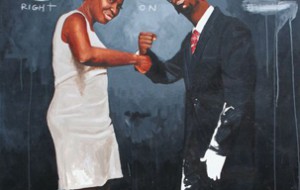
Next up, as part of my spotlight on Atlanta-based artists, is Fahamu Pecou, of “Fahamu Pecou is the Shit” fame. Known for his large-scale painted riffs on art magazines, Pecou also incorporates performance and maintains an active online presence. Playing with strategies of pop culture branding and promotion, Pecou delves into stereotypes of black masculinity and notions of fine art. Along these lines, his latest forays extend to the representation of the Obamas in the media. Here we learn about his most recent work, upcoming performances, his views on Atlanta, and what it really means to be “the shit.”

Fahamu Pecou, “The Code”, Acrylic and oil stick on canvas, 66 x 49.5 inches, 2009.

Fahamu Pecou, “The Code,” 2009. Acrylic and oil stick on canvas, 66 x 49 1/2 inches.

Victoria Lichtendorf: It seems like you’ve been pretty busy these past few years with solo shows in Chicago, Atlanta, San Francisco, and Dallas, as well as group shows in New York, Miami, and recently, Cape Town, South Africa. You went to school here in Atlanta, but what makes you stay?

Fahamu Pecou: Atlanta has always felt like home to me. After college, I moved back to NY. Though I had a great time and was inspired art-wise, I missed Atlanta. I missed the community and trees…LOL. Atlanta is a great place to be. The city is growing and I feel like a part of the foundation, a claim I don’t think I could make in New York or L.A. For me, it’s great that I get to travel and be inspired in all these other places and then bring that energy back to Atlanta.

Fahamu Pecou. UnAmerican Idol. Courtesy Fahamu Pecou.

Fahamu Pecou, "UnAmerican Idol," 2009. Acrylic and gold leaf on canvas, 63 1/2 x 49 inches. Courtesy Fahamu Pecou.

VL: Diamond Lounge Creative seems like a pretty demanding day job. Are you becoming any less involved? Do you identify with them or any other artists who’ve followed a similar path from advertising, such as Andy Warhol and Barbara Kruger?

FP: I am still very much involved in Diamond Lounge, now called RED|Creative. I am the principle designer and creative director. So my days are almost endless. But it is a great environment to work in. My team is extraordinary and we all have our own creative lives outside of RED. In many ways, RED is a think tank, a place where creative minds collaborate. We don’t consider ourselves graphic designers or copywriters. We are artists first and foremost; advertising and marketing design is just another medium for us, like painting or drawing.

I do identify highly with Warhol. He was a master of bridging the commercial world and the fine art world. I can identify with that. I like to think that anyone and everyone should have access to art. It should be a part of our daily lives. It should be fun and thoughtful. It should be accessible.

Continue reading »

Road to Freedom: Interview with Julian Cox

June 3rd, 2009
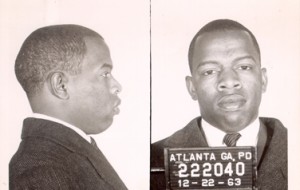
John Lewis. Courtesy High Museum.

John Lewis. Courtesy High Museum of Art.

Like many museums, traveling shows tend to dominate the exhibition schedule at the High Museum of Art. In contrast, Road to Freedom: Photographs from the Civil Rights Movement, 1956-1968, organized by Julian Cox, Curator of Photography, was generated by the museum and drew on wide-ranging regional resources and exchange with the local community. The exhibition ran from June 7 to October 5, 2008, marking four decades since the assassination of Atlanta native Dr. Martin Luther King Jr.

Civil rights veteran and longtime U.S. Congressman for the 5th District in Atlanta, John Lewis contributed an afterward to the exhibition catalogue and was involved in education and outreach events at the museum. While working for the Student Nonviolent Coordination Committee (SNCC, or “snick”) in the 1960s, Lewis shared an Atlanta apartment with photographer Danny Lyon, who at the time was a staff photographer for the SNCC.  Along with well-known photographers such as Lyon, Road to Freedom exhibited many photographers and photographs lost to history, including photojournalists working for the black press, and in some cases, evidence photos filed away decades ago.

Prior to his appointment at the High in 2005, Cox was an associate curator at the J. Paul Getty Museum in Los Angeles and also worked at the National Museum of Photography, Film, & Television in Bradford, England, and the National Library of Wales, Aberystwyth. Michael David Murphy, subject of my last interview and co-organizer of Atlanta Celebrates Photography, notes, “Julian Cox’s impact on Atlanta’s cultural scene, and on the photography community specifically, cannot be underestimated. I’ve never seen a curator who’s more engaged with the public. Road to Freedom wasn’t just a remarkable feat of curation and scholarship, it was a generous gift to the city.”

Road to Freedom Installation Detail. Courtesy High Museum.

"Road to Freedom" installation detail. Courtesy High Museum of Art.

Victoria Lichtendorf: It seems astonishing that Road to Freedom is the first major exhibition of Civil Rights photography in close to thirty years. How do you account for this lapse?

Julian Cox: I think it comes down to the fact that photojournalism and documentary photography do not have much of a home in fine art museums. If you look around the country, there are only a few institutions committed to showing this kind of work. The High wanted to appropriately mark the fortieth anniversary of Dr. King’s assassination; he’s an international figure, of course, but he’s also a great Atlantan, so again, we were trying to reach different audiences in putting together a show of this kind.

Danny Lyon (born 1942), Stokely Carmichael, Confrontation with National Guard, Cambridge, Maryland, 1964. Gelatin silver print. Purchase with funds from Joan N. Whitcomb. Courtesy High Museum of Art.

Danny Lyon (American, born 1942), "Stokely Carmichael, Confrontation with National Guard, Cambridge, Maryland," 1964. Gelatin silver print. Purchase with funds from Joan N. Whitcomb. Courtesy High Museum of Art.

VL: In a talk you gave for the 2007 ARLIS conference in Atlanta, you mentioned that as a relative newcomer to the States, you initially knew little about the Civil Rights Movement. In what ways did your “outsider” status act as an asset?

JC: In an odd way, I think it helped. People wanted to know what I was up to! I always made it clear that I was on a steep learning curve in terms of learning about the history and developing a nuanced view of the cultural implications etc…. I also made a point of stressing the focus of my inquiry as being about the photography and media culture of the period. I am a photography curator and historian after all.

VL: The exhibition stemmed not only from a desire to commemorate the fortieth anniversary of MLK’s assassination but also to expand the High’s photography collection. Thus in a very concrete sense, RTF seems to have had a lasting impact on the Museum. After the show has completed its tour, will there be any special efforts made to make the photographs accessible to the community on an ongoing basis?

JC: We are looking into the possibility of sharing parts of the archive/collection with colleague institutions in Georgia (Savannah, Columbus, Albany), and we also hope to have a presence at the Center for Civil and Human Rights Partnership, which will open in downtown Atlanta in 2011. We are also in dialogue with the Woodruff library at Emory University, which has some very significant manuscript collections that dovetail with the one we’ve assembled here.

Continue reading »

Celebrating Atlanta Photography: Michael David Murphy

June 2nd, 2009

Michael David Murphy, 100%. A single frame of film from 01/18/2009 in Washington, DC. Audio from Bloom. © MDM.

As part of my quest to learn more about the Atlanta art scene, I’ve been speaking with artists in the area—both seasoned inhabitants and newcomers alike. Since his arrival here two years ago from San Francisco, photographer Michael David Murphy has been busy pursuing his work while acting as the Program Manager for the annual six-week-long festival, Atlanta Celebrates Photography. Along with experimenting with digital and analog methodologies, Murphy has turned to text in his series, Unphotographable. With interests in social activism, photojournalism, and street photography, Murphy was especially affected by Road to Freedom, curated by Julian Cox, who we’ll be hearing from next.

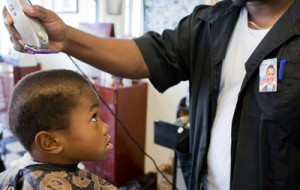
Micahel David Murphy, Barbers for Change, 2008. Courtesy MDM.

Micheal David Murphy, "Barbers for Change," 2008. Courtesy MDM.

Victoria Lichtendorf: Can you tell me a little bit about yourself, how you ended up here in Atlanta, and your involvement with Atlanta Celebrates Photography (ACP)?

Michael David Murphy: I came to photography through poetry. I have an MFA in English, and while pursuing that, picked up a digital camera and fell (back) into photography.

I didn’t know any photographers, so I learned as much I could from libraries, wrote about my process of learning, and spent my time pursuing pictures, mainly on the streets of San Francisco. I ditched digital and moved to film cameras, which offer a special kind of something that’s hard to define, but feels essential.

I’ve been trying to extend ACP’s reach both locally and internationally with our web presence and festival programming…It’s our 11th year, and we’re excited to be bringing Gregory Crewdson and Harry Shearer to our Lecture Series this fall, in addition to all the other events; portfolio reviews, public art, exhibitions, a film series, and more. ACP’s goal is for Atlanta to become a city that’s known for its photography, and it’s an honest challenge to meet and address every day.

As someone new to the South, it was remarkable to move here and discover ACP and the festival. I felt as culturally plugged-in as I could be, while still a stranger in a pretty strange land. One of my goals at ACP is to provide as much support as we can to the diversity of photographers who are here in the metro area, but also provide something significant to people who’ve just moved here and are looking to hit the ground running.

Michael David Murphy R.I.P. U.S.A., 2009. Courtesy MDM

Michael David Murphy, "R.I.P. U.S.A.," 2009. Courtesy MDM.

VL: As an active observer and an activist, how would you describe Atlanta to someone who has never visited? What makes you stay?

MDM: Atlanta’s surface is high gloss, but it’s deceiving. Beneath the new sheen, there’s a reality for artists that includes the possibility of affordable studio space, or the chance to convince a building that you want to install light boxes of ice photographs on their loading dock (my friend Denise Lira did this!)

It’s a blank slate in many ways, a kind of wild west. Burglars on bicycles rob banks here.

Atlanta’s the kind of place where there’s more cooperation than competition and the majority of “culture workers” here are doing their darnedest to make a meaningful impact in the city, for the city and beyond. And there’s room for everyone.

I had two shows last fall at Opal Gallery, a small but active new space in a pedestrian part of town (the only pedestrian part of town). It’s a space where the audience is everyone: dog walkers, students, moms with their kids, guys dropping their shirts off at the cleaners. If you make work that’s politically charged, and eager to find the right audience, it’s a gift to be able to engage people “off the street” with what you’ve made, in addition to the art crowd. I loved going to Opal and being there to chat with people who had questions about the work. Every morning there were smudge-prints of faces on the gallery’s glass from people trying to look into the space, straining to see art.

Continue reading »

Holla from Hotlanta

May 27th, 2009

Beyond Tutlanta…

tutlanta4

I’m writing from Atlanta. A newcomer, I have just learned gardenias are a sign of summer. Apparently, so are Monet’s Water Lilies, which will be temporarily transplanted from MoMA to the High Museum during what promises to be hot days ahead.

Sadly, I still know more about Atlanta’s seasonal horticulture than I do about the local art scene. So having outed my ignorance and in search of an anecdote, I invite you to join me over the course of the next two weeks in finding out what lies beyond the borders of Tutlanta.

The very notion of locality is a complicated one, and my experiences this past Saturday reveal just how fraught the label “regionalism” has become. I spent the day wandering through the Westside Art District, whose central gem is the Atlanta Contemporary Art Center, known as “the Contemporary.” While there, I was treated to a talk by Atlanta-based artist Mark Wentzel, who spoke about his commissioned installation, Morale Hazard. An intersection of moments and places of both personal and national significance, Wentzel’s triadic piece provides an apt springboard for thinking about geographic identity.

Mark Wentzel. Moral Hazard (detail). 2009

Mark Wentzel, "Morale Hazard" (detail), 2009. Courtesy the Atlanta Contemporary Art Center

The most dramatic element of the work, a 1965 powder blue Ford Mustang, hangs suspended from the ceiling, recalling Wentzel’s childhood in the Detroit area while also speaking to the function of the Contemporary’s site as a former Atlanta truck repair facility and to the current state of the U.S. auto industry (an insurance term, Morale Hazard refers to an increased indifference to risk by the insured—enabled, ironically, by insurance). As if flung forth from the upended vehicle, the Mustang’s engine crawls across the gallery space, morphing into a four-legged form, recalling the Aztec Xoloitzcuintle or an Esquincle, the Mexican hairless dog beloved by DIA star artist Diego Rivera.

Mark Wentzel. Morale Hazard (detail), 2009

Mark Wentzel, "Morale Hazard" (detail), 2009. Courtesy the Atlanta Contemporary Art Center

The third element of Morale Hazard is an Eadweard Muybridge-inspired velvety charcoal drawing gracing two walls. The eroding figure of horse and rider glides along a graph, while a pink line marks a mountainous profile of upward production. Muybridge’s famous photographs of a horse in motion (proving once and for all horses do simultaneously lift all four legs off the ground) resulted from  “an exceptionally felicitous alliance” between the photographer and former California governor, railroad baron, horse racer, and founder of a small college bearing his name, Leland Stanford. Wentzel is especially intrigued by the fact that it was Stanford who in 1869 drove the “Golden Spike” into the dusty soil at Promontory Summit, Utah, creating the first transcontinental railroad—a moment which helped render the flesh and blood Mustang moot.

Hearing Wentzel speak, I couldn’t help but think how the merger of east and west rails also signaled the end of American frontierism, famously lauded by Frederick Jackson Turner as central to American identity. Upon its “closure,” the Frontier became an imagined place for nostalgic longing, a sentiment that fanned imperialist desires. A kindred strain of nostalgia prevents the ’65 Mustang from crashing to the floor. But to whom does such nostalgia belong and what dangers might it hazard? Meccas of car culture, Detroit and Atlanta are woefully deprived of infrastructure and mass transit (although the latter’s MARTA system is not without merits); two cities where wars over civil liberties and American identity have been bitterly waged. I couldn’t help noticing 1968 is cited by Wikipedia as the first instance when the term “Morale Hazard” was used by Casualty Insurance. What hangs in the balance?

Continue reading »