The Conflation of Ethics and Morality

March 18th, 2010

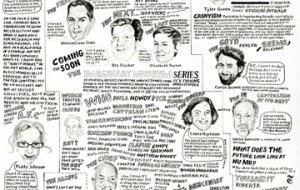
William Powhida, "How The New Museum Committed Suicide with Banality," 2009. Courtesy Schroeder Romero+Shredder and the Artist.

I’ve drawn myself into a debate over ethics and morality with my work, How the New Museum Committed Suicide with Banality (view the high-res version here). I threw a brick through the window of the museum and people want answers. My first problem with this is the assumption that I have them. I don’t. I also don’t envy the New Museum’s position. It is dependent on a few wealthy individuals instead of broad public funding to run its institution. We share the same paradoxical over-dependence on a limited number of wealthy individuals to maintain our independence from political and ideological interference. Assuming public funding, even from the NEA, can bring unwanted political scrutiny of the moral content of the art. This is a paradox the art world faces in its efforts to make art accessible, while remaining free from the kind of traumatic, political interference caused by the politician Jesse Helms, who famously tried to cut funding from photographer Robert Mapplethorpe in the 1980s.

My second problem with the demand for answers is the conflation of ethics and morality. Art critic Jerry Saltz and blogger Tyler Green have engaged in a protracted public feud over the terms. Tyler is an advocate for stronger ethics in the art world, while Jerry seems intent on defending the relative tolerance and heterogeneity of the commercial side no matter how dysfunctional it may appear, even lovingly referring to the art world as “Babylon.” I agree with both of them. I can because they aren’t talking about the same things. Advocating ethical practices and tolerance are two different positions. This difference is key to understanding that freedom of expression is different from maintaining an ethical buffer between the market and the museum.  When Jerry accuses Tyler of engaging in a witch hunt, I believe Jerry does so to protect artists and their freedom of expression. However, perhaps this is at the expense of the New Museum’s questionable ethics.

Similarly, when Jerry and the critic John Yau got into a public spat over their definitions of “America,” I believe that neither of them would side with our previous administration, which used moral authority to justify both immoral and unethical behavior. Ben Davis argues, in his “9.5 Theses on Art and Class,” that the art world is not separate from society or its class structure. But I believe that the general character of the art world is far left of center. Artists are an educated class of cultural producers who routinely challenge “moral authority” and share a tolerance for minority perspectives. That this vision is supported by a wealthy elite is also paradoxical, but there aren’t many alternatives at this point in our late-capitalist democracy.

Continue reading »