Julie Mehretu interviewed by Lawrence Chua
Welcome back to BOMB in the Building, where each week we’re featuring a BOMB contributor relating to an Art:21 Season 5 artist. This is our final week before the official premiere of Season 5. We’ve had a great time digging around in the BOMB Archive these past few months, and hope you’ve enjoyed it as much as we have.
Artist Lawrence Chua interviewed Julie Mehretu for BOMB Issue 91, Spring 1995. “At the heart of Julie Mehretu’s paintings is a question about the ways in which we construct and live in the world,” he wrote five years ago. “I think of Mehretu’s paintings as going a long way toward articulating the disjunction of life as it’s lived today: as we circulate across reality and its mediations, constantly trying to reconcile daily experience with the peculiar light emanating from the end of the world as we know it.”
We can’t think of a better statement with which to end this portion of our “BOMB in the Building” series. Enjoy!

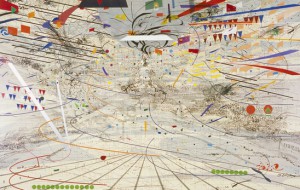
Julie Mehretu, "Congress," 2003. Ink and acrylic on canvas, 71 × 102”.
Lawrence Chua: To what extent are the paintings a critique? We’ve been talking a lot about current political events. . . .
Julie Mehretu: I don’t look at the paintings necessarily as critique. In fact, I’m not so interested in being critical. What I’m interested in, in painting at least, is our current situation, whether it be political, historical or social, and how it informs me and my context and my past. I am trying to locate myself and my perspective within and between all of it. I know I keep on going back to that, but it’s like, here’s a war and here’s the way that we’re treating the war, and how we’re experiencing the war. I was looking at some great Martha Rosler pieces recently, the Bringing the War Home photocollages which she began in the ‘70s. They are her images of advertisements invading the interiors of new homes, new homes designed for living in new worlds, but through the windows you can see soldiers fighting the Vietnam War. There are these interesting juxtapositions of what’s happening and what we experience. Of course there’s much more inherent critique in those pieces.
LC: That sounds metaphoric in a way that your paintings are not, which is what gives your work its power. We live in a moment that is obsessed with the Real. There’s this disjunction between physical daily life and the kind of extremely mediated reality we glimpse on reality TV or Fox News. Maybe it’s that disjunction that is being lived out in your paintings.
JM: When you’re writing, is it important to you to make that bridge between a situation that is happening right now and the eternal process of working and creativity?
LC: I begin with a structure and I try to have as clear an idea as possible about the structure and the way characters are going to move through that structure and the events that are going to propel them. The structure becomes set in a context, whether it’s the nineteenth century of Vanity Fair or the twentieth-century Gulf War. That context will influence language, rituals, actions, but I try to maintain the structure I set out to build. Colm Tóibín taught these writing workshops where he had the students begin by reading three Greek tragedies. His basic premise was that you could trace all Western narratives to these three tragedies, Electra, Antigone, and Medea. The truth of those relationships, those responses, are a part of our consciousness. So maybe a good writer is writing the same stories over and again. The context may make it a bit more relevant to the moment, but it’s not as if a mother killing her child isn’t incredibly relevant to current political events.
JM: The structure, the architecture, the information and the visual signage that goes into my work changes in the context of what’s going on in the world and impacting me. Then there’s this other subconscious kind of drawing, this other activity that takes place, that is interacting with everything that is changing, and it’s the relationship between the two that really pushes me. And why abstraction? There are so many other ways to make paintings about these conditions that I’m drawn to. But there’s something that’s hard to speak about that abstraction gives me access to.
Harrell Fletcher interviewed by Allan McCollum
Welcome back to BOMB in the Building, where each week we’re featuring a BOMB contributor relating to a Season 5 artist. This week, we’re switching it up again and featuring an interview by an Art21 artist instead. In BOMB Issue 95, Spring 2006, Allan McCollum spoke with Harrell Fletcher about his project at Domaine de Kerguéhennec Centre d’Art, Bignan, in France. The conversations fits neatly into the Systems theme for this week, as well as being one of our favorite recent interviews to appear in BOMB. We hope you like it as much as we do!

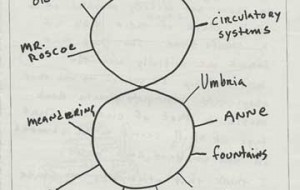
Harrell Fletcher, "The Report," 2003. Xeroxed publication. All images courtesy the artist, Christine Burgin Gallery, New York, and Jack Hanley Gallery, San Francisco.
Allan McCollum: I enjoy that the meaning of your work doesn’t reside in any one piece. In fact, looking at any one piece you might pass over it; they’re often so simple and easy to describe. But looking at project after project (the number seems to go into the hundreds), and then your Learning to Love You More website with a couple of thousand more projects, a certain set of values comes through. You’re not trying to produce singular masterpieces, and almost all your work is about people other than yourself. A lot of the things that we expect an artist to do, you do backward. It constantly takes me by surprise.
Harrell Fletcher: It’s about having a set of natural proclivities. I see the structure of how an artist is supposed to operate, but some of those things don’t feel comfortable to me. In graduate school, I started realizing that I did not have to follow the normal course.
AM: How did you perceive the “normal course” while you were in school?
HF: It’s so concentrated in graduate school; you see all of these people going into their studios, spending hours and hours making objects or paintings. And it’s supposed to be about isolating themselves. Maybe they have a wall of inspirational clippings from magazines, but that’s the extent of their interaction with the world. Continue reading »
Krzysztof Wodiczko interviewed by Giuliana Bruno
Welcome back to BOMB in the Building, where each week we’re featuring a BOMB contributor relating to a Season 5 artist. This week, inspired by Kimsooja’s videos and installations, we’re revisiting the work of Polish artist Krzysztof Wodiczko. Instead of an interview this time, we’re giving you a short video clip of a BOMBLive! conversation that took place before an audience of 75 people at SculptureCenter in Long Island City, NY, on October 27, 2007. In addition to being a great event, it was significant as it marked the launched of BOMB’s “In the Open: Art in Public Spaces” series and also the occasion of our first-ever collaboration with Art21, who screened their Season 3 segment on Wodiczko as a prelude to the conversation.
In this short excerpt from the longer video, author and theorist Giuliana Bruno and the artist discuss his video installations at Hiroshima and elsewhere. You can watch the full 15-minute BOMBLive! video here.
Barbara Kruger interviewed by Richard Prince

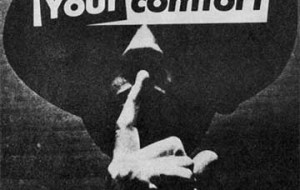
Barbara Kruger, 1981, photo montage.
Welcome back to BOMB in the Building, where each week we’re featuring a vintage BOMB interview relating to a Season 5 artist. This week, we stepped back into our archive looking for a piece by John Baldessari only to find this portfolio of his work from 1986. But since we promised you an interview, we stepped back further in time to find this conversation that correlated to Baldessari’s work instead. In this interview from BOMB Issue 3, Summer 1983 (26 years ago!), Richard Prince and Art21 artist Barbara Kruger ask each other the same question that result with some varied responses. Read the full interview here.
Richard Prince: What about all these recorded conversations we hear about these days?
Barbara Kruger: Presidents, interview, things like that?
RP: Yes.
BK: Well, in most cases recording seems to offer both the curiosity of replication and the resoluteness of evidence.
RP: Does this have anything to do with the pictures we’re looking at?
BK: Yes. I think in some ways their definitions are interchangeable.
RP: Fiction feels good and recanting causes stress. Like lying, in the physiological sense, the telling of a true story is an unnatural act. Do you think fiction has anything to do with replication?
BK: Pictures and words seem to become the rallying points for certain assumptions. There are assumptions of truth and falsity and I guess the narratives of falsity are called fictions. I replicate certain words and watch them stray from or coincide with the notions of fact and fiction.
Yinka Shonibare interviewed by Anthony Downey
Welcome back to BOMB in the Building, where each week we’re featuring a vintage BOMB interview relating to a Season 5 artist. Next up, Yinka Shonibare, whose exhibit at the Brooklyn Museum is on view through Sept 20, was featured in BOMB on the heels of being nominated for the Turner Prize in 2004. Critic and curator Anthony Downey interviewed the London-born Nigerian artist BOMB Isuse 95, Fall 2005. “It is easy to overlook, in all the theorizing about postcoloniality and the politics of identity, about the amount of amusement and frivolity he can pack into his work,” Downey wrote at the time. In the excerpt below, the two discuss the artist’s film, Un Ballo in Maschera [A Masked Ball], which centers around the controversial figure of King Gustav III of Sweden, who was assassinated in 1792. Read the full interview here.

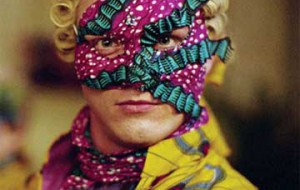
Un Ballo in Maschera (A Masked Ball), 2004, color digital video, 32-minute loop. Images courtesy of the artist, James Cohan Gallery, New York, and Stephen Friedman Gallery, London.
Anthony Downey: The act of not taking sides would seem to be part of an ethical, rather than political, approach if we’re looking at Un Ballo in Maschera as a historical metaphor for political redemption. Is the film a direct comment on the present day in this sense?
Yinka Shonibare: I give the audience two options. You see the king go into the ball, indulge himself in the excess and get murdered. But I give him the option to get up again. It’s up to the audience to decide which version prevails. Do they want him to stay murdered, or do they want him to be saved? The audience is seeing both possibilities. In real life, of course, there is no rewind, or replay; an event happens and that’s it.
AD: So you’re asking the audience to be complicit, if not in the assassination, then in the redemption.
YS: It depends on the person. Viewers have to make up their mind whether this person had the right to assassinate that leader or not. You need a leader, but what sort of leader? The film gives you the opportunity to engage with the various tensions. In the dance and the theatricality as well as the breathtaking visuals, you’re part of that excess and you indulge in it, but then it’s not that simple because there’s a dark side to this beauty. It’s not just a lavish banquet; there’s always this “terrible beauty.”
Cindy Sherman interviewed by Betsy Sussler
Welcome back to BOMB in the Building, where each week we’re featuring a vintage BOMB interview relating to a Season 5 artist. Inspired by Cindy Sherman’s “Transformations,” this week we head back 24 years for a seminal interview with the photographer, conducted by BOMB’s own editor in chief, Betsy Sussler. “Sherman’s earliest photographic work displayed her posed tauntingly in sets. Mimicry, mostly of ‘50s and ‘60s film, they anticipated a voyeuristic response,” Sussler wrote in BOMB Issue 12, Spring 1985. “It was not only Sherman emoting but Sherman becoming different personalities.” Read the full interview here.

Betsy Sussler: When did you decide to be an actress in your photographs? Do you consider it acting?
Cindy Sherman: I never thought I was acting. When I became involved with close-ups I needed more information in the expression. I couldn’t depend on background or atmosphere. I wanted the story to come from the face. Somehow the acting just happened.
What’s Cookin at the Art21 Blog: A Weekly Index
It’s mealtime! Join Sonya for a fine helping of nutrients and adventure with this week’s Index:
Round ‘em up Nicole! Here’s what Art21 artists have been up to this past week.
The Pop-Up Book Academy: An Interview with Sam Gould of Red 76 by Daniel Fuller … a requiem for Maurizio Cattelan? Read more details about the latest show at Harlem’s Triple Candie. Also… a day at Art Disneyland! Jump in the car with Daniel and head to Mildred’s Lane.
Thank you to Daniel for so many of your fabulous posts! Hrag Vartanian introduces new Art21 Guest Blogger, (drum roll, please) …Quinn Latimer.
In the latest Letter From London, Ben Street writes to us with some thoughts pertaining to acts of vandalism on works of art.
Conserve contemporary art! Check out the Art21 Blog’s new column: No preservatives: Conversations about Conservation and read Richard McCoy’s interview with Hugh Shockey from the Lunder Conservation Center.
Mark your calendars … Performa is scheduled to open in NYC this November. In this week’s Flash Points: Nicole Caruth interviews participating artist Saya Woolfalk.
In this week’s addition to the column Teaching with Contemporary Art, Joe Fusaro highly recommends that we visit exhibition, Circles of Influence at the Clark Institute before it closes September 7th!
MoMA Trumpets Amsterdams’ Role as Hub of Conceptual Art by Hrag Vartanian.
Wesley Miller provides an introduction to Season 5 artist Paul McCarthy.
But what if those enemies, just outside the door, came armed with Bach and Mozart and Caravaggio and Goethe? What is the relationship between artistic greatness and democratic inclusiveness? Quinn Latimer asks that and other provocative questions in her response to a recent New York Times article by Michael Kimmelman.
Paul McCarthy is described as a pulsing ID. Read this interview with McCarthy by Benjamin Weisman in this weeks BOMB in the Building.
Check out the newest Art21 column dedicated to all things food! (I’m lovin it!) Gastro-Vision: Aesthetics in Urban Farming, Part I by Nicole Caruth.
And the latest Art21 Exclusive: Artist Joyce Pensato discusses her experiences appearing as a performer in Oliver Herring’s videos.
Paul McCarthy interviewed by Benjamin Weissman
Welcome back to BOMB in the Building, where each week we’ll be featuring a vintage BOMB interview relating to a Season 5 artist. This week we present Paul McCarthy’s interview from BOMB Issue 84, Spring 2002, in which he discussed his career as a performer, filmmaker, and family man with his longtime friend and writer Benjamin Weisman. “Paul’s particular Grand Guignol came out of a true personal crisis that dealt with the ghoulish properties of culture, consciousness and family,†Weisman wrote in BOMB. “Paul has managed to remain a radical artist of true perversion, dedicated to fucking with viewer sensibility while at the same time achieving broad mainstream appeal. A rare accomplishment.†Read the full interview here.

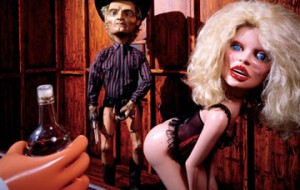
Paul McCarthy, "The Saloon" (1995-96), mixed media, 139×191 x 110â€. Installation view showing Dance Hall Girl and Cowboy (Gunfighter). All photos courtesy of the artist and Luhring Augustine Gallery, New York.
Benjamin Weissman: The pulsing id. That’s what I think about when I think about your videos. Partly achieved through minimal dialogue. A generalized wound is articulated, or dug up: anxiety, sexual tension, humiliation, bodily fluids, consciousness. You get a lot of mileage out of wards via a spare, fragmented mumblelogue that’s more like chanting than dialogue, drilling wards into the ground rather than at other characters, and there’s something repetitious about this method, within a single work, then from piece to piece, year to year. Can Paul’s Anxiety Channel accommodate a fuller script, or would that throw your characters into the acting deep end and deflate the luscious fucked-up universe you invent?
Paul McCarthy: In high school I did a drawing of a man’s face looking out of the picture plane straight at the viewer. Behind him in the landscape I drew a square hole in the ground. I have always been interested in digging. I remember finding a rock in a vacant lot when I was five years old. I tried to break the rock. I pounded it with another rock. At one point I stopped pounding it and picked up the rock to carry it home. After a short distance, a head appeared from the rock. I think I was dressed in white. All the houses around me were white. It was a very bright day.
I’ve talked to myself in performances since the ‘60s. But this auto audio babble got louder in the ‘70s. At times I would talk from the moment it started until the moment it ended. A muttering faceted language serving a number of purposes, directed at me and for myself. It’s a multitude, a kind of runabout. A mother, father, brother, sister this and that. In Santa Chocolate Shop there were five performers including myself. In Saloon there were five performers. There was a script, but during the performance the scripts are improvised, repeated, and become language appropriation trying to be mediated into the other.
BW: When you say language serving a number of purposes—what purposes?
PM: A purpose, B purpose, C purpose and so on.
James Casebere interviewed by Roberto Juarez
Welcome back to BOMB in the Building, where each week we feature a vintage BOMB interview relating to a Season 5 artist or theme. This week we look to the work of James Casebere, who, like Florian Maier-Aichen, has been aggressively pushing the boundaries of what photography is and could be with his tabletop simulations of archetypal institutions. “Casebere’s photographs evoke our deepest fears and longings,” wrote Roberto Juarez, who interviewed the photographer in BOMB 77, Fall 2001. “Perhaps this is because his images captivate our collective imagination, the one ruled by instinct.” Read the full interview here.

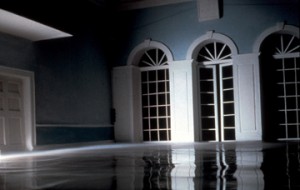
James Casebere, "Monticello #3," 2001, digital chromogenic print, 48×60”. Courtesy Sean Kelly Gallery, NY.
Roberto Juarez: I have my ideas of why you used black-and-white photographs in your earlier work, but tell me—why did you use black and white instead of color?
James Casebere: Black and white had more to do with memory and the past. Color was too much about the present, I associated it with color TV, which was not a part of my past. I wanted the images to be related to a sense of history, let’s say, whether personal or social. And I think black and white adds a certain level of abstraction.
Roberto Juarez: What were the images, in the Penn Station installation?
James Casebere: Most of it was a synthesis between two bodies of work, a combination of domestic space in the foreground with romantic, faraway places in the background. I tried, in part, to simulate the experience of sitting on a train, looking out the window. But the foreground might also be a dining room, or a kitchen, or a café.
Roberto Juarez: How did you create that? Was it a layering of pictures through exposure, or was it from a model that you built?
James Casebere: I built a model. Half the time, there’d be a frame dividing the foreground from the background. The backgrounds were images of the American West, corrals, and also one image of a sinking canoe, and one which was simply an outdoor train platform. There was a mission facade in another image. I was trying to create a sense of wistful reverie.
Roberto Juarez: The West is a very romantic idea in the American psyche. I’ve gotten invitations to submit proposals for light boxes in train stations. It’s become such a fad, or an easy art form for public projects to take on, because it’s not that expensive. But you were early.
James Casebere: I used a light box for a show I did at Franklin Furnace in 1981. It sat in the window, facing the street. I was never interested in the context of a fine art photo gallery. I was really interested in the usefulness of art—in a Constructivist sense, or as in the Bauhaus or de Stijl. What all these movements shared—and they overlapped, of course—was the belief that art should not be broken up into separate disciplines. An artist might make paintings, design buildings, do graphics, photographs and sculpture. It was very multimedia. They also shared the belief that an artist had a purpose, a usefulness within the context of the larger society.
I was looking at how art worked within the larger social world and wanted to place my work where most people see other photographs. So I wanted to put my images into the advertising context, the way conceptual artists like Dan Graham were using pages in a magazine as their art. The magazine is one kind of public space, street signs are another. I wanted to design things that relate to people’s everyday experience. People like Dennis Adams and Jeff Wall began using light boxes at about the same time as myself. Adams actually designed the public spaces, the bus shelters, to show them in. There were Holzer’s broadsides, and Barbara Kruger’s billboards. It was the same impulse. We were all thinking about mass media. One of the first images I shot in New York was of a courtroom which I made into a poster, and put up anonymously around Lower Manhattan. There was that anonymous poster phenomenon going on in the Lower East Side at that time.
An interview with Tom Sachs by John Kessler
Welcome back to BOMB in the Building, where each week we feature a vintage BOMB interview relating to a Season 5 artist or theme. This week, inspired by Jeff Koons’s discussion of public art, we reconsider the work of Tom Sachs on the occasion of his 2003 show Nutsy’s, which exhibited at the Bohen Foundation in New York before traveling to the Deutsche Guggenheim in Berlin. “Sachs’s highly personalized use of materials and processes is rooted in bricolage, a French word for do-it-yourself,” wrote John Kessler, who who interviewed Sachs for BOMB Issue 83, Spring 2003. “His work addresses a wide range of issues including appropriation, branding, consumerism, globalization, entertainment and functionality.” Read the full interview here.

Tom Sachs, "Hermès Valuemeal," 1998, hot glue, ink and paper, 18×12 x 12". Courtesy of Tom Sachs Studio.
John Kessler: Your work is very populist, and I wonder if that’s the main reason you haven’t been given the critical attention you deserve.
Tom Sachs: I find it disappointing. I read October and Arts and Artforum in college, and I always thought that when I moved to New York, I would be engaged in conversations like that. But there was never a movement toward the real. People didn’t go all the way. It’s too threatening to the art world system to have art that works, because part of what makes it so strong is that it is insular. You need to be a little provincial to keep your things tight. That’s partially why I’m not as interested in art as I am in media and technology.
JK: There are so many ideas in your work, like failed utopianism, functionalism and design, high and low culture, surveillance and globalization, that I would imagine critics could really bite into. That is, if they don’t want to talk about hot glue and duct tape.
TS: Well, it’s like Barnett Newman said, it’s what ornithology is to the birds.
JK: You’re talking about criticism?
TS: There is a lot of art that has its pants down, so to speak, and gets the critical attention. I think the popularity of my work doesn’t leave a void for critics to fill. It’s a very complete world; it’s anti-elitist. There might as well be a sign on it saying, ‘This doesn’t need anyone to explain it.’