Connections at MIT Museum

February 25th, 2010

I have never met Aaron Zinman. Not in person, anyway. I’ve spoken with him a few times on the phone, and we’ve chatted via email and Twitter, but I’ve never actually seen the man. But for a few months this past summer, Aaron’s art project became an Internet sensation, and I wanted to know why.

A quick web search tells me he’s pursuing a PhD at MIT’s Media Lab, and it looks like he did some interesting things with IBM and Google. Some of his recent Flickr images suggest he likes to go skiing or snowboarding. He’s a DJ, he frequents Cafe Fabulous in Cambridge, and according to his own Twitter feed, he’s “remarkably able at catching falling objects.” In almost all the pictures I’ve seen of Aaron, he’s flashing a big smile, and most of his emails contain at least one smiley, and more than one exclamation mark. Overall, he seems like an intelligent, passionate, likeable kind of guy.

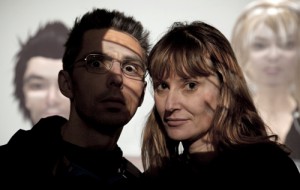
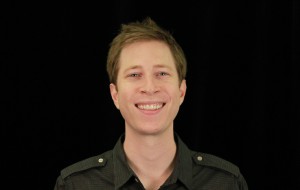
Aaron Zinman, the artist, designer and technologist behind Personas

Aaron Zinman, the artist, designer, and technologist behind Personas

I also know through my searching that last year, Aaron launched Personas, which does what I did—search around—and presents its findings. It’s a simple site, designwise, but it reveals a more complex infrastructure and compels us to ask complex questions.

You click over and enter your name. It could be your full name — first, middle, and last. It could be your professional name. Personas then searches the web, like I did for “Aaron Zinman” and uses “a predetermined set of categories that an algorithmic process created from a massive corpus of data. The computational process is visualized with each stage of the analysis, finally resulting in the presentation of a seemingly authoritative personal profile.” In painfully simplistic terms, it Googles you and paints a pretty picture.

Another quick web search shows that Personas quickly took off shortly after it was launched. All kinds of Web sites, from the niche TechCrunch, to the more mainstream CNN talked up the site. It’s easy to see why. Beautifully designed, the clean background shows you what it’s finding and processing in real time, complete with futuristic animations. What comes out is a spectrum of colors and labels, neatly arranged and visually intuitive.

The Personas search results for "An Xiao"

The Personas search results for "An Xiao"

Typing in my name, an uncommon one on both sides of the Pacific, I’m not surprised to find large chunks of the spectrum devoted to “online” and “art.” I assume the slivers of “religion” and “books” relate to my explorations of Zen poetry. I can even see how the “genealogy” result might make sense.

But a few of them puzzle me: Why “military” and “aggression”? Why “sports”? I’ve never campaigned for or against any wars, and the only way I realized the Super Bowl had come and gone was because I was looking at Twitter’s trending topics.

Personas is an experiment in data portraiture,” Aaron told me. “You get a sense of a machine-kind of thinking and making sense of you. How is the machine parsing you? It’s normally a very opaque process.”

Indeed, watching the animation again, I see other An Xiaos pop up in its searches. There’s “An Xiao Wei,” a kung fu champion. A number of An Xiaos who write academic papers. “An Xiao Qian,” a character in a Chinese action film. Anyone who has the vaguest idea of what I do could tell at a glance that these people obviously aren’t me, but machines can’t recognize that. Not Personas, not Bing, not Google, at least not yet.

Aaron wrote in his project description, that Personas “is meant for the viewer to reflect on our current and future world, where digital histories are as important if not more important than oral histories, and computational methods of condensing our digital traces are opaque and socially ignorant.”

In retrospect, as I learned more about the project, I came to realize that its swift popularity is less a puzzle than an inevitability.

Continue reading »

Performative Interventions: The Progression of 4D Art in a Virtual 3D World

December 31st, 2009

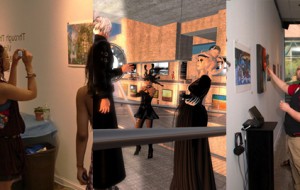
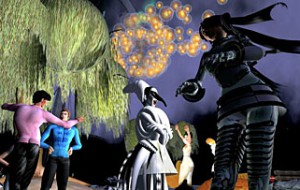
Still from the performance, "Car Bibbe 2," based on a script by Al Hansen, and featuring the avatar of Bibbe Hansen. Second Front, 2008.

Still from the performance, Car Bibbe 2, based on a script by Al Hansen, and featuring the avatar of Bibbe Hansen. Second Front, 2008. © All rights reserved.

“Time” is always present in our interaction with works of art, whether we sit to contemplate a painting, stroll past a sculpture, or watch a video piece for its entire duration or cycle. Some works of art are time-based in that the viewer must experience them through the passage of time, as with music, while others refer to time through links or references to art history, our collective human history, or the timelessness of nature.
Art:21—Art in the Twenty-First Century, Season 2, Episode: Time

Art in the twenty-first century, reflecting and defining new developments in a variety of areas, has radically extended the conventional media of time-based, or 4D work. Following Virtual Artists’ Immersive Discoveries in a Virtual 3D Frontier, I interviewed several Second Life artists who evoke time in their work.

Second Life artists are exploring how to captivate, or use the element of time to interact with an active audience. They have abandoned strict adherence to traditional hierarchies of art and embraced the virtual. In the past fifty years especially, ideas about time have shifted from passive to interactive and, currently, to perceptually immersive, via filmmaking and animation, the theatricality of performance, and virtual reality. This post highlights early visionaries in Second Life who are re-imagining how immersive 3D space can change, or transform 4D art.

Machinima (muh-sheen-eh-mah) is the convergence of filmmaking, animation and game development. It uses real-world filmmaking techniques that are applied within an interactive, immersive 3D space where characters and events can be either controlled by humans or scripts. In Second Life, the actors are avatars in the scene, and the computer (via screen capture software) doubles as the camera, recording everything that happens in the virtual world. It connotes the artistic and performative, or the collaborative action of artist and computer. [The Second Life elements from the Art:21 segment on Cao Fei were filmed using machinima methods. —Ed.]

Continue reading »

Virtual Artists’ Immersive Discoveries in a Virtual 3D Frontier

November 30th, 2009

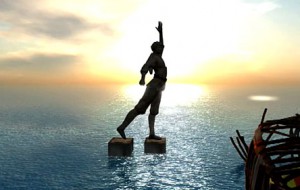
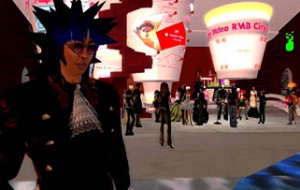
Cao Fei: RMB City. "Art in the Twenty-First Century," production still, 2009. Season 5, Episode: "Fantasy." © Art21, Inc. 2009.

Cao Fei, RMB City. Art in the Twenty-First Century, production still, 2009. Season 5, Episode: Fantasy. © Art21, Inc. 2009.

William Saroyan wrote: The role of art is to make a world which can be inhabited.

Virtual art had its debut in a cave at Twin Rivers near Lusaka, Zambia, about 35,000 years ago, with two dimensional images of Stone Age man in his elemental environment, his world. Before it became synonymous with the digital realm, virtual meant existing in the mind, especially as a product of the imagination. Virtual can refer to things that mimic their “real” equivalents and it denotes work that is realized or carried out chiefly in an electronic medium. Virtual art goes beyond these definitions in Second Life. Second Life, or SL, is an online, virtual world where the use of 3D objects called prims creates the illusion of the third dimension on the two-dimensional surface of the computer’s screen. Observers become immersed, as 3D avatars that can freely move within a world that transcends physical constraints and traditional concepts of time and space. Virtual 3D art exists beyond the surface upon which it’s created, or the screen on which it’s displayed. Virtual 3D art exists in a world that is inhabited and where the viewer, embodied as an avatar, becomes immersed.

In other words, to truly experience immersive, virtual 3D art you have to go there.

I interviewed several artists who are early adopters of the online, virtual 3D world of Second Life. Second Life art ranges from scanned copies of public-domain works to primmed 3D paintings and complex kinetic sculptures that could only exist in perceptually immersive 3D space. These artists have already experienced varying degrees of success in “first life.” DanCoyote Antonelli (DC Spensley in material space) gave me a tour of his algorithmic, interactive, and immersive SL creations that purposefully reject anything that is inherently referential to the physical world.

DanCoyote Antonelli

DanCoyote Antonelli, details from Visions of Global Justice Installation. USC Annenberg School for Communication Network Culture Project, 2008. © All rights reserved.

DanCoyote Antonelli: My earliest work is four years old and embodies the conflict between modernism and post-modernism. What comes after postmodernism? Modernist Marvel, a tongue and cheek homage to modernist architecture, is actually a user interface that guides visitors through a number of algorithmic artworks from the early 2000s in QuickTime virtual reality that are mapped onto prims. Another site-specific work, entitled Hostile Space, explores the personal space of the avatar and demonstrates hyperformalism—a term derived from the combination of the words hyper (as in hypertext) and formalism (in the platonic sense) and is being used here to describe aesthetic self-expression without anthropomorphic, or representative context.

Simply put, virtual worlds offer many of the same benefits of physically visiting an art museum or gallery space, with the extra benefit of network transportability as well as the power of scripting aesthetic and conceptually compelling behaviors that are embedded in the environment.

Continue reading »

“Rachel Is” | An Interview with Rachel Perry Welty

October 29th, 2009
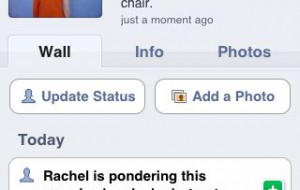
Screenshot from "Rachel is" (Facebook status via iPhone), performed March 11, 2009. Online performance documented by a 551-photograph slideshow of mobile update screen captures from an iPhone. 27 minutes 55 seconds set to loop continuously.

Screenshot from "Rachel is" (Facebook status via iPhone), performed March 11, 2009. Online performance documented by a 551-photograph slideshow of mobile update screen captures from an iPhone. 27 minutes 55 seconds set to loop continuously.

Appropriately enough, I first met conceptual artist Rachel Perry Welty via social media, when word spread about her Facebook-based performance, “Rachel is.” On March 11, 2009, from 7:35 a.m. to 10:56 p.m., she performed using the increasingly popular social network. Every sixty seconds during waking hours she attempted to faithfully answer the status question at the time, “What are you doing right now?” (since replaced by “What’s on your mind?”). We eventually met in person at Status Update, an exhibition at Yale/Haskins Laboratories curated by Debbie Hesse and Donna Ruff that explored the work of artists looking at emerging social media technologies.

Rachel uses a variety of media in her work—sculpture, video, performance, drawing, and installation—mixing minimal aesthetics with Pop humor and homespun craft to create works that point to the mundane and poetic aspects of our everyday lives. Her obsession with mapping the remnants of her daily rituals extends to fruit stickers and bread tags, twist ties and take-out containers, wrong number messages and computer spam. The world of Facebook, quickly becoming a mundane aspect of daily life in the 21st century, presents a logical next step for her explorations.

As so much of my work of late has been with the @Platea social media art collective, I was fascinated with Rachel’s project. I sat down with her via email and chatted a bit about her performance and where she sees social media and art going today.

An Xiao: How long have you been using online social media? How do you use Facebook, Twitter, and other media in your daily life?

Rachel Perry Welty: I’ve been using Facebook and Twitter for less than a year. The New York Times magazine had an in-depth piece about these social networking sites in early September 2008, and this, combined with friends requesting that I join, prompted me to investigate. I’ve found Facebook to be useful as a view to the global artist community, but I don’t send gifts or answer quizzes or throw sheep at people. And I don’t update my status on Facebook anymore after my performance on March 11.

Twitter feels very different to me from Facebook. For one thing, tweets don’t beg for a response. I don’t always want to have a discussion, as much as I just want to report. I have decided to use Twitter as a sort of Amish diary, you know, “Today I plowed the West field and gave birth to a baby boy” sort of thing. Every action is equal. No one experience gets more or less emphasis. I am driven by the limited word count to compose carefully to get as much information in as I can while keeping the poetry alive. All the better when I can do that and twoosh.

I use Twitter as an extension of my creative process, in the sense that it’s a view into the daily life of a working artist. As an artist, my project is concerned with the minutiae of life. As humans, we spend most of our time engaged in the small moments (whether we tweet or Facebook about them or not) and in my project I am trying to get people to notice the things they wouldn’t ordinarily. In that sense, Twitter seems like a perfect platform for me. It’s an ongoing performance.

Continue reading »

Kickstarting Creative Projects: An Innovative Micro-Giving Site, Part 2 of 2

September 25th, 2009

Following up on yesterday’s post, An continues her conversation with Yancey Strickler and sums up her experience of fundraising via Kickstarter.—Ed.

An Xiao: Tell me a little more about the financial side of things. If most artists are like me, they’re not the best with keeping records and managing payments.

Yancey Strickler: We like Amazon Payments because it’s what our entire system runs on. They’re the only ones that can handle our needs. PayPal currently cannot. Plus, we’re working with the most trusted e-commerce site ever. Most people already have an Amazon account, so backing a project is like buying a book. Super simple.

The only drawback is that Amazon Payments are only set up for US customers to receive money, though anyone from other countries can give money. They’re working on expanding their services to other countries, but I don’t know when that will be changed.

Kickstarter's super clear project dashboard

Kickstarter's super clear project dashboard, intuitive for even the most numbers-averse artist

AX: A few of my donors had issues with Amazon Payments initially, though these were quickly resolved and had nothing to do with Amazon or Kickstarter. However, one backer was never able to resolve the issue, so he opted to send me a check. How do you manage financial questions?

YS: I’m the one customer service person for Kickstarter. If anyone has any payment problems, I will end up talking to them. It’s fairly common, as you’re often putting down your credit card information three months before the card is actually charged and things happen. We work very closely with anyone who has any trouble, and there’s a full week to correct any payment problems. The number of declined or failed transactions on Kickstarter is very, very, very low.

The power of momentum: according to Yancey Strickler, "If a project reaches 25% of its funding goal, it has a 90% chance of eventual success."

The power of momentum: if a project reaches 25% of its funding goal, it has a 90% chance of eventual success.

AX: That’s great—so artists can really focus on on the fundraising rather than the details of actually collecting the pledges.

YS: Absolutely. For a creator, it’s their job to spread the word and let people know about the project. The financials and all of that will just flow through Amazon. And best of all: creators get an email with each new pledge. It becomes this incredibly gratifying feeling—especially when it’s complete strangers doing the backing.
Continue reading »

Kickstarting Creative Projects: An Innovative Micro-Giving Site, Part 1 of 2

September 24th, 2009

July 7, 2009. It’s the middle of summer, and I’ve just heard from the folks at the DUMBO Arts Center that my installation proposal, Phone-Tastic View, has been approved for the 13th Annual DUMBO Art Under the Bridge Festival. I’m thrilled, of course, but now I’m up against a new problem: how on earth am I going to pay for this? The installation calls for a standard street sign to be installed on the waterfront. The sign would instruct viewers to send a text message to receive quirky information about the view of the skyline, so I also need to fund the text messaging service. After adding up the numbers, I’m realizing this will cost at least 500 dollars.

That’s when I learn about Kickstarter, a new site for artists to help them crowdsource fundraising, Obama-style, through small donations. What follows is an interview with Yancey Strickler, co-founder of Kickstarter, interweaved with the story of my own fundraising efforts for my first public art installation, along the Brooklyn waterfront.

KickstarterLogoMID

An Xiao: Tell me a little about the origins of Kickstarter. What, if you will, kickstarted this idea?

Yancey Strickler: Our CEO/co-founder Perry Chen came up with idea when he was living in New Orleans a few years ago. He was trying to put on a concert for the New Orleans Jazz Festival, but in order to make it happen he needed to front a lot of money.

He thought that there’s clearly another way to do it without fronting the money out of pocket.  If only he could know demand before he started. So he got the idea of a conditional transaction—you only start the project if you raise enough to fund it. He and I met about four years ago and we started working on applying this idea.

AX: So it started in classic Internet start-up style, with two people and an idea. But now you have a team of five.

YS: Yes, Perry and I were the first two. Then we met Charles Adler, a user experience designer. He designed the whole site.  Lance Ivy, the technical founder of User Voice, developed it. Andy Baio joined us as chief technology officer after first serving as an adviser. He runs the very popular Waxy.org, and previously founded a company (Upcoming) that Yahoo eventually purchased. And our primary adviser is Sunny Bates, who just knows everyone and has just been incredible with us. She’s been very helpful in making the site successful.

We’re all spread around the country.  Only once have we all been in the same room.

AX: Wow. Where was it?

YS: Shortly after the site launched, we flew everyone into New York. But even then we only had time for us all to sit down together once.

AX: Sounds like we need to get a Kickstarter page going for your reunion.
Continue reading »

ArtPrize: An Experiment in Decentralized Curation and Competition

August 27th, 2009

Maya Lin, "Ecliptic"

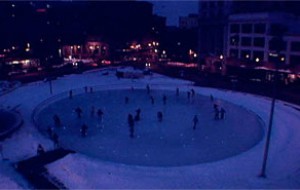
Maya Lin’s (Season One) “Ecliptic” in Rosa Parks Circle, Grand Rapids, Michigan. (Production still from the Art:21 episode, Identity, © Art21, Inc. 2001.)

There’s been a fair bit of talk lately about how the recession is affecting artists, the art market, and art institutions. And with good reason, pocket books are tight everywhere, and most art, no matter its intended relation to market forces, can’t exist without some kind of capital. It’s not a coincidence that this is also the era of the rise of social media. Facebook, Twitter, and the like are facilitating massive realtime networks that are free (as long as you’re connected). These networks become a conduit of exchange for new kinds of goods, and value is now being measured in new ways. Stock prices still matter, but Google rankings are starting to matter, too. Content is aggregated by algorithms that calculate value from the unconscious input of millions of users.

How does this new method of exchange and valuation affect the art world? If social networks naturally become markets, placing value on instantly exchanged bits of info, what would happen if we gave that value a monetary correlation, apart from a traditional marketplace? I’ve been working to help develop an new art event that seeks to do exactly that. ArtPrize is a radically open art competition. The annual event will run September 23 to October 10 in Grand Rapids, Michigan. Hundreds of artists from around the world have created online profiles, which are a cross between an artist bio and an open-ended proposal. Hundreds of property owners, institutions, and public spaces in downtown Grand Rapids have volunteered to open their space to artists. We’ve built ArtPrize.org to enable these artists and venues to connect to one another, without a central curator or jury. If that weren’t unorthodox enough, the winner of the cash prize (currently the world’s largest, at $250,000, with additional prizes for the rest of the top ten) will be decided by public vote. Anyone can come to Grand Rapids, register to vote for free, and rank each entry with either an up or a down vote, online or by text message.

Continue reading »

On Virtual Worlds: An Interview with Filmmaker Victor Pineiro, Part 2

August 7th, 2009
Cao Fei. Production still © Art21, Inc. 2009.

Cao Fei. Production still © Art21, Inc. 2009.

Online platforms have always been social environments. “Web 2.0″ was not the birth of the social Web. Rather, it marked a point when Web technologists, recognizing the social nature of the Web, developed and deployed the tools to make social interaction easier for audiences of all ranges of technical familiarity, and to make social activity more prominent across Web publishing platforms.

Video games, too, have always been social experiences that were enhanced with addition of online components. From the early days of MUDs (Multi-User Dungeon), to their evolution into MMORPGs (Massively Multiplayer Online Role-Playing Game), to the online capabilities of the current generation of home video game consoles, online gaming removed the barrier of geographic location from the gaming experience and allowed gamers to always have a pool of other players readily available.

Following up on last week’s interview with Second Skin producer and writer, Victor Pineiro, for this second part, we talked about the online and offline social aspects of gaming culture, the joys of Mario Kart, and a few more odds-and-ends around the production of Second Skin.

[For readers in the New York City area, Second Skin screens tonight, tomorrow, and Sunday at The Tank in Hell's Kitchen]

Jonathan Munar: There’s clearly an element of “social” in these virtual worlds. How would you describe social interaction in these games?

Victor Pineiro: I would argue, as controversial as it may sound, that gamers are actually more social than non-gamers, because being social is built in and facilitated by their activity of choice. Rather than socialize with a handful of people at a bar or someone’s house, or even dozens of people at the occasional party, MMO gamers are consistently socializing with hundreds of other gamers. Most gamers in virtual worlds belong to a guild—a group of gamers that are usually hundreds or thousands strong, and who communicate all the time through the game or online message boards. This is no longer limited to typing—a large portion of gamers use applications to voice-chat with fellow guildies, dozens on the same voice channel. So what you have is, in effect, these enormous conference calls, but tied to shared experiences all the gamers are having together. If you compare the typical gamer’s evening with the typical person, there’s no contest—even at our most social, we’re hardly interacting with dozens or even hundreds of people on a daily basis. For a gamer, that’s their usual Tuesday night.

Continue reading »

On Virtual Worlds: An Interview with Filmmaker Victor Pineiro, Part 1

July 30th, 2009
Cao Fei. Production still © Art21, Inc. 2009.

Cao Fei. Production still © Art21, Inc. 2009.

Admittedly, before beginning production research for our Season 5 segment on artist Cao Fei, I had very minimal experience with the virtual world of Second Life. “Minimal” as in: I downloaded the application a few years back, spent all of two minutes choosing my avatar’s appearance, flew around a few of the virtual environments, logged off, and never touched it again.

Among the aspects of my research was to figure out how to “film” in Second Life—an art called “machinima” to those in the know. The first person that I contacted for advice was Victor Pineiro, writer and producer of Second Skin, a documentary film about virtual worlds that was the talk of the town at its South by Southwest premiere in 2008. Second Skin employs effective use of machinima, illustrating dialogue with animations rendered from game engines. Machinima, however, is only the icing on the cake for this film.

Second Skin explores multiple aspects of the online gaming culture—including obsession, romance, family, teamwork, and fantasy. I spoke to Victor over email to discuss his experiences from the making of Second Skin. The first part of this interview below explores the relationship between the virtual world and the real world.

Jonathan Munar: A recurring theme in the work of Season 5 artist Cao Fei is this idea of taking on alternate personas that are, in part, reflections or extensions of inner fantasies. During the making of Second Skin, what did you observe about the relationship between your film’s subjects and their virtual world counterparts?

Victor Pineiro: The relationships between gamers and their avatars are as varied as the relationships between two people. Often you’ll find that the avatar is an aspirational representation of the gamer—an idealized version of the self. In some virtual worlds, like Second Life, you can modify your avatar to look exactly like you want it to, and many people try to replicate their looks, adding a bit more muscle, a bit less fat, some trendier clothes. On the other hand, sometimes a person’s avatar is merely their trophy rack, on which to hang all of the achievements and accolades they’ve garnered in the game—usually in the form of weapons and armor. For many the avatar is simply an object to gaze at—when questioned with their sexuality, many gamers who play opposite-gendered avatars reply that if they’re going to look at something for hours each day, they’d prefer it to be something they’re attracted to. And for some, the avatar is a person they can escape into—an alter ego that represents someone they’re not, but wish they could be.

Continue reading »

@Platea: Art in the Web 2.0 Ethos

June 25th, 2009

Social technologies have been around for decades, but mainstream use of social media platforms has grown exponentially only over recent years. This column explores uses of social media platforms relevant to the arts community: by artists, art-based organizations, and the general audience. Leading off the column is a post from New York-based artist, An Xiao.

If there’s anything revealed about the use of social media technologies in the Iranian election, it’s that Twitter, Facebook and other social spaces online have become a new form of public space.  Like any public space, social media serve as a place to meet with friends, people watch and, as we’ve seen, even protest.  The key difference with this digital public space is one of scale and access, as users find ways to reach an international and growing user base, limited only by access to a computer or mobile phone and, to a certain extent, a common language.

One question I explore in my social media work is how this new public space can become a site for public art.  I recently founded @Platea, a global online public art collective, to explore this very issue, and to take some salient features of public art–performance, displacement and activation, engagement–and both translate and transform them into the realm of online media.

Cloud Gate by Anish Kapoor (photo by An Xiao)

Cloud Gate by Anish Kapoor (photo by An Xiao)

During the week of May 3-9, @Platea gathered more than 40 individiduals from a half dozen countries to participate in @Platea’s Project II: Co-Modify, a public performance art project.  The idea was simple. First, each performer chose a megacorporation to be “sponsored by” for the week. They then acted it out, imagining the sponsorship as defined by their company. The project was designed firstly as a commentary on the commodification of social media, and, by extension, our social lives in general, but also as a look at the possibilities of collective performance art in the realm of social media.

Continue reading »