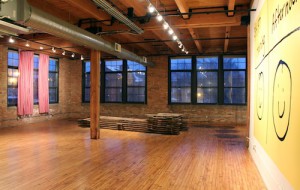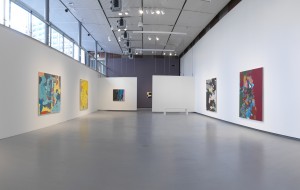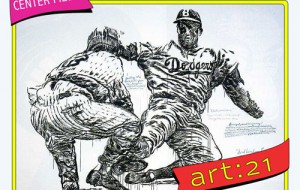
Michelle Grabner exhibited at Autumn Space last month. Her show, DRAFT, ran the gamut of Grabner’s practical, visual, and material practice. A black and white print of two San Francisco 49ers hung in a frame by the front desk near a round, black field painting of white dots. One side of the grand warehouse windows were dressed with larger-than-life red and white gingham curtains. Across from this hung a white gessoed painting and beside that a too-large-to-be-casual Post-it Note doodle adhered to the wall. A fifth long and heavy-looking sculpture of wood and cement lay diagonally across the floor. This last work was produced by Grabner and her husband Brad Killam. The two have been working collaboratively for many many years and the piece supplied a grounding, perpendicular line amongst otherwise vertical planes. In addition to being a painter and writer, Grabner is a professor and chair of painting at the School of the Art Institute. She co-curates exhibitions at The Suburban and Poor Farm with Killam, exploring the potential in rural and suburban curatorial sites. She is represented by Shane Campbell Gallery, Chicago, and will co-curate the 2014 Whitney Biennial at the Whitney Museum of American Art. Whether operating as a teacher or facilitator, or as a painter, printer, collaborator, and sculptor, Grabner returns again and again to marginalized and overlooked frontiers for aesthetic inspiration, culling a minimalist sensibility from the banal pattern of picnic table place mats, gessoed cloth onto a canvas, white dots in a black field, or black pixelation on a white print. By juxtaposing scale and material she tills a subtle American vernacular, and by this constellation of works explores the pursuit of happiness.
Caroline Picard: I want to ask you about collaboration, the when and how of it. When I was at Autumn Space looking at Untitled (2013)—the large wood and concrete sculpture that crosses over the ground of the gallery—it struck me that this piece was a collaborative effort between you and Brad Killam. It has such a striking materiality. It’s so heavy looking, and seems to ground the whole show. I thought it was interesting given that you also work so closely together on The Suburban, and The Poor Farm—what are also unusual and very physical platforms for art. I guess what I’m trying to ask about is the materiality of collaboration, especially your collaborating with Killam. How do you decide to collaborate? How do you define that medium? And is there a relationship between the wood and concrete piece and the curatorial art spaces you run together?
Michelle Grabner: When Brad and I finished our MFA degrees in Chicago we moved to Milwaukee, leaving our colleagues and the discourse we came to depend on in graduate school behind. It was the early ’90s and we had a young family so Brad and I started collaborating under the moniker of CAR (Conceptual Arts Research). Again, let me underscore that this was the early ’90s and the smack of “identity” was inescapable. So in addition to our individual painting practices, we started making work about our family, examining its social dynamics as pressed through the geeky political writings of Maxine Greene, Trinh T. Minh, Homi Bhabha, etc. The CAR work was readily received and we mounted exhibitions at White Columns, Chicago’s Uncomfortable Spaces , Richard Heller, LA, the Milwaukee Art Museum, and All Girls, Berlin in a very short period of time. Milwaukee was the perfect incubator for us. Here we became friends with Felix Gonzalez Torres (MAM hosted his first museum exhibition), the artist Nick Frank, and curator Peter Doroshenko. But once we moved back to Chicago in 1997 (settling in Oak Park for the public school) we immediately launched The Suburban, and that collaborative effort soon replaced the family-focused work that defined our Milwaukee years. However, in 2007 when our youngest kid turned two, Brad and I started making “things” together again. But this time the work is built around formal ideas and the everyday. You are right to identify the material effects that we are investigating. The large-scale manipulation of found materials are distinctly a two-person operation: two middle-aged bodies arranging, stacking, and cobbling together common things like kindergarteners. But instead of Fröbel wooden blocks we build with the cast-off materials and residue from our life that is now split between Chicago and rural Wisconsin.
Center Field, Art in the Middle | Mashed Up and Shredded into Space: An Interview with Candida Alvarez

Candida Alvarez. “mambomountain,” panoramic installation view. Courtesy of Hyde Park Art Center. Photo: Tom van Eynde.
I was down at the Hyde Park Art Center this last December. The doors to the main gallery on the first floor were closed when I arrived but I could sense movement behind them; a crack of light beneath the door was regularly interrupted by shadows, making me increasingly curious about the not-yet-open exhibit. Finally someone pulled back the gallery door, flooding the Art Center lobby with light and gushing color. It seemed like the perfect and sudden immersion into Chicago-based Candida Alvarez’s paintings—to have stood on one side of a dim-lit room only to find a world of vibrant color and lush paint waiting behind a door. This is mambomountain—the artist’s most recent collection of large-scale oil and acrylic paintings. The gallery contains several large works in addition to a small studio archive behind two temporary walls—giving visitors permission to connect the inner workings of her process with the resulting, public canvas. mambomountain is on view at the Hyde Park Art Center until March 24, 2013.

Candida Alvarez. “Chill,” 2011. Oil and acrylic on canvas, 72 x 60 in. Courtesy the artist and Hyde Park Art Center.
Caroline Picard: Can you talk a little bit about how you think about a painting’s relationship to space? Partly, I ask because I read about your show, For Sol Lewitt, where the work seems to intervene marginalized space directly, whether by placing works in an upper corner, or by projection beams of light. (Is that accurate? I only saw photos.) Your show at Hyde Park Art Center is taking similar factors into consideration, even though it might be less apparent as the works are primarily large canvases hung on the wall.
Candida Alvarez: My paintings intervene within a space. They participate and bring into conversation what lies between, above, below, behind, and in front. It is the excitement of taking paintings out of the studio and leading them towards a conversation that can be totally unexpected.
At the Hyde Park Art Center, I created a study room. By adding color and suspending two overlapping portable walls, the dimensions and the mood of the room changed as it heightened a sense of intimacy, which juxtaposed against the larger viewing space, gives those paintings more breathing space.
On the outside wall of the front gallery, there is a monitor that locates me inside my studio space, as you hear me talking about my painting process. I wanted to create an alternative to a wall text in order to possibly grab the attention of the teenagers that roam this community space, who are mostly indifferent to what is on the walls.
Mambo Mountain is an imaginary place, as are these paintings. I grew up in the projects, I rode the elevators up to the 14th floor, and I loved to look out the windows. That is where my mountain started and it has spread to the mountains that my parents grew up on, and live on to this day in Puerto Rico.
Afterimage: An Interview with Dahlia Tulett-Gross and Thea Liberty Nichols

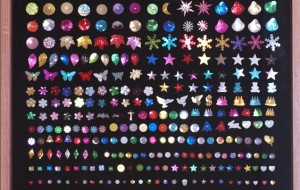
Ellen Nielsen, “Spectacle Box”, 2007. Sequins, pins, wood, glass, velvet, 9″ x 18″ x 3″. Courtesy of the artist.
Last September, DePaul Art Museum hosted an epic group exhibition, featuring Imagist artist work on the first floor and a contemporary generation of artists on the second. While those contemporaries have in many respects plotted their own independent and respective courses, there was something refreshing about co-curators,’ Dahlia Tulett-Gross and Thea Liberty Nichols, ability to highlight the visual and theoretical connection between generations. The resulting exhibition, Afterimage, illustrated a visual legacy, reinvigorating the past while demonstrating it’s transformation into the present.
Caroline Picard: Often collaborative curatorial projects come from on-going conversations — how did you two conceive of the Afterimage show?
Thea Liberty Nichols: You’re right on target in thinking that the show evolved through a series of ongoing conversations, but ultimately, Dahlia came up with the idea. She’s connected to a lot of local galleries and has built relationships with dozens of artists. Recognizing a renewed interest in the Imagists among contemporary artists who, rather than obscure or reject their connection to them, prized it, she isolated a certain look or feel that many of those artists shared with the Imagists. She approached me about co-curating with her partly because I had written my thesis on the Imagists. Ultimately, our commitment to showcasing the work of every artist as an individual within the larger context of our show led to the publication of an exhibition catalog, which we were so pleased to include you in!
CP: What was so important about platforming art with writing in the catalogue?
TLN: We were dedicated to creating some enduring historical record since, like Imagism itself, there’s a lot of historical background noise about art writing in Chicago — both its quality and its outlets, or lack there of. In both instances, rather then engage distant and stale debates, we wanted to have a new conversation featuring new voices. We were lucky to work with a whole host of arts writers, including arts journalists, critics, curators and even some visual artists who also write for our publication.
Tangentially, the same openness to collaboration and fluid thinking through and around a concept evolved into a really rich mode of working for us. It cultivated the organic expansion of our exhibition across multiple institutions and host sites, including The School of the Art Institute’s (SAIC) Roger Brown Study Collection and Joan Flasch Artists’ Book Collection, and Columbia College’s Center for Book and Paper Arts. It also attracted likeminded projects to us, such as Pentimenti Productions, a film company working on a feature length film titled Hairy Who and Chicago Imagists. We partnered with them to conduct interviews with some of the artists in our show and capture footage of the exhibition’s opening night [as seen in the excerpt linked here from Afterimage by Pentimenti Productions].
Afterimage documentation courtesy of Chicago-based Pentimenti Productions, producers of the forthcoming feature documentary Hairy Who & The Chicago Imagists.
CP: How do you characterize the Imagists?
TLN: The term Imagism has served many masters over the years, and it’s elusive — and somewhat divisive — definition has received various receptions from the artists its been applied to. I think when Franz Schulze initially coined the term, he used it to describe the work of a generation of his peers working mid-century. Artists like Leon Golub, who are now commonly known as “the Monster Roster.” Dennis Adrian used the term Imagism to categorize a group of six artists (James Falconer, Art Green, Gladys Nilsson, Jim Nutt, Suellen Rocca and Karl Wirsum) who exhibited at the Hyde Park Art Center in 1966-68 in a series of self-titled exhibitions called the Hairy Who. Its since evolved into a relatively plastic term that encompasses all of these artists and more, including Ray Yoshida, Roger Brown, Ed Paschke, Christina Ramberg, and Phil Hanson — almost all of whom were in our exhibition.

Christina Ramberg, “Loose Beauty”, 1973. Acrylic on board, 19 1/8 x 29 1/2″, diptych. Photo courtesy of The Art Institute of Chicago.
As curators, Dahlia and I thought more about what Imagism’s definition was in relationship, or contrast to, Afterimage’s contemporary artists. The title of the exhibition refers to the optical phenomenon when something in your field of vision persists even after exposure to it has ceased — think ghost image due to retinal burn. We felt that neatly summed up the persistence of Imagism in Chicago, and elsewhere, decades after its emergence. We liked the punniness of the term, too, since our show featured artists literally working “after” Imagism, both in the historical sense and in the sense that they were working in some sort of aesthetic relationship to it.
There was a whole range of approaches these relationship took; some pieces shared a visual vocabulary with Imagism, and resonated strongly with its intense color palette, meticulous level of finish, and busy pictorial arrangements, with their preference for bilateral or indexical arrangements of form. Some artists reveled in a similar brand of black humor. In addition, there was a lot of overlapping subject matter in regards to gender issues and the employment of personal narrative. Lastly, and perhaps most prominently, were the shared art historical, pop cultural, vernacular or commercial references that the artists in Afterimage shared with the Imagists, drawing inspiration from, and even sometimes visually quoting, works by Öyvind Fahlström, Basil Wolverton and Joseph Yoakum among others.
In everything we did, we tried to stay artist centered and content driven — appreciating that the contemporary works stood on their own, and were open to multiple readings. Not every work in the show neatly fit a category, but that dynamism excited us. We never tried to put forth an exhaustive list of artists working in relationship to the Imagists, or suggest that the artists we were able to include comprised some sort of unique entity or “ism” unto themselves.

Roger Brown, City Nights: All-You-Wanted-to-Know-or-Don’t-Want-to-Know-and-were-Afraid-to- Ask A Closet Painting (subtitle supplied by Barbara Bowman, 1978, oil on canvas, 72 x 48 in. Roger Brown Estate Painting Collection, the School of the Art Institute of Chicago. Photograph: William H. Bengtson.
CP: How do you think about aesthetic influence? I’m thinking partly about this quote from the Bad at Sports LP. Someone states that in most cities young artist kill their aesthetic predeccessors — you rebel against and upturn the past, in order to create new, independent works — he said in Chicago we don’t do that. We always love our artistic ancestors.
Dahlia Tulett-Gross: The contemporary artists in the exhibition either studied with the Imagists, were influenced by or shared influences with them. While these artists have held on to certain Imagist “values,” they have also moved through and beyond it. Take Steven Husby for example — his work is finely crafted, with slick surfaces like the Imagists, although it is essentially abstract with no reference to narrative.
Or David Leggett, who explores personal narrative, although his work isn’t physically “tidy” like the Imagists. Ultimately, the artists represented in Afterimage carve their own path to create work that wouldn’t be confused with Imagist work.

David Leggett, “Summer of Dreams and Magic”, 2010. Mixed media on paper, 22″ x 30″. Courtesy of EBERSMOORE Gallery.
I believe that many prominent artists in Chicago turned away from Imagism. Artists like Richard Rezac, Julia Fish, Dan Peterman, Judy Ledgerwood, Tony Tassett, Gaylen Gerber, and Michelle Grabner rejected personal narrative in favor of broader conceptual issues. That said, I find it interesting that many of these artists make finely crafted, patterned or time intensive work — all traits of Imagist work.
TLN: Our ideas about influence — and the circuitous routes it travels — certainly mutated over the two years spent planning the show. The further along we got in our research, and the more studio visits we conducted, the clearer it became that ideas flowed rhizomatically between teachers, students and from peer to peer. Both generations of artists draw inspiration from each other, and the world of art, but also from outside of it, across disciplines, media, time periods and physical locations. The auxiliary programming we scheduled in conjunction with Afterimage reflected this multi-dimensional arts practice, including live musical performances, a food truck and a monumental “jam” comic installation.
CP: Can you talk more about this “rhizomatic” relationship?
DTG: The teacher/student relationship was absolutely integral to the Imagists, who often site Ray Yoshida and Whitney Halstead, among other professors that they had at SAIC as being major influences. Those teachers went beyond the classroom, taking students to the Field Museum, the historic Maxwell Street Market, and other places to find unconventional treasures as source material for artwork.
The Imagists shared close friendships with many of these professors, allowing for an exchange of ideas. Similarly, some of the contemporary artists in Afterimage shared personal relationships with the Imagists. Richard Hull went from student to showing alongside the Imagists at Phyllis Kind Gallery. One of his paintings hangs in a prominent spot in Roger Brown’s house.

John Parot, Navarro’s Problem, 2010. Gouache, enamel and ink collage on paper, 34″ x 30″. Courtesy of Western Exhibitions.
CP: Do you feel like your experience of the Imagists’ work has changed?
DTG: Thea and I have talked about how fresh and exciting the Imagist work still looks. Perhaps because they didn’t follow the dominant trends of their own day, they created work that still feels relevant.
TLN: Since we were able to include the work of a lot of comic and graphic artists in our exhibitions as well, we encountered first hand the palpable influence Imagism has had on the [comics] field— a funny full circle considering how influential comics were to the Imagists. I think a lot of the Imagist aesthetic, if you could boil it down to one thing, still feels relevant because it has become a ubiquitous mode of working for contemporary illustrators, comic artists, and is common place in things like music posters and certain zines and graffiti. The Imagists art practice itself is essentially what we’ve come to understand as post modernity.
Centerfield | The Past Lives of Books
Walter Benjamin allegedly had an opportunity to leave Germany when Axis borders were still somewhat porous. Had he chosen to flee then, it’s likely he would have survived the war. To do so, however, he would have had to abandon his personal library and for that reason chose to stay behind. While I’ve wondered what books he so dearly amassed, I imagine his attachment had less to do with the books themselves and more with the notes he’d scrawled on various margins. Those thoughts he could not have recouped so easily, like breadcrumbs of thought maybe, deer trails familiar to Benjamin when found, but not so easy to re-inscribe. His marginalia was evidence of his relationship with a text. But then again marginalia terrorizes the book. It signifies a book’s mortality, demonstrating the ease with which a book can be intervened, transformed or defaced forever. I want to call attention to those moments when a given reader is compelled to trespass the authority of a text, to disobey a very basic obligation ingrained at a very early age: not to deface a book. During such transgressions, beauty can emerge in the tension between the landscape of a text itself and the trace of its reader. A book is made to be read, as a house is made to be inhabited.
Center Field | Two Histories of the World: Part Two
Objects need not be natural, simple, or indestructible. Instead, objects will be defined by their autonomous reality. –Graham Harman, The Quadruple Object, Zero Books, 2011.
The frame of an installation encloses the maximum number of components in the field. At the same time, the frame creates an image that “opens onto a play of relations which are purely thought and which weave a whole. Therefore, there is always out-of-field, even in the most closed image. – Jungmin Lee, ”Modes of Exhibition as Mediated Space: Projection Installation as Spectatorial Frame,” Art&Education.
In this particular frame we find ourselves on the second floor of the Hyde Park Art Center. Light streams through a few windows into a clean, contemporary exhibition space. In the back of the room towards the window, colorful objects rest on folding tables — a bicycle wheel, for instance, a ceramic pumpkin, an umbrella and a life preserver: those objects have been arranged according to their color (orange, pink, white, black etc.) and seem to wait either for a still life drawing class or a curious church sale. In another portion of the room hollow metal cubes (what might have once functioned as store display cases) have been decorated with a variety of objects — a rubber brush, a draped piece of fabric, a mannequin’s hand, a card printed with various kinds of exotic fish — on the one hand these object seem random but given their painstaking placement, they command attention as monuments made with white elephants.
Centerfield | Goal-less Living Things: The Plants of Heidi Norton

“The crude solution to the problem of vegetative life, interpreted as qualitatively weak and as verging on inanimate existence, forces this life into retreat, puts it on the run, and so increases the distance between philosophy and the plant.” –Michael Marder, Plant-Soul: The Elusive Meanings of Vegetative Life

Heidi Norton. “Meditations on Moldavite Besednice (A Symbiosis),” 2012. Glass, wax, mirror, resin, cactus, fern. 43.5 x 61 x 8.5″. Photo by Melissa Fisher.
Generally we think of plant life as a kind of fuel — a material vitality that exists to be consumed and transformed to a higher purpose: as food, medicine, paper, or housing. As such, vegetation is not often recognized as a material capable of interiority — with an autonomous desire, or a will, that could be inaccessible to humankind. Still, we know that plants seek light. We know they are active in so far as they grow and we know that, left to their own devices, they would consume a given area. Heidi Norton works with common house plants, framing them in planes of glass, resin, wax and paint. She sets up these scenarios in her studio and photographs the transformation of plants over time. In other instances she installs the 3D works as sculptures. Some plants die over the course of an exhibition. Less often, they sprout, generating new life within a sculpture. Photographs and sculptures depict the same phenomena and so play back and forth between something fixed in time — a moment of deterioration — and something in flux. In so doing, Norton creates a moment for apprehension, a moment at which the interiority of plants, framed by the artist in a visible procession towards death and rebirth, might be easier to conceive. Heidi Norton (born in Baltimore, MD in 1977) received her MFA from the School of the Art Institute of Chicago in 2002. She is currently showing work at the MCA until October 23rd.

Heidi Norton. “Time to Live in the Scattered Sun #1,” 2012. Archival pigment print. 11 x 9″. Image courtesy of artist.
Caroline Picard: What led you to incorporate plants into your work?
Heidi Norton: I think mostly it had to do with the primal need to have nature incorporated into my urban space — I wanted to reclaim something I had lost. Up until my mid-twenties, I spent much of my life in a rural part of West Virginia and Maryland, in the valley of Blue Ridge Mountains. My parents were homesteaders and we had a great reliance on nature, we communed in and nurtured it; in return it provided us with food, recreation, and shelter. This symbiotic relationship is integral to my work. The plants’ life is compromised and in exchange it gives something back to you in the form of art. Death can teach more about life than life itself. Destruction is a vital phase in cycles of regeneration.
Centerfield | Embodying the Disembodied: Leif Elggren at LAMPO
Presented by Lampo, a Chicago-based nonprofit presenter of experimental music and intermedia events, and the Graham Foundation, an organization that makes project-based grants to individuals and organizations and also produces public programs, Leif Elggren performed last November as part of LAMPO’s performance series at The Graham Foundation. Elggren has a varied and interesting past — along with Carl Michael von Hausswolff, Elggrene is, for instance, one of the kings of Elgaland-Vargaland: a digital territory that “consists of all Border Territories: Geographical, Mental & Digital.” It is one of the most visited territories in the world. He was born in Sweden in 1950, currently lives in Stockholm, and creates experimental music that integrates visual components. He has many albums to his name, has been working with Kent Tankred under the moniker Guds Soner (or The Sons of God) and represented Sweden at the Venice Biennale in 2001. I was thinking about his LAMPO performance because of the way it dissolved the space between myself (the listener) and the sound.

Leif Elggren with amplified electric shavers. Performance still, Chicago, November, 2011. Photo by Matthew Solarski.
We gathered in the upstairs auditorium of the Graham Foundation to watch Leif Elggren perform. Elggren is known for the ways in which he engages a liminal space, whether by collaborating with ghosts, or annexing the borders. He tries to access and name the marginal space between things, between what is alive and what is dead, what is a this and a that. In this particular instance, he first screened a video of drawings with music. Then he described a process by which he collaborates with the long-dead Emanuel Swedenborg, a scientist, philosopher and theologian from the 1700s. Towards the end of his life, Swedenborg began to have visions wherein he believed he was communicating directly with God. Elggren communicates with that spirit via invocation and an embodiment.
Centerfield | An Interview with Terri Kapsalis
I heard that Western and Eastern medicinal practice split apart with dissection. While the Eastern approach treats a holistic body, whereby each component is connected and influenced by another, the Westerners began to exhume cadavers to identify each interior part. Much of Terri Kapsalis’ work lies at the heart of that divergence: she investigates the insides and outsides of bodies as well as the means by which conclusions about the body are drawn. To leave her interest at that, however, would be too clean and succinct. She is also a performer, and a writer. She investigates the history of sound and music, and yet, in every instance pokes at the methods of communication and authority. With a special advantage as an artist, she poses critical light on common fields, exposing the most captivating and mythical aspects of that landscape. Kapsalis has published such works as Public Privates: Performing Gynecology from Both Ends of the Speculum (Duke University Press) and The Hysterical Alphabet (WhiteWalls).
"Hortensia," drawing by Gina Litherland with text by Terri Kapsalis, excerpted page from The Hysterical Alphabet, published by WhiteWalls, 2008.
Caroline Picard: Can you talk about the role of research in your practice? I was thinking particularly of the museum label you created for the Hull House’s display of Jane Addams’ travelling medicine kit and your Victorian-style children’s book, The Hysterical Alphabet. In both instances, the final, public result points back to a phenomenal amount of research. What is that process like for you? How do you create a public conclusion?
Centerfield | Fielding Practice Podcast #16: Review-o-Rama
Bad at Sports is back with another “Fielding Practice” podcast produced especially for the Art21 Blog! We’ve been away for a couple of months working on a series of projects, most notably our summer residency/exhibition at Columbia College’s A+D Gallery (click here for details). If you’re in Chicago, come by the A+D Gallery tonight for our CLOSING FESTIVITIES and RECORD RELEASE PARTY! July 19, 5-8pm, 619 South Wabash Avenue.
On this month’s podcast, Duncan MacKenzie and Claudine Isé are joined by Bad at Sports co-founder Richard Holland. We discuss three exhibitions on view in Chicago this summer: Peripheral Views: States of America, at the Museum of Contemporary Photography; ”Color Jam,” a summer-long, outdoor public installation by Jessica Stockholder (who is featured in the Season 3 episode “Play” of the Art in the Twenty-First Century series); and we also take a look at “Zachary Cahill: USSA 2012, The People’s Palace’s Gift Shop,” an exhibition-cum-intervention in what was once the giftshop at the Chicago Cultural Center.

Doug Rickard. "#82.948842, Detroit, MI.," 2009. On view in the exhibition "Peripheral Views: States of America" at the Museum of Contemporary Photography in Chicago.

"Color Jam," a public art installation by Jessica Stockholder at the corner of State and Adams in Chicago.
Audio clip: Adobe Flash Player (version 9 or above) is required to play this audio clip. Download the latest version here. You also need to have JavaScript enabled in your browser.
Click here to listen to the podcast.
And as always, our panelists’ picks for the events we’re most looking forward to seeing in the coming months:
Richard Holland: Sic Transit Gloria Mundi: Industry of the Ordinary, a mid-career survey of the Chicago artists’ collective held in the main exhibition hall at the Chicago Cultural Center, August 17, 2012 – February 17, 2013.
Duncan MacKenzie: Skyscraper: Art and Architecture Against Gravity, at the MCA Chicago, June 30-September 23, 2012.
Claudine Isé: Places for the Spirit: Traditional African American Gardens at the DuSable Museum of African American History and the Chicago Botanic Garden, July 14-September 30, 2012.
Thanks so much for listening!
I am always amazed by the effect of performance, particularly the ways in which a single, cohesive piece (often comprised of abstract, sequential movements) emerges from a group. It’s a little like watching a magic trick—seeing a woman cut in half with a saw without understanding how the illusion of her bisection is possible. Millie Kapp creates similar illusionary spaces—spaces of theater and spectacle in which words are inessential; the body is the text— a vehicle for expression—and auxiliary props become equal bodies. Recently she has been working with a collaborative group called Husband. In the following interview we talk about the process of building a performance, the way she interacts with material and the group she works with.
Caroline Picard: How did your collaborative performance group start?
Millie Kapp: In February of 2012, Annie Maurer, Matt Shalzi, and Noah Furman and I began our fourth piece together. At this time we decided to make the parameters and commitment of our group official with a name. After months of snowballing free associations, we decided on the name Husband. We named ourselves after a prop we’d used in 2011, a husband pillow, that played a particularly integral part in the performance, The palm poises as a plant does and slips into the evening of the day. Through play-based experimentation, the husband pillow shifted meaning and took on layered significances as it performed as body, face, machine, and mirror [over the course of the performance]. These kinds of shifts and layers are things we try to do with most of our movement, text, and objects.

Husband, "A Face on the Doorway." Still from performance, DanceBridge Showcase, 2011. Photo by John Sisson.
The first work that we did together was in 2010 entitled, Waiting for tonight: Waiting for tonight. This piece was performed at Sullivan Galleries. We subsequently made The palm poises as a plant does and slips into the evening of the day and performed this work at the Archer Ballroom, Links Hall, Roxaboxen Exhibitions, and the 9×22 Bryant Lake Bowl in Minneapolis, MN. In fall 2011 we made A Face in the Doorway, and showed this work at the Chicago Cultural Center and the Clemente Soto Vélez Cultural Center in New York. Recently, we showed The hidden woods in the conversation at Alderman Exhibitions. It was not until recently however, that Husband became an official collective. We needed to work together for a few years before such a commitment!