Future Metaphors: Fractured Time

September 10th, 2010

You need to a flashplayer enabled browser to view this YouTube video

Ryan Trecartin, I-BE AREA (Double Jamie, Ramada Omar, and Sally Man Pause), video excerpt, 2007

Lately, I’ve been thinking about the kinship between Ryan Trecartin’s narratives and those of Maya Deren who, like Trecartin, used the camera (the Kino-Eye) as a device to expose and subsequently repair fractured and splintered humanity.

A fracture is generally not a pleasant event. Often, a certain amount of pain or violence –a loss of control and composure– accompanies a break. In the fantastic book Metal and Flesh (a favorite of mine), Ollivier Dyens describes this rupture as a necessary step in a movement towards posthumanism by using the fiction of Kafka, Wells and Orwell as examples of “plastic bodies” –bent, misshapen, bestialized, tortured and altered until their humanity is lost, or replaced, by some other state.

Posthumanism can be understood in at least two very distinct ways. One, I’ll call the material understanding, which has to do with bodies that have transcended what can be commonly understood as human. The other use of the term describes a philosophical posture that has moved beyond humanism (although it is up for debate what this “moving beyond humanism” actually means). However, one condition that both terms require is this break from humanity/humanism that Dyens describes, a rupture that can either be academic (in the philosophical understanding) or psychological/physical (in the material understanding). This rupture creates an interesting condition: despite being chronologically posterior to modernity, posthumanism’s break with humanity/humanism parallels pre-modern modes in its rejection of the category of the human.

Continue reading »

Bruce Nauman’s Cyborg Eyes

August 3rd, 2010

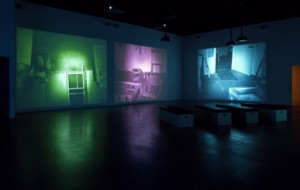
Bruce Nauman, "Mapping the studio II with color shift, flip, flop, & flip/flop (Fat Chance John Cage)," 2001

Not all events are recorded equally. Despite YouTube’s diarrheic explosion of what constitutes a potential video, clips where almost nothing happens are still difficult for a lot of people to get behind. Sometimes video is difficult when it’s not entertaining, but entertainment is not something most disciplines in art are ever expected to be. Nobody expects Robert Ryman to be funny, or captivating.

The first generation of artists working in video seemed to understand the revolutionary potential of the medium. Such pioneers as Peter Campus, Nam June Paik, Steina and Woody Vasulka, VALIE EXPORT, or Bruce Nauman (among a multitude of others…) explored how video recording technologies changed the audience’s perception of time, space and the body by making them confront how their video image manipulated these concepts to make them their time, their space, their body. Despite the physical separation between the machine and the human, video does indeed control our “nerve endings.”

To me, the idea of the cyborg is more interesting as a way to mark a certain symbiosis with technological systems that we have created to enhance the abilities of our organic bodies. A few months ago, I wrote about the concept of the Kino-Eye as a proto-cyborg, explaining how video technologies have extended what is humanly possible for us to see with the “hardware” we are born with. As we move into a future that is quickly becoming hyper-mediated by video (you can get a smart phone with AVATAR pre-loaded on it!), it becomes difficult to ignore the fact that all these moving images are changing the way our brains work, and how we respond to recorded events.

Continue reading »

Future Metaphors: An Introduction

July 6th, 2010

You need to a flashplayer enabled browser to view this YouTube video

Shana Moulton, “Whispering Pines 9,” video, 2009

In an essay titled “Cyborg Anthropology,” Gary Lee Downey, Joseph Dumit and Sarah Williams offer a sort of manifesto:

Cyborg Anthropology invests in alternative worldmaking by critically examining the powers of the imagination invested in the sciences and technologies of contemporary societies. In the past, anthropology became a source of insight for popular theorizing precisely because it described alternative worlds and informed the imagination of radical difference. Cyborg anthropology offers new metaphors to both academic and popular theorizing for comprehending the different ways that sciences and technologies work in our lives – metaphors that start with our complicity in many of the processes we wish were otherwise.

In this monthly column, I will attempt to write about art inspired by the ideas of cyborg anthropology. Let’s call it cyborg criticism (in blog form). I am aware that I’ll probably mangle a lot of theory while doing it, but let’s be optimistic and call it “creating new metaphors” instead. While there is a certain cringe factor in embarking on a “practice” that includes the word “cyborg” in it (because of the nerdy implications of the term), it seems somewhat myopic to dismiss these ideas completely. In our current cultural landscape, contemporary technologies have completely shaken up the way we perceive ourselves and our worlds. To further explain my point, Downey et al. again: “cyborg anthropology explores a new alternative by examining the argument that human subjects and subjectivity are crucially as much a function of machines, machine relations, and information transfers as they are machine producers and operators.” In the end, it’s a matter of terminology and of shifting foci.

Perhaps an example is in order. For clarification, let’s look at Shana Moulton. In her series Whispering Pines, Moulton’s stream of exercise equipment, cosmetic products ,and new age rituals and paraphernalia show the way in which her character Cynthia is molded by these technologies, continually struggling to cure and improve her body and mind beyond their human state to become “better.” Cynthia leaks, melds, morphs, opens up, and transforms. Her body is a plastic body, an unstable mass created, bent, and shaped by machines, rituals. In Moulton’s video Whispering Pines 9 (2009), Cynthia uses an Avon foot massager posing as a Zuni artifact to regrow her mysteriously absent lower body. The climax of this video finds her joyfully dancing in the desert in the Southwest, each hemisphere of her body separate but somehow connected; a body reconstructed and improved by technology. The parallels Moulton makes between ancient Zuni artifacts as seen on Antiques Roadshow and the artifacts Cynthia finds in her living room provide clear examples of the changing ontological position technology holds in our society. Whereas Zuni selfhood was predicated on the artifacts they crafted, the massage equipment we have created shapes and rebuilds us in turn.

So why embark on this column? I think it’s a political move — or maybe political is too strong a word. It is an attempt to wrap my brain around these issues and to give Internet high fives to artists that are creating the “new metaphors” our society needs. In his book Metal and Flesh, Ollivier Dyens insists:

…we are physically very similar to one another but are separated by worlds (technologically specific worlds) that are increasingly dissimilar. We are not witnessing the end of great ideological stories but their infinite proliferation, and to such a point that formerly unwavering representations like time, space, life, and death are also mutating and muliplying. Like head trauma victims, we are now seeing space, perceiving time, experiencing life, and considering death according to “languages” that are not and cannot be universal. Because of technology, the world has become a series of exclusive and personal realms.

Art has the ability to help us build bridges between our “personal realms.” It can show us how to navigate our worlds and compensate for the increasing parallax our personalized 21st-century technologies add to our field of vision.